
 Excavator
294 models
Excavator
294 models  Backhoe Loader
51 models
Backhoe Loader
51 models  Crane
68 models
Crane
68 models  Concrete Mixer
79 models
Concrete Mixer
79 models  Wheel Loader
54 models
Wheel Loader
54 models  Compactor / Roller
45 models
Compactor / Roller
45 models  Motor Grader
42 models
Motor Grader
42 models  Concrete Pump
66 models
Concrete Pump
66 models  Skid Steer Loader
11 models
Skid Steer Loader
11 models  Telehandler
13 models
Telehandler
13 models 


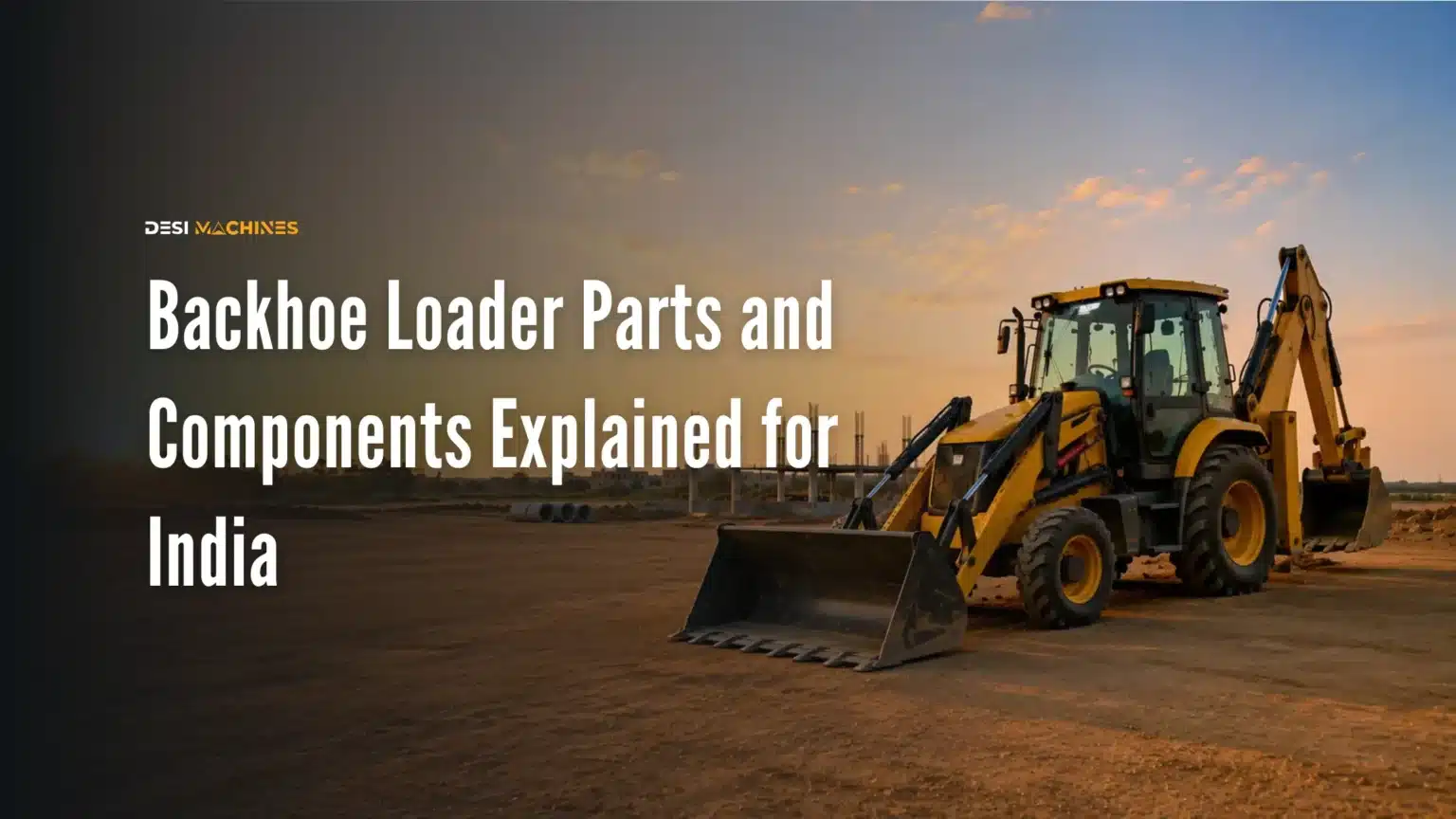
A backhoe loader is a single machine built from three joined sections: a wheeled tractor unit in the middle, a loading shovel at the front, and a digging arm — the backhoe — at the rear. Its parts belong to one of those three sections plus the hydraulic system that powers all of them. Knowing the names is what lets you describe a problem to a mechanic, order the right spare, and check a machine properly before you pay for it.
Most first-time buyers in India learn these names the hard way, standing next to a broken machine while a dealer explains the bill. This guide walks the machine from front to back in plain language, with the figures taken from the models listed on DesiMachines at the time of writing.
What are the main parts of a backhoe loader?
The machine splits into four groups of parts. The loader end at the front lifts and carries. The backhoe end at the rear digs. The tractor unit in the middle carries the engine, gearbox, axles and cab. And the hydraulic system runs through all three, because almost nothing on a backhoe loader moves by mechanical linkage alone. Oil under pressure does the work.
That layout is why one operator can dig a trench, swing round, load the spoil into a tipper and drive to the next job without changing machines. It is also why a backhoe loader has more moving joints than a machine that only digs. Every joint is a pin, a bush and a grease point, and every one of them is a part that eventually wears.
| Section | Main parts | What it does |
|---|---|---|
| Loader end (front) | Shovel, loader arms, tilt and lift cylinders, quick hitch | Scoops loose material, loads trucks, backfills, levels |
| Backhoe end (rear) | Boom, dipper, bucket, king post, swing cylinders, stabiliser legs | Digs trenches and pits, lifts pipes, breaks with a hammer |
| Tractor unit (middle) | Engine, transmission, front and rear axles, brakes, steering, cab | Powers the machine and moves it between jobs |
| Hydraulic system | Pump, tank, control valve, cylinders, hoses, filters | Converts engine power into pushing and lifting force |
If you are still deciding whether this machine suits your work at all, start with the backhoe loader guide, and read what a TLB actually is if the dealer keeps using that term.
What are the parts of the front loader end?
The loader end is the simpler half. A pair of steel loader arms runs from the middle of the machine to the shovel, and two sets of hydraulic cylinders control them. Lift cylinders raise and lower the arms, tilt cylinders roll the shovel forward to dump or back to hold the load.
The shovel itself (many operators call it the panja or simply the bucket) is a welded steel box with a cutting edge along the bottom. Its size is quoted in cubic metres. The JCB 3DX carries a standard 1.0 m³ (1,000 litre) shovel, while the bigger JCB 4DX takes 1.2 m³, both current as per the August 2026 listings.
Two numbers matter more than the size. Breakout force is how hard the shovel can push up through a heap of packed material, measured in kgf (kilogram-force, the weight the machine can effectively push with). The BULL CH76 Challenger quotes 8,183 kgf of shovel breakout force. Payload is how much weight the shovel can safely carry, which is 1,650 kg on the 3DX. A shovel that looks big but has weak breakout force will slide over a hard heap instead of biting into it.
At the front lip you will find bolt-on cutting edges and, on some machines, bolt-on teeth. These are sacrificial: they are meant to wear away so the shovel body does not. Replacing a worn edge is cheap. Welding up a shovel whose body has worn thin is not.
What are the parts of the backhoe end?
The rear digging arm has three main sections that fold like a human arm. The boom is the first section, hinged at the machine and curving upward. The dipper (also called the dipper arm or stick) is the second section, hinged to the end of the boom. The bucket hangs at the end of the dipper.
Each of those three has its own hydraulic cylinder, so an operator can hold the boom still and curl only the bucket, or reach out with the dipper without moving the boom. That independence is what lets a skilled operator cut a clean trench wall rather than a rough scoop.
Digging depth is set by boom and dipper length. The 3DX reaches 4,770 mm (4.77 m) down; the 4DX, with a longer arm, reaches 5,360 mm. The smaller JCB 2DX stops at 3,020 mm, which is enough for water and cable trenches but not for a deep foundation.
Three more parts belong to this end. The stabiliser legs, two hydraulic legs that drop either side of the rear, lift the back wheels clear of the ground so the machine does not rock while digging. The swing or slew mechanism lets the whole arm pivot left and right. And the king post is the vertical casting that carries the boom and allows that pivot.
Buckets at this end are changed to suit the job: a narrow 300 mm bucket for cable trenches, a wide one for drains, a rock breaker for hard material. The backhoe loader attachments guide covers what each one is for and how they mount.
What is a king post and why does it fail?
The king post is the vertical pivot at the rear on which the entire backhoe arm swings. Everything the arm does, from the weight of the boom to the digging force at the bucket and the sideways load when the operator swings a full bucket round to the spoil heap, passes through that one casting and its pins.
It fails for a boring reason: no grease. The king post has grease nipples that need attention on the daily and weekly rounds, and on a hard-worked machine they are the first thing an operator skips. Once the bushes run dry, the pins wear oval, the arm develops a visible sideways wobble at full reach, and the repair moves from a grease gun job to a pin-and-bush replacement with the arm off the machine.
When you inspect any used backhoe loader, extend the arm fully, swing it slowly, and watch the king post area. Play there is expensive. The backhoe loader maintenance schedule sets out which greasing rounds belong to which service interval.
What does the hydraulic system contain?
The hydraulic system is the part of the machine that turns diesel into digging force. Engine power drives a pump, the pump pushes oil out of a tank at high pressure, a control valve block routes that oil to whichever cylinder the operator has selected, and hoses carry it there. Filters clean the oil on its way back.
Two figures describe the system. Pump flow, in litres per minute, sets how fast the arms move. System pressure, in bar, sets how hard they push. A machine with high flow feels quick; a machine with high pressure feels strong. Indian backhoe loaders sit in a fairly narrow band on both counts.
| Model | Engine power | Max pump flow | System pressure | Hydraulic system capacity |
|---|---|---|---|---|
| JCB 3DX | 49 HP (37 kW) | 114 L/min | 270 bar | 92 L |
| JCB 4DX | 74 HP (55 kW) | 148 L/min | Not specified | 115 L |
| BULL CH76 Challenger | 55 HP (40.5 kW) | 108 L/min | 230 bar | 115 L |
| CAT 424 | 74 HP (55 kW) | 132 L/min | 245 bar | 42 L |
| Tata Hitachi Shinrai Power | 74.3 HP (55.4 kW) | 113 L/min | 245 bar | Not specified |
| ACE Phantom 4WD N | 96 HP (71.5 kW) | 118 L/min | 225 bar | Not specified |
Figures as per the August 2026 listings on DesiMachines. Where a manufacturer does not publish a figure, it is shown as “Not specified” rather than estimated.
Hoses are the part of this system that fails most often, and they nearly always fail from rubbing rather than from pressure. A hose routed against a sharp bracket wears through its outer cover, then its steel braid, and then bursts, usually at the worst moment. Checking hose routing during the daily walk-round is the cheapest insurance on the machine. Hydraulic system maintenance covers oil grades, filter intervals and the warning signs in detail.
What parts are in the tractor unit?
The middle of the machine is a tractor. The engine sits at the front under the bonnet; on the 3DX it is a 3.0 litre four-cylinder unit producing 49 HP (37 kW). Behind it, the transmission (JCB calls its version a synchroshuttle, a four-speed gearbox with an electric forward-reverse shuttle) sends drive to the axles.
The rear axle carries most of the machine’s weight and drives the big rear wheels. On 2WD machines the front axle only steers; on 4WD machines it drives as well, which is what gets a machine out of wet clay. Which one suits your work is a real decision, and 2WD vs 4WD backhoe loaders works through it.
What the steering itself is, and what the front axle is doing while you turn, is covered in the guide to backhoe loader steering and the front axle, including the working pressures makers publish and the centrally pivoted axle that keeps both front wheels on the ground.
Tyres are mismatched by design: small front, large rear. The 3DX runs 9 x 16 front and 16.9 x 28 rear. That difference is not a fault. The big rear tyres carry the load and give grip (traction, the ability to push without slipping), while the small fronts keep the steering light. Front and rear sizes across the whole class, and how the front fitment changes on a 4WD machine, are listed in the guide to backhoe loader tyre sizes.
Brakes on most Indian backhoe loaders are oil-immersed multi-disc units on the rear axle, sealed away from dust and water. They last well precisely because they are sealed, but when they do need attention the axle has to come apart, so a soft brake pedal is never something to run on.
The cab holds the two sets of controls, with loader levers facing forward and backhoe levers on a seat that swivels to face the rear, plus the instrument panel and, on newer machines, the telematics unit that reports hours and faults back to the dealer.
Which parts wear out first in Indian conditions?
Dust, heat and long working hours decide the wear order on an Indian site, and it is fairly predictable.
| Part | Typical warning sign | What ignoring it leads to |
|---|---|---|
| Bucket teeth and cutting edges | Rounded tips, slower digging, more fuel per trench | Wear reaches the bucket shell — a fabrication repair |
| Pins and bushes at every joint | Knocking sound, visible play when the arm is extended | Pin bores wear oval; boom or dipper needs re-boring |
| Hydraulic hoses | Weeping at the crimp, chafed outer cover | Sudden burst, lost oil, half a day off the job |
| Air and oil filters | Black smoke, dropping power, oil dark on the dipstick | Dust into the engine, into the hydraulics, expensive damage |
| Stabiliser pads and shoes | Machine rocks slightly while digging | Rough trench walls; load transfers back to the tyres |
| Tyres | Uneven wear, cuts in the sidewall | Poor grip in wet ground, higher fuel burn |
The pattern behind that table is simple. The parts that touch the ground and the parts that carry oil wear fastest, and both are cheap to replace early and costly to replace late. This is also where the genuine versus aftermarket parts question actually bites, because the price gap is widest exactly on these fast-moving items.
Air and oil filters earn their place in that table, and they are bought as a set rather than one at a time: a backhoe loader filter kit covers all six filter positions in one box, ordered against the engine model rather than the badge on the machine.
Fuel burn tends to climb as wear sets in, which is often the first thing an owner notices before any part visibly fails. What a backhoe loader really uses in fuel explains how to measure that properly instead of guessing.
Ready to compare machines rather than parts? Browse the full range of backhoe loaders and talk to a dealer about the configuration your site needs.
How do you check these parts before buying a machine?
Walk the machine cold, before anyone starts it. Look under the boom and dipper for oil streaks, which mean a leaking cylinder seal. Grab the bucket and rock it to feel for pin play. Check that both stabiliser legs sit flat and that their pads are not worn to a wedge.
Then start it and work every function to full extension. Cylinders should move smoothly, without jerking or drifting back down under load. Drift usually means worn cylinder seals or a tired control valve, and neither is a small bill.
Finally, look at the service record against the hour meter. A machine whose filters and oils were changed on schedule will show it in the condition of the hydraulic oil: clean oil is honey-coloured and clear, tired oil is dark and smells burnt. Yeh check pehle karo, price baad mein: sort out the machine’s condition before you argue about the number.
The same anatomy-first approach works across the fleet. If excavators are also on your shortlist, excavator components covers that machine part by part, and the wider parts and running costs guide collects the maintenance side in one place.
When you are ready to shortlist, compare live backhoe loader models and specifications and send an enquiry to a dealer near you.
A note on the figures in this guide
All specifications quoted here are taken from our listings at the time of writing (August 2026) and describe standard configurations. Manufacturers change specifications by variant and model year, and dealer-fitted options can differ from the standard build.
Knowing the parts is one thing; buying them is another. The construction equipment spare parts buying guide covers when a genuine part is worth the dealer price, when an aftermarket one will do, and how to spot a fake before it goes into the machine.
The same part-by-part treatment for the other machine on most road jobs is in the guide to road roller parts and components.
The same part-by-part treatment for pick and carry cranes is in our Hydra and Farana crane parts guide.
For what those two buckets actually hold, see backhoe loader bucket capacity and reach.
A wheel loader shares the engine and hydraulic parts described here but carries a very different chassis and axle layout, set out in the guide to wheel loader parts and components.
The dashboard is the one part that reports on all the others, and backhoe loader warning lights sets out what each lamp on it actually means.
The four force figures a backhoe publishes, and why the front shovel varies far more between machines than the rear bucket does, are compared across the range in backhoe loader breakout force.
Those legs have their own setup, wear and fault pattern, which is set out in the guide to backhoe stabilizer legs.
Prices, specifications and features are indicative, vary by variant, location and date, and should always be confirmed with the official OEM or authorised dealer before any purchase decision. DesiMachines is not liable for decisions taken on the basis of information that may have changed after publication.