
 Excavator
294 models
Excavator
294 models  Backhoe Loader
51 models
Backhoe Loader
51 models  Crane
68 models
Crane
68 models  Concrete Mixer
79 models
Concrete Mixer
79 models  Wheel Loader
54 models
Wheel Loader
54 models  Compactor / Roller
45 models
Compactor / Roller
45 models  Motor Grader
42 models
Motor Grader
42 models  Concrete Pump
66 models
Concrete Pump
66 models  Skid Steer Loader
11 models
Skid Steer Loader
11 models  Telehandler
13 models
Telehandler
13 models  Dozer
Dozer 


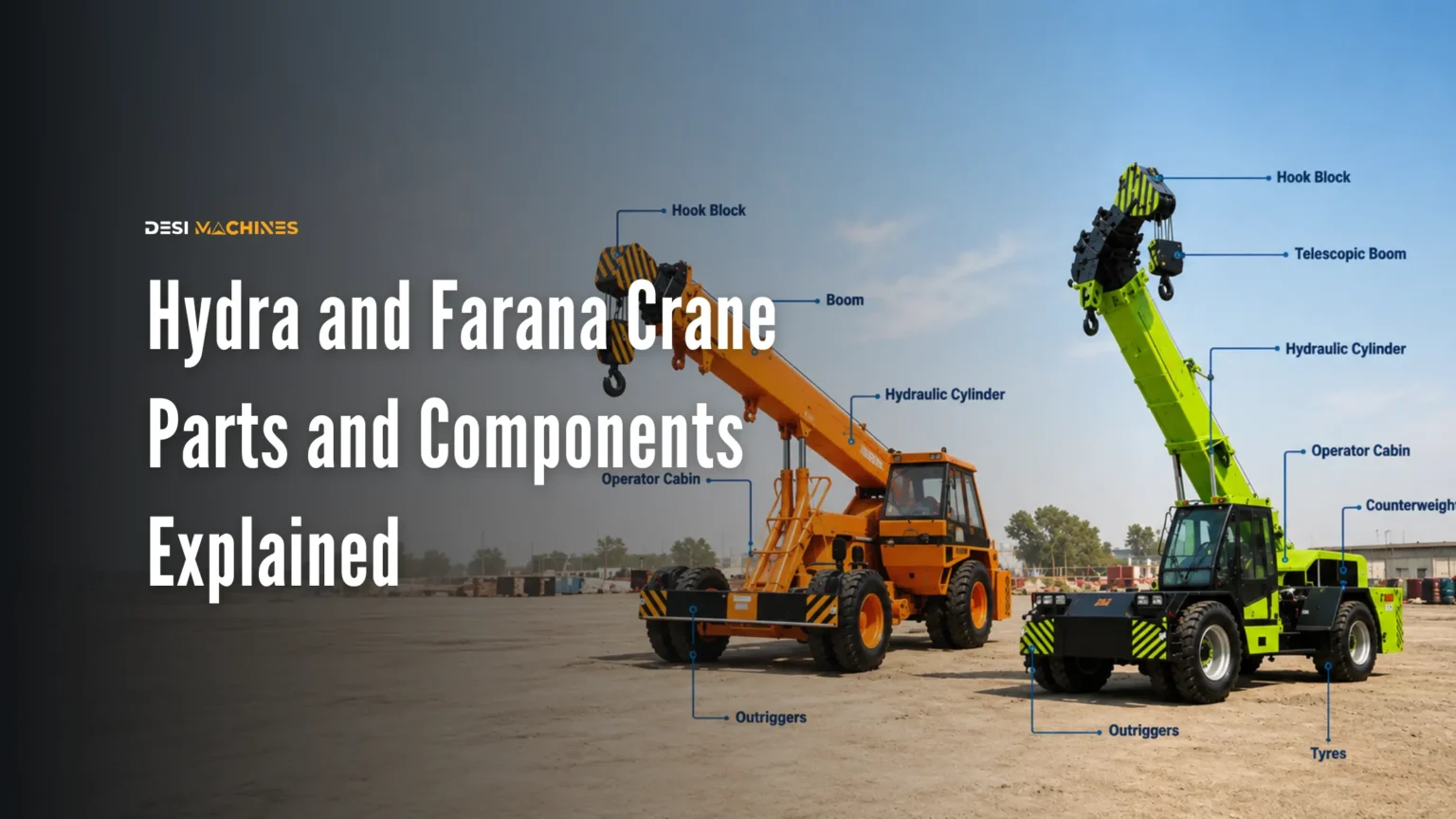
A Hydra crane is a pick and carry crane: a wheeled machine that lifts a load on a telescopic boom, then drives with that load still hanging and sets it down somewhere else. Its parts fall into six groups: the boom, the winch and rope that raise the hook, the articulated chassis that bends in the middle to steer, the engine and transmission that move it on the road, the hydraulic system that powers every movement, and the tyres and brakes that hold all of it up. A Farana (spelt Franna by the maker who invented it) is the same machine built heavier, usually with four wheel drive.
This guide names each part, explains in plain words what it does, and uses the figures published for the 63 pick and carry cranes listed on DesiMachines, from a 9 tonne Rhino to a 35 tonne F350. If you are still working out which machine you need rather than what is inside it, start with pick and carry cranes in India.
What are the main parts of a Hydra crane?
The main parts of a Hydra crane are the telescopic boom, the derricking cylinder that lifts that boom, the winch with its wire rope and hook block, the turret or front frame the boom sits on, the articulation joint in the middle of the chassis, the diesel engine and gearbox, the hydraulic pump and control valve, the axles, tyres and air brakes, and the operator cabin. Everything the machine does comes from one of these.
| Part | What it does | Where it sits |
|---|---|---|
| Telescopic boom | The steel arm that slides out in sections to reach height and distance | Front of the machine, above the front axle |
| Derricking cylinder | The hydraulic ram that raises and lowers the whole boom | Under the boom, near its base |
| Telescoping cylinder | Pushes the boom sections out and pulls them back in | Inside the boom |
| Winch (hoist) | Winds the wire rope in and out to raise or drop the hook | At the boom base or on the front frame |
| Wire rope | The steel rope that carries the load from winch to hook | Over sheaves along the boom |
| Sheaves (pulleys) | Grooved wheels the rope runs over at the boom tip and in the hook block | Boom tip and hook block |
| Hook block | The hook plus its pulleys; more rope lines here means more lifting power | Hanging from the boom tip |
| Articulation joint | The hinge in the middle of the chassis that lets the machine bend to turn | Between the front and rear halves |
| Steering cylinders | Two hydraulic rams that push the two halves apart to bend the machine | Either side of the articulation joint |
| Diesel engine | Turns the wheels through a gearbox and drives the hydraulic pump | Behind the cabin |
| Hydraulic pump and control valve | Send oil to the boom, winch and steering, one movement per lever | Engine bay and cabin side |
| Axles, tyres and brakes | Carry the machine and the load, and stop it, on air brakes rather than car-type brakes | Front and rear |
| Counterweight and chassis ballast | Dead weight at the back that stops the machine tipping forward | Rear of the chassis |
| Operator cabin | Where the operator drives and works the boom, with the load chart on the wall | Mid-chassis, left side |
Two words in that table trip up first-time buyers. Derricking just means raising or lowering the boom, the way you lift your forearm from the elbow. Telescoping means sliding the boom sections out to make the boom longer, like opening a car aerial. A Hydra does both, and it does them with separate cylinders.
How many parts does a Hydra crane boom have?
Most Hydra crane booms have three or four telescopic parts, and four is the more common answer. Of the 68 pick and carry cranes listed on DesiMachines, 42 have a four-part boom, 19 have a three-part boom, 5 small machines have a two-part boom and 2 have a five-part boom (figures as of September 2026). More parts means more height from the same folded length, on a machine that still has to fit under a village electricity line when the boom is down.
| Boom type | How many machines | Boom height range | Lifting capacity range |
|---|---|---|---|
| Two-part boom | 5 | 9.0–12.8 m (29–42 ft) | 9–25 Tonne |
| Three-part boom | 19 | 9.6–23.1 m (31–76 ft) | 12–30 Tonne |
| Four-part boom | 42 | 9.3–22.6 m (31–74 ft) | 14–35 Tonne |
| Five-part boom | 2 | 22.9–24.3 m (75–80 ft) | 25–30 Tonne |
Read one line on the spec sheet carefully. On many four-part booms the maker writes something like “3 parts hydraulically powered and fully synchronised, 4th part power extended and manually pinned for safety”. That means the last section is not meant to slide in and out during work. The operator sets it once, drops a steel pin through it, and leaves it. If your job needs constant reach changes at full height, a fully powered three-part boom can be the more practical machine than a four-part one.
The boom is raised by a derricking cylinder. Twenty of the listed machines use a single double-acting cylinder and twenty-seven use two of them, one on each side. Double-acting means oil pushes the ram both ways, up and down, instead of relying on the boom’s own weight to come back down. On the biggest machines listed, the boom reaches 24.31 m (about 80 ft) on the Indo Power 30FNX, which is the tallest reach in this class on DesiMachines at the time of writing, and 22.6 m on the 35 tonne ACE F350.
What is inside the winch, and what do “falls” mean?
The winch is a hydraulic drum that winds wire rope in and out, and falls is simply how many lines of that rope run between the boom tip and the hook block. Six falls means six lines share the load, so each line carries roughly a sixth of it. That is why the same rope can lift a much heavier load at six falls than at four.
| Winch figure | What the listed machines publish | What it means for you |
|---|---|---|
| Falls | Four falls on 23 machines, six on 37, eight on 2 (some models list both four and six) | More falls, more lifting power, slower hook |
| Rope diameter | 13 mm on all 36 machines that publish it | The rope is a wear part; the diameter tells you what to order |
| Line pull | 3.5 to 4.6 Tonne where it is published | What one line of rope can pull before the winch stalls |
| Line speed | 35 to 55 metres per minute | How fast the hook rises with the rope reeved |
| Brake | Fail-safe type on every machine that lists one | The brake grips when pressure is lost, not when it is applied |
That last row is the one to understand. A fail-safe brake is held open by hydraulic pressure and closed by a spring. If a hose bursts or the engine stops, the pressure goes and the spring clamps the winch shut, so a load in the air stays in the air. It is the opposite of the brake in your car.
Two more parts sit in this group and both cost real money when they fail. The hook block on most listed machines is described as self-adjusting, meaning it keeps itself straight as the rope pays out. The rope tensioner keeps the rope wound tight on the drum, because a slack wrap crushes the layer beneath it and kinks the rope. A kinked rope is scrap; there is no repair.
Why does a Hydra crane bend in the middle instead of turning its wheels?
A Hydra steers by bending at a hinge in the middle of the chassis, which is called articulated steering. Two hydraulic cylinders push the front half against the rear half, and the whole machine folds like a pair of scissors. The front wheels stay straight relative to the front frame. Fifty-four of the 63 listed machines describe this arrangement, most of them through a “full power orbitrol” unit. Orbitrol is the hydraulic valve that turns steering-wheel movement into oil flow.
The reason is space. A pick and carry crane spends its life inside plot boundaries, factory sheds and half-built basements, and articulation lets a 15 tonne machine turn inside a lane it could never turn in on car-type steering.
| Steering figure | Range across the 63 listed machines |
|---|---|
| Articulation angle | 35° to 55° |
| Minimum turning radius | 5,500 mm to 10,000 mm (5.5–10 m) |
| Typical small-machine turning radius | 6,500 mm on 18 machines |
There is a trade-off, and it matters on every lift. When the machine is bent, the boom is no longer in line with the chassis, and the crane’s stability drops sharply, which is why load charts give separate figures for lifting over the front and lifting at an angle. Before you accept any of these numbers on a job, read how to read a crane load chart. The chart, not the boom length, decides what the machine may lift that day.
Why does a pick and carry crane have no outriggers?
Because it is designed to lift and then travel, and a machine standing on outriggers cannot travel. Outriggers are the legs a mobile crane lowers to lift itself off its tyres and stand on solid ground. Of the 63 pick and carry cranes listed on DesiMachines, exactly one — the ACE FX 300 — publishes outrigger cylinders in its specification. The other 62 lift on their tyres, full stop.
That single fact explains most of what feels strange about these machines:
- The tyres are structural. They are load-bearing parts, not just wheels. The listed machines run 11.00 x 20 (16 ply) or 12.00 x 24 (18–20 ply) tyres, four at the front on every machine in the class, and then either two or four at the rear depending on the model. The full ladder of front and rear sizes is set out in the guide to hydra crane tyre sizes by tonnage class. Ply rating is the strength of the casing, and a lower-ply replacement tyre is not a cheaper tyre — it is a smaller crane.
- Tyre pressure becomes a lifting spec. A soft tyre lets that corner settle, the boom tips further out, and the load moves further from the machine’s centre. Check pressures cold, every morning.
- Ground condition is part of the load chart. No outrigger pads means nothing spreads the weight. Loose fill, a covered drain or fresh backfill under one wheel is the classic Hydra accident in India.
- Creep speed exists for a reason. Twenty-two listed machines publish a creep speed of 0.76 to 1.9 km/h, which is walking pace or slower. That is the speed at which you are meant to move with a load hanging.
The safety rules that follow from this, who may operate and what gets checked before the first lift, are set out in crane safety rules and operator training in India. If your work genuinely needs to lift from a fixed spot at full height, a mobile crane with proper outriggers is the right machine, not a bigger Hydra.
Comparing a Hydra against a Farana before you buy? Browse the pick and carry cranes listed with prices and talk to a dealer about what your site can actually take.
What engine, gearbox and brakes does a Hydra crane use?
A Hydra runs a four-cylinder water-cooled diesel engine, a heavy-duty gearbox with a high-low range, and air-operated brakes on both axles. Engine power across the 63 listed machines runs from 47.5 HP (34.9 kW) on the smallest 12 tonne machines to 137 HP (102 kW) on the 30 tonne Indo Power 30FNX, with operating weight from 7,750 kg to 27,450 kg (7.7 to 27.4 tonne).
The engines are the same Indian truck and tractor engines you already know from other machines on your site. Mahindra, Volvo Eicher, Escorts, Ashok Leyland, Simpson and Indo Farm units all appear in this class. That is good news for parts: a Hydra engine part is usually available in any district town, unlike an imported crane engine.
| Drive line part | What the listed machines show |
|---|---|
| Drive | 38 machines are 2 wheel drive, 22 are 4 wheel drive, and 2 offer a 2WD/4WD selector |
| Gearbox | Constant-mesh or synchromesh, typically 6–10 forward and 2 reverse speeds with a high/low lever |
| Road speed | 28–50 km/h unloaded, depending on the model |
| Brakes | Air-operated on front and rear wheels on most models |
| Parking brake | Spring-actuated fail-safe type on most; a hand lever on ten models |
Those last two rows are linked, not separate choices: every machine with a hand lever also runs air-assisted hydraulic brakes rather than full air ones, which is set out with the counts in Hydra crane brakes explained.
The 2WD versus 4WD choice is the one that decides where the machine can work. Two wheel drive is the standard build in this class and is fine on paved yards, factory floors and hard-packed sites. Four wheel drive appears on the heavier machines — the four wheel drive models listed run from 14 to 35 Tonne, against 9 to 30 Tonne for two wheel drive — and is what you need on wet ground, on a rising approach road, or on any site during the monsoon. A 23 tonne ACE F230 and a 23 tonne Escorts F23 both come as 4WD machines on 101 HP engines, which is the common pattern at the top of the Farana class.
What is in the hydraulic system of a Hydra crane?
The hydraulic system is a pump, a control valve, the cylinders and motor it feeds, and two filters. Sixteen of the listed machines publish this group, and it is consistent: a vane-type pump and a four to six spool control valve with a built-in pressure relief valve. Seven of them go further and name the filters: a 100 mesh strainer on the suction line and a 25 micron full-flow filter on the return line.
Translated: each spool in the control valve is one lever in the cabin — boom up/down, telescope in/out, winch up/down, steering. The relief valve is a safety dump; when pressure climbs past the set limit it opens and sends oil back to tank instead of bursting a hose. The two filters do different jobs. The 100 mesh strainer is a coarse screen protecting the pump from big debris; the 25 micron filter on the return line is the fine one that keeps the oil clean, and 25 micron is roughly a third the thickness of a human hair.
Dust is the enemy here, and India supplies plenty of it. Every hour the return filter is left blocked, dirty oil bypasses it and goes back to work scoring the pump and the cylinder seals. The full routine — oil change intervals, contamination signs, monsoon precautions — is covered in hydraulic system maintenance for construction equipment, and the hour-by-hour service points are in the equipment service schedule.
Which Hydra crane parts wear out first?
On an Indian site the wire rope, the boom wear pads, the tyres and the hydraulic hoses go first. None of them are expensive on their own, and all four are the parts owners try to stretch one more month.
| Part | Why it wears | What to watch for |
|---|---|---|
| Wire rope | Bends over sheaves thousands of times, plus rain, dust and stored load | Broken wires, flattened sections, kinks, rust in the valleys of the strands |
| Sheaves and hook block | Rope grinds the groove; a worn groove then grinds the rope | A groove that has gone sharp or uneven, a hook that will not swivel freely |
| Boom wear pads | The sliding sections rub on plastic pads with every telescope movement | Boom sections rattling sideways, an uneven gap between sections |
| Tyres | They carry the load itself, often on rough approach roads | Sidewall cuts and bulges. On this machine a sidewall problem is a lifting problem |
| Hydraulic hoses and seals | Heat, vibration and dust cycling every day | Weeping joints, a boom that settles slowly when parked with the load up |
| Clutch plate | Loaded creep-speed travel is hard on a dry friction clutch | Slipping in high gear, a burning smell after a shift |
| King pin and articulation bearings | The whole machine’s weight pivots here | Play at the hinge, uneven tyre wear, wander on the road |
A boom that settles, meaning it drifts down slowly with the load up and the engine off, is the one to take seriously. It usually means a leaking cylinder seal or a tired holding valve, and it is not something to run through the season. For what to check before you fit a replacement, see the spare parts guide.
How do you check these parts before you buy or hire?
Walk the machine in this order and you will have covered every group in this guide in about twenty minutes.
- Rope, hook and sheaves first. Run the winch down fully and pass the rope through a gloved hand. Broken wires or a kink means budget for a new rope before you talk price.
- Telescope the boom fully out and back. Watch for jerks, listen for knocking, look at the gap between the sections. Then leave the boom up for ten minutes with the engine off and see if it settles.
- Bend it lock to lock. Full articulation both ways. It should be smooth, and the hinge should not clunk.
- Look at all eight tyres and the pressures. Sidewalls first, tread second. On a pick and carry crane the tyres are part of the lifting system.
- Cold-start the engine and watch the exhaust. Then check for oil weeping at every hose joint and cylinder rod you can reach.
- Ask for the load chart and check it is the chart for that exact model, in the cabin, readable.
Buying second-hand? The full inspection routine for this class of machine, including hour-meter checks and papers, is in the used Hydra crane buying guide. If you are still choosing between owning and hiring, crane buying and rental in India compares the two, and the pick and carry cranes we list show what each capacity class currently costs.
Read next
Same anatomy treatment for other machines: backhoe loader parts and road roller parts. For the crane family as a whole, types of cranes and how they work sets out where the pick and carry crane sits among tower, crawler and truck-mounted machines. And if the Hydra-versus-Farana question is still open, our blog compares Hydra and Farana cranes side by side.
Knowing the parts is one thing; knowing whether the machine fits your site is another. Our guide to Hydra crane boom height and turning radius compares reach, turning circle and width across all 67 pick and carry cranes listed.
Once you know the parts, the hydra crane fuel and oil capacities guide gives the service volumes those parts run on, model by model.
The hook itself, its safety latch and the signs that it must be replaced are covered in the crane hook guide.
All specifications in this guide are taken from the machines listed on DesiMachines at the time of writing (August 2026) and are quoted as published ranges across the 63 pick and carry cranes listed. Individual variants differ. Prices, specifications and features are indicative, vary by variant, location and date, and should always be confirmed with the official OEM or authorised dealer before any purchase decision. DesiMachines is not liable for decisions taken on the basis of information that may have changed after publication.