
 Excavator
316 models
 Backhoe Loader
54 models
 Crane
68 models
 Concrete Mixer
79 models
 Wheel Loader
65 models
 Compactor / Roller
45 models
 Motor Grader
42 models

 Concrete Pump
66 models
 Skid Steer Loader
11 models


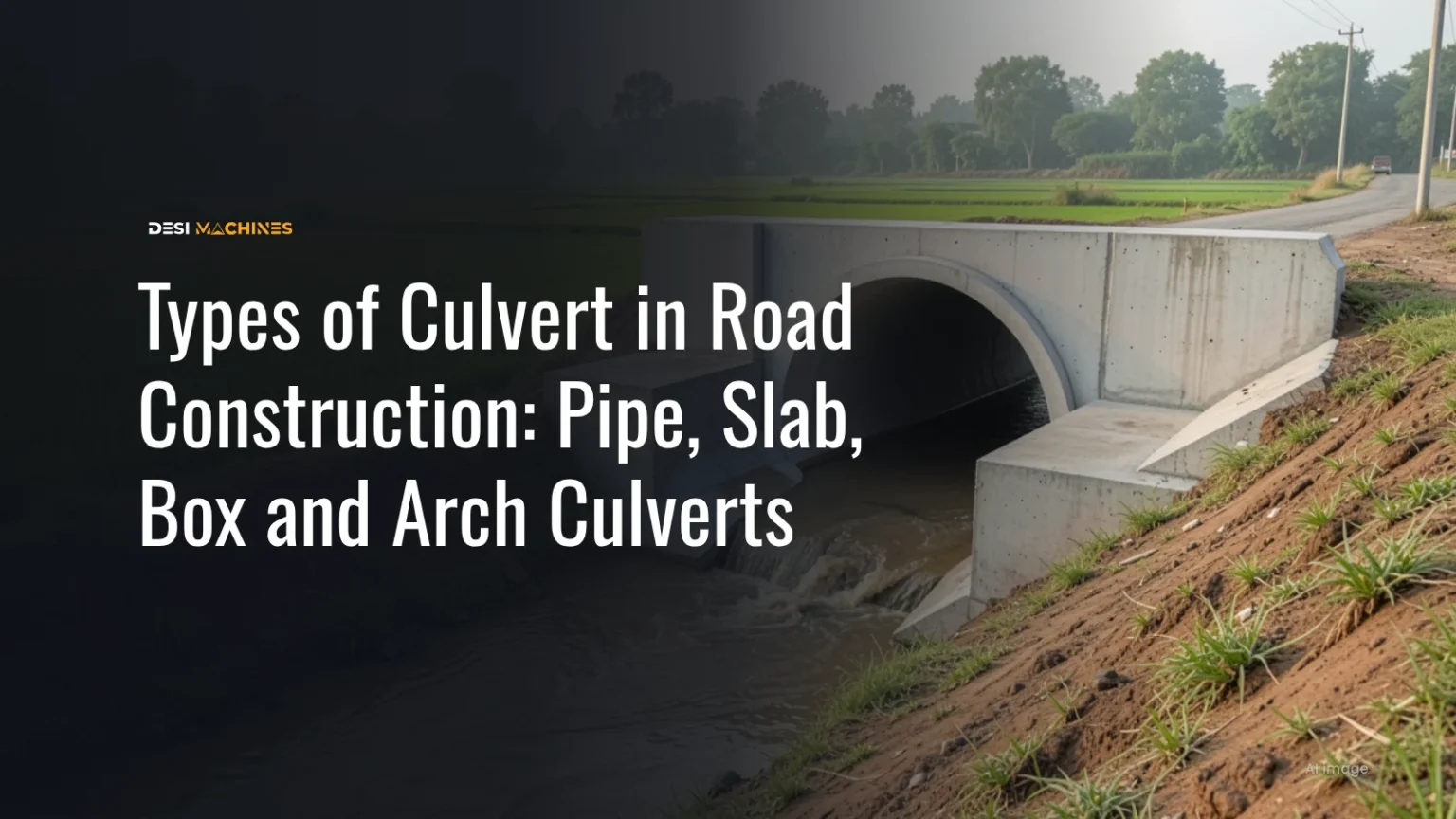
A road across flat Indian farmland needs about one culvert every kilometre, and up to three per kilometre in rolling ground: small openings built under the road so that a stream, a canal or rain water can pass from one side to the other without flowing over it. Four types of culvert are used in India: the pipe culvert (RCC hume pipes), the slab culvert, the box culvert and the arch culvert.
Those counts come from IRC:SP:13, the Indian Roads Congress (IRC) guideline for small bridges and culverts. Its rules, with the MoRTH road specifications, decide which type goes where, and they are the basis for everything below.
What is a culvert in road construction?
A culvert is a cross-drainage structure: it carries water across the line of the road, under it. That is the opposite job to a side drain in road construction, which runs along the road edge and brings water to the culvert.
The size limit is set by IRC:5, the general code for road bridges. Its 2015 edition defines a culvert as a structure with a total length of up to 6 m (about 20 feet) between the outer faces of its walls, measured at right angles to them. Anything longer is a bridge. There is one exception: a cross-drainage structure built with pipes is called a culvert whatever its length, so a row of six pipes is still a pipe culvert.
Why does a road need so many of them? A raised road behaves like a dam. When the bank of a new road is thrown across open farmland, rain that used to spread across the fields in a thin sheet piles up on the high side, floods the crops and soaks the foot of the bank. IRC:SP:13 says this plainly in its article on pipe and box culverts: relief has to be given by passing the water across the road, through causeways or culverts. The bank itself, and why water at its toe is dangerous, is covered in the guide to embankment construction in road.
IRC:SP:13 also gives a rough rule for when a culvert is enough. Where the catchment, the area of land that drains to the crossing, is up to 1 sq km (100 hectares), a culvert usually does the job. Above 1 sq km a small bridge is normally needed.
What are the types of culvert?
IRC:SP:13 lists the forms a small bridge or culvert can take: RCC hume pipes, an RCC slab on masonry or concrete abutments, a stone slab on the same, an RCC box, and an RCC or masonry arch. The abutments are the side walls that carry the slab or arch. In everyday site language that gives four types, with the stone slab as an old, small version of the slab culvert.
| Type | What it is | Where it is chosen | Limits to know |
|---|---|---|---|
| Pipe culvert (hume pipe) | One or more precast RCC pipes laid through the road bank, with a headwall at each end | Small streams and field drainage where there is enough height for earth cover over the pipe; usually the cheapest choice | Pipe at least 1,000 mm across; at least 600 mm of cushion between pipe top and road level; up to six rows of pipes |
| Slab culvert | An RCC slab resting on two masonry or concrete abutments, open below | Rocky or firm ground, and sites where there is not enough cushion for a pipe | Span at least 2 m and height at least 1.5 m so it can be cleaned; a stone slab only up to 2 m span, 200 mm thick |
| Box culvert | A closed RCC box (top slab, two walls and a bottom slab cast as one), single or multi-cell | Soft ground with low bearing capacity, because the bottom slab spreads the load | MoRTH standard designs start at 2 m x 2 m for a single cell; built with or without earth cushion on top |
| Arch culvert | A masonry or RCC arch on abutments | Mostly older roads; built where good stone and skilled masons are available | Needs firm foundations to take the outward thrust of the arch |
IRC:SP:13 is direct about cost. For small structures, it says, pipe culverts with a single row or up to six rows of RCC pipes should be used as far as possible, because they are likely to work out cheaper than slab culverts.
There is also a type defined by location, not shape. A balancing culvert is placed at a low point on the road’s long section, where two down-gradients meet, to let water that has collected on one side pass to the other and keep the water level equal on both sides. Watching the road during the first heavy rain shows where these are needed.
Pipe culvert: NP3 vs NP4 pipes, size and cover
The pipes in a pipe culvert are precast concrete pipes made to IS 458, the Bureau of Indian Standards code for concrete pipes. Most people on site call them hume pipes, after the spinning process used to make them. IS 458 sorts non-pressure pipes into classes by how much traffic they can carry above them:
- NP2: light-duty reinforced pipe, for culverts carrying light traffic.
- NP3: medium-duty reinforced pipe, for culverts carrying medium traffic.
- NP4: heavy-duty reinforced pipe, for culverts carrying heavy traffic.
IRC:SP:13 asks for NP3 or NP4 pipes in culverts. The MoRTH Specifications for Road and Bridge Works (5th revision, clause 1013) go further for highway work and ask for NP4 pipes. At the common culvert sizes the two classes have the same wall thickness; the extra reinforcement in NP4 is what lets it carry more load before it cracks.
| Internal diameter | Wall thickness | NP3 load at 0.25 mm crack | NP4 load at 0.25 mm crack |
|---|---|---|---|
| 900 mm | 100 mm | 43.11 kN per metre | 66.30 kN per metre |
| 1,000 mm | 115 mm | 47.90 kN per metre | 72.60 kN per metre |
| 1,200 mm | 120 mm | 57.48 kN per metre | 88.30 kN per metre |
The test load is the load a pipe takes, pressed along its full length between bearing strips, before a crack 0.25 mm wide appears. The NP4 pipe takes about one and a half times the NP3 figure at each size.
Four IRC:SP:13 rules decide the size and position of a pipe culvert:
- Minimum diameter 1,000 mm (1 m). Smaller pipes choke with silt and are hard to clean. The standard pipe culvert drawings referred to in IRC:SP:13 are for 1,000 mm and 1,200 mm pipes.
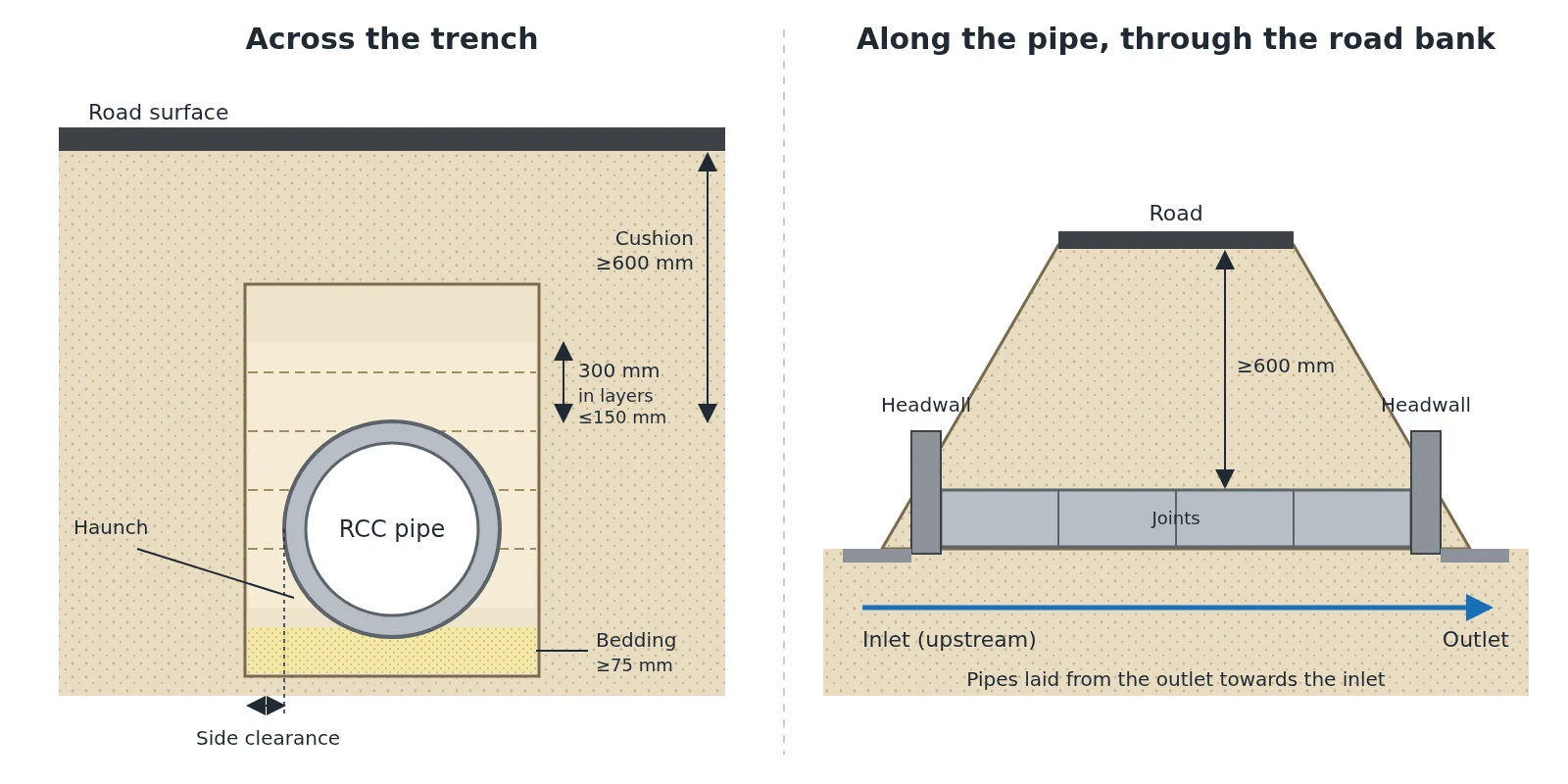
- At least 600 mm (2 feet) of cushion, the earth and road layers between the top of the pipe and the road surface.
- First-class bedding, compacted sand or gravel, is enough up to 4 m of fill over the pipe. Between 4 m and 8 m of fill, the pipe sits in a concrete cradle.
- Where one pipe is not enough, more are laid side by side, up to six rows. MoRTH clause 2905 keeps adjacent pipes apart by at least half the pipe diameter, never less than 450 mm.
Under IS 458, collar-jointed pipes come in effective lengths of 2.5 m, 3 m, 3.5 m or 4 m, and NP3 and NP4 pipes of 900 mm and above may also be made 1.25 m long. Shorter pipes are lighter to handle, which matters when you see the weights in the machines section below.
When is a box culvert or a slab culvert used instead?
The ground and the height available decide it. IRC:SP:13 gives three plain rules:
- Where the founding strata is rock or firm soil, use an RCC slab culvert.
- Where there is not enough cushion above the stream bed to bury a 1 m pipe under 600 mm of earth, use a slab culvert. This is common on low roads across flat land.
- Where the soil has a low bearing capacity, use an RCC box culvert.
The box works on weak soil because its bottom slab acts as a raft, spreading the weight of the road and traffic over the full width of the box. A slab culvert puts the same weight down through two narrow abutment footings. MoRTH has standard box designs, from a single 2 m x 2 m cell upward, with and without earth cushion on top, for foundation soils bearing up to 20 tonnes per square metre. A box can also be precast in segments in a yard and lifted into place by crane, which cuts the shuttering and curing work done at the stream.
A slab culvert has one advantage on village roads that IRC:SP:13 mentions: in dry weather it doubles as a cattle crossing.
To keep any culvert cleanable, IRC:SP:13 asks for a vent height of normally at least 1,500 mm and a slab span of at least 2 m.
Culvert headwalls, wing walls and return walls
The walls at each end of a culvert hold back the earth of the road bank and guide water in and out. Three kinds of end wall are used:
- Headwall: the wall across the end of a pipe culvert, flush with the pipe mouth. It stops the bank slipping over the pipe end.
- Wing walls: walls that splay outwards from the abutment, generally at 45 degrees, which is why they are also called splayed wing walls. They funnel water into the opening.
- Return walls: walls parallel to the road. Their straight length should normally be 1.5 times the height of the embankment.
Where the bank is higher than 2 m, IRC:SP:13 prefers splayed walls. The top of any wing wall or return wall should be at least 450 mm wide, and weep holes, small drain holes through the wall, go in at no more than 1 m apart each way so that water does not build up behind it. The same guideline warns against high headwalls to hold back a deep fill: it is better to make the culvert longer so the bank keeps its natural slope. At the outlet, a curtain wall, a short wall dug into the bed, protects against scour.
How is a pipe culvert laid?
MoRTH Section 2900 sets out the method. In order:
- Excavate the bed to the line and level on the drawings. In a trench, leave a clear width on each side of the pipe of at least 150 mm or one-quarter of the pipe diameter, whichever is more, and no more than one-third of the diameter. Keep the trench sides as near vertical as possible.
- Remove soft or spongy soil and replace it with compacted granular fill. In rock or boulders, dig at least 200 mm below the pipe and refill with stone-free earth.
- Lay the bedding. First-class bedding is well-graded sand or other granular material passing a 5.6 mm sieve, at least 75 mm thick after compaction, shaped to fit the bottom of the pipe for at least a tenth of its height. A concrete cradle is M15 concrete or richer, and the pipe goes on it before the concrete sets.
- Lower the pipes. Laying starts at the outlet and works upstream to the inlet. A bell-mouthed pipe has its bell end facing upstream.
- Joint the pipes. A collar joint uses an RCC collar 150 to 200 mm wide, with a 13 to 20 mm gap packed with 1:2 cement-sand mortar. The finished joints are kept covered and damp for at least four days.
- Backfill once the joints have hardened. Up to 300 mm above the top of the pipe, use clean soil in layers no thicker than 150 mm, rammed or vibrated, with special care under the haunches, the lower curved sides of the pipe. Fill both sides at the same time so the pipe is not pushed sideways.
- Build the headwalls and aprons, then open to traffic only when there is at least 600 mm of fill over the pipe.
High embankments get one extra step. Where the fill over the pipe will be more than three times the pipe’s outside diameter, MoRTH 2903 asks for the bank to be built first, to a height above the pipe top equal to the pipe’s outside diameter and at least five pipe diameters wide on each side, and only then is the trench cut into it. After the trench is backfilled, a loose layer one pipe diameter deep goes over the pipe before the next layers are rolled. The density of each layer is checked with the methods in the guide to the field density test.
Culvert vs bridge vs causeway: what is the difference?
Length decides culvert or bridge; whether water crosses over or under the road decides culvert or causeway.
| Structure | Size | Water passes | Typical use |
|---|---|---|---|
| Culvert | Total length up to 6 m; any length if made of pipes | Under the road | Field drains, small streams, catchments up to about 1 sq km |
| Small bridge | Up to 30 m overall, no single span over 10 m | Under the road | Defined streams and nallahs too big for a culvert |
| Minor bridge | Total length up to 60 m | Under the road | Rivers and wider channels |
| Causeway | A dip in the road profile, paved to resist flowing water | Over the road, in floods | Wide, shallow flows in flat country on low-traffic roads |
IRC:SP:13 notes that a causeway is the simplest answer on flat land, but too many dips make a road less useful and costly to keep up, and on waterlogged land a raised road with culverts is the better arrangement. Which class of road gets which standard is explained in the guide to types of roads in India.
Which machines build a culvert?
A culvert is a short job with several different tasks: dig, bed, lift, joint, backfill and compact. On Indian road sites these machines do most of it.
A backhoe loader digs the trench, trims the bed and loads the spoil, and it drives on its own wheels from one culvert to the next. The JCB 3DX lists a maximum digging depth of 4,770 mm, enough for a 1 m pipe trench under a normal bank. Its backhoe also lists a maximum lift capacity of 1,490 kg, and that figure matters. Working from the IS 458 wall thickness, a 2.5 m length of 1,000 mm NP4 pipe has an outside diameter of 1,230 mm and about 1 cubic metre of concrete, so it weighs roughly 2.4 tonnes (2,400 kg). That is well over what the backhoe arm can lift. MoRTH allows a tripod and pulley or careful manual handling, and many contractors use a pick-and-carry crane.
A hydra crane lifts the pipes off the truck and lowers them onto the bedding, and it also places precast box segments. The Escorts Hydra 14 is rated at 14 tonnes, its maximum at the shortest boom radius; what it can safely lift falls as the boom reaches out, so read the load chart for the actual radius to the trench.

An excavator handles the bigger digs: foundations for box and slab culverts and trenches cut into high banks. The Tata Hitachi EX 200 Infra, a 20-tonne class machine, lists a maximum digging depth of 5,920 mm.
Small compactors finish the job. MoRTH 2907 asks for rammed, tamped or vibrated layers of 150 mm near the pipe and allows pneumatic or light mechanical tampers there; a plate compactor or a rammer suits that zone. MoRTH clause 305.4.4 adds that fill against the abutments or wing walls waits until the masonry or concrete has been in place for 14 days, and goes up in equal layers on both sides.
For a whole road package, the guide to machinery required for road construction shows how many of each machine a job needs. If you are taking on culvert work, compare backhoe loader models and prices and hydra cranes, or the full range of excavators, and talk to a verified dealer before you buy.
How are culverts numbered and looked after?
Every culvert on a road gets a number. IRC:SP:13 uses the kilometre and the count within it: 21/8 is the eighth cross-drainage structure in kilometre 21. A short code then describes it, made of the number of spans, the clear span in metres and a letter for the type: S for an RCC solid slab, P for a pipe culvert, A for an arch and B for a box. So 1 x 2 x S is one span of 2 m with an RCC slab.
On a culvert with railings the number goes on two 300 mm x 300 mm plates, one for each direction of travel. Pipe culverts are buried and usually have no parapet, so IRC:SP:13 asks instead for two stone or RCC marker posts, 150 mm x 150 mm, standing 300 mm out of the ground, one on each side and fully outside the roadway width, with the culvert number painted or engraved at their base.
Upkeep is simple but cannot be skipped. A culvert full of silt or plastic does not pass water, and the water then tops the road or soaks the bank. IRC:SP:42, the road drainage guideline, asks for drains and culverts to be cleaned before and after the monsoon: the barrel, the inlet and the outlet, together with the side drains that feed them. The layers of road built over the culvert are explained in the guide to road construction layers, and more on design, materials and testing sits on the road construction guide hub.
The clauses in this guide come from the IRC:SP:13-2004 Guidelines for the Design of Small Bridges and Culverts and the MoRTH Specifications for Road and Bridge Works, 5th revision (Sections 305, 1000 and 2900), with the culvert definition from IRC:5-2015 and pipe classes and test loads from IS 458:2021. IRC has since issued a second revision of SP:13 (2022), so check the clause numbers against the edition named in your contract.
Prices, specifications and features are indicative, vary by variant, location and date, and should always be confirmed with the official OEM or authorised dealer before any purchase decision. Culvert types, sizes and code clauses should be confirmed against the current edition of the IRC guideline and MoRTH specifications and with your project engineer before work starts. DesiMachines is not liable for decisions taken on the basis of information that may have changed after publication.
Machines, tenders and news for this industry: Road Construction