
 Excavator
294 models
Excavator
294 models  Backhoe Loader
51 models
Backhoe Loader
51 models  Crane
68 models
Crane
68 models  Concrete Mixer
79 models
Concrete Mixer
79 models  Wheel Loader
54 models
Wheel Loader
54 models  Compactor / Roller
45 models
Compactor / Roller
45 models  Motor Grader
42 models
Motor Grader
42 models  Concrete Pump
66 models
Concrete Pump
66 models  Skid Steer Loader
11 models
Skid Steer Loader
11 models  Telehandler
13 models
Telehandler
13 models 


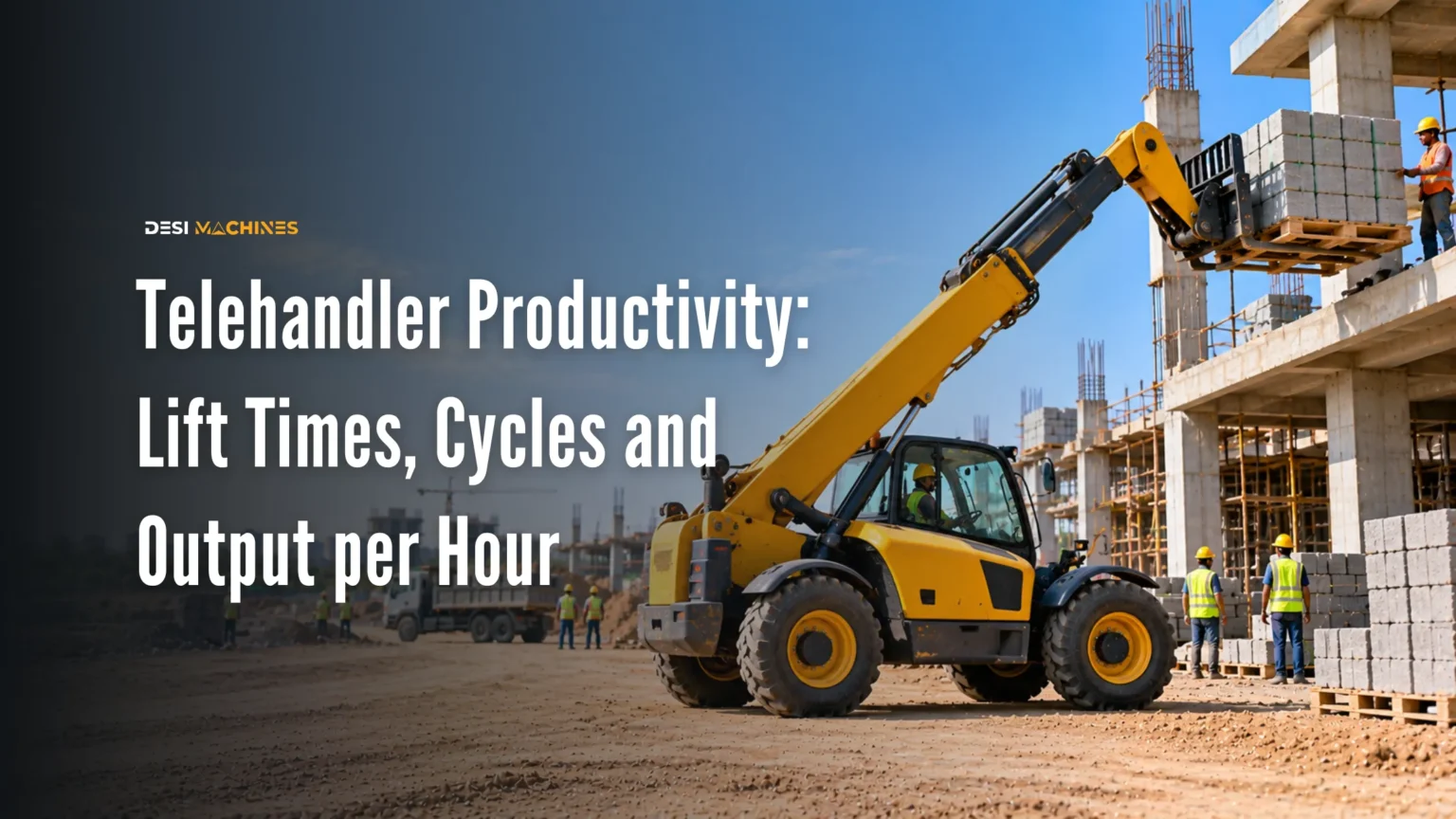
A telehandler raises its boom to full height in 8.4 to 15 seconds and brings it back down in 8.6 to 19 seconds. Put the two together and the boom accounts for about 22 seconds of a working cycle on a typical machine sold in India. That is the part the machine controls, and it is the smaller part: the driving, the picking up and the placing around it take longer than the lift ever will.
So telehandler productivity — how many loads the machine shifts in an hour — is rarely set by how fast the boom moves. It is set by how far the load has to travel and how well the work around the machine is organised. The figures below come from the 13 telehandlers listed on DesiMachines, and they show where the time actually goes.
How long does a telehandler take to lift and lower its boom?
Nine of the 13 telehandlers we list publish a lifting time and a lowering time on their own specification sheets, both measured in seconds for a full movement of the boom. A boom is the telescopic arm that carries the forks; lifting time is how long it takes to raise that arm from rest to its highest point.
Table 1: Published lifting and lowering times across the telehandlers listed on DesiMachines
| Machine | Maximum lift height | Lifting time | Lowering time | Boom time per cycle |
|---|---|---|---|---|
| JCB 540-70 | 7,000 mm (7.0 m) | 8.4 sec | 8.6 sec | 17.0 sec |
| JCB 530-110 | 11,000 mm (11.0 m) | 9.2 sec | 9.2 sec | 18.4 sec |
| JCB 530-70 | 7,000 mm (7.0 m) | 9.1 sec | 10.3 sec | 19.4 sec |
| SANY STH634A | 10,400 mm (10.4 m) | 11 sec | 9 sec | 20.0 sec |
| MANITOU MXT 840 K | 7,600 mm (7.6 m) | 13 sec | 9 sec | 22.0 sec |
| MANITOU MXT 1740 K | 17,400 mm (17.4 m) | 14.30 sec | 10.40 sec | 24.7 sec |
| SANY STH844A | 13,400 mm (13.4 m) | 13 sec | 13 sec | 26.0 sec |
| SANY STH1056A | 17,100 mm (17.1 m) | 15 sec | 19 sec | 34.0 sec |
The MANITOU MXT 840 K IND publishes the same 13 second lift and 9 second lower as the MXT 840 K above, so it is not listed twice.
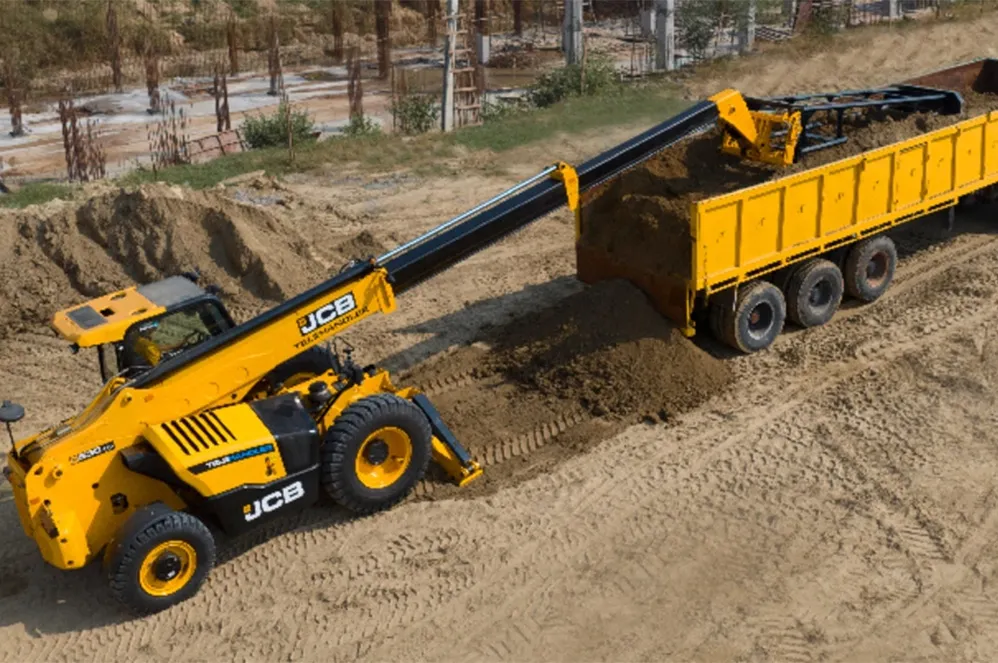
The middle of that range is a boom time of 22 seconds. The fastest machine on our books completes a full raise and lower in 17 seconds; the slowest takes twice that. The specification sheets do not say whether the figure was measured with a load on the forks or with the forks empty, so treat it as a comparison between machines rather than a promise about your site.
One detail is worth noticing. Five of the nine machines lower faster than they lift, which is what you would expect when gravity is helping. Three do not, and on the SANY STH1056A the boom takes four seconds longer to come down than to go up. A boom carrying a load on a long arm is lowered under control rather than dropped, and the published numbers reflect that.
How many lifts per hour can a telehandler do?
If the boom were the only thing taking time, a telehandler at the middle of our range would complete about 163 lifts an hour. That is simply 3,600 seconds divided by a 22 second boom cycle. The fastest machine would reach roughly 211 and the slowest about 106.
Nobody gets those numbers, and it is important to understand why before you budget a job on them. Those figures describe a machine standing still, raising and lowering an empty boom without stopping. A real cycle has four more parts, and the specification sheet publishes none of them:
- driving from where the load is to where it goes
- lining the forks up and getting them under the load
- extending or retracting the boom to reach in
- setting the load down and reversing out
Those four depend on your site, your operator and how the material is stacked. So the honest way to read the lift times is as a ceiling, not a target. They tell you the machine will never be the reason you fall short.
Why the carry decides your output, not the boom
Every telehandler on our list that publishes a travel speed runs between 23 and 34 km/h. Nine of the 13 publish one. That sounds quick until you work out what a short carry costs in time.
Take a machine moving at 25 km/h, which is 6.9 metres per second. A 100 metre carry to the placing point and 100 metres back is 200 metres of driving, and that alone takes about 29 seconds — and that is with no turning, no slowing at the stack and no reversing. Add it to a 22 second boom cycle and you are already past 50 seconds before the operator has touched a single load.
Where the time goes in one telehandler cycle (100 m carry)
The first two blocks are arithmetic from published figures. The third is set by your site and your crew, and it is usually the largest of the three.
Double the carry to 200 metres each way and the driving alone passes a minute. This is why two contractors running the same machine report completely different output. The machine is identical. The distance is not.
The practical conclusion is the same one that applies to a wheel loader working a face: shorten the carry before you shop for a faster machine. Moving the stack 50 metres closer will do more for your day’s output than any specification on the sheet.
Compare live telehandler models and prices and talk to a dealer about what suits your site.
Does a taller telehandler work more slowly?
This is the question most buyers ask when they see a machine that lifts 17 metres, and the published figures give a clear answer: no, not in proportion to the height.
Divide each machine’s lift height by its lifting time and you get the speed the boom actually moves. Across our nine machines that runs from 0.58 to 1.22 metres per second, and the fastest booms belong to the tallest machines. The MANITOU MXT 1740 K raises 17.4 m in 14.30 seconds, which is 1.22 m/s. The much shorter MANITOU MXT 840 K raises 7.6 m in 13 seconds, or 0.58 m/s — less than half the speed, on less than half the height.
Put plainly, the 17 metre machine goes more than twice as high for about one extra second. A tall telehandler is not a slow telehandler. If your work genuinely needs the height, the time cost of having it is small.
What does change with height is what the machine can hold out there. Lifting capacity falls as the boom extends, and that relationship is set out in the telehandler load chart. Check the chart before you assume a machine rated at four tonnes can place four tonnes at full reach, because it cannot.
What else decides telehandler output on an Indian site?
Four things move the number far more than the specification sheet does.
How the material is stacked. Bricks and blocks banded on pallets can be picked in one movement. The same bricks loose on the ground have to be handled twice, and the machine waits while labour loads them. Palletised material is the single biggest change most sites can make.
Ground and gradient. A telehandler on firm, level hardstanding runs near its published travel speed. On soft, rutted or sloping ground the operator slows down, and the carry that took 29 seconds takes a minute. Wet season sites lose output this way rather than through any fault in the machine.
The attachment fitted. Forks, a bucket and a jib do not work at the same rate. A bucket has to be filled, which adds a digging movement the fork never makes. The range of telehandler attachments covers what each one is suited to.
Whether the machine is waiting. A telehandler standing idle while a mason finishes a lift produces nothing, and this is the most common loss on Indian building sites. Machines are usually faster than the trade they serve. Plan the day so the telehandler always has the next load ready.
A machine that has started to lift slowly when it used to be quick is a different matter. That is a fault, not a productivity problem, and the causes are covered in our guide to telehandler boom problems.
Which figures should you check before buying?
Table 2: What a telehandler specification sheet publishes, across the 13 machines listed on DesiMachines
| What you can look up | Machines publishing it | Range across the listed machines |
|---|---|---|
| Maximum lifting capacity | 13 of 13 | 2,721 kg (2.7 tonnes) to 7,000 kg (7.0 tonnes) |
| Maximum lift height | 13 of 13 | 7,000 mm (7.0 m) to 34,700 mm (34.7 m) |
| Maximum outreach | 13 of 13 | 3,800 mm (3.8 m) to 28,000 mm (28.0 m) |
| Operating weight | 13 of 13 | 6,972 kg (7.0 tonnes) to 23,800 kg (23.8 tonnes) |
| Engine power | 13 of 13 | 74 HP (55 kW) to 211 HP (155 kW) |
| Travel speed | 9 of 13 | 23 km/h to 34 km/h |
| Lifting time | 9 of 13 | 8.4 sec to 15 sec |
| Lowering time | 9 of 13 | 8.6 sec to 19 sec |
| Loads per hour | None | Not a specification; it depends on your site |
Outreach is how far forward the boom can place a load, measured from the front of the machine. It matters more than height on most building sites, because it decides whether the machine can reach over a boundary wall or a foundation trench without being repositioned.
Notice the last row. No manufacturer publishes loads per hour, and any seller who quotes you one is estimating. Ask what carry distance and what material that estimate assumed; the answer will tell you how seriously to take it.
Weight and width decide whether the machine can get to your site at all, and those are set out in telehandler weight and dimensions. Running cost per hour starts with the tank and oil figures in our telehandler fuel and oil capacities reference.
How do you confirm the figures for your own machine?
Work from the specification sheet for your exact model and variant, not from a class average. Lifting times differ between two machines from the same maker, and the JCB 530-70 and JCB 540-70 above differ by 2.4 seconds on the boom cycle despite sharing an engine.
Three checks are worth doing before you commit:
- Ask the dealer for the printed specification sheet and find the SPEED section. Lifting and lowering times are published there in seconds.
- Time a real cycle during the demonstration, from the moment the forks leave the ground to the moment the load is set down. Compare it with the published boom time and you will see how much of your cycle is site, not machine.
- Measure your actual carry distance. It is the number that will decide your output, and it is the one nobody writes down.
Model pages on this site carry the manufacturer’s published figures for each machine, and manufacturers publish the same data themselves — the JCB 530-110 specification page is one example. Where the two disagree, ask the dealer to confirm in writing which applies to the variant you are buying.
If you are still deciding between machine types, the complete telescopic handler guide covers the machine from the beginning, including how it compares with a backhoe loader.
Telehandler productivity, in short
The boom is fast and it is not your problem. Nine of the 13 telehandlers listed in India raise a full boom in 8.4 to 15 seconds and lower it in 8.6 to 19 seconds, which is about 22 seconds of boom movement in a working cycle. A 100 metre carry adds roughly 29 seconds on top, and the loading, placing and positioning that the sheet does not publish usually adds more than both together.
Shorten the carry, palletise the material and keep the next load ready, and the same machine will do noticeably more in a day. Choosing a telehandler with a faster boom will not.
Browse the full range of telehandlers, or narrow it down by maker with JCB telehandlers, SANY telehandlers and Manitou telehandlers.
A note on the figures in this guide
Every lifting time, lowering time, travel speed, height, reach, weight and power figure above is taken from the manufacturer’s published specification for the 13 telehandlers listed on DesiMachines at the time of writing. Cycle and speed calculations are plain arithmetic on those published figures and are shown so you can repeat them. Where a specification is not published — loads per hour is the clearest example — this guide says so rather than estimating.
Prices, specifications and features are indicative, vary by variant, location and date, and should always be confirmed with the official OEM or authorised dealer before any purchase decision. DesiMachines is not liable for decisions taken on the basis of information that may have changed after publication.
