
 Excavator
294 models
Excavator
294 models  Backhoe Loader
51 models
Backhoe Loader
51 models  Crane
68 models
Crane
68 models  Concrete Mixer
79 models
Concrete Mixer
79 models  Wheel Loader
54 models
Wheel Loader
54 models  Compactor / Roller
45 models
Compactor / Roller
45 models  Motor Grader
42 models
Motor Grader
42 models  Dozer
41 models
Dozer
41 models  Concrete Pump
66 models
Concrete Pump
66 models  Skid Steer Loader
11 models
Skid Steer Loader
11 models  Telehandler
13 models
Telehandler
13 models 


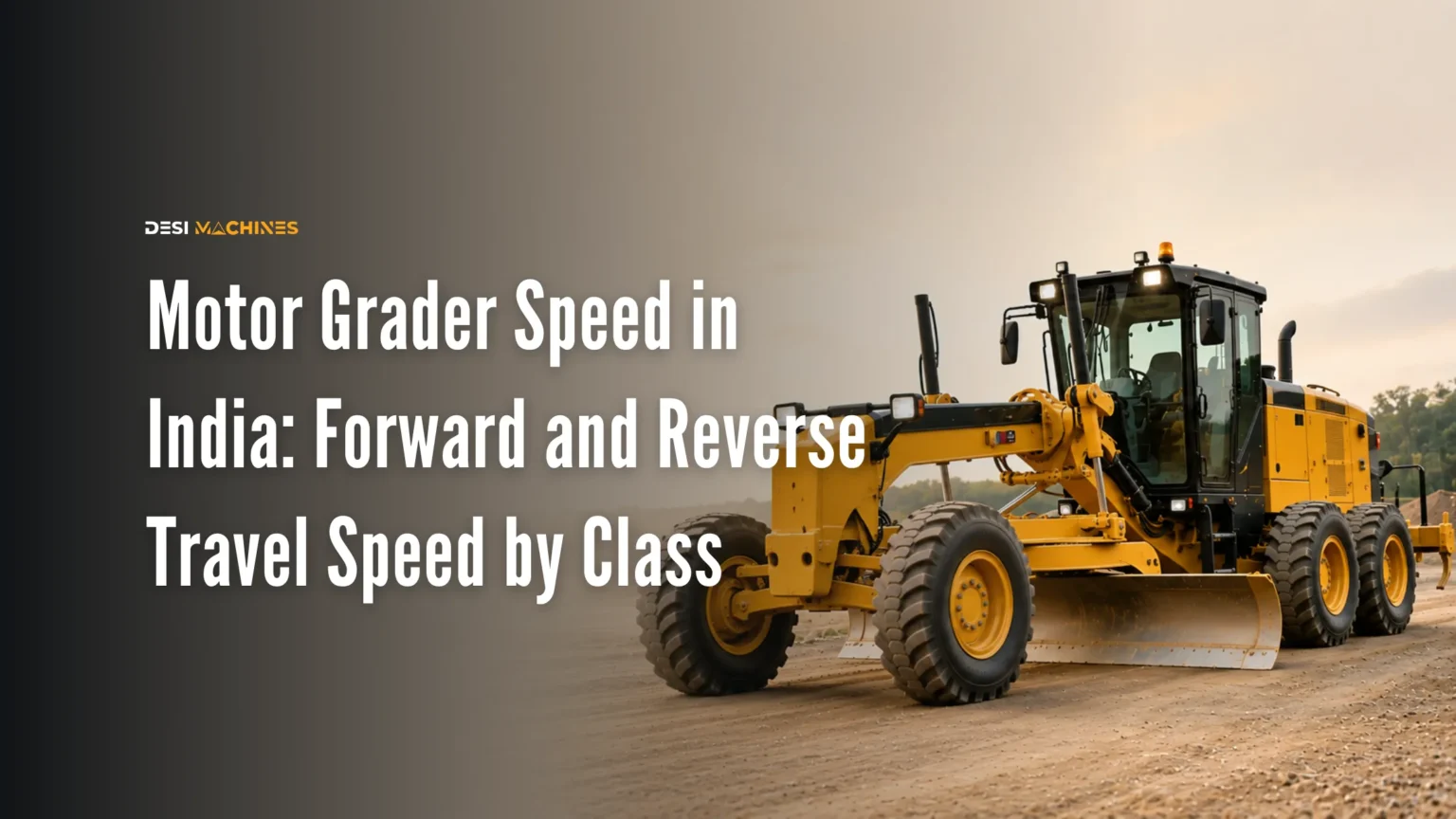
Motor grader speed is two numbers on every spec sheet, not one. Each grader publishes a maximum forward speed, the fastest it will travel on the road between jobs, and a maximum reverse speed, the fastest it will back up. Across the 42 motor graders listed on DesiMachines, forward speeds run from 32.5 to 51.7 km/h and reverse speeds from 9.5 to 41.6 km/h, as per the current September 2026 spec sheets.
Most buyers read the forward figure and ignore the second one. That is the wrong way round. A grader does its work in long passes up and down the same stretch, so it spends almost as much time going backwards as forwards, and the reverse figure is the one that varies wildly between machines. Two graders with nearly the same forward speed can differ by four times in reverse. This guide gives both figures by blade width class, explains what sets them, and shows why the fastest machine on the books is not the biggest one.
How that speed turns into finished ground, and how many passes a road width actually needs, is worked through in our guide to motor grader productivity and output per hour.
What is the top speed of a motor grader?
Between 32.5 and 51.7 km/h for the machines listed here, with the middle of the catalogue sitting close to 43 km/h. That is genuinely fast for a construction machine, and it is deliberate.
A motor grader is built to drive itself to work. It runs on rubber tyres, not tracks, so it does not need a trailer for short moves the way a crawler excavator does. A road contractor working a 20 km stretch of village road will drive the grader from one end to the other under its own power several times a week. The gearbox is designed for that trip, not just for grading.
Compare it with the other machines on a road job. A soil compactor tops out around 13 km/h and a crawler excavator does about 5 km/h. The grader is the one machine in the road train that keeps up with traffic. That is why the forward figure looks so high next to everything else on site.
The fastest machine listed is the Cat 16M3 at 51.7 km/h. The slowest is the Mahindra Roadmaster G80 at 32.5 km/h. Both are useful machines; they are simply geared for different work.
Why does a motor grader publish a reverse speed at all?
Because a grader works backwards half the time, and the manufacturer knows it.
Think about how a road is actually graded. The operator drops the blade at one end of the stretch, moves forward cutting and shifting material, lifts the blade at the far end, then reverses the whole way back to start the next pass. The machine does not turn around. Turning a 9 metre long grader on a 6 metre wide village road is not practical, and every turn costs more time than the reverse leg.
So the return leg is done in reverse, at whatever speed the transmission allows. On most machines here the reverse gearing is a real design decision, not an afterthought. Manufacturers building for high-output highway work give the machine a fast reverse. Manufacturers building a simpler, cheaper machine for rural roads give it a slow one, because the gearbox costs less.
This is the single biggest difference between the machines on the books, and almost nobody puts it in a sales brochure.
How fast does a motor grader go, by blade size?
Graders in India are sold by blade width, so that is the sensible way to group the speeds. The blade width is the length of the moldboard, the curved steel blade slung under the machine that does the cutting.
Table 1: Motor grader forward and reverse speed by blade width class, India (figures as per current September 2026 specifications)
| Blade width class | Operating weight | Forward speed | Reverse speed |
|---|---|---|---|
| 3.0 m (10 ft) — 9 machines | 7,160–11,500 kg (7.2–11.5 tonne) | 32.5–48.0 km/h | 9.5–30.0 km/h |
| 3.4–3.7 m (12 ft) — 21 machines | 9,100–17,900 kg (9.1–17.9 tonne) | 36.0–48.3 km/h | 17.7–38.1 km/h |
| 3.9–4.3 m (14 ft) — 7 machines | 15,481–25,968 kg (15.5–26.0 tonne) | 39.0–50.5 km/h | 25.5–40.0 km/h |
| 4.9 m and wider (16 ft up) — 5 machines | 25,750–65,840 kg (25.8–65.8 tonne) | 43.4–51.7 km/h | 30.0–41.6 km/h |
The 3.7 metre (12 ft) class is where most of the Indian market sits, with 21 of the 42 machines listed. It is the standard size for state highway work, PMGSY rural roads and general site levelling.
Read the forward column and the bands barely move. Read the reverse column and they climb steadily. That is the pattern worth understanding.
Does a bigger motor grader travel faster?
Not really, and the catalogue makes that plain.
The heaviest machine listed, the Cat 24M at 65,840 kg (65.8 tonne), travels at 43.4 km/h. The Cat 120 GC at 14,496 kg (14.5 tonne) travels at 48.3 km/h. The lighter machine is faster on the road, and it weighs less than a quarter as much.
Forward speed is set by the top gear ratio, not by size or engine power. Every grader here has enough power to reach its geared top speed on a level road. What differs is how the maker chose to gear the last ratio, and that choice follows the intended job. A mining grader spends its life inside a pit and never needs to cross a district, so a very high top gear buys nothing.
Reverse speed behaves differently. There the pattern is real: the 3.0 metre class starts at 9.5 km/h and the widest class starts at 30.0 km/h. Bigger machines are built for high-output work where the return leg is dead time somebody is paying for, so they get a proper reverse gearbox.
If you take one thing from the table, take this: size predicts reverse speed, not forward speed.
Why reverse speed decides how much you grade in a day
Because the return leg is time you pay for and get nothing back from.
Work through a normal 200 metre pass. The Mahindra Roadmaster G80 reverses at up to 9.5 km/h, which is 2.6 metres per second, so backing up 200 metres takes about 76 seconds at its ceiling. The Cat 120 GC reverses at up to 38.1 km/h, or 10.6 metres per second, and covers the same 200 metres in about 19 seconds.
That is roughly 57 seconds of difference on every single pass. A grader doing 30 passes in a shift gives back about half an hour of working time on the faster machine, before anything else about the two machines is compared.
Two honest cautions on that arithmetic. It uses each machine’s published ceiling, and no sensible operator reverses at full speed along a narrow road with people and material on the shoulder, so real reverse legs are slower on both machines. And a fast reverse gearbox is part of what you are paying for in a more expensive machine, so this is not free output.
The point is not the exact seconds. It is that reverse speed is a real production number, and it is the one nobody asks about at the dealership. If your work is long straight passes on highway or canal jobs, ask for it. If your work is short patches on village roads where you reverse 20 metres at a time, it matters much less.
What speed do you actually grade at?
Far slower than any figure in the table, and no manufacturer in this catalogue publishes it.
That absence is worth stating plainly. Compactors publish a working speed alongside their travel speed, because compaction quality depends directly on how fast the drum moves. Motor graders do not. None of the 42 machines listed here carries a published grading speed, so any number you are told for one is somebody’s field estimate, not a specification.
What the machines do tell you is that they are built to crawl. Every grader here uses a powershift or hydroshift transmission with several forward gears, and the low gears exist precisely so the machine can hold a steady creep while the blade cuts. Fine finishing work happens near walking pace, because the blade has to hold a constant height and any bounce shows up in the finished surface.
Judge grading speed by the surface, not by the clock. If the machine is leaving ridges or the blade is riding up over hard material, the answer is a lower gear, not more throttle. For how the blade itself is set and what it can reach, see motor grader cutting depth and blade reach, and for what the blade is doing through a pass, how motor graders work.
Can you drive a motor grader on public roads in India?
A motor grader is a wheeled machine, so unlike a crawler excavator it can physically drive on a road, and its top speed is set up for exactly that. The legal side is separate from the mechanical side.
A grader is a registrable machine. Like a backhoe loader or a wheeled crane, it is bought with registration, road tax and insurance as part of the on-road cost rather than the ex-factory price, and driving it on a public road means the machine is registered and the operator holds the right licence. Confirm the current requirement for your state with your dealer and your RTO before planning road moves, because these rules are set state by state and change.
Two practical points that catch first-time owners. A grader is wide: the blade can sit wider than the wheels, and on the machines here the widest moldboards run past 4.9 metres, which is more than a single carriageway lane. Blade position matters when you travel. And the machine is long, often 9 metres or more, so a turn that looks fine for a tractor is not fine for a grader.
For how these costs sit alongside the machine price, see our equipment finance options.
Which speed figures should actually decide your purchase?
Reverse speed first, forward speed a distant second.
Forward speed is close to irrelevant between machines in the same class, because they are all in the same band. The gap between 42 and 46 km/h on a road move of 15 km is about two minutes. It is not a reason to choose one grader over another.
Reverse speed is different, and it is the number to ask about, because it varies by four times across the catalogue and it directly sets how long your return legs take. Match it to your work: long passes on highway, canal or airport jobs reward a fast reverse; short patch work on rural roads does not.
Then stop looking at speed. Blade width sets how much ground you cover per pass, engine power sets what material you can move, and both matter more than either speed figure. The motor grader buying guide works through the full list, and grader vs bulldozer covers the prior question of whether a grader is the right machine at all.
Compare motor graders with live specifications and talk to a dealer near you.
Where the published figures could not be used
Four machines were left out of the bands above, and it is fair to say which and why.
Three have a reverse speed that cannot be right as published. The BEML BG825 lists a reverse speed of 47.9 km/h against a forward speed of 44.9 km/h, which would make it faster backwards than forwards. The Komatsu GD825A-2 and the Komatsu GD535-6 both list a reverse speed of 3.9 km/h, where comparable machines of the same weight and power reverse at around 30 km/h. Their forward speeds look consistent with their class and were kept.
One more was set aside on the forward figure. The Fine FMG 585HD lists 20 km/h forward and 19 km/h reverse, while the closely comparable Fine FMG 130, with the same 130 HP engine and a similar weight, lists 40 and 30. The figures may be correct for a differently geared variant, but they are far enough from every other machine on the books that using them would have pulled the published floor down on the strength of one unverified entry.
These have been raised for correction against the source data. Until they are confirmed, treat those four spec sheets as needing a check with the dealer, and take every figure in this guide as the published specification rather than a measured result. Ask for the figure for the exact variant and emission stage you are buying, because the same model name can be geared differently between versions.
Motor grader speed: the short version
Forward speed runs 32.5 to 51.7 km/h across the graders listed here and barely separates one machine from another. A grader is geared to drive itself to work, which is why the number looks high next to a compactor at 13 km/h or a crawler excavator at 5 km/h.
Reverse speed runs 9.5 to 41.6 km/h and is the figure that matters. It climbs with machine class, from 9.5 km/h at the bottom of the 3.0 metre blade class to 41.6 km/h at the top of the widest class, and it sets how much of your shift disappears into return legs. On a 200 metre pass the difference between the slowest and fastest reverse in the catalogue is close to a minute, every pass.
Bigger does not mean faster forward. The 65.8 tonne Cat 24M travels slower than the 14.5 tonne Cat 120 GC. Size predicts reverse speed, not top speed.
No grading speed is published by any manufacturer here, so treat any quoted figure as an estimate and judge the work by the surface instead.
Compare motor graders on live listings, or read the same speed question answered for other machines: excavator travel speed, backhoe loader speed and gears, wheel loader top speed and road roller speed and gradeability.
How heavy the machine is decides how it travels between jobs as much as how fast it goes, and the figures are in our guide to motor grader weight and dimensions.
Specifications quoted here are the standard published figures taken from our listings at the time of writing. Prices, specifications and features are indicative, vary by variant, location and date, and should always be confirmed with the official OEM or authorised dealer before any purchase decision. DesiMachines is not liable for decisions taken on the basis of information that may have changed after publication.