
 Excavator
294 models
Excavator
294 models  Backhoe Loader
51 models
Backhoe Loader
51 models  Crane
68 models
Crane
68 models  Concrete Mixer
79 models
Concrete Mixer
79 models  Wheel Loader
54 models
Wheel Loader
54 models  Compactor / Roller
45 models
Compactor / Roller
45 models  Motor Grader
42 models
Motor Grader
42 models  Dozer
41 models
Dozer
41 models  Concrete Pump
66 models
Concrete Pump
66 models  Skid Steer Loader
11 models
Skid Steer Loader
11 models  Telehandler
13 models
Telehandler
13 models 


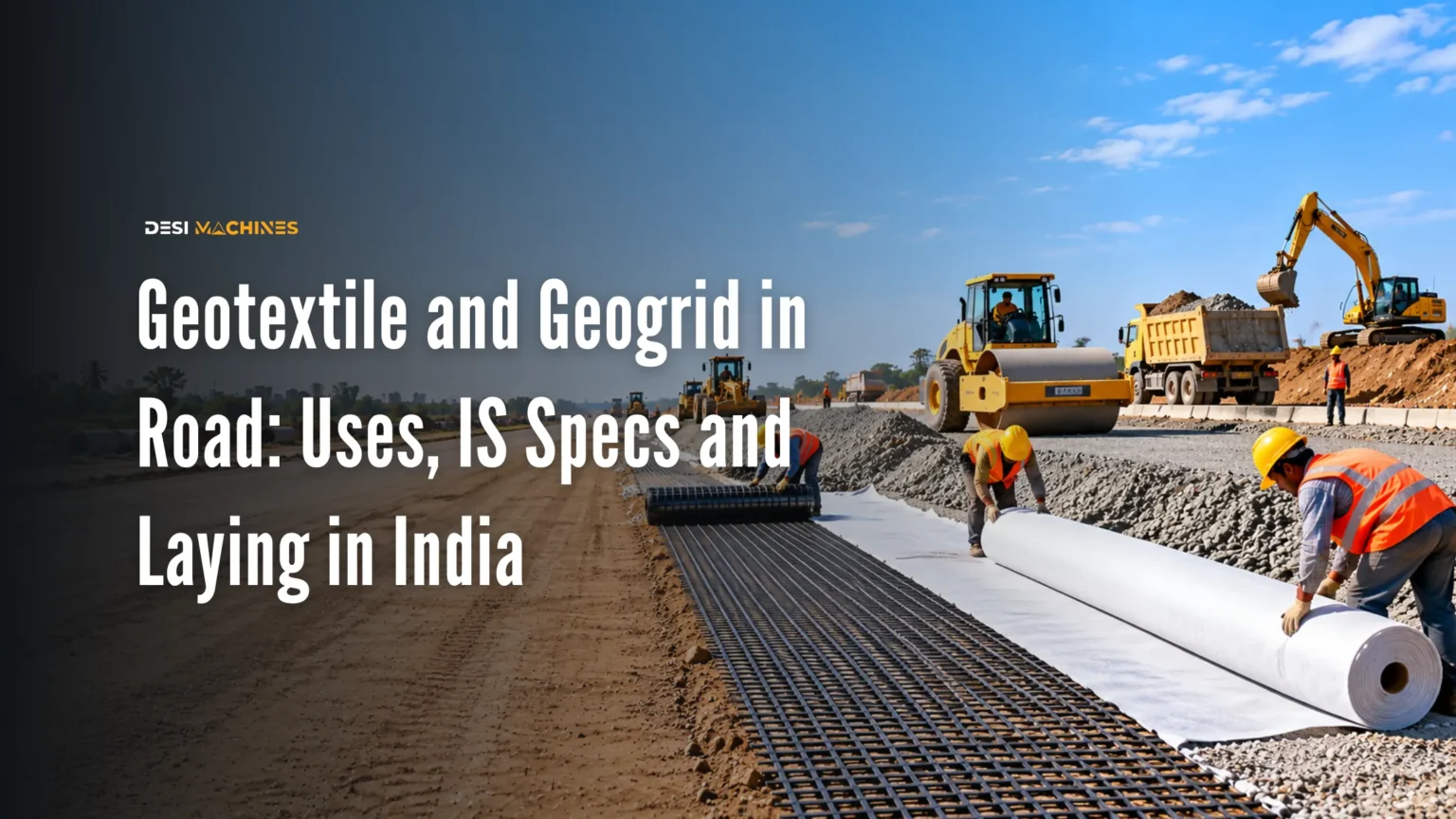
If you are choosing between a geotextile and a geogrid for a road job, put the strength figures aside for a moment, because the two do different work. A geotextile is a fabric laid as a continuous sheet, and its job is to keep soft subgrade soil and clean granular material from mixing into each other. A geogrid is an open mesh, and its job is to lock into aggregate through its holes and carry tension.
Geotextile road construction in India covers four separate jobs, and the Bureau of Indian Standards names all four: subgrade separation, subgrade stabilisation, base reinforcement, and overlay stress absorption. Which one you are buying for decides the specification you write, and it is the thing most quotations leave vague.
What a geotextile actually does under a road
Picture a village road built on black cotton soil after the monsoon. You lay 200 mm (20 cm) of granular sub-base over wet clay and start rolling. Two things go wrong at once. Fine clay pumps up into the gaps between your stones, and your sharp aggregate punches down into the soft clay. Within a season the clean layer you paid for is half mud, and the road starts to rut.
A separation geotextile sits at that boundary and stops both movements. Water still passes through it, which matters, because a layer that blocked water would trap pressure under the road. Soil particles do not pass. IS 16391 puts it plainly: the geotextile prevents fines from migrating into the base course, and prevents base course aggregate from penetrating into the subgrade.
The gain is measurable, and the standard quotes it. On a weak subgrade with a California Bearing Ratio of 2 percent, which is the soaked strength test Indian pavement design runs on, a geotextile extended the service life of a flexible pavement by a factor of 2.5 to 3.0 against the same road built without one. On a moderate subgrade at CBR 4.2 to 4.5 percent, the factor was 2.0 to 3.3. The layer also raised the pavement’s structural number by about 19 percent on the weak subgrade and 13 to 22 percent on the moderate one. A sheet costing a fraction of the aggregate above it is close to doubling the life of the road.
Where each one sits in the layer stack
Solid orange line: the separation geotextile, laid on the prepared subgrade before any granular material goes down. Green dashed line: a geogrid placed inside the base course, where its holes fill with aggregate. The two are not alternatives stacked at the same level. They are answers to different problems, and a job with very soft soil and heavy traffic sometimes uses both. The five layers themselves, and the thickness each one is normally laid at, are set out in our guide to road construction layers in India.
Geotextile or geogrid: which one your job needs
The mesh and the fabric fail at each other’s jobs. A geogrid cannot separate, because its holes are wide open and clay walks straight through. A geotextile reinforces only weakly, because a sheet must stretch a long way before it pulls tight, and by then the road has already rutted.
Geogrid language is worth learning before you read a quotation, because IS 17373 defines each term. The apertures are the open spaces between the ribs. The longitudinal ribs run the way the roll came off the machine and carry the grid’s stated tensile strength; the transverse ribs run across, holding them in position and forming the apertures. The junctions where the two cross hold the shape together. A uniaxial geogrid is strong in one direction only; a biaxial one is strong in both, and the standard is explicit that the two strengths need not be equal, so ask for both figures.
| Question | Separation geotextile | Geogrid |
|---|---|---|
| Physical form | Continuous fabric, woven or non-woven | Open mesh of ribs and junctions |
| Main job | Separation and filtration | Reinforcement through interlock |
| Where it goes | On the prepared subgrade, under the granular layer | Inside a granular layer, or in a reinforced soil wall |
| Does water pass? | Yes, that is part of the specification | Yes, the apertures are open |
| Stops clay pumping up? | Yes | No |
| Indian standard for it | IS 16391 : 2015 | IS 17373 : 2020 (walls and slopes) |
One caution on that last row. IS 17373 covers geogrids in reinforced soil walls and slopes, which on Indian highways means the near-vertical earth structure holding up a flyover approach. Its own scope says it is a material purchasing aid and must not be used as a design guideline. Base reinforcement of the pavement itself is named as an application in IS 16391, but the grid specification for it comes from the project drawings, not from IS 17373.
What IS 16391 asks for in a separation geotextile
IS 16391 splits separation geotextiles into Class 1 and Class 2, and then splits each class again by how far the fabric stretches before it breaks. Class 1 is the tougher grade, for rough site conditions and weaker soils. Class 2 is for gentler conditions. Within each class, a fabric that stretches less than 50 percent has to be stronger than one that stretches 50 percent or more, because a low-stretch fabric takes the whole load at once instead of yielding into it.
The figures below are the amended ones. Amendment No. 1 to IS 16391 was issued in December 2023 and it replaced the whole of Table 1. Most of the values carried over, but the CBR puncture strength requirement changed a great deal, and many circulating PDFs and supplier datasheets still quote the superseded 2015 numbers. In the 2015 table the Class 1 low-stretch puncture minimum read 400 N, the same figure as the trapezoidal tear row above it. The amendment raised it to 2,250 N. If a datasheet offers you 400 N of puncture resistance and calls it Class 1, it is quoting a specification that has not been current since 2023.
| Property | Class 1, stretch under 50% | Class 1, stretch 50% or more | Class 2, stretch under 50% | Class 2, stretch 50% or more |
|---|---|---|---|---|
| Grab strength, N, minimum | 1,100 | 700 | 800 | 500 |
| Sewn seam strength, N, minimum | 990 | 630 | 720 | 450 |
| Trapezoidal tear strength, N, minimum | 400 | 250 | 300 | 180 |
| CBR puncture strength, N, minimum | 2,250 | 1,400 | 1,700 | 1,000 |
| Burst strength, kPa, minimum | 2,700 | 1,300 | 2,100 | 950 |
| Permittivity, per second, minimum | 0.02 | 0.02 | 0.02 | 0.02 |
| Apparent opening size, mm, maximum | 0.60 | 0.60 | 0.60 | 0.60 |
| Ultraviolet stability at 500 hours, percent strength retained, minimum | 70 | 70 | 70 | 70 |
Three of those rows need translating. Grab strength is what it sounds like: the fabric is gripped and pulled until it tears, and the figure is the force that took. Permittivity is how readily water passes through the sheet, so a minimum means the fabric must not be too tight to drain. Apparent opening size is the largest soil particle that can get through, which is why it is a maximum and not a minimum, and it is the row people misread most often.
There is a trap in how these numbers are certified. Every value except apparent opening size is a minimum average roll value, measured in the weaker of the fabric’s two principal directions. The datasheet figure is therefore a floor any tested roll must reach, not typical performance. Ask the supplier for the test certificate against IS 16391 and check which edition it names.
Two further requirements are easy to overlook. Resistance to installation damage is set at 95, 93 and 90 percent strength retained for clayey sand, well-graded sand and poorly-graded gravel fill, so a coarser, sharper fill is allowed to damage the fabric more. Roll width is 2.0 m or 5.0 m unless buyer and seller agree otherwise, and roll length 50 m or 100 m. Width matters on a narrow road: a 5.0 m roll on a 3.75 m carriageway wastes fabric on every run.
The three geogrid types in IS 17373
IS 17373 sorts geogrids into three types by tensile strength and aperture size. All three are polyester. Flexible geogrids, the standard notes, are woven, knitted or bonded ribs of polyester or polyvinyl alcohol yarn, and they are always coated.
| Type | Construction | Tensile strength, machine direction | Aperture size |
|---|---|---|---|
| Type 1 | Polyester knitted or woven | Up to 400 kN/m | 10 to 50 mm, both directions |
| Type 2 | Polyester bonded | Up to 200 kN/m | 50 to 500 mm along, 10 to 100 mm across |
| Type 3 | Polyester bonded | Up to 1,300 kN/m | 50 to 1,000 mm along, 50 to 200 mm across |
A figure on a geogrid datasheet is not the strength you design with. The standard requires the ultimate short-term strength to be cut down by three reduction factors first: installation damage, long-term durability against chemicals and micro-organisms, and creep, which is the slow stretching a polymer does under a load held for years. A factor of safety comes on top. What is left is the long-term design strength, and it is well below the headline number. Those factors are agreed for the specific site, so a grid quoted purely on ultimate strength has not been priced against your soil.
Up to 70 degrees from horizontal the structure is a reinforced soil slope; steeper than that and it is a reinforced soil wall. The reason the technique spread through Indian highway work is land, because a reinforced structure stands far steeper than an earth embankment and so needs less right of way and less fill.
Jute and coir geotextiles: India’s own materials
India makes more jute and coir than anywhere else, and both have their own Indian standard as road geotextiles. They are not substitutes for polymer fabric on a national highway, but they are a real answer on low-traffic rural roads, and easier to get in the districts where those roads are built.
IS 14715 Part 1 covers woven and non-woven jute geotextile for strengthening road subgrades, and is specific that it suits flexible pavements on weak subgrades carrying relatively low traffic. Which grade you need follows from the subgrade’s CBR, the grain size and permeability of the soil, the traffic as equivalent single axle loads, and the rutting you will accept.
| Property | Woven jute (IS 14715 Pt 1) | Non-woven jute (IS 14715 Pt 1) | Coir bhoovastra (IS 15869) |
|---|---|---|---|
| Mass per unit area | 724 g/m² minimum, at 20% moisture regain | 500 g/m² | 400, 700 or 900 g/m² by grade |
| Thickness | 1.85 mm at 2 kPa | 4 mm at 2 kPa | 6.5 mm minimum at 20 kPa |
| Tensile strength | 25 x 25 kN/m minimum, along x across | 4 kN/m along, 5 kN/m across | Set per grade, dry and wet |
| Elongation at break | 10% x 10% | 5% along, 6% across | Not specified in this table |
| Burst strength | 3,500 kPa minimum | 1,750 kPa minimum | Not specified in this table |
| Apparent opening size | 150 to 400 micron | 265 micron | Open weave by construction |
| Width | Not less than 100 cm | 150 cm | 100 cm minimum or as required |
The 25 kN/m figure for woven jute comes with its evidence attached, which is rare in a specification. The standard’s foreword says it was settled after roughly 50 case studies and a review of practice abroad, and that woven jute at 25 kN/m in both directions meets the strength requirement for most soil types and traffic loads Indian rural roads see.
Coir works differently again. IS 15869 covers open weave coir bhoovastra, made from coconut husk fibre by natural retting or by machine, in three grades by mass: 400 g/m², 700 g/m² and 900 g/m². Its dry and wet strengths vary by grade, and the standard has since been amended with several of those values revised, so ask for a certificate against the current edition rather than an old table. Coir’s job is holding soil against erosion while vegetation takes root. It slows runoff by forming small check dams across the slope, holds sown seed in place, and cuts wind speed at the soil surface. On embankment faces and canal banks, that is the work.
Both jute and coir rot, and on a rural road that is the design intent rather than a defect. The fabric separates and reinforces through the early years while the subgrade consolidates under traffic, and by the time the fibre has gone the soil beneath has improved. Do not specify either where the fabric must keep working for the life of the pavement.
How geotextile is laid on a road
IS 14715 sets out an installation method for jute geotextile, and the sequence is close enough to general practice to follow on any fabric. The mistakes it guards against are the ones that show up two monsoons later.
First the subgrade is cut to level, cleared of roots and rubbish, and compacted at its optimum moisture content, which is the water content at which a given compaction effort gives the highest density. Vegetation is pulled out rather than buried. Then the fabric is unrolled so it drapes and touches the soil at every point, because a sheet bridging a hollow carries load in tension instead of spreading it. It is pinned with U-shaped staples of 11 gauge wire at 750 mm spacing, and any overlap between rolls is 150 mm. The standard advises avoiding overlaps where you can, which is the practical argument for matching roll width to carriageway width. A thin cushion of local sand, no more than 75 mm thick, may then go over the fabric to stop sharp aggregate puncturing it under the roller. No traffic runs directly on the fabric.
Getting the subgrade right before the fabric goes down is most of the job: a motor grader to cut the level, a soil compactor to reach the density the design assumes. Fabric laid on a subgrade that was never properly compacted will not save the road, and every one of these standards is written assuming that step was done.
What geotextile costs in India, and how it is quoted
We do not list geotextiles or geogrids, so there is no price on this page, and a figure quoted without knowing your state and quantity would be no use to you. Knowing how the quotation is built is what lets you compare two of them.
Geotextile is sold by area, normally per square metre, and the rate moves with three things: mass per unit area in grams per square metre, the strength class it certifies to, and the polymer or fibre. A Class 1 polymer fabric costs more than a Class 2 of the same mass, because it must meet higher minimums on every row of Table 2. Jute and coir are quoted the same way, per square metre against a grade.
Four points decide whether a quotation is comparable:
- Ask which standard and which edition. A price against the 2015 CBR puncture figure is not a price for the same product as one against the December 2023 amendment.
- Buy area, not roll length. Add roughly 5 to 10 percent to your carriageway area for the 150 mm overlaps and trimming, and check the roll width suits the road.
- Ask whether laying is included. Staples, sand cushion and labour are sometimes in the rate and sometimes not.
- Ask for the test certificate. The row hardest to judge by eye, apparent opening size, is the one that decides whether the fabric separates at all.
Set the fabric cost against the layer it protects rather than the whole road. Our guide to road construction cost per km in India gives the rates by road class that the granular layers sit inside, and the construction cost estimating method works the same way for a building.
Where this fits in the rest of the road
Geosynthetics sit at the bottom of the pavement, so they interact with everything above, and the road construction guide covers the sequence as a whole. On a concrete road the separation question still applies under the sub-base: CC road construction and dry lean concrete set out that build. For a bituminous road, the binder grade you lay on top is a separate decision, covered in bitumen grades for Indian conditions.
For the machines, compare live models and dealer availability on the compactor category and the motor grader category. Subgrade cutting on a small rural job is often done with a backhoe or an excavator rather than a grader.
The full texts of the standards quoted here are public. IS 16391 : 2015 with its December 2023 amendment is the one to read before writing any separation geotextile specification, and IS 14715 Part 1 : 2016 carries the jute tables and the installation method.
All specification figures on this page are quoted from the Indian Standards named beside them, including Amendment No. 1 of December 2023 to IS 16391. Standards are revised and amended, so confirm the current edition and the grade actually supplied against the manufacturer’s test certificate before you specify or accept material. Site conditions, subgrade strength and traffic vary by project, and the choice of geosynthetic is a design decision for the project engineer. DesiMachines is not liable for decisions taken on the basis of information that may have changed after publication.
Machines, tenders and news for this industry: Road Construction