
 Excavator
294 models
Excavator
294 models  Backhoe Loader
51 models
Backhoe Loader
51 models  Crane
68 models
Crane
68 models  Concrete Mixer
79 models
Concrete Mixer
79 models  Wheel Loader
54 models
Wheel Loader
54 models  Compactor / Roller
45 models
Compactor / Roller
45 models  Motor Grader
42 models
Motor Grader
42 models  Concrete Pump
66 models
Concrete Pump
66 models  Skid Steer Loader
11 models
Skid Steer Loader
11 models  Telehandler
13 models
Telehandler
13 models 


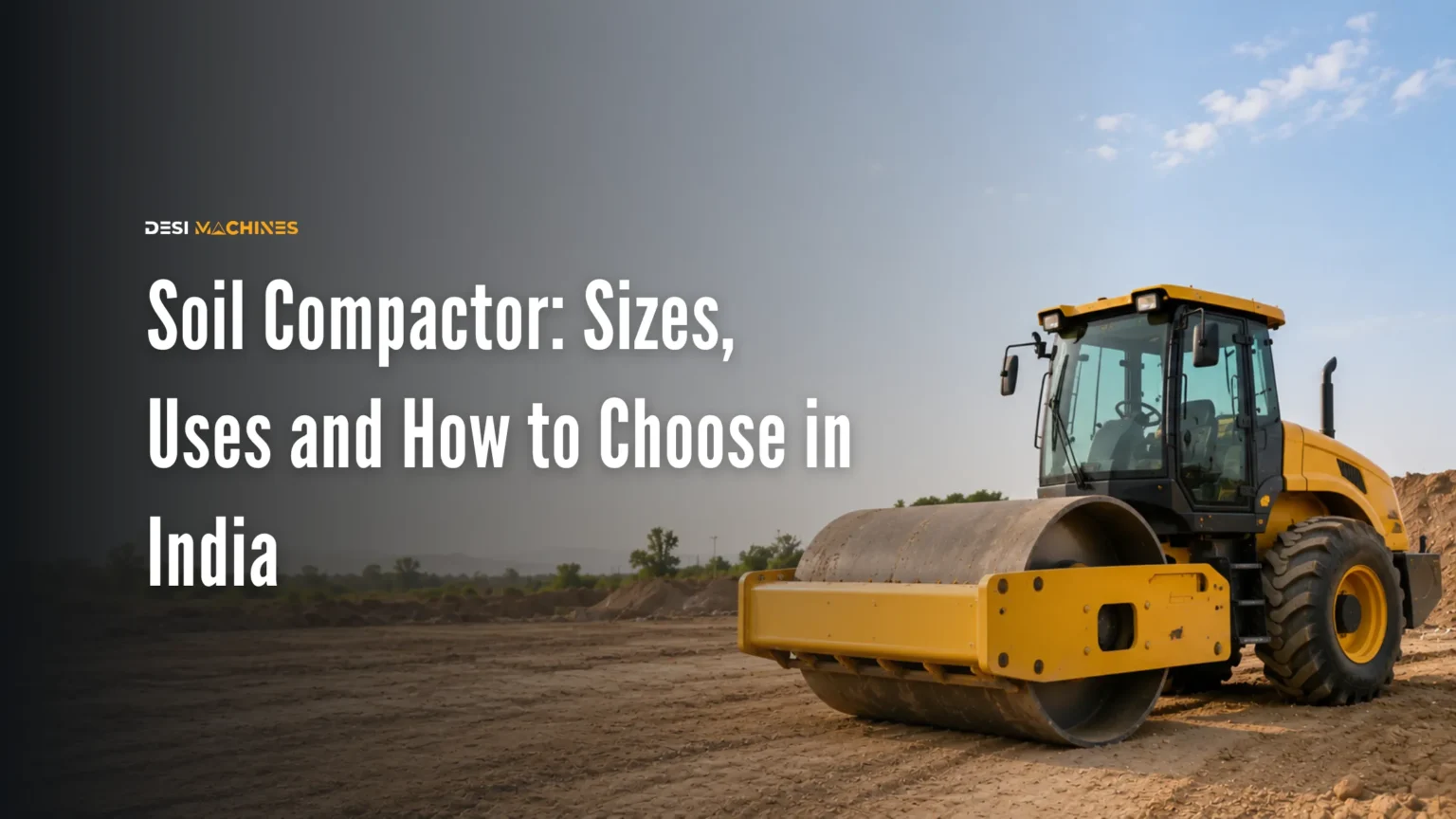
A soil compactor is a single-drum vibratory roller used to press loose earth, gravel and stone into a hard, settled layer before anything is built on top of it. It has one wide steel drum at the front that shakes as it rolls, and two rubber tyres at the back that drive the machine. On Indian sites people simply call it a roller, a mitti roller or a soil compactor, and it is the machine you see working on almost every road, highway embankment and building foundation in the country.
This guide explains what the machine actually does, how it differs from the two-drum tandem roller that often stands next to it, what the sizes mean, and how to pick one for your own work. It is written for someone buying or hiring a roller for the first time.
What is a soil compactor machine?
A soil compactor is a self-propelled roller with one vibrating steel drum and two driven rear tyres. The drum does the compaction. The tyres give the machine grip (traction) so it can climb a loose embankment without the drum spinning uselessly.
Inside the drum sits a heavy weight mounted off-centre on a shaft. When that shaft spins fast, the weight throws the drum up and down hundreds of times a minute. That shaking is what separates a soil compactor from a plain dead-weight roller: the vibration shakes soil grains past each other so they lock together tightly, instead of just squashing the top surface. If you want the physics in detail, the vibratory roller guide covers amplitude and frequency properly.
The class is also called a single drum roller, and in the catalogue it sits as its own family alongside tandem rollers and pneumatic tyred rollers. Machines sold in India for this work run from roughly 9,700 kg (9.7 tonnes) up to 22,000 kg (22 tonnes).
How does a soil compactor work?
The machine works in passes. You drive forward over a spread layer of soil, then reverse over the same strip, then move sideways by about half a drum width and repeat. Each run over the same ground is one pass.
Two forces do the work together. The first is static weight — the dead load of the drum pressing down. That is measured as static linear load in kilograms per centimetre of drum width. On an 11-tonne machine like the L&T 1190 it is about 30.5 kg/cm. The second is centrifugal force — the extra downward punch created by the spinning weight, quoted in kilonewtons (kN). The same machine produces 258/169 kN at its high and low settings.
Most machines give you two vibration settings. High amplitude means the drum lifts higher and hits harder, which pushes the compaction deeper — good for thick layers of soil. Low amplitude is a gentler, faster shake for thin layers and finishing. On the L&T 1190 those settings are 1.8 mm and 0.9 mm of drum movement at 31 and 34 Hz. Use high amplitude on a thin layer and you will loosen what you already compacted, so it pays to learn which lever does what.
Soil compactor vs tandem roller: which one do you need?
A soil compactor has one steel drum and rubber rear tyres. A tandem roller has two steel drums, one at each end. That single difference changes what each machine is good for.
The soil compactor’s rear tyres let it grip and climb loose material, and its wide drum covers ground fast, so it belongs on earthwork: embankments, subgrade and stone layers. A tandem roller rolls on steel at both ends, which gives a flat, sealed finish but very little grip on loose soil, so it belongs on the final bitumen surface. Contractors who own both use the soil compactor to build the road up and the tandem roller to close it off. The guide to tandem roller sizes, uses and prices covers that second machine on its own, including the two size classes it is sold in.
| Soil compactor (single drum) | Tandem roller | |
|---|---|---|
| Drums | One steel drum, two rubber rear tyres | Two steel drums |
| Typical operating weight | 9,700–22,000 kg (9.7–22 tonnes) | 2,800–10,060 kg (2.8–10 tonnes) |
| Typical drum width | 2,100–2,150 mm | 1,000–1,750 mm |
| Main job | Soil, embankment, gravel and stone layers | Bitumen surfacing and finishing |
| Grip on loose ground | Good — driven rubber tyres | Poor — steel on both ends |
| Indicative price band | ₹28.5–42.0 Lakh | ₹14.3–46.2 Lakh |
Two examples make the price gap clear. The CASE 450NX, a small 2,900 kg (2.9 tonne) tandem roller with a 1,000 mm drum, is listed around ₹14.3–18.9 Lakh (indicative, as of August 2026). A full-size 9,200 kg (9.2 tonne) tandem such as the L&T 990HFi is around ₹33.3–38.9 Lakh. If your work is small patch repairs and footpaths rather than earthwork, a mini roller is the cheaper answer, and for trench bottoms and tight corners a plate compactor does the job for a fraction of the money.
What size soil compactor do I need?
Almost the entire Indian market sits in one size band: 10 to 12 tonnes. That is not an accident. An 11-tonne machine with a roughly 2,100 mm drum compacts a standard 200–300 mm soil layer in a sensible number of passes and still fits on a normal trailer, so it became the default for road and highway work.
Go lighter, around 9.7 tonnes, and you have a machine that is easier to move between small sites but needs more passes on thick layers. Go heavier, to 13–14 tonnes, and you gain depth on deep embankment fills. The 22-tonne class is a different animal altogether, meant for large dam, mining and port fills.
These are the single-drum machines listed in India as of August 2026, with figures taken from the current specification sheets.
| Model | Operating weight | Drum width | Engine power | Indicative price (Aug 2026) |
|---|---|---|---|---|
| Dynapac CA245 CEV-V | 9,700 kg (9.7 t) | 2,130 mm | 74.5 HP (55.5 kW) | ₹32.3–37.8 Lakh |
| Escorts EC 5250 | 10,350 kg (10.4 t) | 2,130 mm | 110 HP (82 kW) | ₹28.5–33.6 Lakh |
| ACE ASD 115 | 11,000 kg (11 t) | 2,130 mm | 112 HP (83.5 kW) | ₹30.4–35.7 Lakh |
| L&T 1190 | 11,050 kg (11.1 t) | 2,100 mm | 102 HP (76 kW) | ₹28.5–33.6 Lakh |
| CASE 1107NX | 11,100 kg (11.1 t) | 2,150 mm | 101 HP (74 kW) | ₹32.3–37.8 Lakh |
| Ammann ARS 110.2 | 11,100 kg (11.1 t) | 2,130 mm | 101 HP (74 kW) | Price on request |
| Volvo SD110 | 11,150 kg (11.2 t) | 2,134 mm | 99.2 HP (74 kW) | ₹36.1–42.0 Lakh |
| HAMM HC 119i | 11,200 kg (11.2 t) | 2,140 mm | 99.2 HP (74 kW) | ₹33.3–38.9 Lakh |
| XCMG XS115H | 11,500 kg (11.5 t) | 2,130 mm | 133 HP (99 kW) | ₹35.2–41.0 Lakh |
| JCB VM117 | 11,525 kg (11.5 t) | 2,100 mm | 74 HP (55 kW) | ₹34.2–39.9 Lakh |
| HAMM HC 139iD | 13,160 kg (13.2 t) | 2,140 mm | 128 HP (95.6 kW) | ₹35.2–41.0 Lakh |
| Dynapac CA405D CEV-V | 13,960 kg (14 t) | 2,130 mm | 121 HP (90 kW) | ₹32.3–37.8 Lakh |
| SANY SSR220C-8H | 22,000 kg (22 t) | 2,130 mm | 197 HP (147 kW) | Price on request |
Notice that engine power does not track weight closely. The JCB VM117 carries 11,525 kg on 74 HP while the XCMG XS115H carries a similar 11,500 kg on 133 HP. Engine size mostly decides how well the machine climbs a slope and how fast it travels between strips, not how hard it compacts. The published gradeability and speed figures put single drum machines at 26 to 53% climbing ability and 10 to 13 km/h travel speed. Compaction comes from drum weight and vibration, so compare static linear load and centrifugal force when you are judging compaction ability, and engine power when your site has steep haul roads.
For a size that matches your own layer and site, get a machine suggestion for your job.
Smooth drum or padfoot: which drum suits your soil?
The drum comes in two surfaces and the choice depends entirely on what your soil is made of.
A smooth drum is a plain steel cylinder. It works from the top down and suits granular material: sand, gravel, crushed stone, and the stone layers of a road. This is what most soil compactors ship with.
A padfoot drum has rectangular steel pads welded around it, so the load is concentrated on small patches instead of the whole surface. That pressure punches into sticky clay and breaks up lumps, which a smooth drum simply rides over. For clay embankments and black cotton soil, padfoot is the right tool. The sheepsfoot roller guide explains that kneading action in more detail.
Some manufacturers sell a padfoot variant of the same base machine, and some offer a bolt-on padfoot shell that wraps over a smooth drum. Which option exists for a given model varies by manufacturer, so confirm the exact variant with our team before ordering. If you are unsure which soil you are dealing with, the soil compaction guide walks through matching the method to the material.
Where is a soil compactor used on an Indian road job?
On a highway or village road contract the soil compactor is the machine that builds the road up, layer by layer, long before any bitumen appears.
It starts on the subgrade, the natural ground levelled and compacted to take everything above it. Then it compacts the granular sub-base, the crushed-stone layer spread over the subgrade. Then the wet mix layer of stone and stone dust above that. On highway and canal projects it also compacts the embankment, the raised earth bank the road sits on, in lifts of 200–300 mm at a time.
Away from roads the same machine compacts building foundation beds, industrial floor sub-bases, and the backfill around large structures. Under PMGSY rural road work and NHAI highway contracts, a 10–12 tonne single drum roller is the standard machine on site, which is exactly why that size band dominates the market. It usually works behind a motor grader that spreads and levels each layer first.
How many passes does a soil compactor need?
Between four and eight passes over the same strip is the normal working range for a 10–12 tonne machine on a 200–300 mm layer. The honest answer, though, is that nobody can tell you the number from a desk.
Passes depend on the soil type, how wet it is, how thick the layer is spread and how heavy the roller is. Clay takes more passes than sand. Soil that is too dry will not bind however long you roll it, and soil that is too wet turns into a pumping, spongy mess under the drum. That water content is the single biggest thing site engineers get wrong.
The reliable method is to run a short test strip at the start of the job. Compact 20–30 metres, check the density after four passes, again after six, again after eight, and see where the readings stop improving. That pass count becomes the rule for the rest of the layer. Rolling past that point burns diesel and can loosen what you already achieved. On a contract job the density is confirmed by a field test rather than by eye, so build that check into the programme.
What does a soil compactor cost in India?
A new 10–12 tonne single drum soil compactor runs from roughly ₹28.5 Lakh to ₹42.0 Lakh (indicative, as of August 2026), depending on brand, engine and drum specification. The lighter and heavier classes sit outside that band, and the largest 22-tonne machines are quoted on request.
Within that range the Indian brands sit at the lower end and the European brands at the upper. The Escorts EC 5250 and L&T 1190 are around ₹28.5–33.6 Lakh, the SANY SSR110C-10 PRO around ₹29.5–34.7 Lakh, and the Volvo SD110 around ₹36.1–42.0 Lakh.
The purchase price is only part of the cost. Diesel is the big running expense, and these machines carry fuel tanks of roughly 196 to 315 litres depending on model, which tells you something about how long they are expected to run between fills. Add operator wages, drum and scraper wear, and transport between sites — a 22-tonne machine needs a proper low-bed trailer, which the 11-tonne class often does not. The road roller dimensions guide sets out the length, width, height and ground clearance of every machine listed, which is what the transporter will ask for. If you are buying on finance, work out the monthly outgo before you commit; equipment loan and EMI options are worth comparing across lenders. Buyers weighing a second-hand machine should read the used equipment buying guide first, because drum condition and vibration bearing health are expensive things to get wrong.
Ready to shortlist? Compare live soil compactor models and prices and speak to our team.
What to check before you buy your first soil compactor
Start with the layer you actually compact. If it is 200–300 mm of soil on road or building work, the 10–12 tonne class is your machine and everything else is a distraction.
Then check the drum surface against your soil: smooth for sand, gravel and stone, padfoot for clay. Compare static linear load and centrifugal force between models rather than only engine HP, because those two numbers describe compaction and HP describes climbing and travel. Ask what amplitude settings the machine offers, since a single fixed setting limits you to one layer thickness.
Look hard at dealer support and spare parts in your district. A roller sitting idle for a fortnight waiting for a vibration bearing costs far more than the price difference between two brands. Ask what the service interval is and what a routine service costs. Finally, check the emission norm on the machine you are quoted, as CEV Stage V compliance affects what you can legally run on public contracts; the BS-CEV emission norms guide explains where the rules stand.
If you are still deciding between machine types, the types of compactors guide lays the whole family side by side, and static vs vibratory rollers covers the other axis of the choice. Browse the full range of compactors and rollers when you are ready to compare live listings.
If the machine is needed for one job rather than a fleet, the guide to road roller rental in India sets out hire rates by the hour and the day and what the rate should cover. One thing you will not find on these machines is a water tank: none of the 21 single drum soil compactors we list publishes one, because water helps nothing when the drum is on soil rather than asphalt. The road roller fuel and water capacity guide sets out the diesel tank sizes for the class.
For the mechanical side of the same machine, the guide to road roller parts and components covers the drum shell, the eccentric shaft sealed inside the drum and the hydrostatic drive that moves it.
Once you have settled on a pass count, road roller productivity and output per hour turns it into the square metres you can finish in a shift.
Soil compactors start at 74 HP and the working class sits at 99 to 133 HP; the full comparison, including how engine power lines up against centrifugal force, is in the guide to road roller engine power by class.
The rear tyres on a soil compactor are one of the few specs that never change between brands. See road roller tyre size for the ply ratings and what the 23.1-26 code actually means.
Prices, specifications and features are indicative, vary by variant, location and date, and should always be confirmed with the official OEM or authorised dealer before any purchase decision. DesiMachines is not liable for decisions taken on the basis of information that may have changed after publication. Figures are taken from our listings at the time of writing.