
 Excavator
294 models
Excavator
294 models  Backhoe Loader
51 models
Backhoe Loader
51 models  Crane
68 models
Crane
68 models  Concrete Mixer
79 models
Concrete Mixer
79 models  Wheel Loader
54 models
Wheel Loader
54 models  Compactor / Roller
45 models
Compactor / Roller
45 models  Motor Grader
42 models
Motor Grader
42 models  Dozer
41 models
Dozer
41 models  Concrete Pump
66 models
Concrete Pump
66 models  Skid Steer Loader
11 models
Skid Steer Loader
11 models  Telehandler
13 models
Telehandler
13 models 


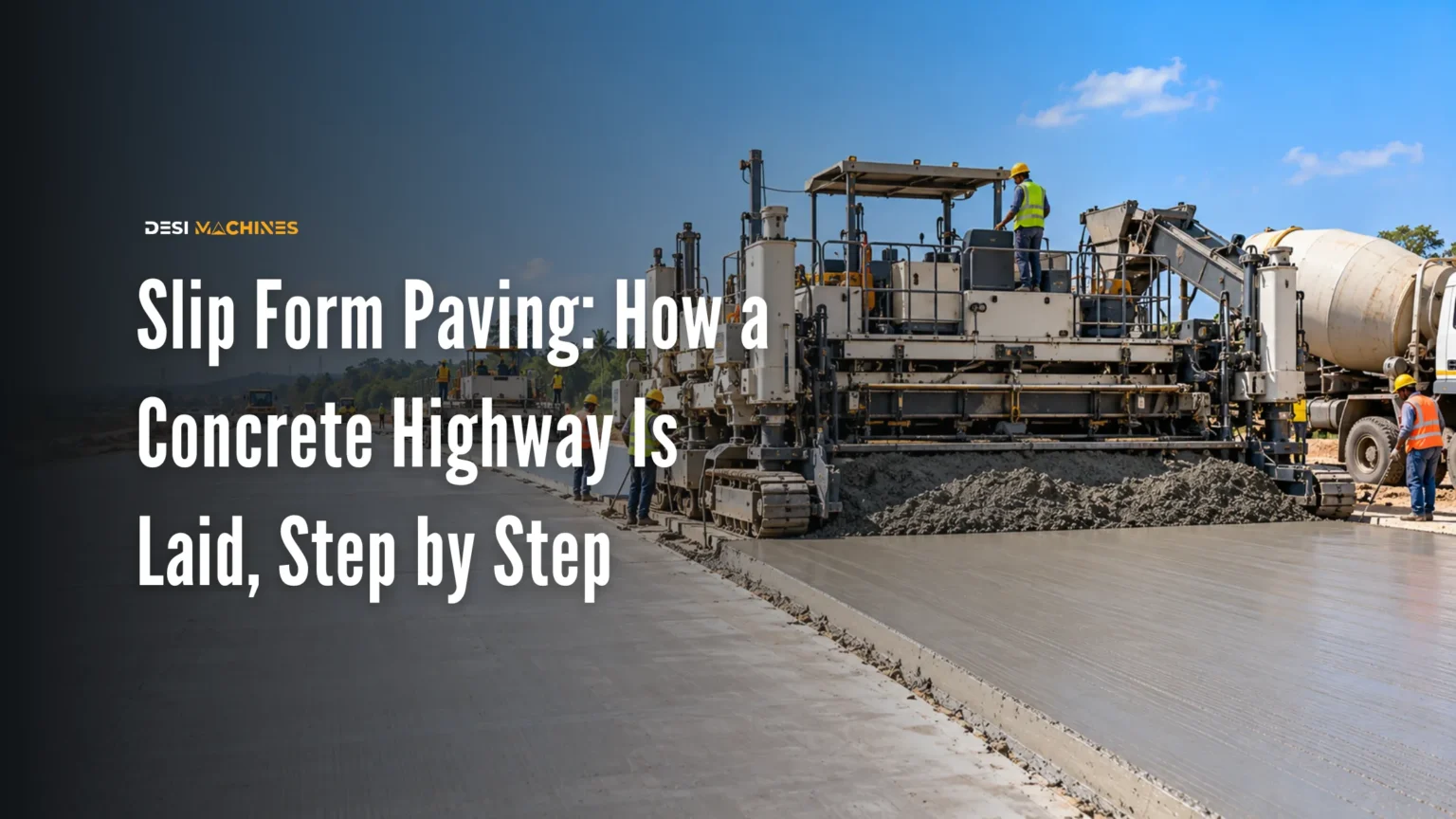
A slip form paver lays a concrete highway slab in one continuous pass, moving at not less than 1 metre a minute and laying at least 500 metres in a working day. It spreads, vibrates, shapes and finishes the concrete as it travels, with no fixed side forms at all, and it holds its line and level by reading two tensioned guide wires running beside the road.
That is slip form paving: moulds slide along with the machine and leave the slab standing on its own behind it. It is how Indian national highways and expressways get their concrete surface. The figures here come from the Ministry of Road Transport and Highways (MoRTH) Specifications for Road and Bridge Works, Fifth Revision, Section 602 on cement concrete pavement. A contract can name a later edition or set tighter numbers, and where it does, the contract wins.
What is slip form paving, and how is it different from fixed form paving?
Slip form paving builds the slab with side moulds fixed to the paver itself. Fixed form paving builds it between steel side forms that are staked to the ground first, with the paving machine running on rails along the top of them.
A fixed form crew sets at least 300 m of forms ahead of the paver and strips them after every pour. A slip form crew sets guide wires instead, and its concrete has to be stiff, because nothing holds the edge once the machine has passed. MoRTH puts a reasonable paving slump at 25 mm, plus or minus 15 mm. Slump is how far a cone of fresh concrete sags when the mould is lifted, so a low number means a stiff mix.
| Slip form paver | Fixed form paver | Hand-laid between side forms | |
|---|---|---|---|
| What holds the edge | Moulds on the machine, then the concrete itself | Steel side forms staked to the ground | Steel or timber side forms |
| How level is controlled | Sensors reading guide wires on both sides | Rails on top of the forms | Screed board on the forms |
| Set-up ahead of paving | Stakes and guide wire, approved 12 hours before | At least 300 m of forms, or one day’s run | Forms for the day’s panels |
| Where it fits | Highways, expressways, long continuous runs | Medium lengths, urban roads, irregular widths | Village roads, small areas the machines cannot reach |
| Trial length before main work | At least 100 m, over two days | At least 100 m, over two days | At least 50 m, over two days |
Source: MoRTH Specifications for Road and Bridge Works (Fifth Revision), clauses 602.3.4, 602.8, 602.9 and 602.11.
The slab itself is PQC, pavement quality concrete, a design mix judged on flexural strength (resistance to bending) of at least 4.5 MPa. A village CC road is a lighter, hand-laid build, and the CC road construction guide covers that version.
What does a slip form paver do as it moves forward?
A slip form paver is a tracked machine, on two or four crawler tracks, carrying a row of tools across its full width. Read from front to back, they do five jobs in order.
First, a strike-off plate or a screw auger (a large spiral) pushes the concrete dumped in front sideways and cuts it to height. That pile must always stand higher than the finished slab. Second, internal vibrators, a row of pokers hanging down into the concrete, shake the air out of it. MoRTH asks for 8,000 to 10,000 impulses a minute under load, with the vibrators no more than 600 mm apart and their output adjustable.
Third, a conforming plate or a set of oscillating finishing beams presses the vibrated concrete into the shape of the slab, edges and crossfall included. Fourth, on most highway pavers, a dowel bar inserter pushes the steel bars for the transverse joints down into the fresh concrete at set intervals. A dowel bar is a smooth bar that crosses a joint so one panel cannot step up or down against the next. Last, a finishing float smooths the top.
MoRTH also wants the paver heavy enough to keep its tracks driving through a wall of stiff concrete, and sets a floor on vibrator power that the table further down works out. Slip form pavers are bought or hired by large highway contractors as part of a full train; the machines that feed one are ordinary ones, covered below.
How is a concrete road laid with a slip form paver, step by step?
The work runs in a fixed order on a highway concrete job, and a cracked or bumpy slab usually traces back to one step that slipped.
The slip form paving train, front to back
Source: MoRTH Specifications for Road and Bridge Works (Fifth Revision), clauses 602.6, 602.9.3 to 602.9.12.
- Prepare the base. The PQC goes on a cured layer of dry lean concrete. Any crack in that layer wider than 10 mm is repaired first, the surface is blown clean with compressed air, and a separation membrane of 125 micron PVC sheet goes down, overlapped at least 300 mm. The dry lean concrete guide explains how that layer is built.
- Set the guide wires. Stakes and wire go up along both sides of the slab, and the Engineer approves their line and level at least 12 hours before paving. The next section covers how.
- Lay a trial length. Before the main work starts, the contractor builds at least 100 m of full-width slab over two days, away from the carriageway, with the same plant and paving rate planned for the job.
- Mix and haul. The batching plant weighs every material by load cell, within 1% for cement, water and admixture and 2% for aggregate. From the moment water hits the mix to the end of texturing, the clock allows 120 minutes below 25°C and 90 minutes between 25°C and 30°C. Concrete that runs over is rejected.
- Place and pave. The side placer drops concrete across the full width in front of the paver, and the paver moves without stops and starts, because every stop leaves a bump.
- Protect the slab. Loaded trucks do not run on a finished slab until 28 days after it was placed. If the second lane is paved separately, its paver may only run on the first lane once that lane has cured for at least 14 days, on rubber pads that protect the texture.
Weather sets the hours of work. No concreting is allowed when the concrete arriving at the paver is above 30°C, or when the air is above 35°C, and none when the concrete is below 5°C and the temperature is still falling. On a summer job in Rajasthan or Telangana that often pushes paving into the night. Chilled water or ice flakes may be used to cool the mix.
How do the guide wire and sensors keep a slip form paver on level?
A slip form paver has no rails to follow, so it carries electronic sensors that touch or read a tight wire on each side of the road. Sensors at the four corners of the paver hold the level of the shaping plate and finishing beams, and at least one more set holds the steering line. If the wire is right, the slab is right. If the wire sags, the slab sags with it.
The stakes go in 5 to 6 m apart on straight road and no more than 3 m apart on curves. The wire runs at a constant height above the finished slab edge, within 3 mm up or down, and one wire stays at a fixed side distance from the edge, within 10 mm.
The tension test is simple enough to do by hand. Hang a 500 gram weight at the midpoint between two stakes: the wire must not dip more than 20 mm. The wire must be up and tensioned at least 2 hours before the paver reaches that stretch. Once set, the stakes stay untouched from 12 hours before concreting until the curing compound is on. A truck clipping one stake in the night will show up as a dip in the morning.
So when a paver is sold or hired “with electronic sensor”, this is what it means: height and line sensors reading a string line, so the machine copies the line the survey crew set.
How much concrete does a slip form paver need per hour?
Multiply the slab width by its thickness by the paving speed. At MoRTH’s minimum speed of 1.0 m a minute, a 7.0 m wide slab 300 mm thick eats 2.1 cubic metres of concrete every minute, which is 126 cubic metres an hour. That number decides the size of everything behind the paver.
Slab thickness comes from the pavement design for that road under IRC:58, the Indian Roads Congress guideline for rigid pavement design, so the rows below are worked examples, not recommended thicknesses.
| Slab (7.0 m wide) | Concrete per hour at 1.0 m/min | Batching plant, at least (+25%) | 8 m³ mixer loads per hour | Concrete for a 500 m day | Minimum vibrator power |
|---|---|---|---|---|---|
| 250 mm thick | 105 m³ | about 131 m³/hr | about 13 | 875 m³ | about 14.6 kW |
| 300 mm thick | 126 m³ | about 158 m³/hr | about 16 | 1,050 m³ | 17.5 kW |
| 350 mm thick | 147 m³ | about 184 m³/hr | about 18 | 1,225 m³ | about 20.4 kW |
Worked from MoRTH clauses 602.9.1 (1.0 m/min, 500 m a day), 602.9.3.1 (plant at least 25% above paving capacity) and 602.9.5.3 (2.5 kW per metre width per 300 mm depth).
A 500 m day at 1 m a minute is 500 minutes, a little over eight hours of paving with no stops. And the number of trucks you need depends on the round trip as much as the drum size. If a loaded mixer takes 60 minutes to go from plant to paver and back, keeping a 300 mm slab fed at 16 loads an hour needs about 16 trucks on the road. Halve the trip to 30 minutes and about 8 will do, which is why the batching plant is set up close to the paving front. The transit mixer productivity guide shows how to work out trips per hour for a given lead.
Which machines make up a slip form paving train?
Most of the machines on the job are ordinary ones a contractor can buy or hire anywhere. MoRTH wants the whole set sized for at least 500 m a day, with the make and capacity of each machine approved before work begins.
| Machine | Job in the paving train | Example on DesiMachines |
|---|---|---|
| Wheel loader | Feeds sand and graded stone into the batching plant bins | JCB 455-5N, L&T 9020 |
| Batching and mixing plant | At least four aggregate bins, weighing by load cell, computer control cabin | Not a listed class |
| Transit mixer (or tipper) | Hauls mixed PQC to the paver without segregation | Tata Signa 2830.K (8 m³ drum), Ashok Leyland AVTR 3825 (9 to 10 m³), Mahindra Blazo X 28 (6 or 7 m³) |
| Slip form paver | Spreads, vibrates, shapes and inserts dowels in one pass | Not a listed class |
| Tandem roller (layer below) | Compacts the DLC the slab sits on | Volvo DD90, HAMM HD 99i VV |
Drum capacities as listed in Oct 2026; check the variant with the dealer.
MoRTH allows tipping trucks or transit mixers for the haul. A tipper cannot keep the mix turning, so it suits a short lead; a transit mixer buys time on a longer one. Browse transit mixer models and prices or wheel loader models for the plant end, and the road construction equipment guide maps every machine to the layer it builds.
How is a slip formed slab textured and cured?
Texturing gives a concrete road its grip. While the concrete is still plastic, a beam of steel tines is dragged across it, cutting grooves 3 mm wide and 3 to 4 mm deep. Done across the road, the grooves are spaced at a fixed random pattern of 10 to 21 mm, repeated, because evenly spaced grooves make tyres hum at one pitch. Done along the road, the tines sit 18 to 21 mm apart. A wire brush is the alternative. Either way the sand patch test checks the result: an average texture depth of 1.00 mm, plus or minus 0.25 mm, measured between 24 hours and 7 days after laying.
Curing starts the moment texturing finishes. A mechanical sprayer puts down a resin-based aluminised curing compound in two coats. It has to seal the surface within 60 minutes and hold at least 90% of the water in the concrete. In hot, dry or windy weather, tents on mobile frames cover the fresh slab for at least 3 hours. After that, two layers of wet hessian go on and stay damp for 14 days. The curing compound guide explains the grades and why the aluminised type is used on roads.
When are the joints cut in a slip formed concrete road?
Early, and inside a narrow window. Concrete shrinks as it hardens, and if no joint is cut it cracks on a line of its own choosing. MoRTH says sawing can start as early as 4 to 8 hours after laying and must not go later than 8 to 12 hours, depending on temperature, wind and humidity. Too early and the blade tears stones out of the edge; too late and the slab has already cracked somewhere else.
Where a maturity meter is used to track strength, the rule is cleaner: start sawing once the concrete reaches 2 MPa and finish before it reaches 7 MPa. The first cut is only 3 to 5 mm wide, just enough to make the crack form under it. It is widened and sealed later.
The saws are diamond-bladed, petrol, diesel or electric, and the rule on spares is blunt: at least one standby saw in working order, and no concreting at all if the saws are not ready. The joints are also kept off the joints in the DLC below, transverse joints by 800 to 1,000 mm and longitudinal ones by 300 to 400 mm, so two planned cracks never sit on top of each other.
What checks does a slip formed slab have to pass?
A slip formed slab is accepted on level, smoothness, texture and strength. The smoothness test is the one contractors fear, because it is measured with a 3 m straightedge along the middle of each lane and it catches every stop the paver made.
| Check | Limit for a concrete pavement |
|---|---|
| Surface level against design | ±5 mm |
| Gap under a 3 m straightedge | 3 mm maximum |
| Bumps of 4 mm, national highway | No more than 15 in 300 m, or 9 in 75 m |
| Bumps of 7 mm, national highway | No more than 2 in 300 m, or 1 in 75 m |
| Texture depth (sand patch) | 1.00 mm average, ±0.25 mm |
| Flexural strength | Characteristic value at least 4.5 MPa |
| Workability at the paver | Slump around 25 mm, ±15 mm, set during the trial |
Source: MoRTH Specifications for Road and Bridge Works (Fifth Revision), Tables 900-1 and 900-2, clauses 602.3 and 602.9.11.
Two stop rules are worth knowing. If the slab edges slump below the allowed level, paving stops until the contractor can show the machine forming edges correctly, and the bad edge is propped with a side form and rebuilt. If the surface fails the smoothness rule on two working days in a row, normal work stops until the cause is found.
Where does slip form paving not fit?
A slip form train only pays back on a long, continuous run of one width, because the trial length, the batching plant and the truck fleet are a fixed cost that only a long run spreads thin. A short stretch, a narrow town road or a junction goes to a fixed form paver or to hand-guided work between side forms, which MoRTH allows only in small approved areas and holds to the same checks. A PMGSY or panchayat road is laid in short hand-finished panels under IRC:SP:62, and none of this train applies. How each layer from soil to slab fits together is in the road construction layers guide.
The paving rules on this page are from the MoRTH Specifications for Road and Bridge Works, Fifth Revision, Section 602 and Section 900. The materials that go into the slab are covered in the road construction materials guide, and every other layer and machine sits under the road construction guide. For the trucks that feed the paver, compare transit mixer models and prices and connect with a dealer.
Prices, specifications and features are indicative, vary by variant, location and date, and should always be confirmed with the official OEM or authorised dealer before any purchase decision. DesiMachines is not liable for decisions taken on the basis of information that may have changed after publication. Paving requirements quoted here follow the MoRTH Specifications for Road and Bridge Works (Fifth Revision) and are not a substitute for the contract specification or a pavement design by a qualified engineer; machine figures are taken from our listings at the time of writing.
Machines, tenders and news for this industry: Road Construction