
 Excavator
294 models
 Backhoe Loader
51 models
 Crane
68 models
 Concrete Mixer
79 models
 Wheel Loader
54 models
 Compactor / Roller
45 models
 Motor Grader
42 models

 Concrete Pump
66 models
 Skid Steer Loader
11 models



In the Marshall stability test, a small cylinder of hot bituminous mix is warmed to 60 °C in a water bath and squeezed on its side until it gives way. The peak load it carries, in kilonewtons, is its Marshall stability, and how far it squashes before giving way, in millimetres, is its flow. For a dense bituminous macadam (DBM) or bituminous concrete (BC) layer made with ordinary paving bitumen, MoRTH asks for at least 9.0 kN of stability and a flow of 2 to 4 mm.
Those two numbers, with the air voids measured on the same specimens, decide how much bitumen goes into every tonne of mix a hot mix plant sends to a highway job. Below are the IS code, the apparatus, the procedure, the arithmetic and the MoRTH limits.
What does the Marshall stability test measure?
A bituminous layer has two jobs that pull against each other. It must be stiff enough not to rut under loaded trucks on a hot afternoon, and flexible enough not to crack as the road bends under each wheel. The Marshall test puts a number on both.
Stability is the maximum load the specimen carries before it fails, reported in newtons or kilonewtons. A higher figure means the stone skeleton and the bitumen together resist deformation better. Flow is how much the specimen deforms, in millimetres, up to that maximum load. A very low flow points to a dry, brittle mix. A very high flow points to a soft, over-rich mix that will rut.
The ratio of the two, stability divided by flow, is called the Marshall quotient, in kN per mm. It reads like a stiffness figure, and MoRTH limits it to between 2 and 5 for a mix made with viscosity grade bitumen.
The same specimens are also weighed in air and in water to find their bulk density. From that come the volume figures that matter just as much: air voids, voids in the mineral aggregate (VMA) and voids filled with bitumen (VFB). On Indian highways it is the method the specifications name for designing every dense bitumen layer.
Which IS code covers the Marshall stability test?
The Indian Standard is IS 17127 : 2019, Determination of Stability, Flow and Bulk Density of Bituminous Mixes by Marshall Method. BIS drew on ASTM D6927-15 in writing it, and the standard was reviewed in 2024 with no amendment issued. It gives two methods:
- Method A uses a 102 mm (4 inch) diameter specimen, 63.5 mm (2.5 inch) high, for mixes whose nominal maximum aggregate size is up to 25.4 mm. This is the everyday Marshall test.
- Method B uses a 152.4 mm (6 inch) specimen, 95.2 mm high, for large-stone mixes up to 37.5 mm. Road specifications call this the modified Marshall test.
The road specifications then say what the results must be. The MoRTH Specifications for Road and Bridge Works (Fifth Revision), clause 505.3, requires the binder content for DBM to be found by the Marshall mix design procedure in the Asphalt Institute Manual MS-2, and clause 507.3 applies the same rule to BC. IRC:111-2009, Specifications for Dense Graded Bituminous Mixes, carries the same requirement table.
It sits beside the other road lab checks: the CBR test for the soil underneath, the field density test for each compacted earth and granular layer, and the cube test for concrete.
What apparatus is used in the Marshall test?
For Method A, IS 17127 clause 3.2 asks for the following.
| Item | What IS 17127 specifies (Method A) |
|---|---|
| Specimen mould | Cylinder, base plate and extension collar for a 102 mm diameter specimen |
| Compaction hammer | Flat circular foot, 4.54 ± 0.01 kg sliding mass, free fall of 457.2 ± 1.5 mm, hand or mechanically operated |
| Breaking head | Upper and lower curved segments that grip the specimen on its side, running on two guide rods |
| Loading machine | Loads at a steady 50.8 mm (2 inches) per minute |
| Load measurement | At least a 20 kN ring dynamometer with a dial, sensitive to 50 N, or a load cell |
| Flow meter | Graduated in 0.25 mm steps or finer, or a dial gauge or LVDT |
| Water bath | Thermostatic, holds 60 ± 1 °C, water at least 30 mm over the specimen, shelf 50 mm off the bottom |
Add a compaction pedestal, ovens, a mixer, thermometers and a balance readable to 0.1 g. Method B scales everything up, with a 10.21 kg hammer and the same 457.2 mm drop.
How is the Marshall stability test done, step by step?
The steps below follow IS 17127 Method A. Every step carries its own tolerance in the standard, so a result is only comparable with another lab’s if both kept to them.
- Dry and sieve the aggregate. Oven-dry it at 105 to 110 °C to constant weight, then separate it into size fractions so each batch can be made up to the job grading.
- Set the temperatures from the bitumen, not from habit. Mixing is done at the temperature where the binder’s viscosity is 170 ± 20 centipoise, and compaction where it is 280 ± 30 centipoise. Modified bitumen needs the maker’s range instead. The guide to bitumen grades explains what the VG grades mean.
- Weigh and mix one batch per specimen. About 1,200 g of aggregate gives one specimen 63.5 ± 2.5 mm high. Heat the aggregate, dry-mix it for about 5 seconds, pour the weighed bitumen into a crater in the middle and mix for about 60 seconds until every stone is coated.
- Fill the mould. The mould and hammer face are heated to between 90 and 150 °C. A paper disc goes in the bottom, then the mix, which is spaded 15 times round the edge and 10 times over the middle, then another paper disc on top.
- Compact both faces. MoRTH sets the compaction level for DBM and BC at 75 blows on each face. Give 75 blows, turn the mould over and give 75 more, holding the hammer upright.
- Cool, extract and measure density. Let the specimen cool, push it out, and find its bulk specific gravity by weighing in air and in water (ASTM D2726, or a coated or vacuum-sealed method). Three replicate specimens at one binder content must agree within ± 0.020 of their mean.
- Condition in the water bath. Within 24 hours of compaction, soak the specimen for 30 to 40 minutes at 60 ± 1 °C.
- Load it to failure. Lift it out, wipe it, set it in the breaking head and load it at 50.8 mm per minute. Record the peak load as the stability and the flow-meter reading at that instant as the flow. No more than 30 seconds may pass between taking the specimen out of the bath and reading the peak load, because the mix starts cooling at once.
A minimum of three specimens is tested at each binder content, and the reported stability and flow are the mean of the three.
Minimum Marshall stability in MoRTH Table 500-11, by binder and specimen size (kN at 60 °C)
The 152 mm figures are the Table 500-11 minimums multiplied by 2.25, as clause 505.3.2 directs for the modified Marshall test on aggregate larger than 26.5 mm.
How are Marshall stability and flow worked out?
The raw load needs one correction. Stability depends on the specimen’s height, so IS 17127 Table 1 gives a correlation ratio for each specimen volume, and the corrected stability is the measured load multiplied by that ratio. A specimen of the standard 63.5 mm height (509 to 522 cm³) takes a ratio of 1.00. A few rows from the table:
| Specimen volume (cm³) | Thickness (mm) | Correlation ratio |
|---|---|---|
| 483 to 495 | 60.3 | 1.09 |
| 496 to 508 | 61.9 | 1.04 |
| 509 to 522 | 63.5 | 1.00 |
| 523 to 535 | 65.1 | 0.96 |
Here is how it works on an example specimen. Say the dial gives a peak load of 10.8 kN on a specimen that measures 61.9 mm high. The ratio is 1.04, so the corrected stability is 10.8 × 1.04 = 11.2 kN. If the flow reads 3.2 mm, the Marshall quotient is 11.2 ÷ 3.2 = 3.5 kN/mm. That specimen passes a DBM with viscosity grade bitumen on all three counts.
One unit trap catches people reading old lab sheets. IS 17127 asks for flow to be reported in units of 0.25 mm, the way the dial reads. MoRTH states its limits in millimetres. A flow of 2 to 4 mm is 8 to 16 dial units, so a report showing “flow 12” means 3 mm, not 12 mm.
How does Marshall mix design find the optimum binder content?
A single Marshall result tells you whether one mix passes. A Marshall mix design runs the test at several bitumen contents to find the one that suits the job. IS 17127 notes that the binder content normally steps in half-per-cent increments, with at least three specimens at each step. A design with five steps therefore needs fifteen specimens.
The lab plots stability, flow, density, air voids, VMA and VFB against bitumen content. Air voids come from two densities. The theoretical maximum specific gravity (Gmm) is measured on loose mix by ASTM D2041 and is the density the mix would have with no air at all. The bulk specific gravity (Gmb) is measured on the compacted specimen. MoRTH clause 519.6.9 writes the air voids as:
Air voids (%) = (Gmm − Gmb) × 100 ÷ Gmm
With Gmm = 2.480 and Gmb = 2.381, that gives 0.099 × 100 ÷ 2.480 = 4.0 per cent. VMA is all the space between the stones in the compacted specimen, air plus bitumen. VFB is the share of that space taken up by bitumen. A mix with 4 per cent air voids and 13 per cent VMA has a VFB of 9 ÷ 13 = 69 per cent.
MoRTH clause 505.3.2 then fixes the choice: the binder content is selected to give 4 per cent air voids in the mix design, and at that content the mix must meet every other limit in the table below. The result becomes the job mix formula, submitted to the Engineer with its Marshall results and graphs at least 21 days before work starts. The minimum bitumen contents in MoRTH Tables 500-10 and 500-17 (4.0 to 5.4 per cent by mass, depending on layer and grading) are floors, not targets.
What Marshall values does MoRTH ask for DBM and BC?
MoRTH Table 500-11 is the requirement for DBM, and clause 507.3.1 applies it unchanged to BC. IRC:111-2009 Table 8 publishes the same figures.
| Property | Viscosity grade bitumen | Modified bitumen, hot climate | Modified bitumen, cold climate |
|---|---|---|---|
| Compaction level | 75 blows on each face of the specimen | ||
| Minimum stability at 60 °C | 9.0 kN | 12.0 kN | 10.0 kN |
| Marshall flow | 2 to 4 mm | 2.5 to 4 mm | 3.5 to 5 mm |
| Marshall quotient (stability ÷ flow) | 2 to 5 | 2.5 to 5 | |
| Air voids | 3 to 5 per cent | ||
| Voids filled with bitumen (VFB) | 65 to 75 per cent | ||
| Coating of aggregate | 95 per cent minimum (IS 6241) | ||
| Tensile strength ratio | 80 per cent minimum (AASHTO T 283, a moisture damage test) | ||
Minimum VMA depends on the aggregate size and the design air voids. At 4 per cent air voids, MoRTH Table 500-12 asks for at least 12 per cent VMA with 26.5 mm nominal aggregate and 11 per cent with 37.5 mm aggregate.
The coarser DBM grading 1 uses 37.5 mm aggregate, which is too big for a 102 mm mould. Where the maximum aggregate size is above 26.5 mm, MoRTH switches to the modified Marshall test on 150 mm specimens, multiplies the minimum stability by 2.25 and sets a minimum flow of 3 mm. IRC:111-2009 states the flow adjustment differently, multiplying the flow limits by 1.5, so check which document the contract names.
Mastic asphalt sits outside this table. It is poured rather than rolled and has practically no air voids, as the guide to mastic asphalt explains.
How often is the Marshall test done on a road job?
The design is done once per mix and again whenever the aggregate or binder source changes. After that it becomes a daily production check. The MoRTH Section 900 quality-control table for DBM and BC asks for:
- three tests of stability, flow value, density and void content for every 400 tonnes of mix, with a minimum of two tests a day per plant;
- a binder content test on the same 400-tonne basis;
- a moisture susceptibility test for each mix type whenever the aggregate source or quality changes.
Between tests, the plant’s output may wander from the job mix formula only within set limits. For BC, Table 500-18 allows ± 0.3 per cent on binder content and ± 10 °C on mixing temperature. Where an anti-stripping agent is added to make the bitumen stick to wet stone, the MoRTH appendix checks it with a soaked Marshall test: one group of specimens is held 24 hours in water at 60 °C, and the soaked group must keep at least 75 per cent of the dry group’s stability.
The lab result is only half the story. Once the mix is laid, MoRTH clauses 505.3.5 and 507.3.5 want cores, taken no sooner than 24 hours after laying, that show a field density of at least 92 per cent of the Gmm measured that day. That is the point where the Marshall design meets the rollers. Compare pneumatic tyred roller models and tandem rollers for that work and talk to a dealer near the job.
What does a failed Marshall result tell you?
A result outside the limits is a warning about the mix, and the road code for damage shows what each warning turns into once traffic arrives. IRC:82-2015, the code of practice for maintaining bitumen surfaces, names the mix among the causes of several common defects. (A second revision, IRC:82-2023, has since been issued.)
| Marshall result | What the number says | Cause IRC:82-2015 ties to the mix, and the defect |
|---|---|---|
| Stability below the minimum | The mix gives way under a lower load at 60 °C | A mix designed without enough stability is listed among the causes of rutting |
| Air voids below 3 per cent, VFB above 75 per cent | Bitumen is filling almost every gap between the stones | Too much binder and low voids in the mix cause bleeding, a fatty surface that softens in heat |
| Air voids above 5 per cent | Too much open space left in the compacted mix | Loss of adhesion from water entering, or a surface with too many voids, is the commonest cause of potholes |
| Flow below the limit, binder at the floor | A dry mix that breaks with little give | Too little bitumen heads the causes of ravelling and is among the causes of hairline cracks |
The correction happens in the lab. A change of grading, binder content or aggregate source means a fresh trial and a revised job mix formula, approved before the plant uses it, as MoRTH clause 505.3.3 requires. The guide to the types of pavement failure covers each defect, its severity and its repair.
Which machines decide whether the Marshall design works on the road?
Three machines decide whether the road matches the lab. The hot mix plant holds the job mix formula within ± 0.3 per cent binder, the paver lays it hot and to thickness, and the rollers bring it to 92 per cent of Gmm before it cools. DesiMachines does not list hot mix plants or pavers, so for the plant side see the overview of running a hot mix plant.
Rolling is the third link. MoRTH clause 501.6 sets out three stages: breakdown rolling with 8 to 10 tonne smooth-wheel rollers, intermediate rolling with 8 to 10 tonne vibratory rollers or a 12 to 15 tonne pneumatic tyred roller at a tyre pressure of at least 0.56 MPa, and finish rolling with 6 to 8 tonne tandem rollers.
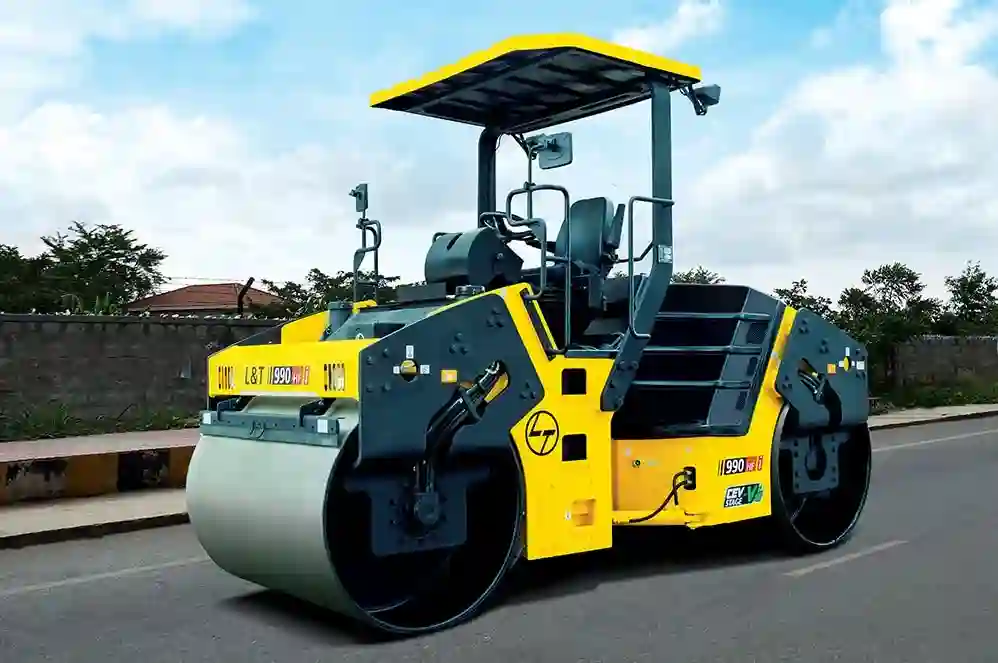
Several of the heavier tandem rollers sit in that 8 to 10 tonne band. The L&T 990HFi has an operating weight of 9,200 kg (9.2 tonnes) and the Volvo DD90 8,700 kg. Among the pneumatic tyred rollers, the Dynapac CP275 weighs 14,000 kg empty and up to 30,000 kg ballasted, so its working weight can be set for the intermediate pass. How many of each a road package needs is worked out in the guide to machinery required for road construction.
Where the Marshall test fits in road construction
The Marshall test covers hot bituminous layers only. The guide to road construction layers shows where DBM and BC sit in the stack, and the guide to road construction materials covers the aggregate tests the stone has to pass before it reaches the plant. Every other topic is listed in the road construction guide. When the mix design is approved and the rolling plan is next, compare tandem roller models side by side and get a quote from a dealer.
The procedure on this page follows IS 17127 : 2019, Determination of Stability, Flow and Bulk Density of Bituminous Mixes by Marshall Method, clauses 3 and 4. The requirements come from the MoRTH Specifications for Road and Bridge Works (Fifth Revision), clauses 501.6, 505.3, 507.3, 519.6.9 and Section 900, cross-checked against IRC:111-2009.
Prices, specifications and features are indicative, vary by variant, location and date, and should always be confirmed with the official OEM or authorised dealer before any purchase decision. DesiMachines is not liable for decisions taken on the basis of information that may have changed after publication. Test limits quoted here follow IS 17127 : 2019, the MoRTH Fifth Revision and IRC:111-2009; the contract’s own specification governs, and none of this replaces a mix design by a qualified laboratory.
Machines, tenders and news for this industry: Road Construction