
 Excavator
294 models
 Backhoe Loader
51 models
 Crane
68 models
 Concrete Mixer
79 models
 Wheel Loader
54 models
 Compactor / Roller
45 models
 Motor Grader
42 models

 Concrete Pump
66 models
 Skid Steer Loader
11 models


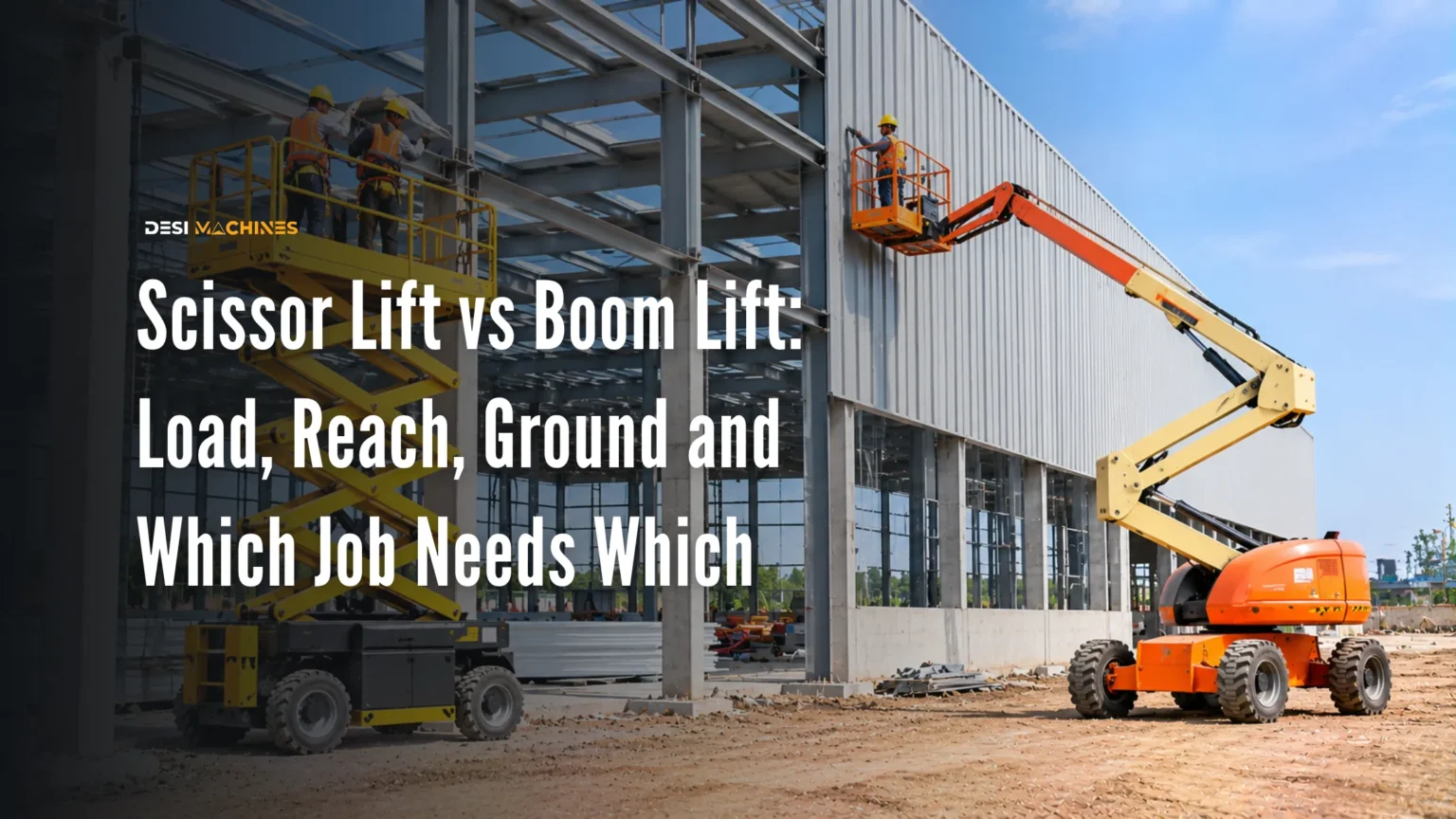
At about the same 15 to 16 m working height, a rough-terrain scissor lift and an articulating boom lift weigh almost the same, roughly 7 to 7.5 tonnes, yet they do opposite jobs. Haulotte’s HS15 E scissor lift carries 750 kg, or four people, on a deck about 3.9 m long. Its HA16 E boom carries 300 kg in a basket 1.8 m long, but it can put that basket 7.9 m out to the side, and the scissor cannot reach sideways at all.
So the scissor lift vs boom lift choice comes down to one line: a scissor lift wins on load, deck space and simple straight-up work; a boom lift wins when something stands between the machine and the job. This guide puts the two side by side using the published Indian ranges of Haulotte and JCB. It covers load, ground, set-up, moving around the site, what to ask when hiring, and which job needs which. The six types of aerial platform and the meaning of working height, platform height and outreach are explained in the main guide to aerial work platform types and how to choose. No prices are quoted here.
What is the difference between a scissor lift and a boom lift?
A scissor lift raises its deck straight up and keeps it above its own wheels, while a boom lift carries its basket up and out beyond its wheels. Everything else that separates them, from load to ground to set-up, follows from that one fact.
The safety standards put it in the same terms. Under ISO 16368 and EN 280-1, a scissor lift is a Group A machine: the centre of the platform always stays inside the tipping lines, which are the edges of the machine’s base. A boom lift is Group B: the platform can travel outside those lines. A Group A machine can carry a heavy deck because the weight stays over the base. A Group B machine has to balance a small basket at the end of a long arm with a heavy counterweight at the back.
Figure 1. Where the platform sits against the tipping lines
1
2
3
4
1 = scissor deck (Haulotte HS15 E, 13 m platform height), always between the tipping lines. 2 = boom basket (Haulotte HA16 E, 14 m platform height). 3 = the boom’s 7.9 m horizontal outreach, measured from the turntable. 4 = dashed tipping lines at the edges of each base. Roughly to scale at 12 px to 1 m, using the figures on each machine’s Haulotte India page.
How do scissor lifts and boom lifts compare at the same height?
Put five machines of about the same working height side by side and the trade-offs show up row by row. All five below are from Haulotte India’s current range, so the figures are measured the same way.
| Figure | Compact 14 (slab scissor) | HS15 E (rough-terrain scissor) | HA16 E (electric articulating boom) | HA16 RTJ (diesel articulating boom) | HT16 RTJ PRO (diesel telescopic boom) |
|---|---|---|---|---|---|
| Working height | 13.75 m indoors, 9.8 m outdoors | 15 m | 16 m | 16 m | 16.1 m |
| Platform height | 11.75 m indoors | 13 m | 14 m | 14 m | 14.1 m |
| Horizontal outreach | None | None | 7.9 m | 8.3 m | 13 m |
| Load on platform | 320 kg (3 people indoors, 1 outdoors) | 750 kg (4 people) | 300 kg | 230 kg (2 people) | 250 kg (2 people), 350 kg option |
| Platform size | 2.4 m x 1.17 m, 3.32 m extended | 3.93 m x 1.89 m, 4.9 m extended | 1.8 m x 0.8 m | 1.83 m x 0.80 m | 1.83 m x 0.76 m |
| Machine weight | 3,070 kg | 7,518 kg | 7,030 kg | 6,095 kg | 7,930 kg |
| Overall width | 1.2 m | 2.3 m | 2.3 m | 2.3 m | 2.29 m |
| Steepest slope it climbs (gradeability) | 25% | 45% | 40% | 40% | 45% |
| Tilt allowed when raised | 3.5° front to back, 1.5° side to side | 5° front to back, 3° side to side | 5° | 5° | 5° |
| Drives while raised up to | 11.75 m indoors, 9.8 m outdoors (working height) | 15 m (full height) | Not stated | Not stated | Not stated |
| Outside turning radius | 1.83 m | 6.75 m | 5.05 m | 4.5 m | 3.6 m |
| Power | Battery, 24 V | Battery, 48 V (8 x 6 V) | Battery, 48 V | Diesel, 18.4 kW | Diesel, 18.5 kW |
Figures as published on each model’s page on Haulotte India, read on 5 November 2026. “Slab” means a machine built for smooth, firm floors; “rough-terrain” means one built for unpaved site ground.
JCB’s Indian range gives a second, almost exact pair. Its A45E articulated boom has a 15.84 m working height, a 13.84 m platform height and 7.48 m of outreach, and JCB rates its basket at 300 kg with no restriction across its reach. The S4550E electric scissor lift reaches 15.8 m, lifts its deck to 13.8 m and carries 230 kg, at an overall weight of 3,593 kg. In JCB’s pair, the boom actually carries more than the scissor at the same height.
Here is the first surprise in these tables. “A scissor lift carries more” is true of the big rough-terrain scissors, not of every scissor.
Which carries more load, a scissor lift or a boom lift?
A rough-terrain scissor lift carries the most by a wide margin; a slab scissor carries about the same as a boom. The HS15 E takes 750 kg and four people, against 230 kg to 300 kg in every boom basket in Table 1.
The deck makes an even bigger difference than the kilograms. The HS15 E’s deck is about 3.9 m by 1.9 m, roughly 7.4 square metres, before its 0.98 m extension slides out. A boom basket of 1.8 m by 0.8 m is about 1.4 square metres. That is five times the standing and working room on the scissor. For two fitters running a cable tray, with a ladder of tray sections and a box of fixings beside them, that space is the job.
Three details on the sheets change the headline load:
- The extension deck carries less. The slide-out part of the deck has its own, lower rating: 225 kg on the HS15 E and 120 kg on the Compact 14. Heavy kit stays on the main deck.
- Outdoors, fewer people. The Compact 14 keeps its 320 kg limit outdoors but drops from three people to one, and its outdoor working height falls from 13.75 m to 9.8 m. The reason is wind: each person at the rail catches it.
- Some booms have two ratings. JCB rates its T65D telescopic boom at 1,000 lb (about 454 kg) within 80% of its working envelope and 661 lb (about 300 kg) across the whole envelope. The envelope is the side-view outline of every point the basket can reach. Ask which figure applies at the point where your work sits.
Either way, these machines lift people and their hand tools. Cladding panels, pipe lengths and steel go up on a telehandler or a crane, and the people follow in the platform.
Which needs firmer ground, a scissor lift or a boom lift?
A boom lift asks more of the ground, even when it weighs the same as a scissor lift. The scissor’s load stays over the middle of its base, so its weight is shared by all four wheels. When a boom swings its basket out over one side, much more of the machine’s weight moves onto the wheels on that side.
So a boom on soft fill, a fresh trench backfill or the edge of a drain is the riskiest pairing on a site. Neither maker’s web spec page gives a wheel load or ground pressure figure, so ask for the maximum wheel load in writing and show it to the site engineer before the machine goes onto made ground or an upper floor.
The rest of the ground story is in three numbers:
- Weight. A slab scissor such as the Compact 14 weighs 3,070 kg (about 3 tonnes) and is 1.2 m wide. Every rough-terrain scissor and boom in Table 1 weighs between 6 and 8 tonnes and is about 2.3 m wide. On a suspended slab, a ramp or a goods lift, that difference decides whether the machine can be used at all.
- Tilt. Every machine refuses to rise past a set tilt. The slab scissor allows only 1.5° side to side; the rough-terrain scissor 3°; the booms 5° (Haulotte’s larger HA20 RTJ allows 4°, with a 6° option). A small slope that a boom shrugs off will stop a slab scissor.
- Gradeability (the steepest slope the machine can drive up). It is 25% for the slab scissor and 40% to 45% for the rough-terrain scissor and the booms. A site road after rain is rough-terrain ground.
Haulotte’s sheet for the HS18 E, its 18 m rough-terrain scissor, gives a maximum drive working height of 13 m. Read “drive height” on the sheet as well as working height whenever you plan to move a raised scissor along a job.
Which is quicker to set up and move around the site?
On a long run at one height, the scissor lift is quicker. On scattered points at different heights, over or around obstacles, the boom lift is quicker. The slab scissor and the three booms in Table 1 list no outriggers and work on their wheels. Haulotte’s rough-terrain HS15 E and HS18 E come with outriggers as standard: legs that lower onto the ground, worked from one central control or one by one.
A scissor lift works like a moving floor. The crew rises to the ceiling, does a stretch of work and drives along at height to the next stretch. The HS15 E drives at its full 15 m. On a false ceiling, a sprinkler line or a long run of ducting, nobody comes down until the battery or the shift ends.
A boom lift works like an arm. It reaches over a parapet, under a pipe rack or across a drain, but each new point means swinging the turntable, lifting the boom and moving the jib, the short arm at the end that sets the basket’s angle. Two figures from the Haulotte sheets matter here:
- Up and over clearance is the height of an obstacle the boom can reach over and still drop its basket on the far side: 7.65 m on the HA16 RTJ, 7.9 m on the HA16 E and 8.5 m on the larger HA20 RTJ. The telescopic HT16 RTJ PRO lists no up and over figure: its straight boom is built to reach far out, not over and down.
- Tailswing is how far the back of the machine swings out past its wheels when the turntable turns. It is 10 cm on the HA16 RTJ, 42 cm on the HA20 RTJ and 93 cm on the HT16 RTJ PRO telescopic. Against a wall or beside live traffic, that last figure needs its own barricaded space.
Turning space is the other half of moving around. The Compact 14 turns in an outside radius of 1.83 m, small enough for corridors and between racks. The big HS15 E needs 6.75 m, and the booms in Table 1 need 3.6 m to 5.05 m.
Getting to the site is part of set-up too. A 3-tonne slab scissor, 2.5 m long and 1.2 m wide, needs a much smaller truck and may fit a goods lift if the lift’s rated load allows. The 6 to 8 tonne machines, 4.4 m to 6.7 m long in transport position, need a trailer or a truck with a loading ramp, both ways.
Which one does your job need?
Start from the work, not the machine. This table matches common Indian site jobs to the type that suits them and the figure that decides it.
| Job | Better choice | The figure that decides it |
|---|---|---|
| False ceiling, sprinklers, ducts or cable trays in a finished mall, hospital or office | Electric slab scissor | 1.2 m width for corridors; deck extends to 3.32 m; drives at height indoors |
| Formwork stripping or soffit work over a large slab on open site ground | Rough-terrain scissor | 750 kg and four people; 40% to 45% gradeability |
| Roof sheets, purlins and gutters on a steel shed, worked from outside | Articulating boom | 7.65 m to 8.5 m up and over clearance clears the eave |
| Façade glazing, cladding or painting from the ground or road | Telescopic boom | Up to 13 m horizontal outreach on a 16 m machine (HT16 RTJ PRO); ask for the envelope at your height |
| Bolting or welding steel at many points across a frame | Articulating or telescopic boom | Reach to each joint from one standing spot |
| Work above a pit, a drain, machinery or a row of seats | Articulating boom | Outreach; a scissor must stand directly under the work |
| Lights and fittings along a warehouse aisle | Slab scissor | 1.83 m turning radius between racks |
If the table leaves you between two answers, four questions settle it, in this order:
- Is anything between the spot where the machine can stand and the work? If yes, you need a boom.
- Is the work spread along one height over a wide area? If yes, a scissor will be quicker.
- What is the ground? A finished floor points to a slab scissor or an electric boom. Unpaved ground needs a rough-terrain machine of either kind.
- How much goes up at once? More than 300 kg, or more than two people working together, points to a rough-terrain scissor.
The same job often needs both at different stages. Booms work the steel and the façade while the site is open ground; scissors take over inside once the floors are cast and the building is closed. The pages on building construction equipment and on which jobs suit an electric machine cover that sequence, and the guide to electric scissor lifts covers battery care and indoor or outdoor ratings in detail.
Need to lift loads as well as people at height? Compare telehandler models and prices; many take a work platform certified for that exact machine, as the guide to telehandler attachments explains.
What should you ask before hiring either one?
Hiring is common for these machines, so compare quotes like for like. Two quotes for “a 16 m lift” can mean a 3-tonne slab scissor and an 8-tonne telescopic boom, and the bills will differ because the machines do.
- The exact model, with its working height, outreach and platform load in writing, and the outdoor rating if any of the work is outside.
- Transport both ways. For a short job on a 6 to 8 tonne machine, the trailer can be a large part of the bill.
- Who operates it. If the hire company sends an operator, ask whether that person is trained on this group of machine; if your own worker drives, ask what training the hire company gives at hand-over.
- Charging or fuel. A battery machine needs a socket and a night’s charge; a diesel one needs fuel and someone to fill it.
- Breakdown cover: how fast a replacement arrives, and who knows the emergency lowering procedure if a platform stops half way up.
The guide on how to rent construction equipment covers the agreement, the deposit and the checks at hand-over, and you can explore equipment on rent for the lifting machines that work beside a platform.
Is a scissor lift safer than a boom lift?
Neither is safer in itself; each carries a different main risk. A scissor lift’s risk is tipping on ground it was not built for, or a wheel dropping into a gap while raised. A boom lift adds the risk of a worker being thrown out by a jolt at the wheels, and of being crushed against a beam overhead.
The makers fit devices against each. Scissors have tilt alarms and pothole guards, bars that drop beside the wheels so a wheel cannot roll into a hole. Haulotte lists an overhead bar it calls Activ’Shield among its safety features, to reduce the risk of crushing injuries, and offers a connected anchor point for its booms, FASTN, that detects whether a worker’s lanyard is clipped on. On any boom, the worker wears a harness clipped to the basket’s anchor point.
Training follows the machine. A boom (Group B) and a scissor (Group A) handle differently, and the operator should be trained and shown the exact model before first use. The guide on heavy equipment operator training covers how operators are trained in India, and the explainer on scaffolding safety norms in India sets out where the work-at-height rules stand.
Planning the machines around the work at height? Compare telehandlers and cranes for the lifting side of the job and connect with a verified dealer. More access platform guides are on the aerial work platform guide home.
Sources, read on 5 November 2026: Haulotte India’s model pages for the Compact 12, Compact 14 Dual, HS15 E, HS18 E, HA16 E, HA16 RTJ, HA20 RTJ and HT16 RTJ PRO (technical data, standard equipment and safety features); JCB India’s electric scissor, articulated boom and telescopic boom range pages and its S4550E, A45E and T65D model pages. The Group A and Group B classes are those of ISO 16368 and EN 280-1. Telehandler and crane links lead to each machine’s listed specifications.
Prices, specifications and features are indicative, vary by variant, location and date, and should always be confirmed with the official OEM or authorised dealer before any purchase decision. DesiMachines is not liable for decisions taken on the basis of information that may have changed after publication.