
 Excavator
294 models
Excavator
294 models  Backhoe Loader
51 models
Backhoe Loader
51 models  Crane
68 models
Crane
68 models  Concrete Mixer
79 models
Concrete Mixer
79 models  Wheel Loader
54 models
Wheel Loader
54 models  Compactor / Roller
45 models
Compactor / Roller
45 models  Motor Grader
42 models
Motor Grader
42 models  Dozer
41 models
Dozer
41 models  Concrete Pump
66 models
Concrete Pump
66 models  Skid Steer Loader
11 models
Skid Steer Loader
11 models  Telehandler
13 models
Telehandler
13 models 


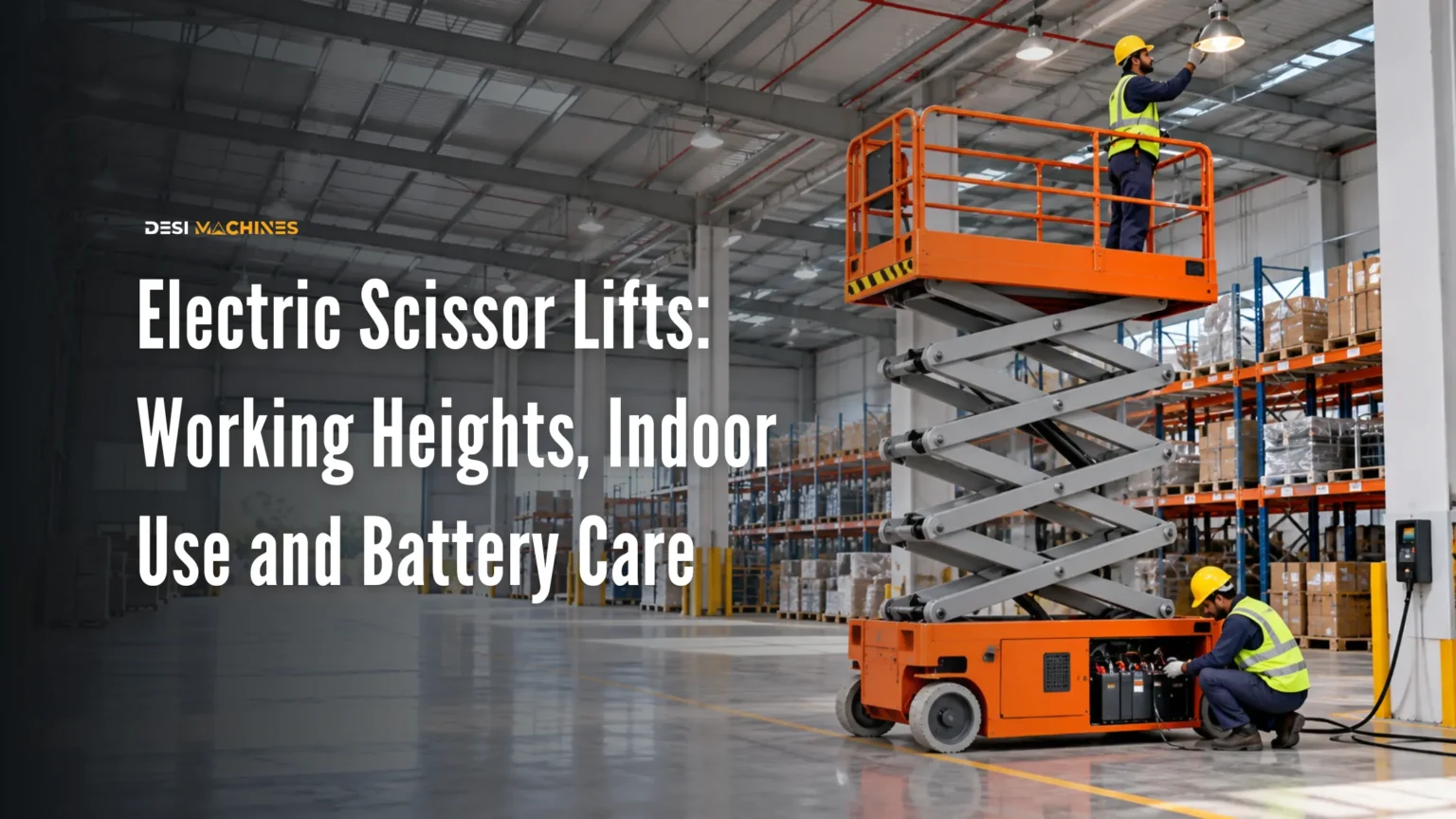
Electric scissor lifts on sale in India reach working heights of 7.7 m to 21 m (about 25 ft to 69 ft) and carry 230 kg to 750 kg on the deck. In plain terms, that is one to four people and their tools, lifted straight up on battery power with no exhaust and very little noise.
An electric scissor lift is a work platform on a folding steel frame. The frame opens like a pair of crossed scissors, the deck rises, and the workers on it do their job at the ceiling, the beam or the light fitting. It moves people, not loads. That one fact decides most of what follows.
The figures on this page come from two makers’ published Indian ranges: JCB, which builds its electric scissor lifts in India, and Haulotte India. Both were read in October 2026.
What is the difference between working height and platform height?
Platform height is how high the floor of the deck goes. Working height is how high a person standing on that deck can reach, and on every sheet read for this guide it is the platform height plus exactly 2 m.
That 2 m is the allowance for a standing worker’s arms. So a machine sold as “10 m” lifts the deck to 8 m. If your ceiling is 10 m and the job is on the ceiling, a 10 m working height machine is the minimum, not a safe margin. Measure the job, add nothing, and pick by working height. Then check the platform height too, because a tall worker reaching overhead for an hour gets tired fast.
Platform height and the extra 2 m of reach, by model
Dark bar: platform height. Amber bar: the 2 m reach allowance. The total is the working height each maker publishes. Drawn to scale, 1 m = 26.4 px.
Which electric scissor lifts are sold in India?
JCB sells five electric scissor lifts in India and says on its Indian site that the range is made in India and exported. Every one carries two people. The table below is taken from each model’s page on JCB India’s electric scissor range.
| JCB model | Platform height | Working height | Load on deck | People | Rated for outdoor use | Machine weight |
|---|---|---|---|---|---|---|
| S1932E | 5.71 m | 7.71 m (25 ft) | 230 kg | 2 | Yes | 1,590 kg |
| S2632E | 7.92 m | 9.92 m (33 ft) | 250 kg | 2 | No | 2,180 kg |
| S2646E | 8.1 m | 10.1 m (33 ft) | 450 kg | 2 | Yes | 2,663 kg |
| S3246E | 9.7 m | 11.7 m (38 ft) | 320 kg | 2 | Yes | 2,866 kg |
| S4046E | 11.9 m | 13.9 m (46 ft) | 320 kg | 2 | No | 3,070 kg |
Specifications as published by JCB India, October 2026.
The first two digits of each JCB name track the platform height in feet: the S4046E’s 11.9 m deck is 39 ft. That makes the names easy to read once you know the trick.
Haulotte’s Indian range is wider. It lists electric scissor lifts from 8 m to 21 m of working height, with deck loads from 230 kg up to 750 kg. The small and mid models are slab machines for smooth floors. The HS-series models are big rough-terrain machines. The HS18 E, for one, has four-wheel drive and outriggers, and Haulotte groups its all-terrain electric platforms under the name PULSEO. Three of them, from the Haulotte India electric scissor range, show how far apart the two ends are:
| Haulotte model | Working height | Platform height | Load indoors | Load outdoors | Battery | Climbs (gradeability) | Machine weight |
|---|---|---|---|---|---|---|---|
| Optimum 8 | 7.78 m | 5.78 m | 230 kg, 2 people | 230 kg, 1 person | 24 V, 180 Ah | 25% | 1,550 kg |
| Compact 10 | 10 m | 8 m | 450 kg, 3 people | 450 kg, 1 person | 24 V, 225 Ah | 25% | 2,490 kg |
| HS18 E | 18 m | 16 m | 750 kg, 4 people | Not split on the sheet | 48 V, 8 x 6 V, 435 Ah | 40% | 8,048 kg |
Specifications as published by Haulotte India, October 2026. Gradeability is the steepest slope the maker rates the machine to climb.
What is an electric scissor lift best suited for?
Work at a fixed height over a wide area, indoors or on flat paved ground. Think false ceilings, fire sprinkler lines, electrical trays, lights, air-conditioning ducts, painting, glazing from the inside and warehouse racking. Haulotte names construction, masonry and electrical work, cleaning and events among its uses. JCB names everything from concert rigging to construction.
Three things make the electric version fit these jobs. It gives off no exhaust, so it can work inside a mall, a factory or a metro station while people are around. It is quiet, so night work in an occupied building is possible. And Haulotte’s slab models run on non-marking tyres, which matters on a finished floor that someone has paid good money to polish.
The smallest JCB, the S1932E, is narrow enough to pass through a standard doorway with its rails folded, according to JCB. Haulotte’s Optimum 8 is 0.79 m wide overall. Those are the machines for moving from room to room.
A scissor lift is poor at reaching over something. The deck goes straight up, so the machine has to stand right under the work. For a roof edge, a beam over a pit, or a light over a row of seats, you need a boom lift instead (see the boom lift section below).
Can an electric scissor lift be used outdoors?
Some can, and the sheet will tell you which. Two of JCB’s five models, the S2632E and the S4046E, are not rated for outdoor use. The other three are.
Read the people count as well as the yes or no. Haulotte’s Compact 10 carries three people indoors and one person outdoors, with the same 450 kg either way. The Optimum 8 drops from two people to one. The reason is wind. A person standing at the rail catches wind, and the outdoor rating is worked out for that, so the extra people come off first.
Ground is the other limit. Haulotte’s slab machines are rated to climb a 25% slope, and every machine here refuses to rise if it sits on more than a small tilt. JCB’s tilt sensor stops the lift above 1.5 degrees side to side or 3 degrees front to back. Haulotte’s Compact 10 allows 1.5 degrees side to side and 3.5 degrees front to back. A slab is fine. An unpaved site road after rain is not. For broken ground, the rough-terrain HS18 E climbs 40% and allows 2 and 5 degrees, but at 8,048 kg it is a different class of machine, and it may only be driven up to a working height of 13 m out of its 18 m.
Both makers fit pothole guards: bars that drop beside the wheels when the deck rises, so a wheel cannot roll into a gap. JCB states the lift will not raise until the guards are fully down.
How long does the battery last, and how long does it take to charge?
One working day per charge, refilled overnight. JCB states that every one of its scissor lifts runs on deep-cycle lead-acid batteries, reaches a full charge in 8 hours, and lasts a full day’s work.
The battery figures on the Haulotte sheets say the same thing in numbers. A 24 V battery rated 225 Ah, as on the Compact 10, holds about 5.4 kWh (24 x 225 = 5,400 watt-hours). The Compact 10’s standard charger is rated 27 A, and 225 Ah divided by 27 A comes to roughly eight hours from flat, the same overnight figure JCB states. The big HS18 E carries 48 V and 435 Ah, which works out to about 20.9 kWh, nearly four times as much.
Two notes on reading those figures. “Ah (C20)” on a sheet means the battery’s capacity measured over a 20-hour discharge, which is a standard way of rating it. And kWh is the number to give your electrician, because it tells them how much the charger will draw from the building each night.
Haulotte fits a multivoltage charger as standard on the Compact 10 and lists an accelerated 380 V charger as an option on the HS18 E. A 380 V charger needs a three-phase supply. Ask the dealer what socket the standard charger needs, and check the site has one, before the machine arrives.
How do you look after a scissor lift battery?
Both makers fit lead-acid batteries as standard on their slab machines. On Haulotte’s, it is the flooded kind, with removable caps and liquid inside: its standard kit includes a manual battery watering system, with an automatic one as an option, and it offers maintenance-free AGM batteries on the Compact 10 and lithium-ion on the Optimum 8 as extras. If the sheet mentions watering, the battery needs topping up.
The habits that keep a lead-acid pack healthy are simple. Charge it fully at the end of every shift instead of topping it up in short bursts during the day. Do not leave the machine standing flat for days. Top up with distilled water only, and only to the level the battery maker marks. Keep the terminals clean and dry. And use the charger that came with the machine, because it is matched to the battery.
On a hired machine, ask who waters the batteries. If nobody does, a hire fleet’s batteries wear out early and the machine dies before lunch.
Electric scissor lift: the pros and cons
| For it | Against it |
|---|---|
| No exhaust at the point of use, so it can work inside occupied buildings | Needs a full overnight charge, about 8 hours on JCB’s lead-acid machines |
| Quiet enough for night work in malls, hospitals and offices | Runs for about a day per charge; double shifts need a charging plan |
| Non-marking tyres (on Haulotte’s slab models) protect finished floors | Slab models need firm, nearly level ground: tilt limits of 1.5 to 3.5 degrees |
| Large deck: two to four people with materials, up to 750 kg on the biggest | Goes straight up only, with no reach over obstacles |
| Simple controls, and the deck can be driven while raised | Fewer people allowed on the deck outdoors because of wind |
| The smallest models fit through a standard doorway | Flooded batteries need regular watering, and a neglected pack is costly to replace |
Scissor lift or boom lift?
A boom lift puts the platform on the end of an arm. An articulating boom has a joint in the arm, so it can reach up, over a pipe rack or a wall, and down again. The trade is capacity. Haulotte’s electric articulating booms in India run from 12 m to 20 m of working height but carry 230 kg to 250 kg, about a third of what its biggest scissor lift takes. JCB India’s electric page lists articulated booms too, led by the A45E.
So choose by the shape of the job. Straight up over a wide area with materials: scissor lift. Up and over something: boom lift. The word “boom” also turns up on cranes, and a crane boom is not built to carry people; the hydra crane boom height guide covers that machine.
What about a telehandler with a work platform?
On a construction site that already runs a telehandler, a work platform on the boom is the usual alternative. The 13 telehandlers listed in India lift from 7 m to 34.7 m, from the JCB 530-70 at 7 m through the SANY STH844A at 13.4 m to the rotating Manitou MRT-X 2570 at 24.8 m. Every one of them carries a fuel tank of 100 L to 320 L, so none is electric.
The telehandler wins outdoors, on rough ground and when the same machine must also move pallets and steel, as the telehandler applications guide sets out. The scissor lift wins indoors and on long jobs at one height, where a bigger, quieter, cleaner deck is the point. One rule does not change: a platform for people must be approved for that exact telehandler, and the telehandler attachments guide explains why. Never lift a worker in a bucket, on forks or in a basket hung from a crane hook. Where no machine fits, the scaffolding safety norms in India are the next thing to read.
Compare live telehandler models and prices and ask a dealer which ones are approved for a work platform.
What should you check before you buy or hire one?
Seven questions cover most of it.
1. Working height. Measure the highest point of the job and match it to working height, then check the deck height a worker will actually stand at.
2. Indoor or outdoor, and how many people. Ask for the outdoor rating and the outdoor person count in writing.
3. The floor under it. These machines are heavy for their size: 1,550 kg to 3,070 kg for the slab models above, on four small tyres. On an upper floor or a suspended slab, ask the structural engineer before the machine goes up, and check the goods lift’s rated load too.
4. Stowed size. Compare the lowered height and width with the doors, ramps and lifts on your route.
5. Battery type and charging. Flooded, AGM or lithium; who waters it; how long the charge takes; and what socket the charger needs.
6. Warranty and service. JCB states a two-year, 2,000-hour warranty as standard. Ask any maker for the written warranty and the nearest service engineer, because a lift stuck halfway up with a dead battery needs someone who knows the emergency lowering procedure.
7. Safety equipment. Tilt alarm, pothole guards, an emergency stop on the deck and at the base, and a manual lowering point. JCB says every model it sells is certified to EN 280, the European design standard for mobile elevating work platforms, so ask for the certificate.
On price: neither maker publishes an Indian price for these machines, so this guide gives none. The price moves with working height, deck load, slab or rough-terrain build, and battery type, and lithium and AGM packs appear on the sheets as extra-cost options. For a job lasting weeks rather than years, hiring is common, and JCB says its range is designed with rental companies in mind. If you do buy, equipment finance works the same way as for any other machine.
Other electric machines on Indian sites
A scissor lift is the one electric machine that JCB sells in India, as the guide to the electric JCB explains. For handling pallets inside the same buildings, see electric forklifts. For digging, the electric choice in India today is an excavator, and the electric excavators listed run from the compact LiuGong 9027FE EV up to large mining machines. The rest of the series sits on the electric construction machines guide.
Browse the electric excavators and telehandlers listed in India, and send an enquiry to get a dealer call back.
Prices, specifications and features are indicative, vary by variant, location and date, and should always be confirmed with the official OEM or authorised dealer before any purchase decision. DesiMachines is not liable for decisions taken on the basis of information that may have changed after publication.