
 Excavator
294 models
 Backhoe Loader
51 models
 Crane
68 models
 Concrete Mixer
79 models
 Wheel Loader
54 models
 Compactor / Roller
45 models
 Motor Grader
42 models

 Concrete Pump
66 models
 Skid Steer Loader
11 models


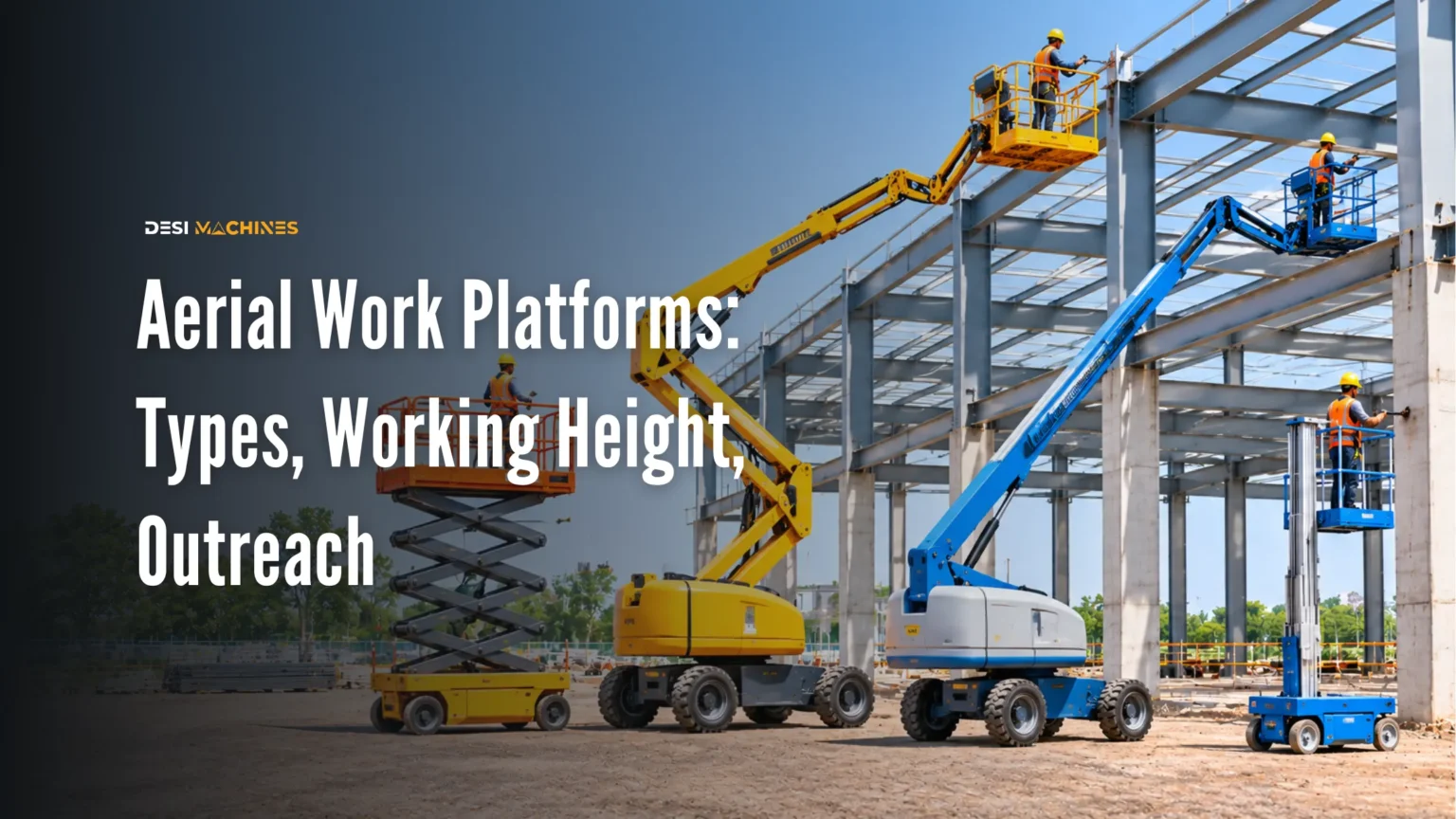
Aerial work platforms sold in India lift a worker from about 6 m to 43 m off the ground, and the right one is picked with three questions: how high the job is, how far out from the machine it sits, and what ground the machine will stand on. Every aerial work platform answers those three in its own way, and that is what separates a scissor lift from a boom lift, a mast lift or a platform on a truck.
This guide is for a contractor, site engineer or facility manager who has to get people safely up to a ceiling, a façade, a roof sheet or a street light, and wants to understand the machines before talking to a maker or a hire company. It covers what an aerial work platform is, the main types with real working heights from the Indian ranges of JCB and Haulotte, how the safety standards group them, the three numbers on every spec sheet, which machine suits which job, and what to check before you buy or hire one. No prices are quoted here.
What is an aerial work platform?
An aerial work platform is a machine that lifts people, with their tools and a little material, to a working position at height and holds them there in a railed basket or deck. It is also called a MEWP (mobile elevating work platform), an aerial lift, a cherry picker or, very commonly in India, a man lift.
The key word is people. A crane and a forklift are built to lift loads. An aerial platform is built to lift a worker, so its whole design is about keeping that worker inside the rails and keeping the machine from tipping. A typical platform carries 200 kg to 300 kg on a boom and up to 750 kg on a large scissor deck, which is two or three people and their kit, not a pallet of bricks.
Wikipedia’s article on aerial work platforms draws the same line: a telehandler is a true crane, designed to deliver cargo such as pallets of material, while a person lift carries a person with some tools. That is why the rules, the training and the safety devices on an aerial platform are different from those on a crane, even when both have a boom.
On Indian sites the job used to be done from bamboo or steel scaffolding, a ladder or a drum tied to a crane hook. A platform replaces all three for short, repeated work at height: it is up in minutes, it moves along the job, and the worker stands inside guard rails the whole time.
What are the types of aerial work platforms?
There are six main types, and they differ in one thing above all: whether the platform goes straight up or can also reach sideways. A machine that only goes straight up has to stand directly under the work. A machine with a boom can stand back and reach over a wall, a pit or a row of seats.
Table 1: Types of aerial work platform, with working heights from Indian ranges
| Type | How it lifts | Working height (examples read Nov 2026) | Load on platform | Best for |
|---|---|---|---|---|
| Vertical mast lift | A telescopic mast pushes a one-person basket straight up | 5.8 m to 10 m (Haulotte Star range) | 200 to 230 kg | Indoor maintenance, warehouse stock work, lights and signs |
| Scissor lift | Crossed steel arms open like scissors and raise a wide deck | 7.71 m to 15.8 m (JCB, six models); 8 m to 21 m (Haulotte) | 230 to 750 kg | Ceilings, ducts, sprinkler lines, painting, glazing from inside |
| Articulating boom lift | A boom with one or more joints, so it reaches up, over and down | 15.84 m to 20.3 m (JCB); 12 m to 41 m (Haulotte) | 230 to 300 kg | Work over obstacles, roof edges, plant and pipe racks |
| Telescopic boom lift | A straight boom that slides out in sections | 21.92 m (JCB T65D); 16.1 m to 43 m (Haulotte) | 230 to 300 kg, up to 450 kg on some | Long reach to a façade or structure from far back |
| Trailer-mounted boom | A boom on a towed trailer, set on outriggers before lifting | 12 m to 18 m (Haulotte HTA range) | 227 kg | Short jobs moved between sites by a pickup or tractor |
| Vehicle-mounted boom | A boom built onto a truck, with outriggers | Not specified in the ranges read | Not specified | Street lights, power and telecom lines, tree trimming |
Working heights and loads are as published by JCB India and Haulotte India for their Indian ranges, read in November 2026. The vehicle-mounted type is described from Wikipedia’s article; neither maker lists one in India.
Two smaller groups sit between these. Haulotte sells lightweight self-propelled booms (HLA16 PX and HLA19 PX, 16 m and 19 m) that are light enough for upper floors and level themselves on hydraulic outriggers. Wikipedia calls a similar family spider lifts, after the way their legs unfold. And a telehandler with a certified work platform on its boom can do some of the same work, which is covered further down.
Electric scissor lifts are the most common machine of the lot on Indian building sites, malls and factories, and they have their own detailed page: the guide to electric scissor lifts covers working heights by model, indoor and outdoor ratings and battery care.
How do safety standards group aerial platforms?
The international design standard for these machines is ISO 16368, Mobile elevating work platforms: Design, calculations, safety requirements and test methods, and the European version is EN 280-1. Both sort every platform by two labels, a group and a type. Makers print these on the sheet, and hire companies use them to match a machine to an operator’s training.
Table 2: MEWP groups and types under ISO 16368 and EN 280-1
| Label | What it means | Usual examples |
|---|---|---|
| Group A | The centre of the platform always stays inside the machine’s tipping lines (the edges of its base) | Scissor lifts, vertical mast lifts |
| Group B | The platform can move out beyond the tipping lines | Articulating and telescopic booms, trailer and truck booms |
| Type 1 | Can travel only when lowered to its transport position | Push-around mast lifts, trailer booms |
| Type 2 | Can travel while raised, driven from a control point on the chassis | Less common; the driver is on the chassis, not in the basket |
| Type 3 | Can travel while raised, driven from the platform itself | Self-propelled scissor and boom lifts |
So a self-propelled scissor lift is usually a Group A, Type 3 machine, and a self-propelled articulating boom is Group B, Type 3. The difference matters for training. A Group B machine can tip if the boom swings out over soft ground, so operators are trained differently for it.
India has no separate national standard for aerial platforms that we could find, so buyers and hire companies usually ask for a machine built to ISO 16368 or EN 280, with the maker’s test certificate. Which work-at-height rules apply to a given Indian site is a legal question that has changed in 2026; the explainer on scaffolding safety norms in India sets out where the rules stand.
What do working height, platform height and outreach mean?
Three numbers decide almost every choice, and they are easy to mix up. Platform height is how high the floor of the basket or deck goes. Working height is how high a person standing on it can reach. Outreach is how far out sideways the platform can go from the machine.
On every JCB sheet read for this guide, working height is the platform height plus 2 m. The A45E articulating boom lifts its basket to 13.84 m and is sold as a 15.84 m machine. The T65D telescopic boom goes to 19.92 m and is sold as 21.92 m. So when a maker says “16 m”, read it as a basket at about 14 m.
Working height, platform height and outreach on three JCB machines
Drawn to scale at 12 pixels per metre. The JCB S4046E scissor lift raises its deck straight up to 11.9 m, giving 13.9 m working height and no outreach. The JCB A45E articulating boom lifts its basket to 13.84 m, giving 15.84 m working height, and reaches 7.48 m out to the side. The JCB T65D telescopic boom lifts its basket to 19.92 m, giving 21.92 m working height, and reaches 17.22 m out to the side.
5 m10 m15 m20 m
S4046E scissor
A45E articulating
T65D telescopic
1
2
1
2
3
1
2
3
Table 3: The three numbers for the machines in the figure
| JCB model (figure label) | 1. Working height | 2. Platform height | 3. Outreach | People on platform | Power |
|---|---|---|---|---|---|
| S4046E scissor lift | 13.9 m (46 ft) | 11.9 m | None (straight up) | 2 | Electric |
| A45E articulating boom | 15.84 m (52 ft) | 13.84 m | 7.48 m | 2 | Electric |
| T65D telescopic boom | 21.92 m (72 ft) | 19.92 m | 17.22 m | 3 | Diesel |
Figures as published on JCB India’s access platform range pages, read November 2026. The figure is drawn to scale at 12 px to 1 m; orange marks working height, blue the platform and green the maximum outreach.
Two warnings about outreach. First, the maximum outreach is not available at the maximum height. A telescopic boom reaches furthest when the boom is near flat, and at full height it reaches much less, so ask for the machine’s working envelope (the side-view drawing of every point the basket can reach). Second, a boom with a longer reach is usually a heavier, wider machine that needs firmer ground and more room to set up.
Load is the third limit. Haulotte quotes its machines in kg, JCB in people. A 230 kg basket is two people with hand tools. A sheet of glass, a welding set or a box of tiles comes out of that same figure, and the platform’s overload sensor will stop it rising if the total is too high.
Should you choose a scissor lift or a boom lift?
Choose a scissor lift when the work is straight above firm, level ground and spread over a wide area. Choose a boom lift when something stands between the machine and the work, or when the work is high on the outside of a building.
A scissor lift carries more and is simpler to drive. Haulotte’s HS18 E carries 750 kg on its deck, against 230 to 300 kg in the baskets of its booms. A wide deck lets two or three people work side by side along a false ceiling or a cable tray, then drive on and keep working.
A boom lift reaches where a scissor cannot. An articulating boom can climb over a parapet and drop down on the far side. A telescopic boom can stand on the road and put a worker at the fourth or fifth floor of a façade. In return the basket is small, the machine is heavier for its working height, and setting it up takes more care.
Diesel, electric or hybrid: which power suits your site?
Power follows the ground and the air. Indoors, on a finished floor, the machine should be electric: no exhaust, little noise and non-marking tyres. Outdoors on rough, open ground, diesel has the traction and the run time.
The Indian ranges show the split clearly. All six JCB scissor lifts are electric. Its booms come in diesel (AJ48D, T65D), electric (A45E, A60E) and hybrid (A60EH). Haulotte’s booms marked RTJ are diesel rough-terrain machines, and its E models are electric, with an all-terrain electric family it calls PULSEO.
On a building job the choice often changes with the stage. Diesel booms work the façade and the steel while the site is open ground, and electric scissors take over for services and finishes once the floor slab is cast and the building is closed in. The guide to which jobs suit an electric construction machine covers the indoor, tunnel and urban cases in more detail.
Which aerial platform suits which job on an Indian site?
Match the machine to the job, not the other way round. This table starts from the work the crew has to do.
Table 4: Matching the job to the machine
| Job | Usual machine | Why |
|---|---|---|
| False ceiling, ducts, fire sprinklers, cable trays in a mall, hospital or office | Electric scissor lift | Wide deck, no exhaust, drives along the run |
| Lights, signs and cameras inside an airport terminal or a metro station | Vertical mast lift or small electric scissor | Narrow enough for doors and lifts, quiet for night shifts |
| Warehouse racking, stock checks, roof lights in a shed | Vertical mast lift or electric scissor | Small footprint between racks |
| Roof sheeting, purlins and gutters on a steel shed (PEB) | Articulating boom, diesel outdoors | Reaches up and over the eave from outside |
| Façade glazing, cladding, painting a tower from outside | Telescopic boom | Long reach from the ground or road |
| Steel erection, bolting and welding at height | Articulating or telescopic boom | Positions the worker at the joint from any side |
| Street lights, hoardings, trees along a road | Truck-mounted or trailer-mounted boom | Drives or tows from job to job between lifts |
| Data hall cable trays and cooling pipework | Electric scissor lift | Clean, quiet, works on a raised or finished floor |
The full list of machines used on each kind of project, from foundation to finishing, sits on the pages for building construction equipment and airport construction.
Looking for a machine that can also lift loads at height? Compare telehandler models and prices; many of them take a certified work platform on the boom.
Is a man lift the same as a crane?
No. “Man lift” in India usually means an aerial work platform, a machine built to lift people. A crane is built to lift loads, and its hook, boom and safety devices are rated for steel and concrete, not for a person standing in a basket.
The trouble is that the word gets used loosely. On many Indian sites a pick-and-carry crane is also called a man lift crane, simply because it lifts. The ACE NXP 150, for example, is a 15-tonne pick-and-carry crane with a four-section boom. It is a load-lifting crane. A worker should never ride its hook or a drum tied to it. If a crane must carry people for a special job, that needs a purpose-built personnel basket, a lift plan and the crane maker’s approval, and the guide to crane safety rules explains why.
A telehandler sits between the two. With a work platform approved for that exact machine, and with the machine switched into platform mode, a telehandler can lift people. The SANY STH1056A lists a maximum lift height of 17.1 m (17,100 mm), the MANITOU MXT 1740 K 17.4 m and the SANY STH844A 13.4 m, as per their current November 2026 specs. Those are lift heights at the forks, not platform working heights, so ask the dealer for the platform figure. The guide to telehandler attachments covers when a work platform is allowed and what it must carry.
For a site that needs both lifting and access, one telehandler with forks and a certified platform can save hiring two machines. For a site where people work at height all day, a proper aerial platform is safer and quicker.
How do you choose an aerial work platform?
Settle these nine points before you ask a maker or a hire company for a quote. Each one rules machines in or out.
- Measure the highest point of the work and pick by working height, not platform height. Add nothing for comfort; the 2 m reach allowance is already in the figure.
- Measure how far the work sits from where the machine can stand. Any outreach at all rules out a scissor lift.
- Count the people and weigh the kit, including material taken up. Compare that with the platform load in kg.
- Walk the ground. A finished slab, a compacted road, loose fill and a slope each suit a different machine. Ask for the gradeability (steepest slope it climbs) and the ground bearing pressure.
- Indoors or outdoors? Check the outdoor rating and the wind limit on the sheet. Some indoor machines carry fewer people outside, and some cannot go outside at all.
- Check access. Door widths, lift sizes, floor loads on upper storeys and ramps decide whether a machine can even reach the work.
- Decide the power: electric for indoor and finished floors, diesel for rough ground, hybrid when the job moves between both.
- Plan transport. A scissor lift fits on a small truck; a large boom needs a trailer and a loading ramp. A trailer-mounted boom needs only a towing vehicle.
- Ask about service in your city: battery and charger support, spare parts, and whether the maker or hire company trains your operator.
If the job runs for a few weeks, hiring usually makes more sense than buying, and the guide on how to rent construction equipment covers the agreement, the deposit and the checks at hand-over.
What safety checks matter on an aerial platform?
Most accidents with aerial platforms come from three things: the machine tipping, the worker falling out, and contact with overhead power lines. Every check below answers one of them.
- Before each shift, test the controls at the base and on the platform, the emergency stop and the emergency lowering. Wikipedia’s article notes that most machines have a manual lowering valve at the base for a power or control failure.
- Keep the tilt and overload sensors working. They stop the platform rising when the machine stands on too steep a slope or the basket is overloaded. Never bypass them.
- On any boom lift, wear a harness clipped to the anchor point in the basket. A small jolt at the wheels becomes a big jolt at the end of a long boom.
- Keep well clear of overhead lines. Unless the machine is an insulated type built for line work, treat every wire as live.
- Respect the wind limit on the sheet, and bring the platform down when the wind picks up.
- Only a trained operator should run the machine, and the training should cover that group and type of platform. The guide on heavy equipment operator training covers how operators are trained in India.
The international standard for this training is ISO 18878, on MEWP operator training. Ask the maker or hire company whether the training it offers follows it.
What should you ask the maker or hire company?
Two makers with Indian websites were read for this guide. JCB says its electric scissor lifts are made in India and exported, and its Indian range adds articulating and telescopic booms. Haulotte India lists the widest range read, from push-around and mast lifts to scissors, articulating, telescopic, lightweight and trailer-mounted booms.
Whichever maker you choose, ask for the full spec sheet, the test certificate, the working envelope drawing and the service plan for your city before you sign.
Ready to plan the machines around the work at height? Compare telehandlers and cranes for the lifting side of the job, or explore equipment on rent and connect with a verified dealer.
Sources
Working heights, platform heights, outreach, people and power types for JCB’s machines were read on 3 November 2026 from JCB India’s articulated boom, telescopic boom and electric scissor range pages. Working heights, lift capacities and range descriptions for Haulotte’s machines were read the same day from Haulotte India’s range pages for scissor lifts, articulating, telescopic, lightweight and trailer-mounted booms and vertical masts. The definition, the vehicle-mounted and spider types and the safety features are from Wikipedia’s aerial work platform article. The group and type classes are those of ISO 16368 and EN 280-1. Telehandler and crane figures are from each machine’s listed specifications.
Prices, specifications and features are indicative, vary by variant, location and date, and should always be confirmed with the official OEM or authorised dealer before any purchase decision. DesiMachines is not liable for decisions taken on the basis of information that may have changed after publication.