
 Excavator
294 models
 Backhoe Loader
51 models
 Crane
68 models
 Concrete Mixer
79 models
 Wheel Loader
54 models
 Compactor / Roller
45 models
 Motor Grader
42 models

 Concrete Pump
66 models
 Skid Steer Loader
11 models


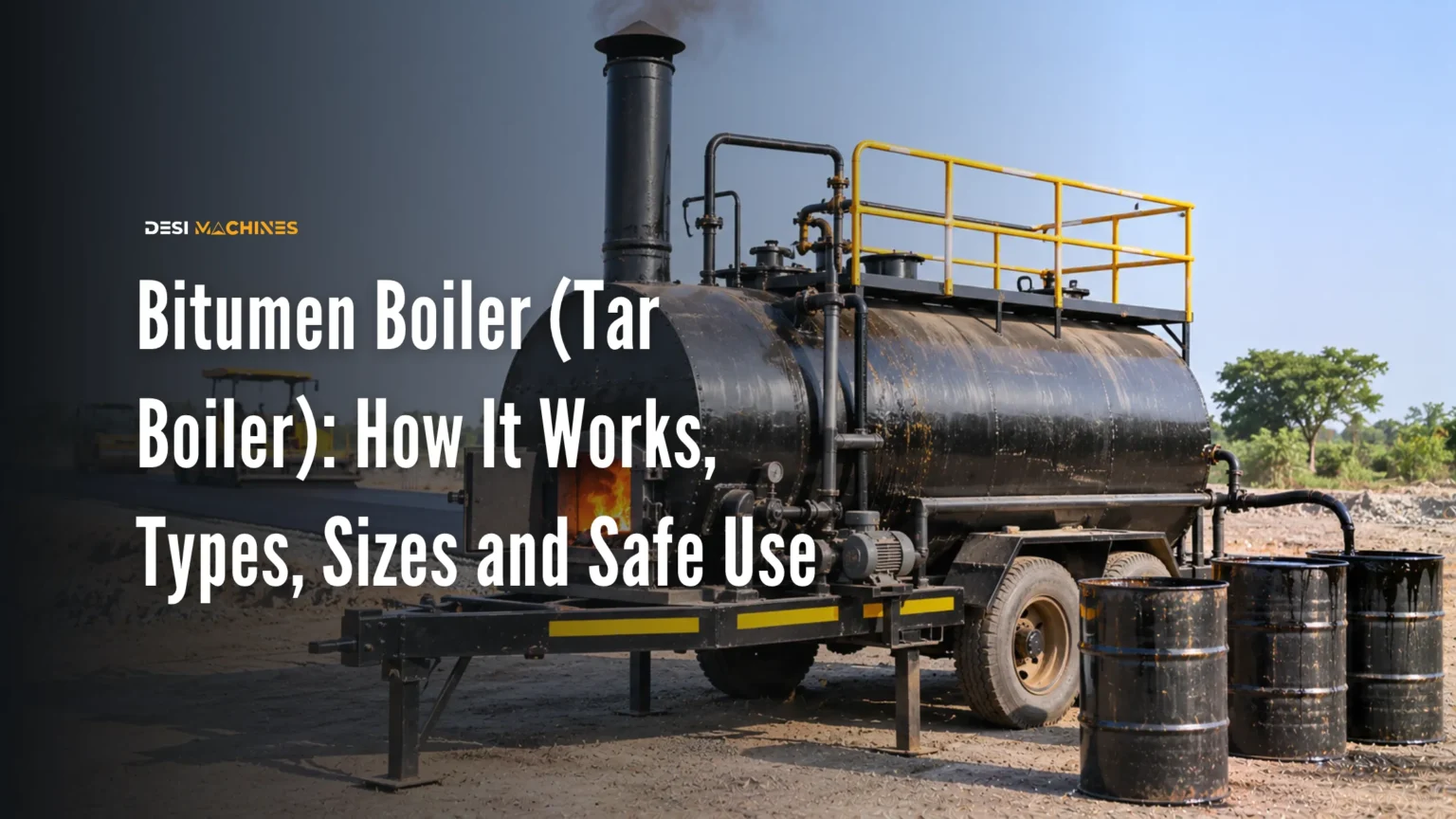
Between 140°C and 191°C: that is the range a bitumen boiler has to reach and hold before paving bitumen is thin enough to spray or mix, with the exact figure set by the grade and the job. A bitumen boiler, called a tar boiler on most Indian road sites, is an insulated steel tank on wheels with a fire or an oil burner under it that melts solid bitumen and keeps it hot for patch work, tack coat, premix carpet and other small road jobs.
The name is trade usage. Nothing in it makes steam, and the Indian Standard for the machine, IS 2094 (Part 1), calls it a heater for bitumen. Below: how it works part by part, its types and standard sizes, the temperatures it must hold, safe daily use, common faults, and what to check before buying or hiring one. The rules come from IS 2094, the IRC’s recommended practice for bituminous work equipment (IRC:72), the IRC Rural Roads Manual (IRC:SP:20) and the MoRTH road specification. No prices are quoted here.
What is a bitumen boiler used for?
A bitumen boiler melts bitumen out of drums or from bulk supply and keeps it at working heat on site, so a small crew can use it where a hot mix plant or a spray truck would be too big. IRC:72 puts it on the list of common tools needed for every kind of bituminous work, next to the thermometers, rakes and drum cutters.
Its regular jobs on Indian roads:
- Tack coat with paving bitumen. MoRTH clause 503.4.3 says paving bitumen used for tack coat is heated in bitumen boilers until it is thinner than 2 poise (poise is a unit of how thick a liquid is). Spray rates and the full method are in the guide to prime coat and tack coat.
- Small premix and grouting work on rural roads. The Rural Roads Manual lists a bitumen boiler, and a tractor to pull it, among the tools for pavement work, and notes that a road roller can do the towing.
- Patching. The same manual puts a mini asphalt boiler of one barrel capacity in the kit of a road maintenance gang for day-to-day repairs, the work that keeps potholes and pavement failures from spreading.
- Making cutback on site. Cutback is bitumen thinned with a solvent such as kerosene or diesel. The bitumen is heated in the boiler first, then mixed with the solvent in a separate drum kept well away from the fire.
- Hand spraying. Many boilers carry a small pump, hose and spray lance, which IRC:72 describes as the usual way to spray on works too small for a pressure distributor.
Three things it does not do. A hot mix plant has its own bitumen heating and storage tank, so the boiler is not part of a plant-fed job laid by an asphalt paver. Mastic asphalt is made in a mastic cooker, a different machine that heats stone and bitumen together. And rapid setting emulsion used for tack coat is not heated at all: MoRTH bans heating or diluting it on site.
How does a bitumen boiler work?
A bitumen boiler works like a large kettle with the fire running through the middle of the water instead of under it. A firebox or an oil burner at one end fires into flue tubes, steel pipes that pass through the bitumen, and the hot gas leaves through a chimney at the other end. The bitumen around the tubes softens, melts and slowly comes up to temperature, and an agitator, or a long pole on smaller boilers, stirs it so the heat spreads evenly.
Solid bitumen goes in through a charging hole on top. Drums are lifted onto a barrel rest with a chain pulley, cut open and emptied in. Hot binder comes out through a draw-off cock, either into buckets or into a small pump that pushes it along a hose to a spray lance.
What keeps it safe and useful is the insulation, called lagging, wrapped round the tank. IS 2094 sets two tests that show whether a boiler is any good:
- Filled to its nominal capacity, the burner must raise the load from 30°C to 150°C in no more than 2.5 hours.
- A full load at 150°C, left standing with the air at 24°C to 30°C, must not cool by more than 20°C in 8 hours.
In plain terms, a boiler that passes the second test loses no more than about 2.5°C an hour while it stands.
Figure 1: Parts of a trailer-mounted bitumen boiler
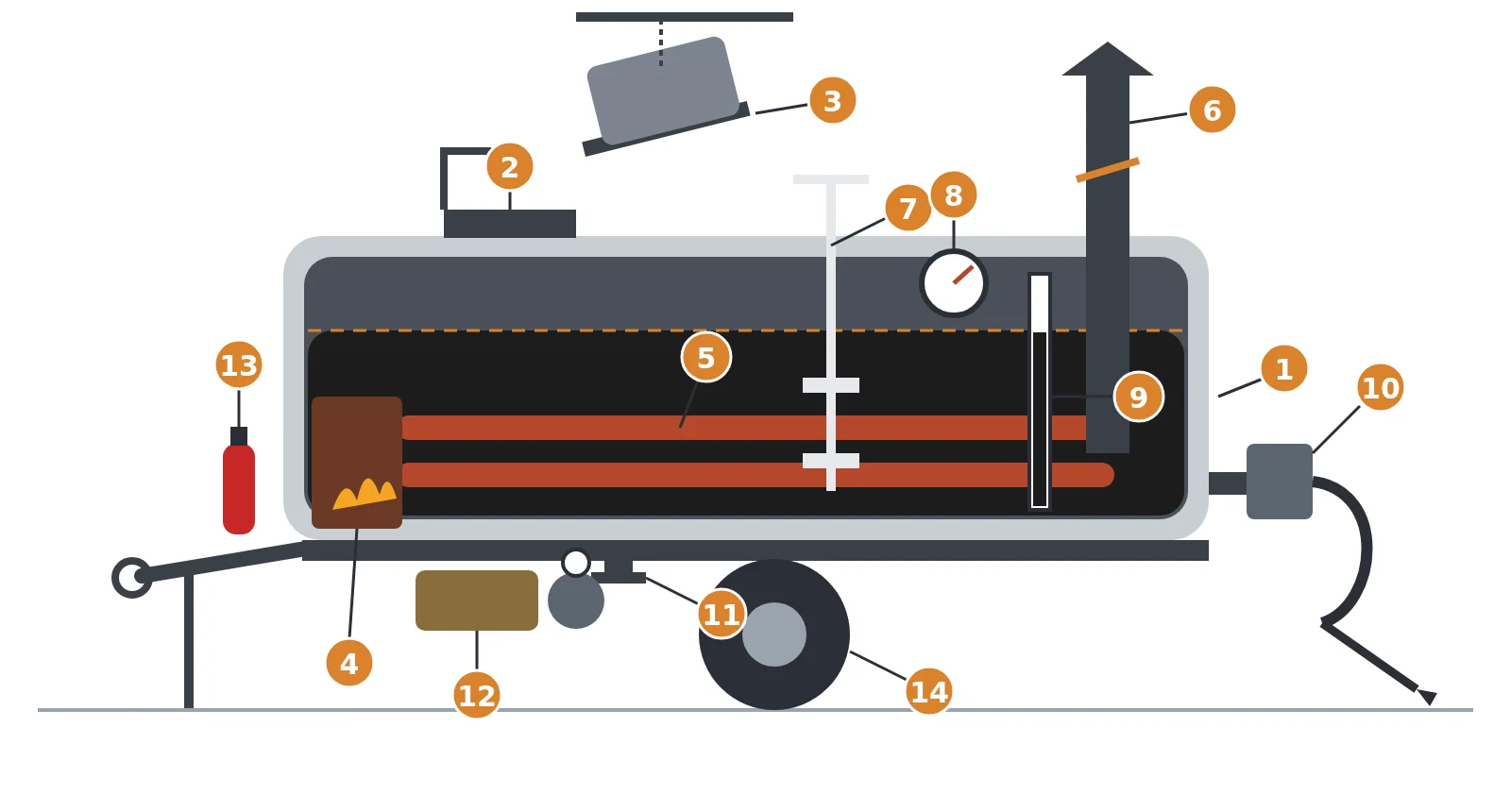
Parts shown in Figure 1:
- Tank with lagging. The insulated steel shell that holds the bitumen. The dashed line marks the free space left at the top.
- Charging hole with a lid that shuts out rain.
- Barrel rest and chain pulley for lifting drums to the charging hole.
- Firebox or oil burner.
- Flue tubes carrying the hot gas through the bitumen.
- Chimney with a damper to control the draught and a cowl to keep rain out.
- Agitator, the stirring paddle. Compulsory on boilers of 500 litres and above.
- Temperature indicator, accurate to 3°C either way on boilers of 500 litres and above.
- Volume indicator, which shows how much binder is left. Compulsory on every size.
- Draw-off cock, hand pump, hose and spray lance.
- Sludge cock at the lowest point, so the tank can be drained completely.
- Fuel tank and burner air tank with its pressure gauge.
- Fire extinguisher. IS 2094 wants one on every heater.
- Tow bar, axle and wheels.
What are the types of bitumen boiler?
Bitumen boilers are sorted three ways: by how they move, by what they burn, and by whether they spray as well as heat.
| Type | What it is | Where it fits |
|---|---|---|
| Mobile | A trailer or self-propelled heater that can travel long distances on public roads with bitumen in it (IS 2094) | Crews that move between villages or road stretches every few days |
| Transportable | A heater meant to move short distances at low speed and be carried to distant sites on another vehicle (IS 2094) | One site at a time, shifted along the road by a tractor or roller |
| Oil fired | Fuel oil through a pressure burner fed by an air tank | The type IRC:72 prefers. The flame is turned up or down with a valve |
| Coal or firewood fired | A firebox burning coal or wood, fed by hand | Allowed by IRC:72, but the heat is harder to control and to cut quickly |
| Boiler with sprayer | A boiler carrying its own pump, hose and spray lance | Tack coat and grouting on small works |
Control is the whole argument for oil. The routine in IRC:72 says the fire has to be turned low the moment spraying starts, or the bitumen overheats and the heater plates burn. An oil burner does that with a valve. A wood fire has to be raked down.
A truck-mounted bitumen pressure distributor is a related but different machine: an insulated, heated tank with a power pump and a spray bar across the back, made to its own standard. It is the machine for mechanised surface dressing and large spray jobs.
What sizes do bitumen boilers come in?
IS 2094 fixes eleven nominal capacities for bitumen heaters, from a 50 litre pot to a 10,000 litre tank, and adds equipment as the size goes up.
| Nominal capacity (litres) | Agitator | Temperature indicator (±3°C) | Other |
|---|---|---|---|
| 50 | Not required | Not required | Volume indicator on every size |
| 100 and 300 | Optional, if the buyer asks | Not required | Volume indicator |
| 500, 1,000, 1,500, 2,000 and 3,000 | Compulsory | Compulsory | Volume indicator |
| 5,000, 7,500 and 10,000 | Compulsory | Compulsory | A ladder to the top may be fitted by agreement |
Two rules sit on top of the table. The real volume of the tank must be at least 10 per cent more than the nominal figure, to leave room for frothing and expansion. And the operator still never fills it to the brim: IRC:72 wants the bitumen level kept at least 15 cm below the top.
For sizing, start from the day’s work rather than the catalogue. A patching gang that uses a drum or two a day is served by the one-barrel boiler the Rural Roads Manual describes. A crew spraying tack coat or grouting a stretch every day needs a boiler that can heat the next load while the last one is being used, which is where the 500 litre and larger sizes, with their compulsory agitator and thermometer, come in.
How hot should bitumen be in a bitumen boiler?
Bitumen in a boiler should be as hot as the grade and the job call for and no hotter: 140°C to 170°C for the paving grades used in hot mix, set by MoRTH Table 500-2.
| Bitumen grade | Bitumen temperature for mixing (°C) |
|---|---|
| VG-40 | 160 to 170 |
| VG-30 | 150 to 165 |
| VG-20 | 145 to 165 |
| VG-10 | 140 to 160 |
Other jobs have their own targets:
- Tack coat with paving bitumen: heated until thinner than 2 poise (MoRTH 503.4.3).
- Grouting on rural roads: 177°C to 191°C, held until the moment of spraying, in the 2002 Rural Roads Manual. That edition names the older penetration grades, from before India moved to VG grades.
- Making cutback: 80/100 penetration bitumen heated to 100°C to 110°C before the solvent is added, in the same manual.
- Rapid setting emulsion for tack coat: not heated on site. MoRTH sprays emulsion at 20°C to 70°C.
Read the temperature, do not guess it. IRC:72 lists a dial thermometer reading 0°C to 250°C with a long lead for use in the boiler, and MoRTH’s quality control tables include the temperature of the binder in the boiler as a check made at regular intervals. IRC:72 warns that a fire left high overheats the bitumen and burns the heater plates. IS 73 also wants paving bitumen not to foam at 175°C, one of the safety limits explained in the guide to bitumen grades.
How do you run a bitumen boiler safely?
The daily routine in IRC:72 guards against three hazards above all: water in the tank, overfilling, and a hose opened under pressure.
- Before lighting up in the morning, look inside for water that collected overnight and dry it out. Water meeting hot bitumen turns to steam and throws the binder out of the tank.
- Light the fire only when there is already some bitumen in the boiler.
- Keep the bitumen at least 15 cm below the top.
- Stir from time to time with a long pole, or with the agitator, so the heat spreads evenly.
- Turn the fire low as soon as spraying starts.
- Never disconnect the hose while the pressure gauge shows any pressure. The bitumen can splash out and burn someone.
- When pumping stops, hang the hose and spray parts vertically so the bitumen drains out.
- Clean the empty boiler every day before it cools, while the thin bitumen inside is still soft.
- Tow it slowly, never behind a fast vehicle, especially when loaded. Oil the wheels and the pivoting carriage daily.
IS 2094 builds part of the safety into the machine: a gap of at least 62.5 cm between the charging hole and the mouth of the chimney or flue, at least 5 cm of air between the fuel tank and the heater, an air vent on closed heaters, lids and cowls that keep rain out, and a fire extinguisher on every heater. The crew’s kit in IRC:72 includes gum boots, gloves, goggles and a first aid box. When cutback is being made, the drum of solvent stays at a safe distance from the boiler.
Why does a bitumen boiler froth, smoke or stop spraying?
A boiler that froths has water in it, one that smokes and smells burnt is too hot, and one that will not spray is usually too cold or blocked. The table covers the faults crews meet most often.
| What you see | Likely cause | What to do |
|---|---|---|
| Bitumen froths up or boils over | Water in the tank from rain or overnight damp, or the tank filled too high | Cut the fire, let it settle, keep the lid and cowl shut, dry the tank before the next load, keep 15 cm free |
| Heavy fumes, burnt smell, hard lumps | Bitumen overheated, not stirred, or the fire left high during spraying | Lower the fire, stir, check the thermometer against the target for the grade |
| Heating takes far longer than usual | Dirty burner nozzle, low air pressure, damaged lagging | Check the air tank gauge, clean the burner, repair the lagging. A sound boiler takes a full load from 30°C to 150°C in 2.5 hours or less |
| Pump runs but little comes out of the lance | Bitumen below spraying temperature, blocked strainer, blocked hose | Start pumping only at application temperature. Clean the strainer with a blow lamp and kerosene, blow hot air through the hose |
| Uneven spray, drips from the lance | Dirty nozzle, lance held at the wrong angle | Clean the nozzle before and after each day’s work. Hold the spray at about 45° to the road |
| Old bitumen will not drain out | Tank not cleaned daily, sludge at the bottom | Clean while warm and drain through the sludge cock |
IRC:72 also asks for the whole pumping unit to be taken out once a month, cleaned in kerosene, and its glands, gaskets and washers checked.
Bitumen boiler or bitumen sprayer: which does your road job need?
A bitumen boiler suits small and scattered work: patching, hand-sprayed tack coat, grouting and small premix jobs on rural roads. For tack and prime coat on a highway package, MoRTH and the IRC expect a pressure sprayer with a spray bar, and on a hot-mix job the plant heats its own bitumen.
Whatever heats the bitumen, rollers finish the layer. For premix carpet, IRC:72 calls for an 8 to 10 tonne steel-wheeled three-wheel or tandem roller, or a smooth pneumatic tyred roller. On our site you can compare tandem rollers such as the CASE 952NX, Escorts HD 85 PLUS and L&T 990HFi, along with pneumatic tyred rollers, and check each model’s listed weight against the job.
The full set of machines a road package needs, from earthwork to the black top, is set out in the machinery required for road construction. Some registration rules for small works contractors also ask for an asphalt mixer and boiler among the machinery a contractor owns; the guide to Zilla Parishad contractor registration shows how that is checked.
What should you check before buying or hiring a bitumen boiler?
Check the plate, the instruments and the safety fittings before the price. IS 2094 lists what a buyer has to tell the maker when ordering, and that list doubles as a checklist:
- Mobile or transportable, depending on how far and how fast it has to travel.
- Nominal capacity, sized from the day’s work, not the biggest on offer.
- Barrel rest and a drum hoist, if you buy bitumen in drums.
- An agitator on a 100 or 300 litre unit, where it is optional.
Then look at the machine itself. The plate should show the maker’s name, type and serial number, year of manufacture, nominal capacity, type of fuel and its working pressure, the minimum quantity for reheating, and the unladen weight. The maker has to supply a certificate that the heater passed the heating test and stating its fuel use at that rate of heating, so ask for it. Check that the thermometer reads, the volume indicator works, the lid and cowl close, the sludge cock opens, the pump and hose are clear and the extinguisher is in place. A BIS Certification Mark is allowed on these heaters but is not compulsory, so its absence alone is not a reason to walk away.
The boiler is one machine in a small crew. The rollers that follow it are the bigger purchase, so browse the full range of road rollers and compactors and talk to a verified dealer. More on how Indian roads are designed and built is in the road construction guide.
Sources
Capacities, construction, instruments, safety, the heating and lagging tests, marking and the buyer’s checklist are from IS 2094 (Part 1):1996, Heaters for bitumen (tar) and emulsion, Part 1 Bitumen heaters, edition 3.1 with Amendment 1, reaffirmed 2012 (IS 2094 Part 1). Uses, fuels, the preference for oil firing, hand spraying, the daily care routine, the crew’s tools and the roller sizes are from IRC:72-1978, Recommended Practice for Use and Upkeep of Equipment, Tools and Appliances for Bituminous Pavement Construction, sections 3, 5, 10 and 11 and the Appendix (IRC:72-1978). IRC:72 dates from 1978 and still describes how these boilers are built and run; its standard sizes have since been revised by IS 2094, whose figures are used here. Mixing temperatures, tack coat heating, the ban on heating emulsion and the boiler temperature check are from the MoRTH Specifications for Road and Bridge Works, fifth revision (2013), Table 500-2, clause 503.4.3 and Section 900. Rural road tool lists, grouting and cutback temperatures and the maintenance gang’s boiler are from IRC:SP:20-2002, Rural Roads Manual, equipment and procedure appendices and the maintenance equipment list. All were read on 7 November 2026.
Prices, specifications and features are indicative, vary by variant, location and date, and should always be confirmed with the official OEM or authorised dealer before any purchase decision. DesiMachines is not liable for decisions taken on the basis of information that may have changed after publication.
Machines, tenders and news for this industry: Road Construction