
 Excavator
313 models
 Backhoe Loader
51 models
 Crane
68 models
 Concrete Mixer
79 models
 Wheel Loader
54 models
 Compactor / Roller
45 models
 Motor Grader
42 models

 Concrete Pump
66 models
 Skid Steer Loader
11 models



Batching plant maintenance runs in four rounds: a look at the mixer blades and the concrete building up on them every day, belts, silos and truck-mixer blades every week, every scale, water meter and admixture dispenser calibrated every month, and fresh oil in the gearboxes every quarter. That is the timetable behind the Quality Council of India’s certification scheme for ready-mix plants. The daily round takes a few minutes, and it is where small faults get caught before they stop a pour.
This guide walks round a plant by the places that wear, then gives the shift checks, a calendar you can print, the calibration routine, the rule for when a mixer blade is finished and a table of common faults. If you are new to the parts themselves, start with the guide to types of batching plant and how one works. It also carries the weighing tolerances that every check below exists to protect.
Which parts of a batching plant wear out?
Nearly everything that moves in a batching plant is pushing stone, sand or cement, and all three grind metal away. The figure numbers the ten places a maintenance round should stop at.
Where a batching plant wears: the ten stops on a maintenance round
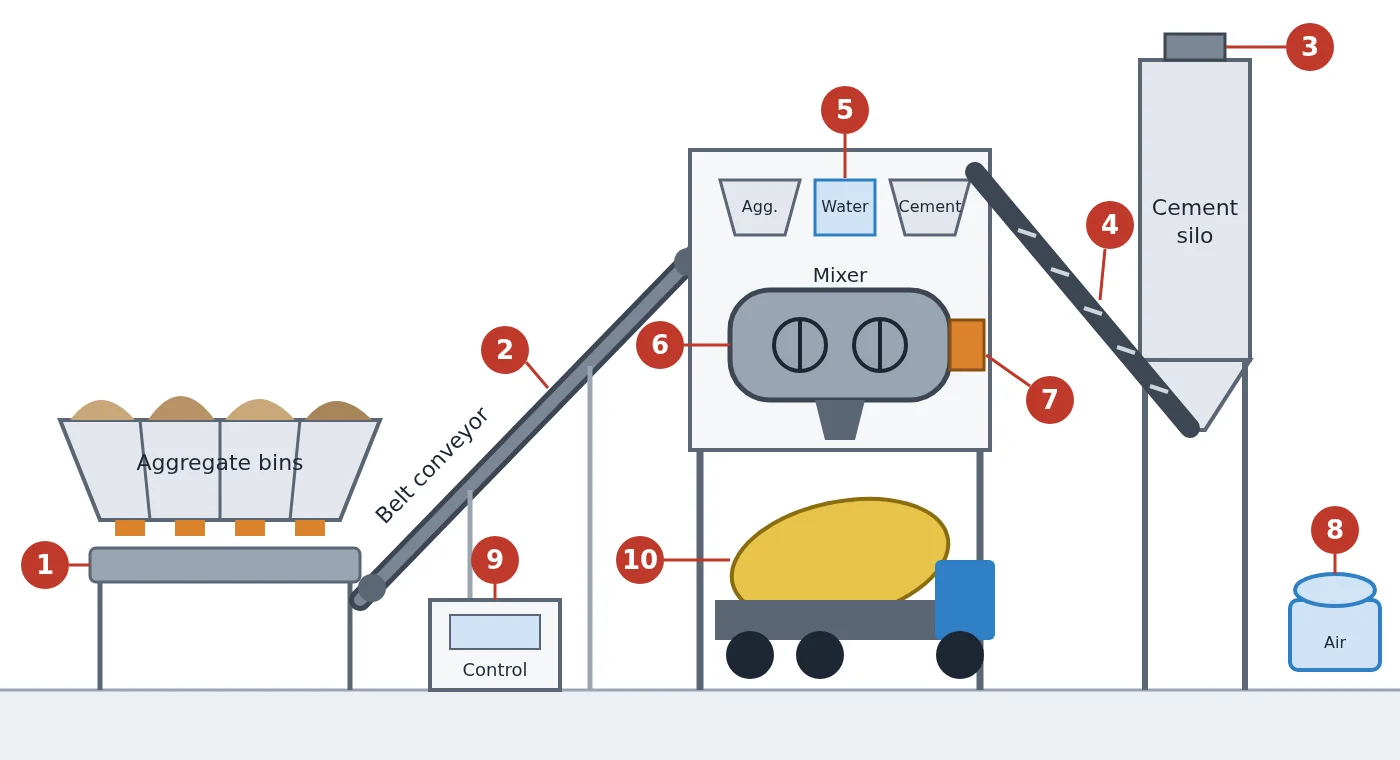
- Aggregate bin gates and the aggregate scale. Gates stick on fines, and dirt under a scale throws its reading.
- Belt conveyor. The belt must run straight (this is called tracking) at the right tension, with free-turning rollers and a working scraper.
- Cement silo top. The dust filter and the pressure-relief valve.
- Screw conveyor, the spiral feed that carries cement from the silo to the cement scale. Damp cement cakes in it and jams it.
- Weigh hoppers and load cells for aggregate, cement, water and admixture. A load cell is the sensor a hopper hangs from; it turns weight into an electrical signal.
- Mixer: arms, blades, liners, shaft-end seals and the discharge door.
- Gearboxes, motors and V-belts that drive the mixer and conveyors.
- Compressed air: the compressor, water trap, filter and oiler that work the gates and valves.
- Control room: the PLC (the plant’s computer), sensors, limit switches and emergency stops.
- Transit mixers. Their drum blades wear the same way the plant mixer’s do.
The Indian Standard for these plants, IS 4925:2004, expects this wear and builds for it. Clause 7.1 asks for a mixer drum and blades of high-manganese or abrasion-resistant steel, or carbon steel with replaceable liners of cast iron or abrasion-resistant steel. Clause 11.2 asks for an automatic oiler and filters on the air lines that feed every solenoid and air valve. Clause 11.4 makes the maker hand over operation and maintenance manuals and a spare parts catalogue, in triplicate.
Ask for those manuals at handover and keep one copy in the control room. Grease grades, oil grades and the blade gap in them are specific to your plant, and they win over any general list, this one included.
What should you check before and after every shift?
A short round with the plant stopped and locked off comes before every start-up. SANY’s batching plant maintenance guide (May 2026) lists these pre-start checks, and they suit any make:
- Power: the neutral wire is tight and no conductor is exposed.
- Bolts: mixer arm, blade and liner bolts and the drive mounts are tight.
- Inside the mixer: nothing has been left in it that could jam the shafts.
- Lubrication: every grease and oil point is topped up, including the shaft-end seals and the gearbox.
- Air: water drained from the air filter and air tank, the oiler filled, compressor oil at its mark.
- Water: the supply is clean.
- A no-load run of 5 to 10 minutes: the shafts turn the right way, nothing leaks from the oil, water or air lines, and the discharge door opens and shuts freely.
After the last batch, wash the mixer out the same day. SANY’s advice is to scrape the residue off the drum walls, shafts and discharge opening and rinse, and if needed to run a few stones with water for a minute to scour it. Flush the water and admixture tanks and their lines as well; admixture left standing in a line dries to a crust.
Hardened concrete on the arms and blades is something a QCI auditor checks for: the checklist asks whether the drum and blades are clean of any appreciable build-up.
Two daily items come from the QCI criteria rather than the maker: look at the aggregate stockpile for mixed sizes and dirt, and measure aggregate moisture so the water in each batch can be corrected. Wet sand carries water into the mixer. If nobody corrects for it, the concrete comes out weaker than its recipe.
What is the maintenance schedule for a batching plant?
The Quality Council of India’s ready-mix plant scheme sets a minimum calendar in Table 10 of its Criteria for Production Control of Ready Mix Concrete, published with the Building Materials and Technology Promotion Council (Issue 1, May 2013, still the criteria document on the scheme’s page in November 2026). A plant seeking certification keeps a record against every line. SANY’s guide fills in the mechanical work around it, interval by interval.
Table 1: Batching plant maintenance schedule, the QCI minimum and a maker’s routine
| How often | QCI minimum (Table 10) | SANY’s routine (May 2026) |
|---|---|---|
| Daily | Aggregate stockpile for segregation and dirt; central mixer blades and concrete build-up | Oil and grease levels; shaft seals for leaks; control panel alarms and emergency stops; clear build-up from the mixer, discharge area and chutes |
| Weekly | Cement and fly ash storage for leaks and weather-tightness; conveyor belts and rollers for wear and alignment; truck mixer blades and build-up | Grease every point, including door hinges, belt pulleys and drive chains; calibrate the scales; belt tension and alignment; blade, scraper and arm wear; tighten fasteners and vibrator bolts; compressor oil; bin doors and dust seals |
| Monthly | Calibrate every scale (mechanical and load-cell), water meter and admixture dispenser | Drain the compressor’s condensate; tighten tower and bin anchor bolts; blades and liners for cracks; recalibrate; hydraulic hoses; discharge door seal gap (about 2 mm); gearbox oil condition; water and admixture lines for leaks |
| Quarterly | Change oil in gearboxes and oil baths | Open up the mixer and replace worn blades, scrapers and liners; test motor insulation with a megger; silo aeration and pressure-relief valves; full scale calibration by a qualified technician; replace worn bearings and belts, and load cells or sensors that have drifted |
Print the table, add your plant’s own grease points from the manual, and have whoever does each check sign against it.
How often should a batching plant be calibrated?
Monthly, if you want QCI certification. The outer limit in IS 4926:2003, the code of practice for ready-mixed concrete, is wider: every two months for mechanical knife-edge scales and every three months for load-cell scales. MEKA’s guide adds a recalibration after any major repair or load-cell change.
The QCI checklist, which draws on Annex E of IS 4926, asks for three things a buyer can check on any plant:
- Records showing at least 500 kg of calibrated, stamped test weights were used.
- Permanent fittings on the hoppers for applying test weights, so a check needs no dismantling.
- Calibration staff who are competent and trained.
The recheck runs over the scale’s working range in steps of no more than 20 kg for cement, mineral admixture and water, 50 kg for aggregate and 1 kg for chemical admixture. Load cells must also be protected from moisture.
MEKA’s calibration guide (January 2026) sets out the routine in five steps:
- Lock the plant out. Clean the hopper, free anything rubbing on it, and look over the load-cell cables and junction boxes.
- Zero the empty scale and watch it for 2 to 3 minutes. It should hold steady.
- Add test weights in steps. MEKA reads at 5, 20, 40, 60, 80 and 100 per cent of capacity, and where a large scale needs more weight than you have, builds up the load with water or aggregate.
- Read on the way up and on the way down. If the same load reads differently in each direction, something is rubbing or binding.
- Adjust the span, recheck every point, then label the scale with the date and the next due date and file the sheet.
Keep silo valves and vibrators still while you weigh, and calibrate an aggregate moisture probe on its own. Once calibrated, each batch has to land within IS 4926’s limits: ±2% for cement and ±3% for water and aggregate. Table 4 in the guide to how a batching plant works sets these beside the tighter IS 4925 machine limits.
When should mixer blades and liners be replaced?
Replace a blade when it has worn to less than two-thirds of its original height. That is IS 4926 clause 9.1.4.4, as the QCI checklist quotes it: measure the blade at the point of largest drum diameter nearest the drum head, from the drum shell to the blade edge. The checklist applies the rule to the plant’s central mixer and to every truck mixer, and it expects worn blades and arms to be replaced at once, not at the next convenient shutdown.
So write down each blade’s height when it is new. Without that figure, the two-thirds rule cannot be checked.
On a twin-shaft or planetary mixer, the manual also gives a gap between blade tip and liner. Too wide a gap leaves a layer of concrete on the liners. SANY lists a wrong blade-to-liner gap among the causes of a mixer overloading and tripping, and its quarterly overhaul replaces worn blades, scrapers and liners together. Before a mixer’s first operation, SANY’s guide says to mix about 1 m³ of mortar and then re-tighten the liners and blades.
The truck mixers that carry the plant’s concrete fall under the same blade rule, checked weekly. When a drum is worn past blades and into the shell, the concrete mixer drum replacement decision is explained separately. To compare drum sizes and makes before you add to the fleet, look through transit mixer models and prices.
What are the common problems in a batching plant?
Most faults fall into four groups: the plant will not start, it weighs wrong, material will not move, or the mixer misbehaves. The table pairs each symptom with its usual cause, drawn from SANY’s fault list and MEKA’s calibration guide.
Table 2: Common batching plant faults and what to check first
| Symptom | Usual cause | Check first |
|---|---|---|
| Mixer motor will not start | Low or no air pressure, an emergency stop not reset, a power or protection switch off | Air pressure gauge, then reset each stop switch in turn |
| Batches weigh wrong, batch after batch | Wrong “drop” setting (the material still falling after the gate shuts) or fine-feed values; uneven feed; a blocked discharge; a choked dust collector | Reset drop and fine-feed values, clear the gate, clean the filter |
| Empty scale reading drifts | Loose load-cell wiring or a damaged cell; poor earthing or cable shielding | Disconnect cells one at a time; check earthing and the cable shield |
| Cement scale reading falls after weighing | The butterfly valve under the cement hopper is not closing fully, so cement leaks through | Clean the valve and reset its limit stop |
| Aggregate weighed but not discharged | Buffer hopper door not shut, belt not running, or no output signal from the weighing system | Door position, belt start, discharge sequence on the control screen |
| Belt slips or runs to one side | Wrong tension or alignment; material jammed in hoppers or under the belt | Tension, tracking, and clean the rollers |
| Cement will not flow from the silo | Cement has caked from damp; aeration off | Aeration air supply, silo filter and seals |
| Mixer trips | Overfilled batch, wrong blade-to-liner gap, loose V-belts, loose safety switch on the mixer cover | Batch size, blade gap, belt tension |
| No discharge after mixing | Pause button not reset, discharge blocked in the software, damaged discharge solenoid valve | Console and screen settings, then the solenoid valve |
| Concrete not evenly mixed | Mixing time too short, water nozzles fitted wrongly | Mixing time setting, nozzle direction |
| No signal when the discharge door closes | Low hydraulic pressure, old concrete jamming the door, loose or faulty proximity switch | Clean the door in manual mode, hydraulic pressure, the switch |
Weighing faults cost the most, because they do not stop the plant. It keeps running and keeps making the wrong concrete. If a cube test fails, the batch printout and the last calibration sheet are the first papers anyone will ask to see. A hydraulic door that keeps sticking usually needs the same care as any other machine’s hydraulics, which is covered in hydraulic system maintenance.
Why do the air supply and power matter so much?
Air opens and shuts most of the gates and valves in a plant. Water in the air lines rusts valve seats and makes cylinders stick, and a cement valve that does not shut is the “scale reading falls” fault in Table 2. That is why IS 4925 asks for an oiler and filters on the air lines, and why draining the air tank is a daily job. Under clause 11.8, if the maker does not supply the compressor, the buyer must tell the maker the air pressure the site will provide. For sizing a site compressor, see the guide to the air compressor for construction and quarries.
Power faults look like control faults. SANY traces control alarms to unstable voltage, signal interference, a failed sensor or a PLC error. IS 4925 asks for totally enclosed, fan-cooled motors protected against dust and able to run at up to 50 °C. Where the plant runs on a generator, size it with the starting load of the mixer motor in mind; the guide to a diesel generator for a construction site shows how.
Who should do the maintenance, and what records should you keep?
Split the work by skill. The plant operator does the pre-start checks, the wash-out and the daily look at the blades. A fitter does the weekly and monthly mechanical work. Calibration needs the test weights and a trained person, either from the maker or a calibration agency. If you are hiring for the control room, the batching plant operator role and its pay are covered separately.
Keep one logbook with the date, the item, what was found, what was done and who signed. The QCI criteria expect records against every line of Table 10 and a full record of every scale check. The same log tells you which part fails most often, and that is the spare to keep on the shelf. SANY’s quarterly replacement list is a fair starting point for spares: blades, scrapers and liners, bearings, belts, relays and switches, sensors, limit switches and load cells.
Which machines around the plant need the same routine?
A plant is only as reliable as the machines feeding it and carrying its output:
- Transit mixers. Weekly blade checks under the QCI calendar, the same two-thirds rule, a clean and readable water gauge, and a water meter whose calibration record stays within 2%. The QCI auditor inspects at least 10 per cent of the trucks on the plant’s register. The transit mixer parts guide names what wears on the truck. Common 6 m³ trucks include the Schwing Stetter AM 6 (C2) and the AJAX AF 6XE.
- Loaders feeding the bins. A wheel loader that keeps the bins full sets the plant’s pace. Browse wheel loader models sized to your bin height.
- Concrete pumps. A pump waiting on a broken plant wastes a crew, and the reverse is just as true.
The full equipment list for a ready-mix site is in RMC plant equipment. If your plant moves between sites, the guide to mobile vs stationary batching plants covers the foundations and set-up checks for each move. When you are ready to match pumps to your plant’s output, compare concrete pump models and prices and talk to a dealer.
Sources
Read on 11 November 2026: the QCI ready-mix plant certification scheme’s Criteria for Production Control of Ready Mix Concrete (Issue 1, May 2013; Table 10, Table 11 and the Section B checklist, which quotes IS 4926:2003 clauses 9.1.4.4 and E-1); IS 4925:2004, Concrete Batching and Mixing Plant: Specification (clauses 7.1, 11.2, 11.4 and 11.8); SANY’s “Concrete Batching Plant Maintenance: A Practical Guide” (20 May 2026); and MEKA’s “Calibration in Concrete Batching Plants: A Step-by-Step Guide” (22 January 2026). Transit mixer names are from each machine’s listing. Batching plants are not listed on DesiMachines, so this guide names no plant prices.
Prices, specifications and features are indicative, vary by variant, location and date, and should always be confirmed with the official OEM or authorised dealer before any purchase decision. DesiMachines is not liable for decisions taken on the basis of information that may have changed after publication.