
 Excavator
294 models
Excavator
294 models  Backhoe Loader
51 models
Backhoe Loader
51 models  Crane
68 models
Crane
68 models  Concrete Mixer
79 models
Concrete Mixer
79 models  Wheel Loader
54 models
Wheel Loader
54 models  Compactor / Roller
45 models
Compactor / Roller
45 models  Motor Grader
42 models
Motor Grader
42 models  Concrete Pump
66 models
Concrete Pump
66 models  Skid Steer Loader
11 models
Skid Steer Loader
11 models  Telehandler
13 models
Telehandler
13 models 


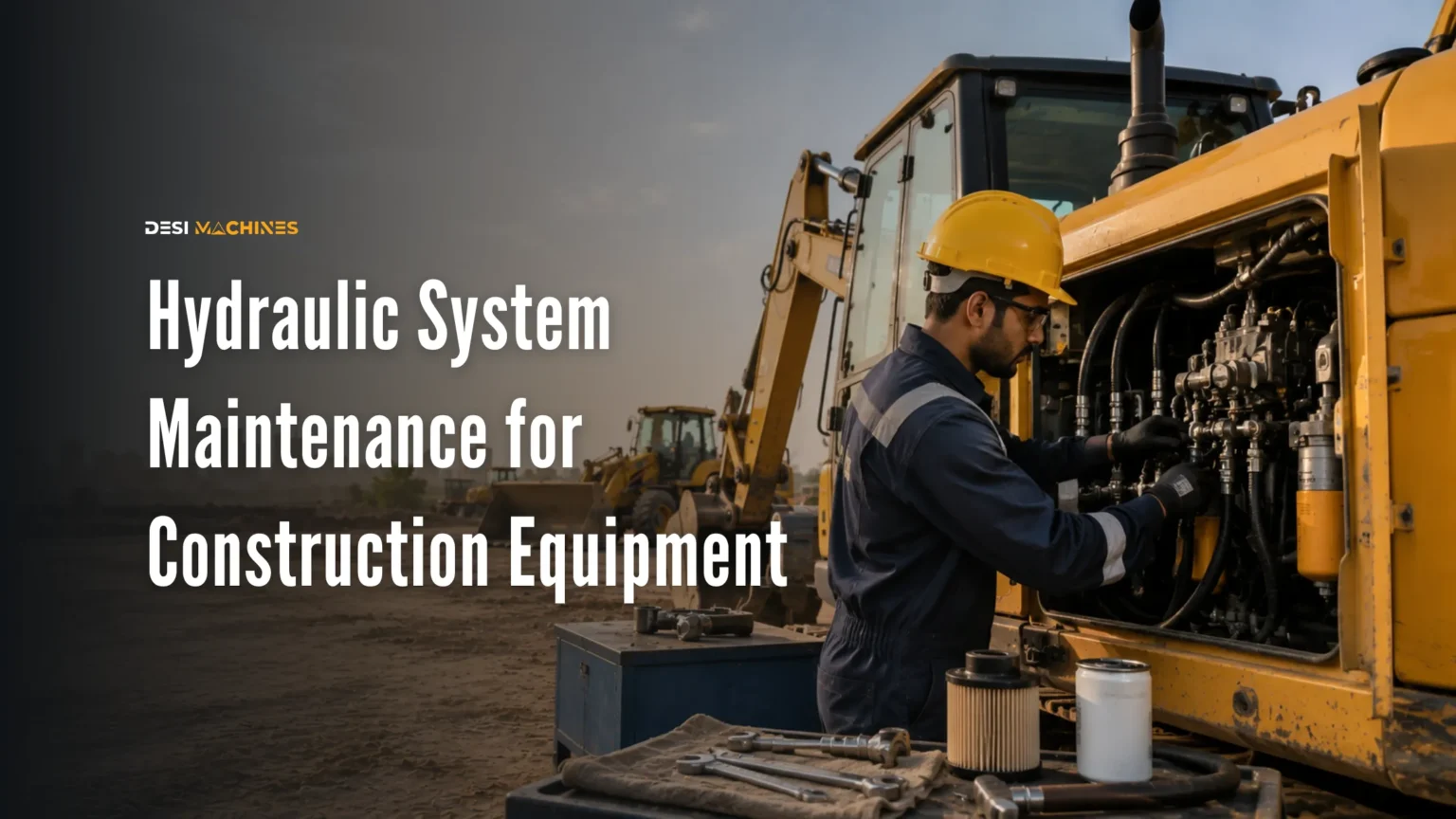
What does hydraulic system maintenance actually involve?
Five things, and none of them are complicated. Check the oil level daily, before the machine starts work and with the boom in the position the manual specifies. Look at the oil itself for colour and smell. Change the hydraulic filters on the hour-meter, not when someone remembers. Walk around the hoses and cylinders looking for weeping joints. Keep the cooler clean of dust and mud so the oil does not overheat.
The reason these small jobs matter so much is the tolerances inside the system. A hydraulic pump and the control valves work with clearances finer than a human hair. Grit that you cannot see in a sample of oil is easily large enough to score those surfaces, and once a pump starts wearing it makes more metal particles, which wear it faster. That loop is why a neglected hydraulic system fails suddenly after months of looking fine.
If you are not sure which parts of your machine are hydraulic in the first place, the excavator components guide shows where the pump, valves, cylinders and tank sit, and how a wheel loader works covers the same ground for a loader.
Why does hydraulic oil get dirty, and why does it matter?
Dirt gets in through three routes, and all three are avoidable. The tank breather draws air in as the oil level rises and falls, and a torn or missing breather draws dust straight in with it. Cylinder rods carry a film of mud back into the seals every time they retract. And careless topping up with an open funnel or a dusty jerry can pours contamination directly into a clean tank.
Water is the other contaminant, and in India it is a monsoon problem. Water in hydraulic oil turns it cloudy or milky, strips its ability to protect metal surfaces and causes rust inside the tank. If the oil on your dipstick looks like weak tea with milk in it, stop and investigate before working the machine hard.
The simplest habit that protects a hydraulic system costs nothing: wipe the filler cap and the area around it before you open it, and never leave the tank open longer than the pour takes. On a dusty site that one rule does more good than an early oil change.
How often should hydraulic oil and filters be changed?
As a general pattern on machines sold here, the hydraulic return filter is changed at around 250 to 500 hours and the hydraulic oil itself at roughly 1,000 to 2,000 hours, with the exact intervals set by the manufacturer for your model. A new machine usually gets an earlier first filter change while the system beds in.
Those intervals assume ordinary conditions. Two Indian realities shorten them. Heavy dust, such as a machine feeding a stone crusher, loads the filters far faster. So does running a hydraulic rock breaker, because a breaker works the oil hard and heats it, and hot oil ages quickly. If your machine spends its life on a breaker, treat the manual interval as a ceiling.
Change the filter with the oil, never one without the other. A new charge of clean oil pushed through a loaded filter is a waste of both, and the machine-specific quantities and grades are set out in the guide on engine oil and hydraulic oil capacity of excavators and in the blog on getting the fluids right.
What are the warning signs of a hydraulic problem?
A hydraulic system almost always warns you before it fails. The table below lists the symptoms operators report most often and what each one usually means.
| What you notice | Usual cause | What to do first |
|---|---|---|
| Boom or bucket moves slowly, machine feels weak | Low oil level, clogged filter, or a worn pump | Check level and filter before suspecting the pump |
| Movement is jerky or stutters | Air in the system, or oil level too low | Check level and look for a leaking suction line |
| Oil looks milky or cloudy | Water contamination | Stop, find the water source, change oil and filter |
| Oil smells burnt and is very dark | Overheating, often a blocked cooler | Clean the cooler fins, check the fan |
| Boom sinks slowly when parked | Worn cylinder seals or a leaking control valve | Do not park loads overhead; get the cylinder inspected |
| Whining or screaming noise from the pump | Starved pump: low oil, blocked suction, wrong grade | Shut down immediately, check level and grade |
| Oil temperature warning during normal work | Dirty cooler, low level, or oil past its life | Clean cooler, check level, review service history |
Table 1: Common hydraulic symptoms and their usual causes
The pattern worth remembering: a weak or noisy machine is far more often low or dirty oil than a failed pump. Check the cheap things first. Replacing a pump on the strength of a noise, when the real fault was a blocked suction strainer, is an expensive way to learn that.
What pressure and flow does a hydraulic system run at?
Higher than most people expect, which is why a pinhole leak in a hose is genuinely dangerous. Backhoe loaders sold in India run their main hydraulics at roughly 230 to 270 bar. The JCB 3DX and JCB 3DX Plus both work at 270 bar with a maximum pump flow of 114 litres per minute. The Mahindra Earthmaster SX runs at 250 bar and 112 litres per minute, the Tata Hitachi Shinrai Prime at 245 bar and 113 litres per minute, and the BULL CH76 Challenger at 230 bar and 108 litres per minute.
At 250 bar, oil escaping a pinhole comes out as an invisible jet fast enough to pierce skin. A fluid injection injury looks like a small puncture and is a surgical emergency. Never run a hand along a hose to find a leak, and never use a finger to check a suspected pinhole. Use a piece of cardboard held at arm’s length, with the machine’s controls operated by someone else.
How do you look after hoses, cylinders and seals?
Hoses fail from the outside in, and they give plenty of notice. Look for cracked or hardened outer covers, rubbing where a hose crosses a frame member, kinks near the fittings, and any weeping at the crimped ends. A hose that has been chafing against steel will fail there, so fix the routing rather than only replacing the hose.
Cylinder rods should be bright and unmarked. A scored or pitted rod cuts the seal every time it strokes, which is why a cylinder that has been left with a damaged rod keeps leaking however many times the seal is replaced. Rust on a rod usually means a machine parked outside through the monsoon with the cylinders extended; park with rods retracted wherever the machine’s design allows, so the exposed surface is minimal.
Seals are consumables. A slight film of oil on a rod is normal lubrication, but drips that mark the ground overnight are a seal that has gone. Attend to it early, because a failing seal lets dirt into the cylinder as readily as it lets oil out. The same logic applies to the running gear, which the excavator undercarriage guide covers in detail.
What changes in the monsoon and in heavy dust?
These are the two conditions that decide hydraulic life in India, and they pull in opposite directions.
In the monsoon the enemy is water. Check the breather is intact, keep the filler area covered, and inspect the oil after any spell of standing water on site. Machines parked in the open for weeks should be started and worked briefly rather than left, and rods should be retracted or greased.
In the dry months on a crusher, quarry or highway job, the enemy is grit. Clean the cooler fins regularly, because a dust-blanketed cooler pushes oil temperature up, and heat ages oil faster than hours do. The engine side of the same problem, and the order to check it in, is covered in excavator overheating: causes and checks. Shorten filter intervals rather than stretching them, and be strict about how oil is stored and poured.
A machine that gets this attention will usually reach resale with its original pump. One that does not will have had at least one large hydraulic bill first, and the backhoe loader maintenance schedule shows how these checks fit into a normal daily and 250-hour routine. Because capacities scale with machine size, the operating weight guide is a useful way to place your machine in the range.
Looking at machines rather than servicing one? Compare specifications across the excavator range and the backhoe loader range, or browse the rest of the parts and running costs guides.
Filters, seals and hoses are where parts quality shows up first: the spare parts buying guide sets out which of them must be genuine, which can safely be aftermarket, and what that choice does to a warranty claim.
Hydraulic filter and oil changes sit inside a wider hour-based routine that also covers the engine, transmission and axles. The full interval-by-interval picture is set out in the construction equipment service schedule.
Oil is only half the job. The pins, bushes and bearings outside the hydraulic system need grease instead, and the greasing guide sets out the points and intervals.
The filters that keep that oil clean are covered in the guide to excavator filters, including why a hydraulic filter left in past its life goes into bypass.
The pressure and flow figures above are backhoe loader figures. The equivalent numbers for wheel loaders, which run considerably higher, are in the guide to wheel loader hydraulic problems.
Service intervals quoted here are general patterns across machines sold in India and do not replace the manufacturer’s schedule for your model and variant. Pressure and flow figures are manufacturer specifications listed on DesiMachines at the time of writing. Specifications are indicative, vary by variant, location and date, and should always be confirmed with the official OEM or authorised dealer before any purchase decision. DesiMachines is not liable for decisions taken on the basis of information that may have changed after publication.