
 Excavator
316 models
 Backhoe Loader
54 models
 Crane
68 models
 Concrete Mixer
79 models
 Wheel Loader
54 models
 Compactor / Roller
45 models
 Motor Grader
42 models

 Concrete Pump
66 models
 Skid Steer Loader
11 models


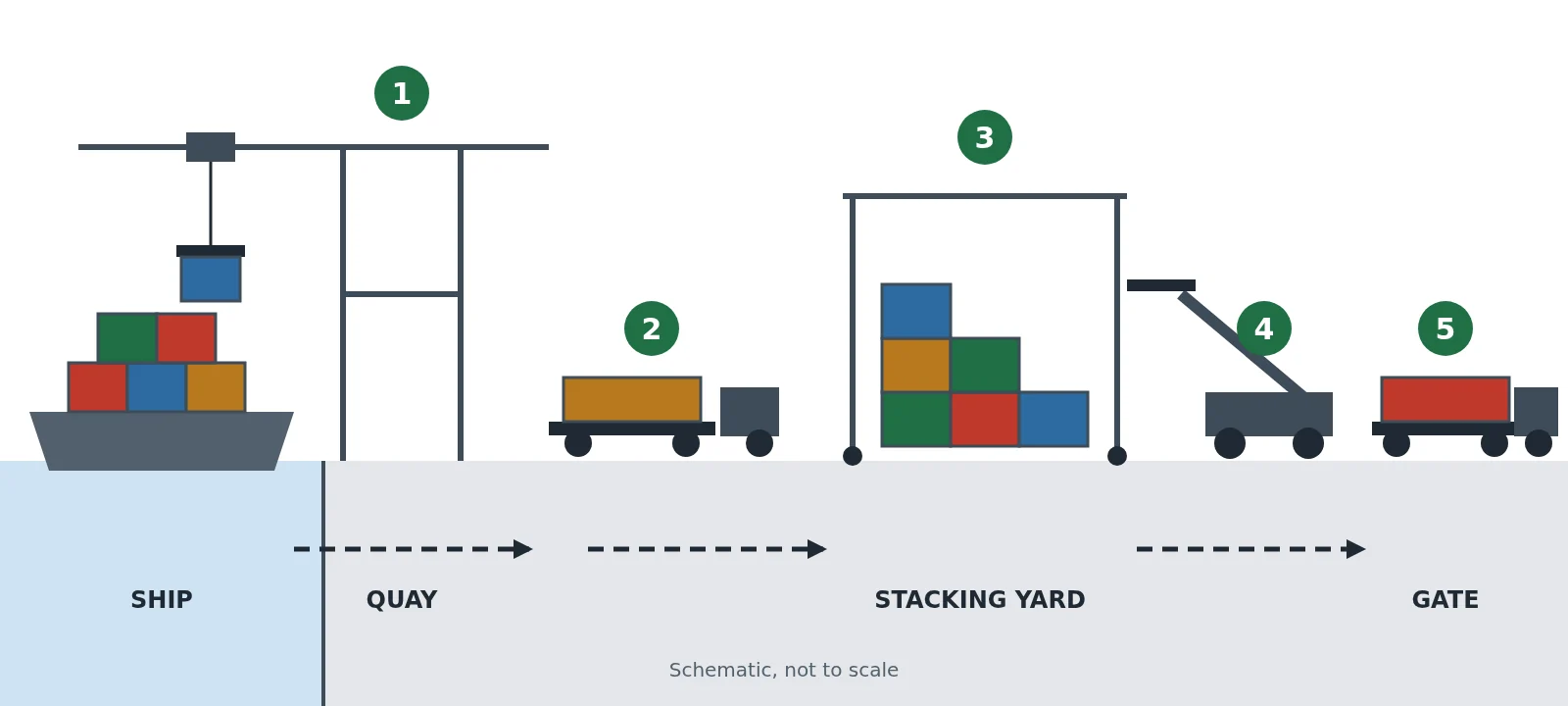
A container coming off a ship at an Indian port usually passes through four machines before it leaves the gate. A quay crane lifts it off the ship, a tractor and trailer carry it into the yard, a yard crane or reach stacker puts it on a stack, and a yard machine later loads it onto a truck. That chain is what people mean by container handling equipment, and every machine in it grips the box the same way: through the four steel corner fittings at its top or bottom corners.
This guide walks the chain one machine at a time. It then explains how a port terminal differs from an inland container depot (ICD) or a container freight station (CFS), how heavy a box really is, and the Indian Standards that say how a container may be lifted. The last part covers the bulk and break-bulk side of a port, where the machines are ones a contractor may already own. DesiMachines does not list quay cranes, yard gantry cranes, straddle carriers, reach stackers or terminal tractors, so they are described here only to explain the work.
Which machines move a container from ship to gate?
Five kinds of machine share the job at a large container terminal, and each one does a single step. The quay crane works between the ship and the quay. Tractors and trailers, or straddle carriers, shuttle boxes between the quay and the stacks. Yard cranes, straddle carriers or reach stackers build and break the stacks. Forklifts work at the warehouse end, where cargo goes into and out of the box.
| Step | Machine | What it does | Where you find it |
|---|---|---|---|
| Ship to quay | Ship-to-shore (quay) crane | Lifts boxes between the ship and the quay | Port container berths |
| Quay to yard | Terminal tractor and trailer, or straddle carrier | Carries boxes to and from the stacks | Ports, large yards |
| Stacking | Rubber-tyred or rail-mounted gantry crane, straddle carrier, reach stacker | Builds the stacks and picks boxes out of them | Ports, ICDs, CFSs |
| Empty boxes | Empty container handler | Stacks empty boxes only | Ports, ICDs, CFSs, empty depots |
| Into and out of the box | Forklift, side loader | Loads pallets and crates into the box, or lifts a box from its side | CFSs, ICDs, warehouses |
What does each container handling machine do?
Ship-to-shore crane. This is the tall crane on rails along the quay. Instead of a hook it carries a spreader, a steel frame that comes down on top of the box and locks into its four top corner fittings with twistlocks (turning pins that lock inside the fitting). Most cranes move one box at a time. Newer ones can take two to four 20-foot boxes at once, and a crane that lifts two 20-foot boxes end to end is generally rated at 65 tonnes. The driver sits in a cabin that hangs from the trolley and runs out over the ship. Work stops when the wind goes above about 22 metres a second. Most of these cranes run on electric power from the quay, not on their own diesel engine.
Yard gantry crane. A gantry crane stands on legs over several rows of boxes and a truck lane. The rubber-tyred version (RTG) runs on tyres, so it needs no track; the rail-mounted version runs on a fixed track. An RTG is slow to travel but reaches high, which is why terminals short of space use it to stack boxes several high.
Straddle carrier. A tall, open-framed vehicle that drives over a box, grips it from the top with a spreader and carries it underneath. Some can stack four high. They travel at up to about 30 km/h with a laden box, and the biggest can lift up to 60 tonnes, which is two full boxes. The driver sits sideways at the very top, facing the middle, to see both ahead and behind.
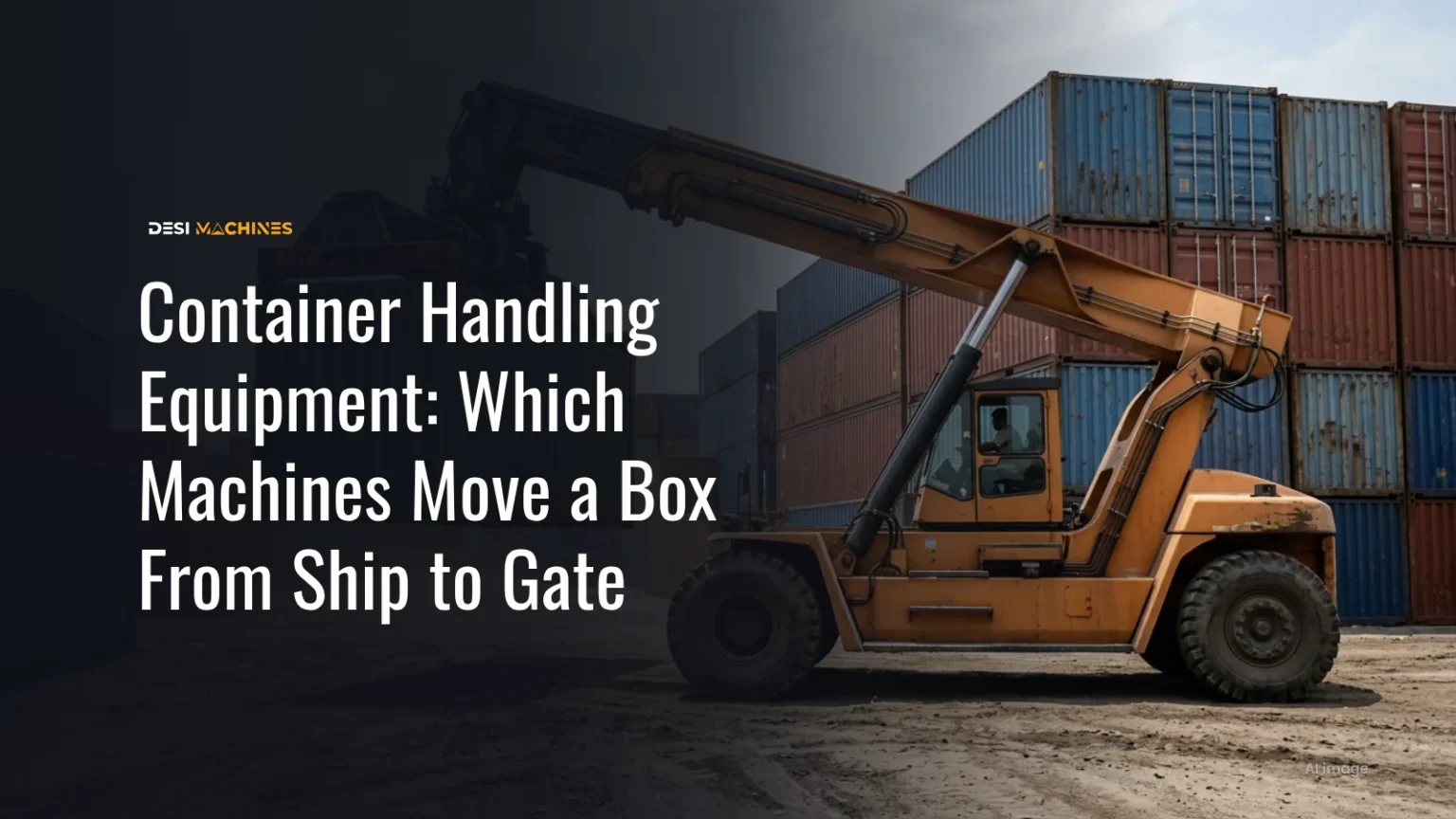
Reach stacker. A heavy truck with a telescopic boom and a spreader at its tip. It works from one side of a stack and can reach a box in the second row, so a block can be kept four boxes deep. Against a forklift it stacks higher and stores more boxes in the same ground, which is why reach stackers have gained ground in container yards. How a reach stacker lifts and what it is rated for are covered in the guide to types of forklift. The battery version, and how a yard fits its charging around the shifts, is covered in the guide to electric reach stackers.
Empty container handler. A machine built to stack empty boxes only, quickly. An empty 20-foot box weighs about 2,200 kg, so it needs far less capacity than a machine for laden boxes.
Terminal tractor. A short tractor that pulls container trailers around the yard. It has a one-person cab, a fifth wheel (the coupling plate) that lifts the trailer nose hydraulically, typically by 380 mm with a 32,000 kg rating, and a typical top speed of about 40 km/h, since the off-road versions are not built for highway running.
Forklifts and side loaders. Big counterbalanced forklifts handle containers at some depots, and side loaders pick a box up from one side. Smaller forklifts do the warehouse work: unloading pallets and crates from a box at the dock and stacking them in the shed. Sizing them is explained in the guide to forklift capacity and load centre.
How is a port terminal different from an ICD or a CFS?
An ICD and a CFS are both container yards away from the ship, so neither needs a quay crane. What they keep is the yard work: stacking, picking, loading trucks and, where a rail siding exists, moving boxes between road and rail.
The Central Board of Indirect Taxes and Customs (CBIC) defines both, in Chapter 27 of its Customs Manual, as “a common user facility with public authority status equipped with fixed installations and offering services for handling and temporary storage of import/export laden and empty containers”. The difference is in Customs status:
- An ICD is a Customs station in its own right, usually inland, away from the port it serves. Bills of entry, shipping bills and assessment are all done there, like a dry port.
- A CFS is attached to a parent Customs station (a port, airport, land Customs station or ICD) and cannot exist on its own. It is usually near the port, set up to take cargo work out of it. A CFS mainly handles examination of goods, stuffing and unstuffing of containers, and grouping or splitting of cargo.
For a machine owner, one detail matters more than the definitions. Under the Handling of Cargo in Customs Areas Regulations, 2009, the company that runs an ICD or CFS has to list its area, equipment and infrastructure when it applies. Guidance issued on these regulations in 2009 (Customs Circular 13/2009) lets the Commissioner of Customs lay down the quantity and specification of material handling equipment, and says the facilities need not be the same at every depot. So a depot’s fleet is set by its own approval and its own cargo, not by one national list. Ask for that list before you quote to supply or hire machines to one.
How much does a container weigh, and which machine can lift it?
An empty 20-foot box weighs about 2,200 kg and an empty 40-foot box about 3,800 kg. Loaded, both are commonly rated to 30,480 kg (about 30.5 tonnes), and the ISO standard for container sizes raised the maximum to 36,000 kg in 2016. Exact empty weights vary by maker, so the figure on the box’s own data plate is the one to use.
| Container | Empty (tare) weight, approx. | Common maximum gross weight | ISO maximum gross weight (2016) |
|---|---|---|---|
| 20-foot standard | 2,200 kg | 30,480 kg | 36,000 kg |
| 40-foot standard | 3,800 kg | 30,480 kg | 36,000 kg |
The arithmetic explains why yards split their machines. A full 20-foot box at 30,480 kg weighs about 14 times its empty weight (30,480 ÷ 2,200). A full 40-foot box weighs about 8 times its empty weight (30,480 ÷ 3,800). A machine sized for empties can be light and quick; a machine sized for laden boxes has to carry the whole gross weight, at height, often one row back.
The same arithmetic answers a question contractors ask about Hydras. A pick-and-carry crane such as the Escorts Hydra 15 is rated at 15 tonnes maximum lifting capacity, and the Escorts Hydra 14 at 14 tonnes, as listed. Those are their best figures, at the shortest radius. A full box at 30,480 kg is about twice the Hydra 15’s maximum, so a laden container is never a Hydra lift. Capacity also falls fast as the boom reaches out: the Escorts F23 2WD is listed at 23 tonnes at 1.5 m radius but 0.9 tonne at 16.6 m. An empty box is light enough only if the machine’s own chart allows it at the radius you need, a chart read as the guide to crane load charts explains, and only with slings rigged as the next section describes.
How should a container be lifted?
IS 7622:2001, the Indian Standard for handling and securing Series 1 freight containers (identical to ISO 3874), names the lifting methods and says which may be used on which box. Its rules that matter most on a yard:
- A spreader lifts from the top openings of all four top corner fittings, with the pull straight up.
- Slings may also pull from the four top corner fittings at an angle. The standard lists which boxes may be lifted that way, and on a 10-foot box the slings must stand at least 60 degrees from the horizontal.
- Slings from the side openings of the four bottom corner fittings must apply their pull no more than 38 mm from the outer face of the fitting. On a loaded box they must also stand at least a set angle from the horizontal: 30 degrees for a 40-foot or 45-foot box, 37 degrees for 30-foot, 45 degrees for 20-foot and 60 degrees for 10-foot. A flatter sling squeezes the box sideways.
- Forks may lift a box only through its fork pockets, never under the base, and must go at least 1,825 mm into the pockets. A second, inner set of pockets on a 20-foot box is for empty boxes only. Forks are not allowed on 45-foot boxes at all.
Each kind of container machine also has its own stability standard, which a buyer can ask the maker to confirm:
| Indian Standard | What it covers |
|---|---|
| IS 6566:2001 (ISO 668) | Container sizes and ratings |
| IS 7622:2001 (ISO 3874) | How containers are lifted and secured |
| IS 15515:2004 | Extra stability tests for variable-reach trucks (the family reach stackers belong to) handling containers 6 m long and above |
| IS 14945:2001 | Extra stability tests for counterbalanced forklifts handling containers 6 m long and above |
| IS 15611 (Part 2):2005 | Extra stability tests for side-loading forklifts handling containers 6 m long and above |
| IS 15926:2012 | How the stability of a straddle carrier is calculated |
The truck standards test stability with the wind blowing at up to 12.2 metres a second, which is Beaufort force 6, a strong breeze. On a coastal yard in the monsoon or a cyclone warning, that is the line past which the machine’s rating no longer holds.
What handles bulk and break-bulk cargo at a port?
Not everything at a port comes in a box. Coal, ore, fertiliser and food grain arrive as dry bulk, and steel, machinery and timber as break-bulk, meaning loose pieces lifted one by one. This side of the port uses different machines, and some of them are the same machines a contractor runs on a road job.
Cochin Port’s published Scale of Rates (2019) is a good picture of it. The port hires out its own forklifts, a reach stacker and harbour mobile cranes, the last charged per tonne of dry bulk and break-bulk cargo. Its toll table also lists “Cranes, Pay loaders, Bull dozers, Excavators” among the vehicles that pay to enter the port. Outside machines, in other words, do work inside the gate.
The wheel loader, the payloader of every Indian site, is the stockpile machine of a bulk yard: it builds and reclaims heaps and loads trucks and hoppers. The guide to wheel loaders explains the load-and-carry cycle. Two common examples are the Liugong 856H MAX (3.5 m³ bucket, 5,500 kg payload, 18,350 kg operating weight) and the Liugong 848H (2.8 m³ bucket, 4,500 kg payload, 16,870 kg operating weight), both as listed in November 2026. Compare more wheel loader models and specifications and talk to a dealer near the port.
Break-bulk lifts in a port yard, such as steel, machinery and crates, are crane work. The types of crane a port uses, from harbour cranes to pick-and-carry Hydras, are set out in the guide to types of cranes.
Which of these machines can a machine owner supply?
The container machines themselves (quay cranes, gantry cranes, straddle carriers, reach stackers and terminal tractors) are specialist equipment, usually bought by the terminal or depot operator. A contractor’s opening is on the work around them: bulk stockpiles, yard maintenance, break-bulk lifts and building or repairing the yard itself.
- Wheel loaders for bulk heaps and truck loading, as above.
- Pick-and-carry cranes for break-bulk and general yard lifts within their load charts. The Escorts Hydra 14 vs Hydra 15 comparison shows how two common models differ.
- Telehandlers for pallet and material lifts. They are not container machines: the 13 telehandlers listed on DesiMachines lift between 2,721 kg and 7,000 kg at most, against a laden box of up to 30,480 kg. See the telehandler models.
Building and repairing berths, breakwaters and yards, and dredging the channel, is a separate job with its own machine list on the page for port equipment, and warehouse handling is on the page for material handling equipment. Live port and harbour packages appear on the tenders and opportunities desk. Why a fenced, paved container yard suits battery machines is explained in the guide to which jobs suit an electric machine, and how a machine itself travels by sea in a container is covered in the guide to construction equipment exports. For other industries broken down by machine, see the heavy equipment guides.
Where the figures in this guide come from. The ICD and CFS definitions are from Chapter 27 of the CBIC Customs Manual 2023; the equipment rule is from Customs Circular 13/2009 as reproduced in Jawaharlal Nehru Custom House Public Notice 28/2009. The lifting rules are from IS 7622:2001 with its Amendment 4 (2010); the stability standards are IS 15515:2004, IS 14945:2001, IS 15611 (Part 2):2005 and IS 15926:2012. Port equipment for hire and the port toll table are from Cochin Port Trust’s Scale of Rates, effective 29 November 2019. Machine descriptions and container weights are from the Wikipedia entries for container crane, gantry crane, straddle carrier, reach stacker, terminal tractor and intermodal container. Machine capacities are from the listed specifications in November 2026.
Prices, specifications and features are indicative, vary by variant, location and date, and should always be confirmed with the official OEM or authorised dealer before any purchase decision. DesiMachines is not liable for decisions taken on the basis of information that may have changed after publication.