
 Excavator
316 models
 Backhoe Loader
54 models
 Crane
68 models
 Concrete Mixer
79 models
 Wheel Loader
54 models
 Compactor / Roller
45 models
 Motor Grader
42 models

 Concrete Pump
66 models
 Skid Steer Loader
11 models


A 100-tonne cement silo holds only about 75 to 80 cubic metres of cement. Cement silo capacity is quoted in tonnes, but a silo is really a volume, and each maker turns cubic metres into tonnes with its own figure for how much a cubic metre of loose cement weighs. MEKA works at 1.25 tonnes a cubic metre and Euromecc at 1.33, so the same steel tank can carry two different tonnage labels.
This guide shows how the tonnes figure is worked out, lists the sizes makers build, and then does the sum that matters to a plant owner: how much cement your plant burns in a day, and so how big a silo, and how many silos, you need. If you are new to the parts of a plant, start with the guide to types of batching plant and how one works.
How is cement silo capacity calculated?
Capacity in tonnes is the silo’s volume multiplied by the bulk density of cement. Bulk density is the weight of one cubic metre of loose powder, air spaces included.
The volume has two parts. The barrel, the upright cylinder, holds π × radius² × barrel height. The cone at the bottom holds a third of a cylinder of the same width and height, so π × radius² × cone height ÷ 3. Add the two and multiply by the density.
Parts of a cement silo and the two sums behind its capacity
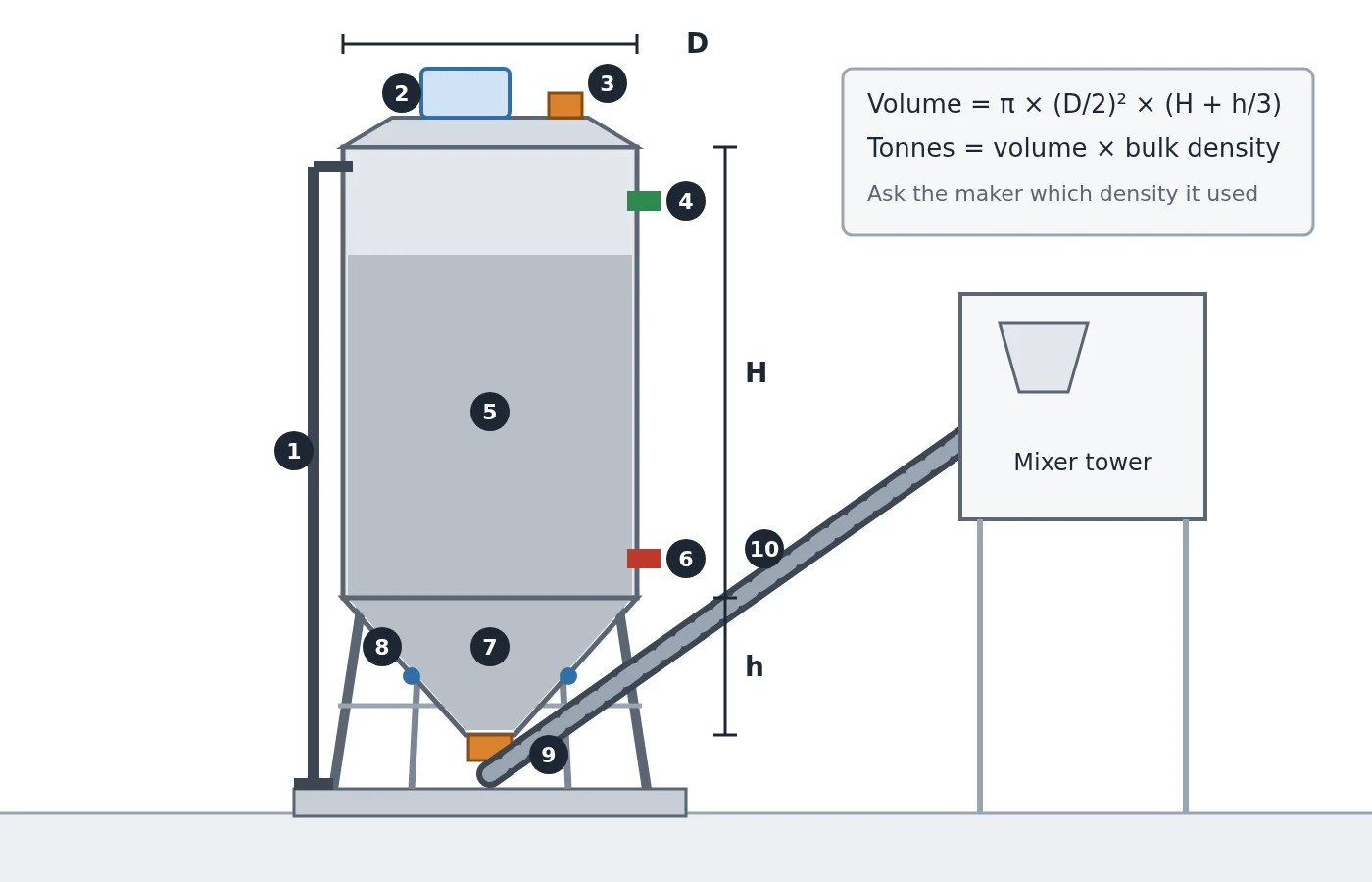
- Filling pipe. The bulk cement tanker blows cement up this pipe into the silo.
- Dust filter on the roof. It lets the delivery air out and keeps the cement dust in.
- Pressure safety valve. It opens if a delivery pushes the pressure inside too high.
- Maximum level indicator. It tells the control room the silo is full.
- Barrel, the cylinder that holds most of the cement.
- Minimum level indicator. It warns that the silo is running low.
- Cone, which funnels cement to the outlet.
- Aeration nozzles, small air jets that keep the cement in the cone flowing.
- Butterfly valve under the outlet. It shuts off the cement so the screw conveyor can be serviced.
- Screw conveyor carrying cement up to the cement weigher in the mixer tower.
The density is where the confusion starts. Three figures are in use:
- MEKA states its silo capacities “calculating at 1,25 t/m³”, that is 1.25 tonnes a cubic metre.
- Euromecc’s silo catalogue (September 2022) prints every capacity “assuming to store cement with bulk density 1,33 ton/m³”.
- IS 875 (Part 1), the Indian code of weights of building materials, gives cement a unit weight of 1,440 kg a cubic metre, and it is the figure Indian quantity sums use, as the cement bag weight guide explains.
| Density used | Who uses it | Capacity of an 80 m³ silo |
|---|---|---|
| 1.25 t/m³ | MEKA silo ratings | 100 tonnes |
| 1.33 t/m³ | Euromecc silo ratings | About 106 tonnes |
| 1.44 t/m³ (1,440 kg/m³) | IS 875 (Part 1) unit weight | About 115 tonnes |
So when two quotes both say “100 tonnes”, ask each maker for the volume in cubic metres. The volume is a measurement of the steel. The tonnes are a label.
A quick check on a maker’s table: every extra metre of barrel on a 3.0 m wide silo adds π × 1.5 × 1.5 = 7.07 m³, about 9.4 tonnes at 1.33. Euromecc’s 3.0 m welded silos step from 68 to 75 m³, and from 90 to 100 tonnes, for one more metre of barrel. That matches.
What sizes do cement silos come in?
The batching plant standard, IS 4925:2004, lists silos of 20, 30, 45, 60 and 75 tonnes in its buyer’s enquiry form, and notes bigger sizes for central cement storage at ground level. Makers today build well past that. MEKA makes welded silos of 50, 75, 100 and 120 tonnes and bolted silos from 50 to 500 tonnes. Constmach lists 50 to 3,000 tonnes, the biggest for cement terminals and cement works.
Euromecc’s catalogue is useful because it prints the volume and the height beside each tonnage. A few rows:
| Build | Diameter | Volume | Capacity | Overall height |
|---|---|---|---|---|
| Welded | 2.4 m | 33 m³ | 43 tonnes | 10.14 m |
| Welded | 2.4 m | 53 m³ | 70 tonnes | 14.14 m |
| Welded | 3.0 m | 68 m³ | 90 tonnes | 13.55 m |
| Welded | 3.0 m | 75 m³ | 100 tonnes | 14.55 m |
| Welded | 3.0 m | 90 m³ | 120 tonnes | 16.55 m |
| Bolted | 3.5 m | 45 m³ | 60 tonnes | 7.75 m |
| Bolted | 3.5 m | 120 m³ | 160 tonnes | 16.50 m |
| Bolted | 4.6 m | 150 m³ | 200 tonnes | 12.61 m |
| Bolted | 4.6 m | 375 m³ | 500 tonnes | 26.29 m |
Two things follow from the table. A 100-tonne welded silo stands about as tall as a four or five storey building. And a wider silo holds more for its height, which is why the largest silos are bolted together on site rather than welded.
Welded or bolted? A welded silo arrives as one finished body, so it is quick to stand up, but it is long and wide on the truck. MEKA builds welded silos up to 120 tonnes; Constmach says up to around 100 tonnes. A bolted silo comes as curved panels that are bolted together on site. It takes longer to erect and its joints must be sealed against rain, but it packs flat: MEKA and Constmach both say two 100-tonne bolted silos, with their screw conveyors and filters, fit in one 40-foot open-top container. Euromecc also makes its 2.4 m silo 2.25 m wide for container delivery.
A silo moved by road may need an over-size permit; the guide to mobile vs stationary batching plants covers moving a plant, foundations included.
How much cement does a batching plant use in a day?
Daily cement use is the plant’s real output in cubic metres an hour, times the hours it runs, times the cement in each cubic metre of concrete.
Real output is lower than the rated figure on the plant. IS 4925 tells buyers to plan on 75% of rated output; the batching plant types guide explains why.
Cement per cubic metre comes from your mix design. IS 456:2000 sets the floor and the ceiling for reinforced concrete. Table 5 asks for at least 300 kg/m³ in mild and moderate exposure, 320 in severe, 340 in very severe and 360 in extreme. That minimum includes fly ash or slag (GGBS) counted as cement. Clause 8.2.4.2 says cement above 450 kg/m³, not counting fly ash and slag, should not be used without special design checks.
| Rated plant output | Planning output (75%) | Concrete in 8 hours | Cement at 300 kg/m³ | Cement at 400 kg/m³ |
|---|---|---|---|---|
| 20 m³/h | 15 m³/h | 120 m³ | 36 tonnes | 48 tonnes |
| 30 m³/h | 22.5 m³/h | 180 m³ | 54 tonnes | 72 tonnes |
| 60 m³/h | 45 m³/h | 360 m³ | 108 tonnes | 144 tonnes |
| 120 m³/h | 90 m³/h | 720 m³ | 216 tonnes | 288 tonnes |
300 kg/m³ is the IS 456 floor for most reinforced work. 400 kg/m³ stands in for a richer designed mix, still under the 450 cap. Use your own mix figure in place of either; for a mix with fly ash or GGBS, split the total between the silos in the same ratio.
The numbers surprise people. A 30 m³/h plant at the code minimum burns 6.75 tonnes of cement an hour, so a 60-tonne silo lasts about nine hours of batching. Run two shifts and it needs about 108 tonnes a day.
How big a cement silo does a batching plant need?
Size the silo from the day’s use, the delivery gap and the tanker load, in that order.
- Find the day’s cement from Table 3, or from your own output and mix.
- Decide how many days of stock to hold. This depends on how far away the cement comes from and how reliable the tankers are. A plant beside a cement depot can live on a day’s stock. A dam site at the end of a hill road needs several.
- Add room for one full tanker load. You want to order while the silo still holds your reserve, and the tanker must be able to empty into it. Ask your cement supplier how many tonnes its bulkers carry.
- Convert with the maker’s density. If the quote is at 1.25 t/m³ and your sum used tonnes, the cubic metres are your tonnes ÷ 1.25.
Worked example. A 30 m³/h plant runs one shift at 300 kg/m³, so it burns 54 tonnes a day. The owner wants one day in reserve plus space for a tanker. Two 60-tonne silos give 120 tonnes, just over two days of cement, and leave room to take a delivery when the stock falls to one day. A single 100-tonne silo would also work, but it puts every tonne in one compartment, which matters the day you switch cement type (see below).
Every plant also needs trucks to carry what it makes. Once the silo is sized, check that the fleet keeps up: the guide to transit mixer output and trips per day does that sum, and you can compare transit mixer models by drum size.
Can a cement silo be too big?
Yes, for a small or slow plant. The ready-mix standard IS 4926:2003, clause 9.1.1.1, says cement kept in storage for more than three months must be retested before use, and rejected if it fails. It also asks that cement be used in the order it was delivered.
A site plant that pours 5 tonnes of cement a week takes 20 weeks to empty a 100-tonne silo, well past three months. A 45-tonne silo empties in nine weeks. Size by use, not by the biggest silo on offer.
IS 4925 also lets the smallest plants skip the silo. Below 30 m³/h, it asks for a cement hopper of suitable size fed by a screw conveyor or by hand, which means bagged cement. From 30 m³/h up, the plant gets a separate cement weigher, and a silo is a matter of agreement between buyer and maker.
How many cement silos does a batching plant need?
One for each kind of cement or powder you will use at the same time. IS 4926:2003 asks for separate storage for each type and grade of cement, with every silo or silo compartment completely separate and fitted with its own filter. Clause 9.1.1.2 asks for separate storage for fly ash, silica fume, slag and other mineral admixtures too.
Count the powders in your mixes. A plant running OPC 53 grade, PPC and fly ash needs three silos or three compartments. Add GGBS and it needs four. Two smaller silos are often better than one large one: you can empty one for a cement change, or for repair, and keep batching from the other.
Fly ash and other powders do not weigh the same per cubic metre as cement, so a silo rated in tonnes of cement holds a different tonnage of them. Ask the maker for the volume and work it out for each powder.
How is a cement silo filled and how do you know what is inside?
A bulk tanker blows cement up the filling pipe with compressed air. The air leaves through the roof filter, and the cement stays behind. IS 4926 asks for a filter big enough to keep the delivery going at the specified pressure, and properly maintained, so that pressure building up inside does not throw off the weighing.
The standard kit on a MEKA silo shows what to expect on any make: minimum and maximum level indicators wired to the batch computer, a pressure safety valve, aeration nozzles and air pipes to keep cement moving, and a hand-lever butterfly valve under the outlet. MEKA’s 2022 catalogue offers radar or ultrasonic level measurement as an option for a reading of how much is inside, not just full or empty.
Two habits prevent most silo trouble. Never fill past the maximum indicator; a tanker driver cannot see inside the silo. And treat a blocked filter as urgent, because a filter that cannot breathe makes the safety valve do the filter’s job. The batching plant maintenance checklist covers the weekly filter shake-out and the screw conveyor.
What should you ask before buying a cement silo?
- The volume in cubic metres, and the bulk density behind the tonnes figure.
- Diameter and overall height, for the crane, the foundation and the trip to site.
- Welded or bolted, and how the bolted joints are sealed against rain.
- Foundation loads for a full silo. Constmach, for one, supplies foundation and load data with each capacity.
- What comes as standard: filter, safety valve, level indicators, aeration and the outlet valve.
- Screw conveyor length and angle, so it reaches your cement weigher.
- How many silos or compartments, one for each cement and powder in your mixes.
IS 4925’s own enquiry form asks the buyer for the number and size of silos, how cement will be fed in and whether a roof filter is wanted, so these questions are what the standard expects you to settle at order time. The full list of machines a ready-mix yard buys is in RMC plant equipment. To carry the concrete away, 6 m³ trucks such as the AJAX AF 6XE and the Schwing Stetter AM 6 (C2) are listed with their specs, and for placing it you can compare concrete pump models and prices.
Sources
Read on 12 November 2026: IS 4925:2004, Concrete Batching and Mixing Plant: Specification (clause 5.1 and Annex A-7 to A-9); IS 4926:2003, Ready-Mixed Concrete: Code of Practice (clauses 9.1.1.1 and 9.1.1.2); IS 456:2000 (Table 5 and clause 8.2.4.2); IS 875 (Part 1):1987 for the unit weight of cement; MEKA’s cement silos page and its concrete plants catalogue (September 2022); Constmach’s cement silos page; and Euromecc’s bulk materials storage catalogue (September 2022). The arithmetic in Tables 1 and 3 is ours. Batching plants and silos are not listed on DesiMachines, so this guide names no silo prices.
Prices, specifications and features are indicative, vary by variant, location and date, and should always be confirmed with the official OEM or authorised dealer before any purchase decision. DesiMachines is not liable for decisions taken on the basis of information that may have changed after publication.