
 Excavator
316 models
 Backhoe Loader
54 models
 Crane
68 models
 Concrete Mixer
79 models
 Wheel Loader
54 models
 Compactor / Roller
45 models
 Motor Grader
42 models

 Concrete Pump
66 models
 Skid Steer Loader
11 models


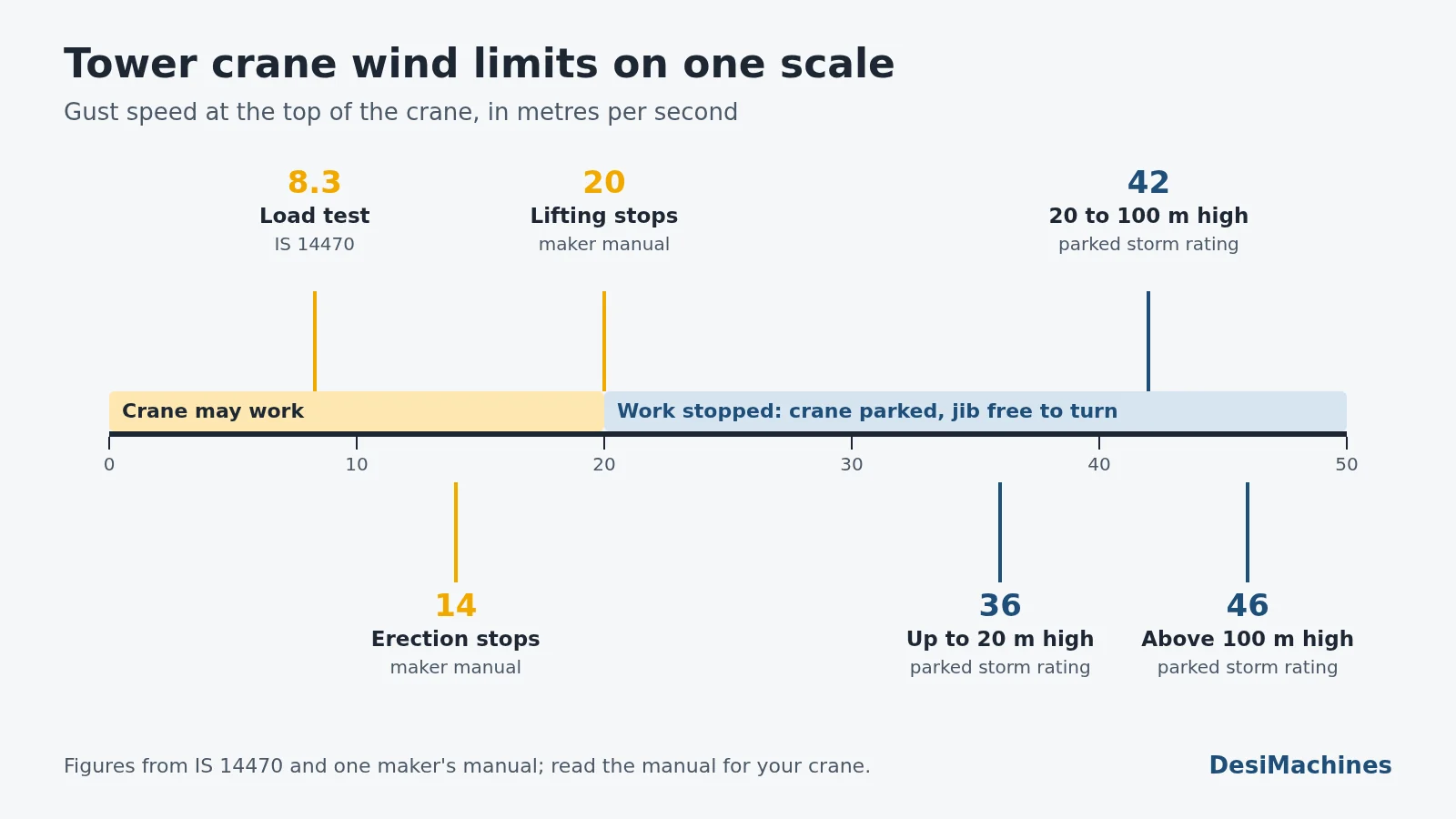
A tower crane has to stop lifting when the wind at the top of the crane reaches the limit in its maker’s manual. On the tower crane manual read for this guide, that limit is a gust of 20 m/s (72 km/h) measured at the tower head, and erection, dismantling and climbing stop sooner, at 14 m/s (50 km/h).
Those two numbers are the start of it. A parked crane has a third rating, the storm wind it can survive when nobody is in the cab, and that one only holds if the jib is left free to turn with the wind. This guide covers all three: the working limits, how the anemometer measures the wind and stops the crane, why big flat loads need a lower limit, and how a site leaves a tower crane for the night or for a cyclone. It draws on four Indian Standards (IS 6521, IS 13367, IS 14470 and IS 875) and on the Zoomlion T1200-64 tower crane instruction manual, all read on 13 November 2026. No prices are quoted.
What wind speed can a tower crane work in?
A tower crane can work up to the wind speed written in its own manual, and not a kilometre an hour more. IS 13367 (Part 1):1992, the Indian code of practice for the safe use of cranes, says in clause 13.6.2 that a crane should not be operated in wind speeds above those in its operating instructions. It adds that gusts make things worse and that the limit for erection, testing and dismantling may be lower than the limit for normal work.
The Zoomlion manual puts numbers on each of those. The figures in the table are for that crane. Another model, or the same model set up differently, can carry a different limit, so read the manual that came with the crane on your site.
| Situation | Wind limit | Same in km/h | Where it comes from |
|---|---|---|---|
| Normal lifting (crane in service) | Gust below 20 m/s, measured at the top of the crane | 72 km/h | Zoomlion T1200-64 manual, safety chapter |
| Loads with more than 1 m² of face per tonne | Lower than 20 m/s, from the maker’s table for that load area | Below 72 km/h | Zoomlion T1200-64 manual |
| Erection, dismantling, climbing, change of set-up | Gust below 14 m/s at the top of the crane | 50 km/h | Zoomlion T1200-64 manual |
| Load test | Not above 8.3 m/s | 30 km/h | IS 14470:1997 clause 4.4 |
| Parked, out of service, height 0 to 20 m | Storm wind of 36 m/s | 130 km/h | Zoomlion manual storm table (FEM 1.004) |
| Parked, out of service, height 20 to 100 m | Storm wind of 42 m/s | 150 km/h | Zoomlion manual storm table (FEM 1.004) |
| Parked, out of service, above 100 m | Storm wind of 46 m/s | 165 km/h | Zoomlion manual storm table (FEM 1.004) |
The last three rows are not working limits. They are what the crane is built to survive when it is parked with nothing on the hook, and the manual’s storm figures follow the European crane design rule FEM 1.004. IS 13367 (Part 1) clause 3.8 draws the same line. A crane is in service while it handles loads in the wind the code allows, and out of service once the wind goes past that and work stops.
The working limit is read at the top of the crane, not on the ground. Wind gets stronger with height, which is why IS 875 (Part 3) raises its design wind speed for taller structures. A calm morning at the gate can still mean a wind at the tower head that is close to the limit.
How do m/s, km/h and kgf/m² connect?
They are the same wind written three ways, and the Indian design codes use the third. IS 875 (Part 3):2015, the Indian wind load code, turns wind speed into pressure in clause 7.2 with p = 0.6 V², where V is in metres per second and p comes out in newtons per square metre. Because the speed is squared, a wind twice as fast pushes four times as hard.
IS 6521 (Part 1):1972, the Indian design code for tower cranes, is written in pressure. Clause 5.4.1 says the structure must take a steady wind pressure of 25 kgf/m² in service and the mechanisms must be designed for 15 kgf/m². Clause 8.1 sets the stability test at that same 25 kgf/m²: in any working position the crane must not tip even if the load on the hook were twice its maximum safe working load. Put 25 kgf/m² through the IS 875 formula and you get about 20 m/s, the same working limit the manual gives.
| What the figure is | m/s | km/h | N/m² | kgf/m² |
|---|---|---|---|---|
| Load test limit, IS 14470 | 8.3 | 30 | 41 | 4.2 |
| Erection and climbing limit, Zoomlion manual | 14 | 50 | 118 | 12.0 |
| Mechanism design wind, IS 6521 clause 5.4.1 | 15.7 | 56 | 147 | 15 |
| Working limit, Zoomlion manual | 20 | 72 | 240 | 24.5 |
| In-service structure wind, IS 6521 clauses 5.4.1 and 8.1 | 20.2 | 73 | 245 | 25 |
To go from m/s to km/h, multiply by 3.6. One kgf/m² is about 9.8 N/m².
Where is the anemometer on a tower crane and what does it do?
The anemometer is a small wind-speed meter with a spinning fan, and on a tower crane it sits at the tower head, the highest fixed point of the crane. IS 6521 (Part 1) clause 42.3.1 asks for an anemometer with an electrical interlock that stops the crane working past its designed wind speed. So it does more than show a reading: it is a safety device.
IS 13367 (Part 1) adds where it goes and who must see it. Clause 13.6.3 puts it at a high point of the crane, or at a similar height in an exposed spot on the site. Clause 9.9.6 says its display must be in clear view of the crane driver or of the person running the lift, and that it must be checked regularly to make sure it still works.
The Zoomlion manual asks for an anemometer on any crane over 50 m tall and wires it into the crane’s safety monitor. When the wind passes the in-service limit, an alarm sounds and the crane stops work, and a flashing orange light gives the wind warning. A reading from the ground, or from a phone weather app, is not the reading that counts.
The same tower head carries the red obstruction light for aircraft that IS 6521 clause 42.3.1.1 asks for. On a site near an airport, crane height also needs AAI height clearance. Checking that the anemometer reads and alarms belongs on the operator’s daily list in the tower crane inspection checklist.
Why do large flat loads need a lower wind limit?
Because the 20 m/s limit assumes a compact load. The Zoomlion manual counts on no more than 1 m² of load face to the wind for every tonne lifted. Shuttering plates, formwork panels, roofing sheets, plywood stacks and glass go well past that, and for those the manual sets a lower in-service limit from a table for that load area.
The push grows with the area and with the square of the speed. Take the IS 875 pressure from the table above and multiply by the face area, before the shape factor the code adds on top. A bundle of shuttering that weighs 1.5 tonnes and shows 6 m² to the wind has 4 m² per tonne, four times what the manual assumes. At 20 m/s that face takes about 240 × 6 = 1,440 N, close to 150 kgf, pushing sideways on a load hanging from a rope. At 10 m/s it is a quarter of that, about 37 kgf.
A hanging load that swings moves out to a bigger radius, and IS 13367 (Part 1) warns that a swinging load increases the overturning moment on the crane. It also asks for tag lines (guide ropes held by a person on the ground) wherever a load catches the wind. How wind eats into the chart’s capacity is covered in reading a tower crane load chart. The manual also tells the operator to stop if the load cannot be held safely in the wind, whatever the anemometer says.
A builder’s banner or advertising board tied to the mast or counter-jib adds wind area too. The manual forbids extra wind-catching surfaces like these without the maker’s written approval.
Why is a tower crane left free to turn in the wind?
So the jib can swing round like a weathervane and point where the wind pushes it least, which is why crews call it weathervaning. A jib locked by its brake has to take a storm side-on. IS 6521 (Part 1) clause 8.2 designs the parked crane for its zone’s storm wind with the jib at its maximum working radius and free to slew (turn), so a locked jib is outside what the crane was checked for.
The trap is in the brake. On the Zoomlion crane the slew brake is a spring brake that closes when the power goes off, so a crane simply switched off at the end of the day ends up with its jib locked. The weathervane release holds that brake open so the jib can turn. The manual says the crane must be able to weathervane through a full 360 degrees, and that the maker must be asked if the site does not allow it.
A full circle means the hook, the jib and the counter-jib must clear every building, scaffold and neighbouring crane as they turn. That clearance has to be planned before the crane is erected, along with the base it stands on, which carries the out-of-service wind load (see tower crane foundation and ballast).
How do you leave a tower crane safe at the end of the day?
The operator puts the crane out of service in a set order before climbing down. IS 13367 (Part 1) clause 13.6.2 says the maker’s instructions on when to take a crane out of service, and how to secure it, must be followed strictly. The steps below follow the Zoomlion manual’s end-of-work and after-work instructions:
- Unhook the load. Never leave a load hanging on a crane with nobody in the cab.
- Raise the hook high enough that it clears everything on site when the jib turns a full circle.
- Run the trolley to its rest position. Before a storm, bring it right in to the minimum radius at the jib foot.
- Set every control lever to zero and lock away the radio remote, if the crane has one.
- Release the slew brake with the weathervane release, so the jib can turn with the wind.
- On a crane that runs on rails, fix the rail clamps so the wind cannot roll it along the track.
- Switch off the cab’s main breaker, close the cab doors and windows, climb down, and switch off the main power box at the foot of the crane.
If a lift cannot wait for the wind to drop, it may suit a different machine. Compare crane models and their specifications for the job.
What changes on a tower crane site in storm and cyclone season?
The parked crane has to survive the strongest wind its location can get, and in India that figure depends on where the site is. IS 6521 (Part 1) clauses 5.4.2 and 8.2 send the out-of-service wind to IS 875 for each zone of the country. IS 875 (Part 3):2015 gives a basic wind speed for every part of India, from 33 m/s to 55 m/s. That is a three-second gust at 10 m above open ground, worked out for a 50-year return period.
| City | Basic wind speed (m/s) | Same in km/h |
|---|---|---|
| Pune, Ahmedabad | 39 | 140 |
| Mumbai, Hyderabad, Surat | 44 | 158 |
| Delhi, Lucknow, Jaipur, Patna | 47 | 169 |
| Kolkata, Chennai, Bhubaneswar, Visakhapatnam | 50 | 180 |
The manual’s storm table (36 to 46 m/s by height) and the IS 875 map are worked out by different methods, so they cannot be compared number for number. The gap is still the reason to ask. On a site in a 50 m/s city such as Chennai, Kolkata, Bhubaneswar or Visakhapatnam, the structural engineer and the crane supplier should confirm the out-of-service rating and set-up for that zone before erection. The Zoomlion manual says to consult the maker where the site exceeds its table, and refers to a separate anti-typhoon supplement for storm measures.
Thunderstorms bring a second danger. The manual says to stop work and set the crane to idle when a storm is coming, and not to climb the crane during one. An operator caught in the cab by a sudden storm should stay there without touching the controls, because lightning striking the steel can pass through anyone on the ladder or touching the crane. The manual tells the site to earth the crane against lightning, and IS 6521 clause 43 asks for the whole crane structure to be bonded to an earthing terminal.
A storm that may have damaged the crane calls for an examination before work starts again. The inspection checklist linked above lists when a tower crane must stop until it has been examined.
Who decides that lifting has to stop?
The operator stops the crane when the anemometer alarms, and earlier if a load cannot be held steady. The person who plans the lift is expected to have seen it coming. IS 13367 (Part 1) clause 10.1 asks the appointed person, who plans where the crane stands, to allow for the effect of wind on it both in and out of service.
Operator training covers this too. IS 13583 (Part 1), the Indian Standard on training crane drivers, lists wind, storms and lightning among the conditions a driver must be taught about, along with how wind acts on a load. An operator who stops a lift in a rising wind is doing what the code expects, and the site should back that call. Courses and certificates are set out in crane operator training in India, and the wider rules are in crane safety rules and checks.
For how cranes of every type rate their lifts, see how to read a crane load chart and the other crane guides. For lifts that do not need a tower crane, browse crane models and prices.
Sources
Wind pressure in service and for mechanisms, stability test, out-of-service stability with the jib free to slew, anemometer interlock, obstruction light and earthing: IS 6521 (Part 1):1972, clauses 5.4, 8.1, 8.2, 42.3.1 and 43, read from the archive.org copy of IS 6521 (Part 1); it dates from 1972, so check for a later edition. Wind and the operating instructions, gusts, erection and test limits, anemometer position and display, in-service and out-of-service definitions, swinging loads, lift planning: IS 13367 (Part 1):1992, clauses 3.8, 9.9.6, 10.1, 13.6.2 and 13.6.3. Pressure formula, basic wind speed map and city table: IS 875 (Part 3):2015, clauses 6.2 and 7.2 and Annex A, read from the archive.org copy of IS 875 (Part 3). Load test wind: IS 14470:1997 clause 4.4. Driver training topics: IS 13583 (Part 1):1993. Working, erection and storm wind speeds, load face per tonne, anemometer above 50 m, slew brake and weathervane release, end-of-work steps, storms and lightning: Zoomlion T1200-64 tower crane instruction manual, edition T1200-64Q-138EN-D01. All read 13 November 2026.
Prices, specifications and features are indicative, vary by variant, location and date, and should always be confirmed with the official OEM or authorised dealer before any purchase decision. DesiMachines is not liable for decisions taken on the basis of information that may have changed after publication.