
 Excavator
316 models
 Backhoe Loader
54 models
 Crane
68 models
 Concrete Mixer
79 models
 Wheel Loader
54 models
 Compactor / Roller
45 models
 Motor Grader
42 models

 Concrete Pump
66 models
 Skid Steer Loader
11 models


Water standing beside a road soaks sideways into the soil under it, and the road then fails from underneath. Side drains stop that: they are the open channels along the edges of a road that carry rain off the carriageway, the shoulders and any cut slopes to a culvert or a natural stream, with their bed kept low on purpose. The Rural Roads Manual, IRC:SP:20, puts that bed 300 mm deeper than the bottom of the road crust, with a fall of at least 0.5 per cent along its length.
IRC:SP:42, the Indian Roads Congress (IRC) guideline on road drainage, calls roadside drains a minor part of a road’s cost that keeps both the embankment and the paved surface safe. This guide explains what side drains do, the kutcha (unlined earth) and lined types, the common shapes, the size and slope figures in the IRC guidelines, how drains change between a road in cutting, on an embankment and on a hill, how a lined drain is built, and which machines dig and clean them.
What is a side drain in road construction?
A side drain is a longitudinal drain, which means it runs along the length of the road, parallel to its edge. Camber, the slight slope from the centre of the road to its edges, pushes rain sideways off the surface. The side drain catches that water at the edge and carries it to an outlet, usually a culvert under the road or a natural watercourse beside it.
IRC:SP:20 gives side drains a second job that is easy to miss. Because the drain bed sits below the pavement layers, it also lets water seep out of the granular base and sub-base, the stone layers under the bitumen or concrete, so they do not stay soaked. Without proper ditches, the manual says, water from the roadway and from cut slopes collects and erodes both the road and the formation slopes.
People call them roadside drains, side ditches, gutters or surface drains. In the IRC books they are part of surface drainage. Subsurface drainage, which deals with water already inside the ground, is a separate system of perforated pipes and filter layers, covered in the guide to geotextile and geogrid in road construction.
Why do roads need side drains?
Water is the main enemy of a road’s foundation. The soil under a road, the subgrade, carries the load safely only while it stays reasonably dry. Once water stands beside the road for days, it moves sideways into that soil and the soil softens.
IRC:SP:42-2014 describes exactly this. Blocked side drains hold ponded water, and on black cotton soil the moisture migrates into the clayey foundation and leads to early failure of the pavement. The road above shows it as edge cracks, broken edges, potholes and settlement. The guide to types of pavement failure traces several of those defects back to poor drainage at the edge.
A good side drain therefore does three things:
- It takes rain off the surface and shoulders quickly, before it can sit on the edge of the pavement.
- It keeps the water level in the drain below the bottom of the road’s layers, so the subgrade and base stay drained.
- It stops water from hillsides and cut slopes reaching the road at all.
IRC:SP:42 also notes the one case where no drain is needed: a road running along a ridge or watershed line, where the ground falls away on both sides and water leaves on its own.
What are the types of side drains?
Side drains are grouped by what lines them. The choice is mostly about land, soil, cost and safety.
Kutcha or unlined drains are plain earth channels cut beside the road. IRC:SP:42 says side drains on rural highways are normally left unlined to save cost, and that unlined drains suit rural and farm areas where land is cheap and the right of way is wide enough for their larger size. Their weakness is erosion. IRC:SP:20 says erosion of an unlined drain becomes severe in silt and sand at flow speeds of 0.3 to 1.0 m per second; in stiff clay the figure is about 1.5 m per second.
Lined drains have a hard bed and sides of brick, stone masonry, stone slabs, plain or reinforced concrete (RCC) or precast concrete sections. Lining lets water run faster without eating the bed, and it lets the sides stand steeper, so a lined drain needs less width. Turfing, grass grown on the drain sides, is a light lining used widely on rural roads.
Covered drains are lined drains with RCC slabs or steel gratings on top. They are used in towns, where the drain often doubles as a footpath and an open drain would be a hazard to people and a dumping place for rubbish.
| Type | What it is | Where it is used | Main limit |
|---|---|---|---|
| Kutcha (unlined earth) | Channel cut in natural soil, sometimes turfed | Rural roads and highways in open country with spare land | Erodes once water runs fast; silts up and needs cleaning every monsoon |
| Brick lined | Brick walls in 1:4 cement-sand mortar on M15 bed concrete | Towns and villages where stone is not local | Lower erosion limit than concrete; walls must thicken as the drain gets deeper |
| Stone lined | Random rubble or coursed masonry, dry stone or stone slabs | Hill roads and places with local stone, slabs common in South India | Coursed stone is costly where stone is not at hand |
| RCC or precast concrete | Cast-in-place M20 walls or precast units on M15 bed concrete | Urban roads, highways through towns, fast work | Shrinkage cracks; joints every 8 to 10 m must be sealed |
| Covered | Lined drain with RCC slab or steel grating on top | Built-up areas, drains used as footpaths | Cover slabs and capping have to be designed for the load on top |
Which shape of side drain is best: V, trapezoidal or U?
IRC:SP:42 lists five cross-sections in use: triangular or V, trapezoidal, rectangular or U, parabolic (a shallow saucer shape) and a trapezoidal drain with a small secondary channel in its bed. Each has a reason.
| Shape | Good at | Drawback | Typical use |
|---|---|---|---|
| V or triangular | Easy and cheap to form; a motor grader can cut and maintain it; shallow V drains are used on hill roads for vehicle safety | Silts up fast and blocks | Low-cost rural roads, shallow drains on hill roads |
| Trapezoidal | Carries more water; easier to build than a saucer | Takes more width | Better rural roads and highways, hill drains |
| Rectangular or U | Narrow, easy to clean, can take a cover slab or grating | Unlined, it erodes and collapses | Urban roads, almost always lined |
| Parabolic (saucer) | Best flow for its size and resists erosion best | Hardest to form | Less common on site because it is hard to shape |
| Kerb and channel | Gives extra usable width at the edge | Water has to leave through outlets at intervals | Town roads; also listed in the hill road manual |
In practice the rural choice is between V and trapezoidal. IRC:SP:42 says the V ditch is favoured on low-cost roads because it is cheaper to form and quick to maintain with a motor grader, and the trapezoidal section is preferred on better roads because it carries more. IRC:SP:20 adds that a rectangular or trapezoidal section gives a driver close to it a sense of danger, and calls the triangular section the most appropriate and widely used one for rural roads.
One more rule of thumb from IRC:SP:42 is worth remembering on site: if a drain needs more capacity, widen it before you deepen it. A wider channel carries the same water at a lower speed, so it erodes less.
What size and slope should a side drain have?
On a designed road, the size comes from a calculation. The engineer estimates the peak flow off the road and the land draining to it, picks the fastest speed the lining can take without eroding, and uses Manning’s formula, the standard equation for flow in open channels, to settle the drain’s cross-section and slope. Flow equals area times speed, so a drain that may only run slowly needs a bigger cross-section.
Where no design data exist, the IRC manuals give starting figures. They do not all agree, because each was written for different roads, so the table names the source of each one.
| Item | Figure | Source |
|---|---|---|
| Drain bed level | 300 mm deeper than the bottom of the road crust | IRC:SP:20-2002 (rural roads) |
| Water level in the drain | At least 0.3 to 0.6 m below the bottom of the pavement’s drainage layer at design flow | IRC:SP:42-2014 cl. 8.2 |
| Minimum bottom width | 0.3 m, for easy cleaning | IRC:SP:42-2014 cl. 8.2 |
| Minimum bottom width (rural roads, no data) | 450 mm | IRC:SP:20-2002 |
| Minimum longitudinal slope | 0.5 per cent if lined, 1.0 per cent if unlined | IRC:SP:20-2002, citing IRC:73-1980 |
| Side slopes | Generally not steeper than 1 in 4 (rural, no data); unlined drains 4:1 to 2:1; a brick-lined drain can be rectangular | IRC:SP:20-2002 |
| Freeboard | 150 mm above the design water level | IRC:SP:42-2014 |
| Hill road side drain | Usually 60 cm x 60 cm, gradient 1 in 20 to 1 in 25 | IRC:SP:48-1998 (Hill Road Manual) cl. 8.4.2.2 |
| Joints in RCC lining | Sealed joints every 8 to 10 m | IRC:SP:42-2014 cl. 8.4 |
A 0.5 per cent slope is a fall of 5 mm for every metre, or 50 cm over 100 m. On flat plains that fall is hard to find. IRC:SP:42 says ditches there follow whatever slope the ground offers, and where natural dips are far apart the ditch grows too long and too big, so extra culverts, called balancing culverts, are added just to shorten it. Most culverts in the plains, it notes, are of this kind. The drain’s invert (its bed line) should run parallel to the road profile wherever possible.
When does a drain need lining? When the water will run faster than the soil can stand. IRC:SP:42’s Table 7.1 gives the safe speed for each surface: most fine sandy, silty and clayey soils sit between about 0.3 and 1.2 m per second, while brick lining is good to 3 m per second, bitumen to 5.4 to 6 and concrete to 6. So a steep stretch of drain through sand will scour unless it is lined, stepped or both.
Not sure of the numbers on your stretch? The IRC sizes are minimums for drains nobody has designed. A highway or a large job should have its drains designed from local rainfall and catchment data, which is what both manuals ask for.
Side drains for a road in cutting and on an embankment
Where the road sits relative to the ground changes where the water comes from, and so where the drains go.
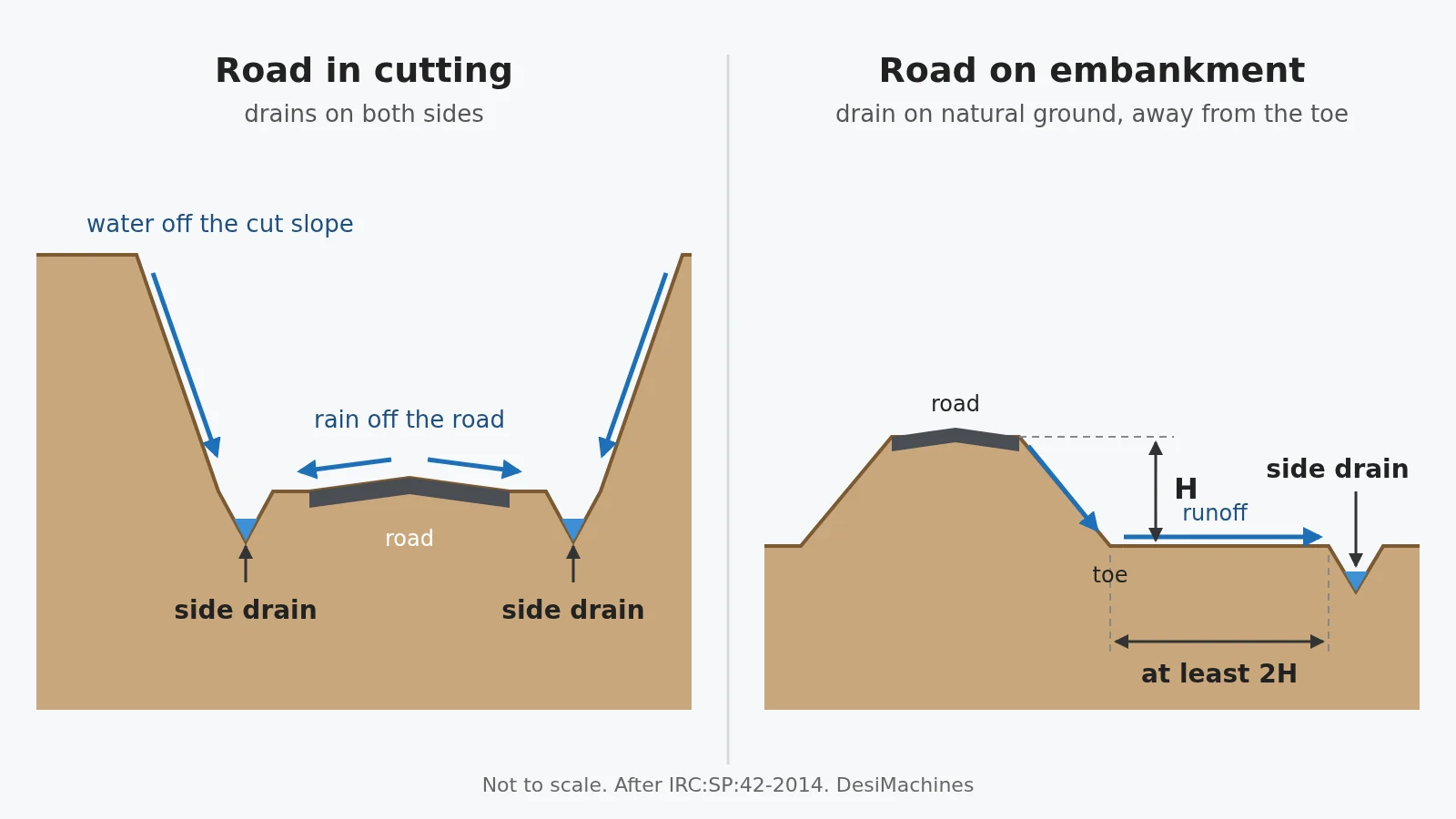
Road in cutting. When the road is cut into the ground, water comes off the road and also runs down the cut slopes towards it. IRC:SP:42 says drains are then needed on both sides. They sit between the shoulder and the foot of each cut slope, and they stop slope water reaching the pavement. In sloping country, where the ground falls across the road, only the uphill side needs an intercepting drain.
Road on an embankment. On a raised road, rain runs off the surface, down the side slopes of the embankment, and reaches the ground at the toe, the bottom edge of the bank. The drain sits out on natural ground, away from the toe, so that it cannot undercut the bank. IRC:SP:42 places an unlined drain at least 2H from the toe, where H is the height of the road top above ground. On a 1.5 m high bank that is at least 3 m out. The same figure notes that a drain placed closer, inside a 4H:1V line from the toe, should be lined with stone, brick or concrete.
On high embankments IRC:SP:42 adds a gutter along the road edge that collects surface water and drops it down the bank through chutes at intervals. Stepped chutes break the water’s speed themselves, so no extra energy dissipater is needed at the toe. How the bank itself is built, layer by layer, is in the guide to embankment construction in road.
Divided highways have one more spot to drain. On a curve the road is banked, so on one carriageway the surface slopes towards the median. IRC:SP:42 says water there has to be collected in the median and piped out to the countryside. The banking itself is covered in the guide to superelevation in road design.
Side drains and catch water drains on hill roads
A hill road usually has the hill on one side and the valley on the other. Everything that falls on the slope above heads straight for the road, so drainage on hills is a matter of the road surviving.
The side drain on a hill road runs along the hill side of the carriageway. The Hill Road Manual, IRC:SP:48, says drains are usually 60 cm by 60 cm, laid at 1 in 20 to 1 in 25 so the water moves fast enough to carry floating debris away, stepped where long steep grades would make it too fast, and backed by a 0.6 m high toe wall on the hill side to stop the slope eroding into it. IRC:SP:42 explains why hill drains stay narrow: widening one means cutting more of the hillside, which costs money and can destabilise the slope. IRC:SP:42 says shallow V drains are normally provided on hill roads for the safety of vehicles.
Since a narrow drain fills quickly, the water has to cross to the valley side often. IRC:SP:48 says 8 to 10 culverts or scuppers per kilometre can be provided for this, or the drains can discharge into natural streams.
A catch water drain is different. It is dug on the hill slope above the road, across the slope, to catch water coming down from higher up before it ever reaches the road or its side drain, and to guide it to the nearest culvert or natural gully. IRC:SP:48 asks for a trapezoidal section, at least stone lined and cement pointed, kept clear of slide areas so it does not make an unstable slope worse, and cleaned and repaired before every monsoon. IRC:SP:20 describes the same drain for rural hill roads.
| Drain | Where it runs | What it catches | Where it sends water |
|---|---|---|---|
| Side drain | Along the road edge | Water off the road, shoulders and cut slopes | To a culvert or natural stream |
| Catch water drain | On the hill slope above the road, across the slope | Water from the upper hillside, before it reaches the road | To the nearest cross-drainage point or a natural gully |
| Cross drain (culvert or scupper) | Under the road, across it | Water from the side drains and streams crossing the line of the road | To the valley or downstream side |
Mines use a similar idea around a pit and call it a garland drain; that is pit dewatering, covered separately in the guide to mine dewatering.
How is a lined side drain built?
MoRTH’s Specifications for Road and Bridge Works (5th revision), clause 309, sets the general rules: dig the drain to the lines, grades, levels and dimensions on the drawings, dress the bed and sides to shape, line or turf it where the drawings say so, and build it in step with the road so that nothing finished has to be dug up later and no part of the work is left without drainage. Usable excavated soil can go into the embankment or subgrade. The steps on a typical brick or concrete drain run like this:
- Set out the line and levels. Mark the drain’s centre line and the invert level at short intervals, so the bed keeps its fall all the way to the outlet. Check that the outlet, a culvert or watercourse, is low enough to take the water.
- Excavate. Dig to the drawing section. IRC:SP:42 notes that trenches can be dug by hand or by machine, and that trench cutters with electronic sensors now hold the gradient and invert level accurately.
- Dress and prepare the bed. Trim the bed and sides, then lay a sand or gravel bed where the drawings show one. On rock, the IRC hill drain details say the sand bed and bed concrete can be left out.
- Cast the bed concrete. IRC:SP:42’s typical drawings use M15 grade bed concrete under brick, stone and RCC drains, about 50 mm thick in the hill drain details.
- Build the walls. Brick in 1:4 cement-sand mortar, random rubble masonry, stone slabs, M20 RCC or precast units, as designed. In the hill trapezoidal detail the pitching is 100 mm of stone on a 20 to 25 mm bed of 1:4 mortar.
- Seal the joints. RCC drains crack from shrinkage, so IRC:SP:42 asks for sealed joints at 8 to 10 m intervals, or as the contract says, to stop water seeping out under the road.
- Fit covers and outlets. In towns, place the designed RCC cover slabs or gratings. Connect the drain to its outlet and protect the outfall against scour.
A kutcha drain is simpler: excavate to section, dress, turf if specified, and connect to the outlet. IRC:SP:42 suggests watching an earthen drain through its first monsoon and widening it if it cannot cope, and warns against letting one run full for long periods, because that erodes its sides.
Which machines dig and clean side drains?
Side drains are mostly an earthmoving job, and three machine types do most of it on Indian road sites.
- Motor grader. A grader’s blade can be tilted and pushed out to the side to cut a V ditch along the road edge and to re-shape it later. IRC:SP:42 mentions this directly as the reason V ditches are cheap to maintain. Two features matter for ditch work: how far the blade shifts sideways, explained in the guide to motor grader blade angles, and crab steering, which lets the wheels stay on firm ground while the blade works in the drain, covered in how motor graders work. Graders such as the Cat 120 and the SANY STG170C-10 do this work on Indian highway jobs.
- Backhoe loader. A common choice for trapezoidal drains, desilting and culvert outlets on rural and district roads, because the same machine also loads the spoil and drives between sites on its own wheels. The JCB 3DX is the best known example.
- Mini excavator. Fits between a town road and a building line to dig or rebuild lined urban drains. A wide, toothless ditching bucket cleans and shapes drains; the choices are in the guide to excavator bucket types. Models such as the JCB 30Z are listed with the other mini excavators.
For the full set of machines a road job needs, from earthwork to paving, see the guide to road construction equipment.
If you are planning drain or earthwork contracts, compare motor grader models and prices and backhoe loaders side by side and talk to a verified dealer before you buy.
How should side drains be maintained?
A drain that is full of silt is no drain at all. IRC:SP:42 sets the policy plainly: clean drains and culverts before and after the monsoon. It splits the work three ways, following IRC:SP:50, the urban drainage guideline:
- Continuous maintenance: regular inspection of side drains by the engineer in charge, clearing blockages as they appear.
- Periodic maintenance: drain work done together with the road’s periodic maintenance.
- Special maintenance: repairing breached sections, or enlarging a drain that has proved too small.
What to look for: silt from eroded earth shoulders, which IRC:SP:42 says is serious in silty soil; grass and bushes growing in the drain, which cut its capacity in high-rainfall areas; stones and debris in hill drains; and garbage in open urban drains. Any of these makes water pond beside the road, and on black cotton soil that ponded water is what softens the foundation.
Keeping water off the road starts at the surface. The right camber in road construction sends it to the edge, and level shoulders let it reach the drain. Below the surface, a drained granular sub-base does the rest, as the guide to road construction layers explains. More guides on design, materials and testing sit on the road construction guide hub.
The clauses in this guide come from the IRC:SP:42-2014 Guidelines on Road Drainage and the IRC:SP:48 Hill Road Manual, with rural road figures from IRC:SP:20-2002 (Rural Roads Manual) and construction rules from the MoRTH Specifications for Road and Bridge Works, 5th revision, clause 309.
Prices, specifications and features are indicative, vary by variant, location and date, and should always be confirmed with the official OEM or authorised dealer before any purchase decision. Drain sizes, slopes and code clauses should be confirmed against the current edition of the IRC guideline and with your project engineer before work starts. DesiMachines is not liable for decisions taken on the basis of information that may have changed after publication.
Machines, tenders and news for this industry: Road Construction