
 Excavator
316 models
 Backhoe Loader
54 models
 Crane
68 models
 Concrete Mixer
79 models
 Wheel Loader
54 models
 Compactor / Roller
45 models
 Motor Grader
42 models

 Concrete Pump
66 models
 Skid Steer Loader
11 models


Every line, arrow and painted word on an Indian road belongs to one of seven types set by IRC:35-2015, the Indian Roads Congress code for road markings: longitudinal, transverse, hazard, block, arrow, directional and facility markings. The two you meet most are the long lines that run along the road, white where you may cross them and yellow where you may not, and the lines painted across it, such as the stop line and the zebra crossing.
This guide takes each type in turn with the sizes the code gives: how long the dashes are, how wide the lines are, what each colour means, what the markings are made of and how a contractor shows they are bright enough at night.
What are road markings?
IRC:35-2015 defines road markings as lines, patterns and words, other than road signs, that are applied or fixed to the carriageway, the kerbs, or objects in or beside the carriageway to control, warn, guide and inform road users. The carriageway is the paved part of the road that vehicles drive on.
Markings do a job that signs cannot. A driver reads them without looking away from the road, and they are harder to hide or vandalise than a signboard. Their weak points are dust, rain and wear, which is why the code asks for them to be renewed and inspected on a schedule. Only the road authority may put markings on a public road, with the police consulted where needed, and the same design has to be used across the country so that a driver from Assam reads a line in Gujarat the same way.
What are the types of road markings in India?
IRC:35-2015 sorts all pavement markings into seven classes, each with a two-letter code. Drawings and contract documents use these codes (LM01, TM02 and so on) so that the client, the consultant and the contractor all mean the same marking.
| Code | Type | What it covers | Common examples |
|---|---|---|---|
| LM | Longitudinal marking | Lines that run along the direction of traffic | Centre line, lane line, warning line, no-overtaking line, edge line, continuity line |
| TM | Transverse marking | Lines laid across the carriageway to control traffic | Stop line, give way line, bar markings before a hazard |
| HM | Hazard marking | Markings that steer traffic around danger, or at merges and diverges | Chevron and diagonal markings, hatch markings, zig-zag lines |
| BM | Block marking | Shapes painted as solid blocks on the road | Zebra crossing, speed breaker triangles and chequers, give way triangle |
| AM | Arrow marking | Arrows showing the direction a driver must take | Straight, turn, merge and deflection arrows |
| DM | Directional marking | Word messages that give direction | Place names and route words painted in a lane |
| FM | Facility marking | Markings for parking and for particular users | Parking bays, BUS, cycle and disabled-user words and symbols |
Transverse and hazard markings carry the highest risk if they are missing or faded, so the code says each one must always come with the matching road sign. A stop line without a stop sign, for example, is not a complete installation.
What do white and yellow lines mean on Indian roads?
White is the normal colour for road markings because it stands out best against black bitumen. Yellow tells you a line must not be crossed. IRC:35 says a continuous yellow line along the road is strictly prohibitive and is not to be straddled, and on undivided roads of three or four lanes the double centre line is painted yellow so it cannot be confused with a solid white lane line.
The shape of the line matters as much as its colour. A broken line may be crossed when it is safe. A continuous line may not. A double continuous line is used where the message has to be beyond doubt, such as down the middle of a four-lane road with no median.
Yellow has three more jobs on Indian roads:
- Parking rules at the kerb. A single yellow edge line means parking is banned for certain hours; a double yellow edge line means no parking or waiting at any time.
- A yellow box painted at a junction, an area where no vehicle may stop.
- Concrete roads. On a pale cement concrete road the code asks for yellow markings, because white would barely show against the concrete.
Three other colours have fixed meanings under clause 2.6. Blue marks bus lanes, for example in a Bus Rapid Transit corridor. Green marks cycle lanes and non-motorised crossings. Red marks spots where different road users share space and conflict is dangerous, such as a busy pedestrian crossing.
Road studs follow the same logic. White studs mark lane lines and the centre of the road, red studs the left edge of the running carriageway, yellow studs the median edge on a divided highway, and green studs an edge you may cross, such as the entry to a truck lay-by or an acceleration lane.
What are the sizes of road marking lines?
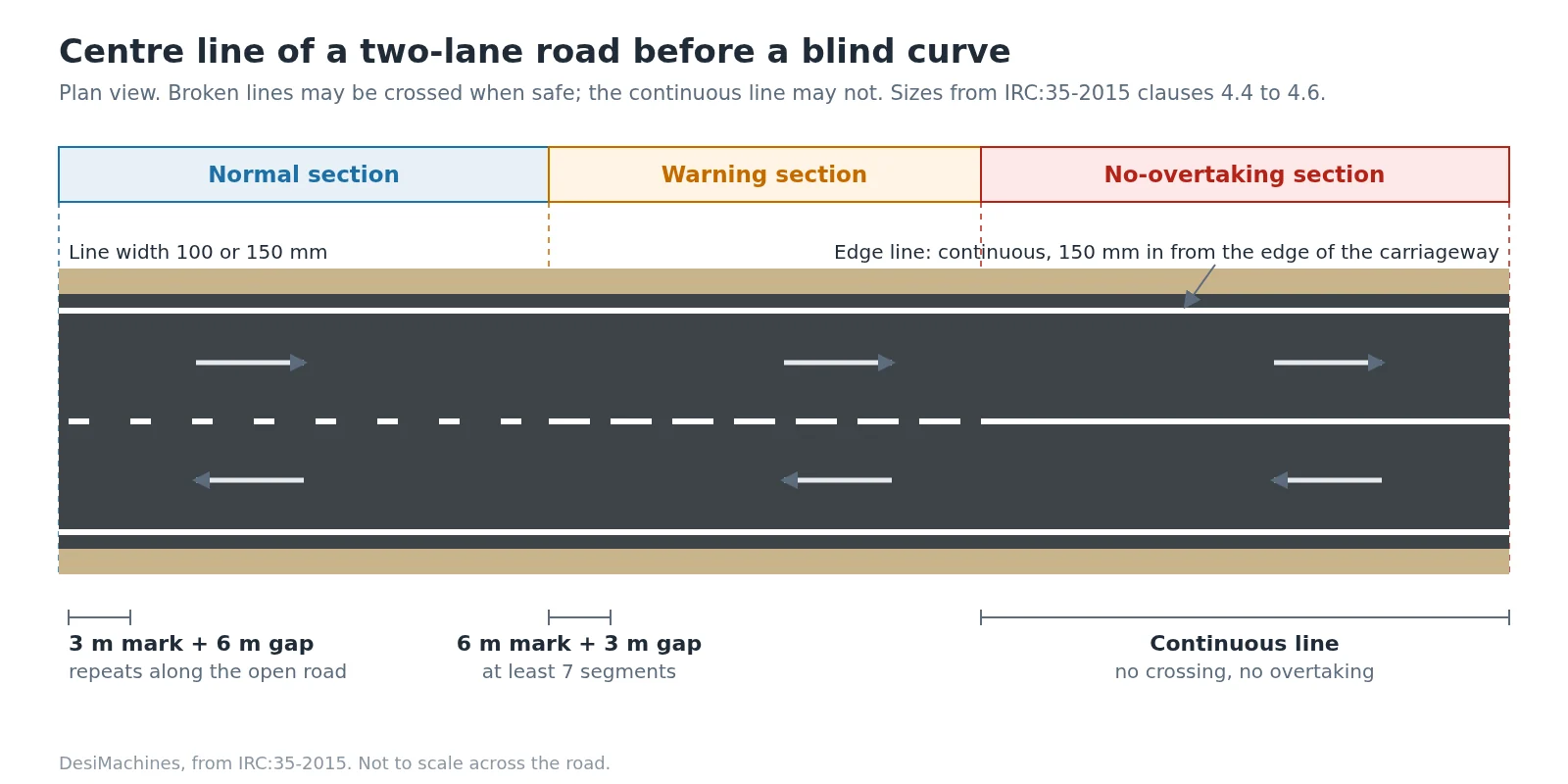
Lines along the road are 100 mm or 150 mm wide (about 4 or 6 inches), and broken lines on an open stretch are painted as a 3 m mark followed by a 6 m gap. Near a hazard the pattern changes so drivers notice it.
| Line | Pattern | Width | Notes |
|---|---|---|---|
| Centre line, normal section | 3 m mark, 6 m gap | 100 or 150 mm | Only on single carriageway roads; not used on roads narrower than 5.5 m except short risky stretches |
| Centre line, warning section | 6 m mark, 3 m gap | Same as the line before it | At least seven segments ahead of any no-overtaking line |
| Traffic lane line, normal section | 3 m mark, 6 m gap | 100 or 150 mm | 150 mm on urban roads and where design speed is over 100 km/h |
| Traffic lane line, warning section | 3 m mark, 3 m gap | 100 or 150 mm | Used before a hazard on multi-lane roads |
| No-overtaking line | Continuous, single or double | 100 or 150 mm | Ladder hatch version: two solid lines at least 600 mm apart, 200 mm cross bars every 4 m (up to 65 km/h) or 6 m |
| Edge line | Continuous | 150 mm on multi-lane divided roads; 200 mm on expressways; 100 mm on two-way roads under 7 m wide | Set 150 mm in from the carriageway edge and at least 200 mm from the face of a raised kerb |
Three placement rules catch contractors out. If a centre line runs onto a bridge, it carries on across only when the bridge is at least 6 m wide between kerbs; on a narrower bridge it stops 30 to 35 m before each abutment. Edge lines are not carried across the mouth of a side road; a broken continuity line takes over there. And a lane line is only painted where a full lane width fits between it and the next line, because a squeezed lane invites side-swipe crashes.
Where does a no-overtaking line start?
A no-overtaking line starts where a driver can no longer see far enough ahead to pass safely, and IRC:35 gives a field method to find that point with two people and sighting poles. They walk the inner edge of the curve, always keeping a fixed distance apart, called the minimum visibility distance (MVD). The point where they lose sight of each other marks the start of the barrier line; the point where they see each other again marks its end. The eye check is made on an object 1.05 m above the road.
| 85th percentile speed | Minimum visibility distance (MVD) | Warning sight distance (WSD) |
|---|---|---|
| Up to 50 km/h | 75 m | 120 m |
| 51 to 65 km/h | 120 m | 180 m |
| 66 to 80 km/h | 170 m | 240 m |
| More than 80 km/h | 240 m | 330 m |
The 85th percentile speed is the speed that 85 out of 100 vehicles do not exceed, measured on the road itself. Where visibility is better than the MVD but shorter than the WSD, a warning line is painted instead of a barrier. On the approach to the barrier, a length equal to the WSD gets a double line, one continuous and one broken: traffic heading into the blind stretch may not overtake, while traffic coming out of it still may. The geometry behind these distances is explained in the guide to sight distance in highway design.
On sharp curves the centre line is not always in the middle. Where the inner radius is under 60 m and the road has been widened, the code splits the width unequally, giving the inner lane up to 1.4 times the width of the outer lane on the tightest bends (radius 10 to 15 m).
What are transverse markings: the stop line, give way line and zebra crossing?
Transverse markings run across the road and tell a driver where to stop or slow. These are the sizes and positions IRC:35 sets.
| Marking | Size | Where it goes |
|---|---|---|
| Single stop line | Solid white line, 200 mm wide on urban roads, 300 mm on rural roads | At signals and before a pedestrian crossing; 2 to 3 m before the crossing, or 1 m before the main signal post |
| Double stop line | Two solid lines, each 200 mm wide, 300 mm apart | Only where a STOP sign controls the junction, with the word STOP painted on the road |
| Give way line | Two broken lines side by side: 600 mm segments, 300 mm gaps, each 200 mm wide and 300 mm apart | Across a minor road joining a major road with no stop sign, signal or police; a hollow triangle is painted 2.5 to 12 m before it |
| Zebra crossing | At least as wide as the footpath and never under 2 m; usually 2 to 4 m | A refuge island at least 1.2 m wide is needed if the crossing is longer than 10.5 m; two rows of yellow studs mark it at night |
Where there is no pedestrian crossing, a stop line sits 1.25 to 9 m from the edge of the road being joined and runs across all the approach lanes. At a signalled junction the order is fixed: the zebra sits 1 m ahead of the main signal and the stop line another 1 m ahead of the zebra.
What are hazard, block, arrow and word markings?
Hazard markings warn of danger and guide traffic around it. Chevrons and diagonal stripes fill the space in front of a median nose or a lane drop, hatching closes off areas no vehicle should drive on, and zig-zag lines warn of a stretch with schools, hospitals or busy footpaths, where the code calls for a keep-clear zone.
Block markings are painted as solid shapes. The zebra crossing is the best known. Speed breakers get white triangles and two rows of black and white chequers, with sizes set in IRC:35 and IRC:99; those sizes are listed in the guide to speed breaker dimensions. A softer option is the thermoplastic bar marking: one set is six bars, each 300 mm wide and 5 mm high, laid 600 mm apart across the full road, with one to four sets before the hazard depending on approach speed.
Arrows tell a driver which way the lane goes and are mandatory to follow. Word messages such as BUS STOP or SCHOOL are painted with letters stretched in the direction of travel: 1.25 m tall for speeds up to 50 km/h, 2.5 m up to 100 km/h and 5 m above that.
Objects on or beside the road get their own paint. A bridge pier or underpass wall inside the carriageway is marked with at least six black and yellow stripes, each at least 300 mm wide, sloping down at 45 degrees towards traffic. Culvert headwalls, poles and similar objects beside the carriageway take black and white stripes in the same pattern, and the kerbs of medians and traffic islands are painted in alternate black and white strips 500 mm wide.
What are road markings made of?
Most permanent markings on Indian highways are hot-applied thermoplastic. It is a mix of resin binder, pigment, filler and glass beads that is melted, laid hot and hardens as it cools, so it dries fast. MoRTH Table 800-9 asks for at least 18 percent binder by weight, and at least 10 percent titanium dioxide in white material. IRC:35 puts its service life at up to two to three years, depending on traffic.
| Material | Where it is used | Points to know |
|---|---|---|
| Hot-applied thermoplastic | Permanent lines, arrows and blocks on highways | At least 2.5 mm thick, not counting surface beads; glass beads sprayed on at 250 g per sq m while hot |
| Road marking paint (solvent-borne or water-borne) | Temporary and work-zone markings, and lines needed only for a short time | Shorter life than thermoplastic; water-borne paint is safer for workers and lets traffic back sooner |
| Cold-applied plastic | Coloured surfaces such as bus and cycle lanes; raised edge lines that rumble under tyres | Holds its colour and brightness longer than thermoplastic; needs no large machine |
| Preformed adhesive tape | Spots where lines need frequent renewal, object markings, transverse lines on busy roads | Laid without a machine or drying time; IRC:35 cites a service life of 3 to 6 months |
The glass beads are what make a line shine at night. Headlight beams enter each bead and bounce back towards the driver. On a wet night a film of water scatters that light, which is why IRC:35 notes that large beads, at least 1 mm across, work better on damp roads.
Under clause 803 of the MoRTH Specifications for Road and Bridge Works, marking is done by machine, with hand methods only where a machine cannot work and the engineer approves. The road surface must be clean, dry and at least 10°C. On new concrete any laitance and curing compound is removed and a sealing primer goes down first. Thermoplastic with a natural binder must not be kept molten for more than 4 hours. The finished line must be within 5 percent of its specified width, within 20 mm of its specified position and within 10 mm in 15 m of its alignment. What thermoplastic and its laying cost per square metre is covered in the blog on thermoplastic road marking paint price.
How is a road marking checked for night visibility?
A road marking passes or fails on brightness, measured with a retroreflectometer, an instrument that shines a beam at the line and reads how much light comes back. The unit is millicandela per square metre per lux (mcd/m²/lx). IRC:35 sets a starting value, measured seven days after laying, and a floor the line must stay above for its warranty period.
| Condition | Initial value (7 days) | Minimum during warranty |
|---|---|---|
| Dry, design speed up to 65 km/h | 200 mcd/m²/lx | 80 mcd/m²/lx |
| Dry, design speed 65 to 100 km/h | 250 mcd/m²/lx | 120 mcd/m²/lx |
| Dry, design speed above 100 km/h | 350 mcd/m²/lx | 150 mcd/m²/lx |
| Wet, any speed | 100 mcd/m²/lx | 50 mcd/m²/lx |
Daytime visibility has its own floor, at least 130 on a cement concrete road and 100 on a bitumen road, in the same unit for diffuse light. On zebra crossings, bus bays and other spots where people walk, markings on urban roads must also give a skid resistance of at least 55 on the British pendulum test when new, and never drop below 45.
The reason for all this is time. IRC:35 asks that a driver can pick out a line at least two seconds ahead, which works out to about 28 m at 50 km/h and 56 m at 100 km/h. Long-term markings should last at least two years, the road authority should demand a warranty to match, and markings should be inspected about every six months for brightness, wet and dry, and for wear.
When are markings laid on a new road?
Markings are the last job on a new road. They go onto the wearing course, the top layer of the pavement, after it has been laid and rolled smooth; the order of the layers below it is explained in the guide to road construction layers. On bitumen roads that final rolling is done by a tandem roller, a two-drum machine such as the HAMM HD 99i VV or the Escorts HD 85 PLUS, and the marking goes down only once that surface is finished, clean and dry. The rest of the machine line-up for a road job is set out in the guide to road machinery required for road construction.
For the money side of a road job, see the guide to road construction cost per km. Which road categories need which markings follows from the road type, covered in types of roads in India, and the cross slope that keeps water off the lines is set out in the guide to camber in road construction. More guides on road design, materials and testing are on the road construction guide hub.
The sizes, colours and test values in this guide come from IRC:35-2015, Code of Practice for Road Markings (second revision), and the laying rules from clause 803 of the MoRTH Specifications for Road and Bridge Works, 5th revision. Check the clause numbers against the edition named in your contract.
Prices, specifications and features are indicative, vary by variant, location and date, and should always be confirmed with the official OEM or authorised dealer before any purchase decision. Marking types, sizes and test values should be confirmed against the current edition of IRC:35 and the MoRTH specifications and with the road authority or project engineer before work starts. DesiMachines is not liable for decisions taken on the basis of information that may have changed after publication.
Machines, tenders and news for this industry: Road Construction