
 Excavator
316 models
 Backhoe Loader
54 models
 Crane
68 models
 Concrete Mixer
79 models
 Wheel Loader
65 models
 Compactor / Roller
45 models
 Motor Grader
42 models

 Concrete Pump
66 models
 Skid Steer Loader
11 models


A cement plant that makes 1 million tonnes of cement a year has to dig and move about 1.5 million tonnes of limestone to do it. So the equipment used in a cement plant is two things: the fixed process plant (crusher, stacker and reclaimer, raw mill, kiln, cement mill, silos and packers) and a mobile fleet of drill rigs, excavators, dumpers, dozers, wheel loaders and cranes that feeds it, most of it working in the plant’s own limestone mine.
This guide is for a fleet owner or contractor thinking about work at a cement plant, and for anyone who wants to know what each machine there does. It follows the stone from the mine face to the cement truck and names the machine classes at each step. It also explains who owns them. The cement makers and their plants, state by state, are listed in the blog on cement companies in India, so they are not repeated here. No prices are quoted.
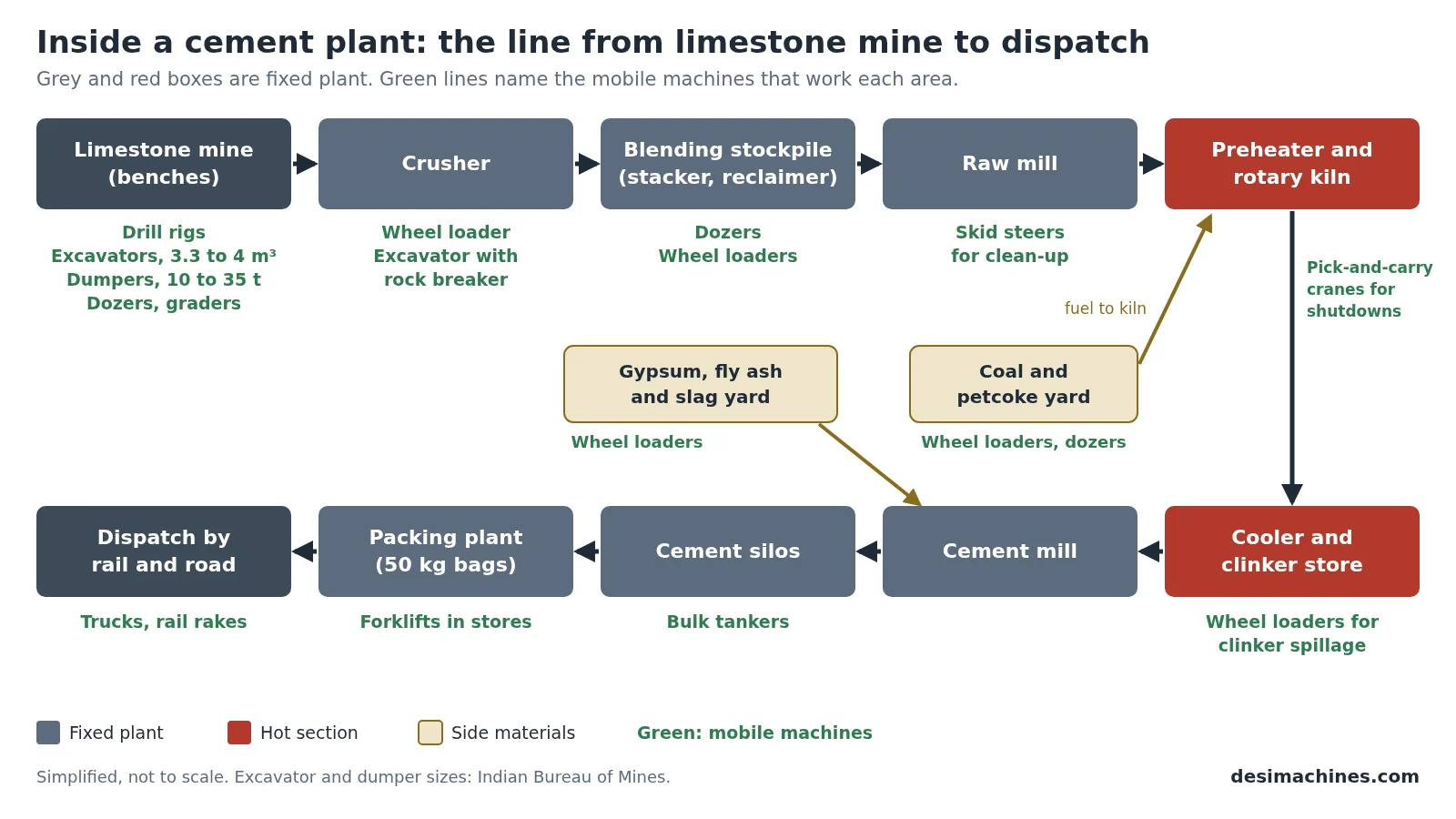
What equipment is used in a cement plant?
Every cement plant runs the same chain. Limestone is mined and crushed, then blended. It is ground with clay and other minerals into a fine powder called raw meal. The kiln burns that powder into hard lumps called clinker. Clinker is ground with gypsum into cement, which is stored in silos and sent out in bags or in bulk.
| Area | What happens there | Fixed equipment | Mobile machines at work |
|---|---|---|---|
| Limestone mine | Stone is drilled, blasted, loaded and hauled to the crusher | Sometimes an in-pit crusher and conveyor | Drill rigs, excavators, dumpers, dozers, motor graders, water tankers |
| Crusher | Run-of-mine stone is broken down to a size the mill can take | Primary and secondary crushers, feeders, conveyors | Wheel loader as back-up feed; excavator with a rock breaker for oversize lumps |
| Blending stockpile | Crushed limestone is laid in long piles and taken back evenly | Stacker and reclaimer on rails | Dozers and wheel loaders around the piles |
| Raw mill and kiln | Raw meal is ground, then burnt at up to 1,450 °C into clinker | Raw mill, preheater tower, rotary kiln, cooler | Skid steers for clean-up; cranes and loaders at shutdowns |
| Coal and additive yards | Fuel, gypsum, fly ash and slag are received and stocked | Wagon tipplers, hoppers, conveyors, coal mill | Wheel loaders, dozers on coal piles |
| Cement mill, silos and packing | Clinker is ground into cement, stored and packed | Ball mill or vertical roller mill, silos, rotary packers | Forklifts in stores, bulk tankers |
| Dispatch | Cement leaves by rail, road and, for coastal plants, sea | Truck and wagon loaders | Trucks and rail rakes |
The fixed plant is what most lists of “cement plant machinery” mean. A plant buys it once, as part of a new line or an upgrade, from engineering firms. The mobile fleet wears out in a few years and much of it is hired on contract. That is where a machine owner fits in, so the rest of this guide stays with it. The same split runs through a steel works, as the guide to equipment used in steel plants shows.
Which machines work in a cement plant’s limestone mine?
The limestone mine is where most of the mobile machines are. According to the Indian Bureau of Mines, limestone in India is mined by the opencast method, and the captive mines that feed cement and steel plants are mechanised. Large mines are cut into benches (flat steps in the pit wall), and the size of each bench is set to suit the machines on it.
The Bureau names the usual pairing: hydraulic excavators of 3.3 to 4 m³ bucket size loading dumpers of 10 to 35 tonnes. Holes are drilled for blasting, and the Bureau’s mine reports list jack hammers and wagon drills, with ANFO, slurry and emulsion explosives. After the blast, the work goes in this order:
- Drill rigs make the blast holes along the bench.
- Dozers push up the blasted stone and level the bench floor.
- Excavators load the stone into dumpers.
- Dumpers carry it up the haul road to the crusher.
- Motor graders and water tankers keep the haul road smooth and the dust down.
Overburden, the soil and waste rock lying over the limestone, has to be removed first and dumped elsewhere, so the same fleet moves more material than the limestone it sends to the plant. How many dumpers one excavator can keep busy is worked out in the guide to the shovel and dumper combination, and the dumper sizes themselves are explained in the guide to types of tippers and dumpers.
Some mines skip drilling and blasting in part of the pit and use a surface miner instead. This tracked machine cuts the stone with a rotating drum under its belly. Wirtgen, which makes them, rates its surface miners for limestone up to 80 MPa in strength; its 220 SM cuts a strip 2,200 mm wide and up to 300 mm deep. It suits soft, flat-lying beds. Hard or folded stone still needs the drill and the blast.
| Machine | Type | Operating weight | Bucket or blade | Where it fits |
|---|---|---|---|---|
| Tata Hitachi ZAXIS 650H | Excavator | 58,340 kg | 3.3 to 3.8 m³ | Loading limestone at the face; inside the Bureau’s 3.3 to 4 m³ class |
| Komatsu PC500LC-10R | Excavator | 49,400 to 51,300 kg | 3.5 to 3.7 m³ | Loading limestone or overburden |
| BEML BD155 | Dozer | 38,000 kg | 7.9 m³ blade | Bench floors, blasted stone, stockpiles |
| Tata Hitachi ZW 370-5A | Wheel loader | 31,750 to 32,570 kg | 4.8 to 8.5 m³ | Crusher feed back-up, coal yard, clinker spillage |
| Escorts HYDRA 15 | Pick-and-carry crane | 12,050 kg | Not applicable | Motors, gearboxes and conveyor parts during maintenance |
A buyer sizing a loading machine for a limestone bench can compare live mining excavator models and specifications and speak to a dealer.
How much limestone and coal does a cement plant move every day?
The Indian Bureau of Mines quotes estimates of about 1.5 tonnes of limestone and 180 to 250 kg of coal for every tonne of cement. Limestone makes up 95% of the core raw material, and cement plants took 94% of all limestone used in India in 2019-20 (308.66 million of 328.62 million tonnes).
Here is what that means for one plant. Take a plant that makes 1 million tonnes of cement a year.
- It needs about 1.5 million tonnes of limestone a year. If the mine works 300 days a year (our assumption), that is about 5,000 tonnes a day.
- At 35 tonnes a load, that is about 143 dumper loads a day. With 10-tonne dumpers it would be 500 loads.
- It burns 180,000 to 250,000 tonnes of coal a year, or about 490 to 685 tonnes for every day of the year, all of it unloaded, stocked and fed by the yard fleet.
Overburden comes on top of the limestone figure, and so do gypsum, fly ash and slag at the cement mill. This is why a single plant can keep a whole contract fleet busy for years.
What happens to the stone after the crusher?
Dumpers tip the limestone into the crusher’s hopper. A wheel loader stands by to feed the hopper when dumpers queue or a load comes in wet and sticky, and an excavator fitted with a rock breaker smashes lumps too big for the crusher mouth. How a crushing line is laid out is covered in the guide to the crushing and screening plant. Some newer mines crush the stone inside the pit and send it out on a conveyor, which cuts dumper trips. The Bureau’s cement chapter lists in-pit crushing and conveying, and pipe conveyors, among the areas where Indian plants can still improve.
From the crusher, a stacker lays the stone in long piles, layer on layer, as it moves along a rail. A reclaimer then cuts across the pile from one end. Stone from different parts of the mine gets mixed this way, so the raw mill gets a steadier feed. Both are fixed machines; dozers and loaders only tidy around them and step in when one is down.
The raw mill grinds the limestone with small amounts of clay, iron ore or bauxite into raw meal. The meal drops through a preheater tower into the rotary kiln, a long sloping steel tube lined with firebrick. Inside, it is heated to as much as 1,450 °C and partly melts into clinker: hard grey nodules of 1 to 10 mm. In a modern kiln with a precalciner, the material passes through in as little as 10 minutes. A cooler then brings the clinker down to around 100 °C so it can be conveyed to storage.
The kiln is the heart of the plant, and the plant tries to keep it running day and night. When it does stop, to repair the firebrick lining or change worn parts, the work has to be done in a short window. That is when pick-and-carry cranes, larger mobile cranes and loaders are brought in.
Which machines work the yards inside a cement plant?
Wheel loaders are the main yard machine. They work in four places:
- the coal and petcoke yard, where fuel arrives by rake or truck, and dozers also push and shape the piles;
- the additive yard, where gypsum, fly ash and slag are stocked;
- around the clinker cooler and clinker store, clearing spillage;
- at the crusher hopper, as back-up feed.
The material decides the bucket. Coal is light and bulky, so a yard loader on coal often runs a larger bucket than the same loader on limestone or clinker. A bucket sized for coal will overload the machine on heavier stone. Mid-size loaders of around 17 to 18 tonnes suit lighter yard work, and the 30-tonne class suits big tonnages and crusher feed. Skid steer loaders get into the low spaces under conveyors and around the mills where a big loader cannot reach.
Dust is the constant problem in every yard. Fine cement, coal and fly ash dust chokes air filters and radiators fast, so a loader working there needs its filters checked far more often than one on a road job.
How is cement ground, packed and sent out?
The cement mill grinds clinker into the fine grey powder that is cement. Most cement is ground in ball mills (rotating drums filled with steel balls), and vertical roller mills, which press the clinker between rollers and a turning table, are more efficient. A little calcium sulfate, usually gypsum and typically 3 to 10%, is ground in to control how fast the cement sets. Blended cements also take in fly ash or ground slag. The Bureau’s chapter puts the current limit for fly ash at 35%, with research on raising it.
Cement goes from the mill into tall silos. Rotary packers fill it into bags, usually 50 kg each, and belt loaders put the bags straight onto trucks and wagons. Bulk cement goes out in bulk tankers or rail wagons. Indian Railways carried 137.19 million tonnes of cement in 2021-22, and some coastal plants have their own jetties for bulk shipping. Forklifts work in the plant stores and on pallets of spares. Most of the dispatch work, though, is done by fixed loading machines and the transport fleet, not by construction machines.
Does a cement plant own its machines or hire a contractor?
Both, and it depends on the job. The fixed plant always belongs to the cement company. The mobile equipment used in cement plant mines and yards is a different matter: a company may run its own fleet, or it may give the work out on contract: drilling and blasting, overburden removal, limestone loading and hauling, haul-road upkeep, stockpile and yard work, and clean-up around the crushers. The contractor brings the machines and operators and is paid for the work done, under the terms of the tender.
For a fleet owner, that contract is the way in. The route runs through the purchase or mines office of a cement works or limestone mine, and the steps for one large cement group are set out in the blog on UltraTech vendor registration. For the wider picture across steel, cement and process plants, with the most asked-about models and open tenders, see the page on machines for steel, cement and process plants.
What should you check before taking a machine into a cement plant?
A mining or yard contract at a cement plant can run for years, in dust and on rough haul roads. Go through these points before you bid:
- Read the scope of work. Note the area (mine, crusher, yard), the material, the hours per shift and who supplies the operator.
- Match the excavator to the dumpers. An excavator that fills a dumper in three or four passes keeps the cycle moving; one that is too small leaves dumpers waiting.
- Match the bucket to the material. Limestone and clinker are heavy; coal is light. One bucket does not suit both.
- Look at the haul road. Its slope and surface set the dumper size and how hard the tyres and brakes work.
- Plan for dust. Ask the dealer about pre-cleaners, cab pressurisation and how often filters need changing in this work.
- Know the rules. A limestone mine is a mine under the Mines Act, 1952, so the mine’s safety rules and its manager decide what a machine and its operator need before work starts.
- Check where the nearest service point and spares are. An excavator down at the face stops every dumper behind it.
New mine and plant work across India is listed as live tender opportunities. To size a loader for a yard or crusher contract, compare live wheel loader models and specifications and connect with a dealer.
Sources: mining method, excavator and dumper sizes, drilling and explosives, and limestone consumption are from the Indian Bureau of Mines’ Indian Minerals Yearbook 2022, Limestone and Other Calcareous Materials. Limestone and coal per tonne of cement, fly ash, rail freight and the technology areas are from its Indian Minerals Yearbook 2022, Cement chapter; both read in November 2026. Kiln temperature, clinker size, cooler temperature, firebrick lining and mill types are from the Wikipedia articles on the cement kiln and the cement mill. Surface miner figures are from Wirtgen’s India product pages, read in November 2026. Machine weights and bucket sizes are catalogue figures as of November 2026. The daily tonnage example is our own arithmetic.
Prices, specifications and features are indicative, vary by variant, location and date, and should always be confirmed with the official OEM or authorised dealer before any purchase decision. DesiMachines is not liable for decisions taken on the basis of information that may have changed after publication.