
 Excavator
294 models
 Backhoe Loader
51 models
 Crane
68 models
 Concrete Mixer
79 models
 Wheel Loader
54 models
 Compactor / Roller
45 models
 Motor Grader
42 models

 Concrete Pump
66 models
 Skid Steer Loader
11 models


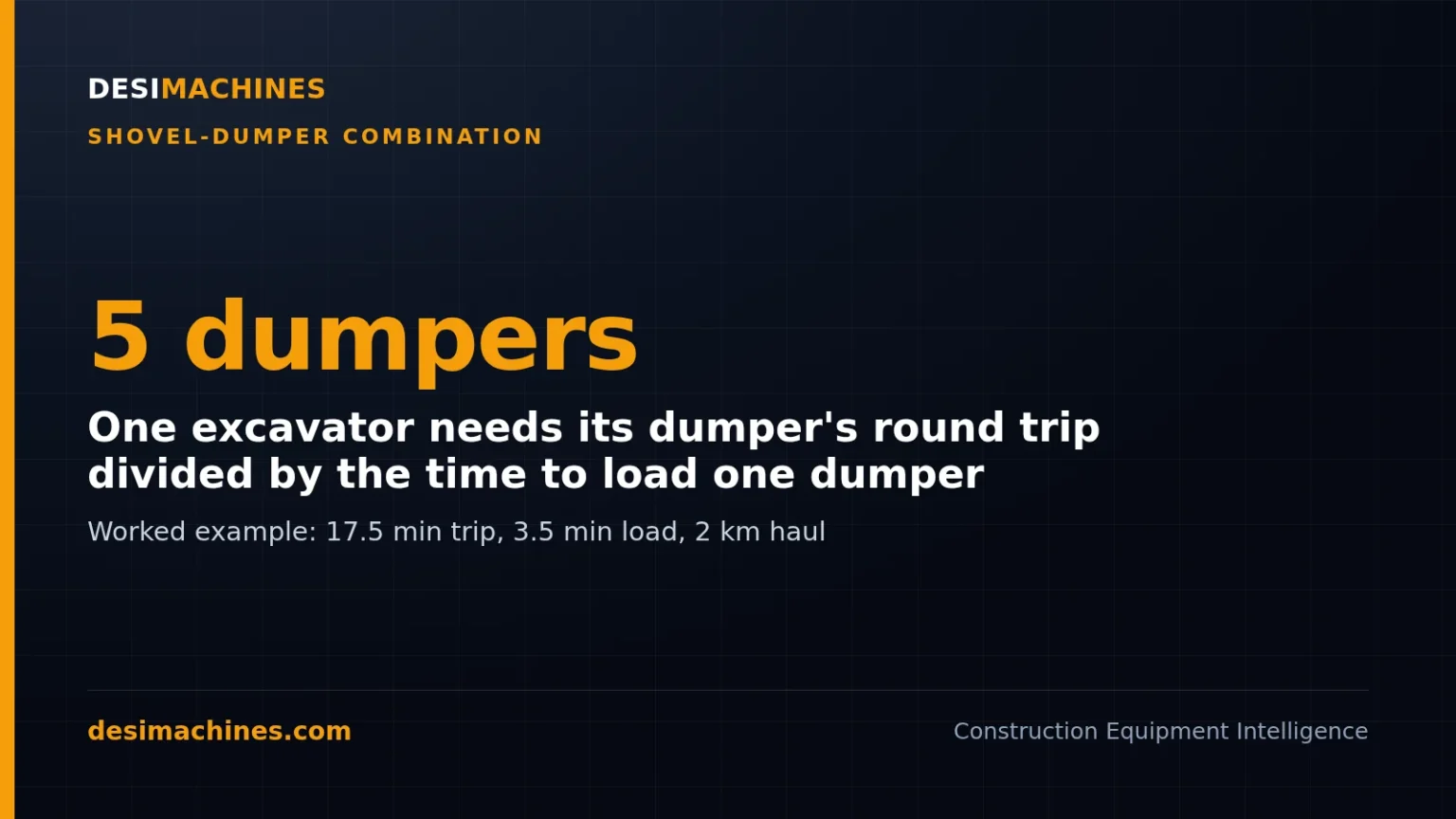
One excavator needs as many dumpers as it can load in the time one dumper takes to finish a full trip. Divide the dumper’s round-trip time by the time the excavator spends filling one dumper, and the answer is your fleet: a 17.5-minute trip and a 3.5-minute load means five dumpers.
That ratio has a name in mining, the match factor, and the pairing of one loading machine with its dumpers is the shovel-dumper combination used in almost every opencast mine and big quarry in India. This guide shows how to count passes per dumper, work out the match factor, pick the number of dumpers, and check the cost per tonne of the choice. Machine figures are read from our own product data in October 2026.
What is a shovel-dumper combination?
It is a loading machine that digs at the face and a group of dumpers that carry the material away. In Indian mines the word “shovel” covers any machine that does the loading: a hydraulic excavator with a backhoe bucket, the same machine fitted as a face shovel, or an older electric rope shovel. The difference between those three is set out in the guide to power shovel vs excavator.

The “dumper” is a rigid-frame off-road haul truck in a mine, and an ordinary road tipper in a quarry or on an earthwork job. The method is the same for both. Only the numbers change.
The two machines depend on each other completely. An excavator with no dumper under its bucket earns nothing, and a dumper waiting at the face burns diesel standing still. Getting the count right is most of the planning, which is why the guide to mining equipment in India calls matching the digger to the truck the idea that decides most of the rest.
How many passes should it take to fill one dumper?
A pass is one bucket load dropped into the dumper body. Work it out by weight, because a dumper is rated by the tonnes it may carry:
Passes = dumper payload ÷ (bucket capacity × fill factor × loose density)
- Bucket capacity is the heaped figure on the machine’s spec sheet, in m³.
- Fill factor is how full the bucket really comes out of that material, as a fraction. Well-blasted rock fills worse than loose soil.
- Loose density is the weight of one cubic metre of the broken material in the bucket, in tonnes per m³.
Take a worked example. These inputs are assumptions to show the method, so replace each one with your own site’s figures. A 4.0 m³ bucket, a fill factor of 0.85 and blasted overburden at 1.8 tonnes per loose m³ put 6.12 tonnes in each pass. A dumper rated for 35 tonnes needs 35 ÷ 6.12 = 5.7 passes.
Five passes leave the dumper about 13% light. Six full passes load 36.7 tonnes, about 5% over its rating. The usual answer is six passes with the last bucket part-filled, which is a skill the operator learns on the job.
Two things limit the choice from the machine side. The bucket must clear the dumper’s side wall when it tips, which the guide to excavator dumping height checks class by class. And the bucket must suit the material, which the guide to excavator bucket capacity covers.
Why do bigger excavators load more slowly per pass?
A bigger bucket means fewer passes, but a bigger machine also swings more slowly. Swing speed is published on most spec sheets in revolutions per minute (rpm), and a 90 degree swing is a quarter of a turn. So the shortest possible time for a 90 degree swing at full speed is 15 divided by the rpm, in seconds. The table applies that to six machines from our catalogue.
Table 1: Bucket size and swing speed across excavator classes (as per the current Oct 2026 spec)
| Machine | Operating weight | Bucket capacity | Swing speed | Shortest 90° swing, one way |
|---|---|---|---|---|
| Tata Hitachi ZAXIS 370LCH | 34,500 to 35,900 kg | 1.3 to 2.5 m³ | 10.7 rpm | 1.4 s |
| SANY SY680C-10HD | 63,620 kg | 3.5 to 4.2 m³ | 7.3 rpm | 2.1 s |
| BEML BE1000-1 | 95,000 kg | 3.1 to 5.55 m³ | 4.5 rpm | 3.3 s |
| Tata Hitachi EX 1200V | 109,000 kg | 4.0 to 6.5 m³ | 5.8 rpm | 2.6 s |
| Komatsu PC2000-8 | 200,000 to 204,120 kg | 12 to 13.7 m³ | 4.8 rpm | 3.1 s |
| Tata Hitachi EX 3600-6 | 362,000 kg | 21 to 23 m³ | 3.2 rpm | 4.7 s |
The last column is our own arithmetic from the published swing speed. It ignores the time the upper structure takes to speed up and slow down, so a real swing is longer. It still shows the pattern: the EX 3600-6 carries more than eight times the bucket of the ZAXIS 370LCH and takes more than three times as long to swing out to the dumper and back. A big machine moves far more per hour, but its bucket cycle is longer, and the dumper count has to be worked from the real cycle, never from the bucket size alone.
What is the match factor in mining?
The match factor (MF) is the rate at which dumpers arrive at the excavator divided by the rate at which the excavator can load them. For one excavator and one type of dumper it comes down to:
MF = (number of dumpers × time to load one dumper) ÷ (number of excavators × dumper cycle time)
The “time to load one dumper” is everything the excavator spends on it: the passes plus the minute or so while one dumper pulls away and the next reverses in. The “dumper cycle time” is the full round trip: wait and load at the face, haul loaded, turn and dump, return empty.
- At an MF of exactly 1, in theory no one waits. The excavator always has a dumper and the dumpers never queue.
- Below 1 there are too few dumpers. The excavator stands idle between dumpers, while the dumpers work flat out.
- Above 1 there are too many dumpers. A queue forms at the face, and the excavator is never idle.
The idea is old. A 2026 review in the Journal of Mining and Environment traces it to work by Douglas in 1964 and a 1968 paper by Morgan and Peterson, which first called it the match factor. It is still the quick check planners reach for before any simulation.
How do you calculate the number of dumpers for one excavator?
Set MF to 1 and solve for the dumpers: number of dumpers = dumper cycle time ÷ time to load one dumper. Carry on the worked example from above, again with assumed figures you should replace with your own.
- Loading: six passes at a 30-second bucket cycle is 3.0 minutes, plus 30 seconds for the next dumper to reverse in. The excavator spends 3.5 minutes on each dumper.
- Haul loaded: 2 km at an average 16 km/h is 7.5 minutes.
- Turn and dump: 1.5 minutes.
- Return empty: 2 km at an average 24 km/h is 5.0 minutes.
The full dumper cycle is 3.5 + 7.5 + 1.5 + 5.0 = 17.5 minutes. Divide by 3.5 and the answer is exactly 5 dumpers.
Figure 1: Where the 17.5-minute dumper cycle goes
Only a fifth of the cycle is spent at the excavator. The road takes the rest, which is why the haul distance is the first number to change your fleet. Stretch the same haul to 3 km and the cycle grows to 23.75 minutes. The dumper count becomes 23.75 ÷ 3.5 = 6.8, and you now have to choose between 6 and 7.
Table 2: Five dumper counts on the 2 km example
| Dumpers | Match factor | Who waits | Loads per hour | Tonnes per hour at 35 t |
|---|---|---|---|---|
| 3 | 0.6 | Excavator, 40% of the time | 10.3 | 360 |
| 4 | 0.8 | Excavator, 20% of the time | 13.7 | 480 |
| 5 | 1.0 | No one, in theory | 17.1 | 600 |
| 6 | 1.2 | Dumpers queue at the face | 17.1 | 600 |
| 7 | 1.4 | Dumpers queue at the face | 17.1 | 600 |
Read the last column. Output climbs with every dumper until the excavator is full, at 60 ÷ 3.5 = 17.1 loads an hour, and then stops. A sixth or seventh dumper adds a driver and a diesel bill and moves nothing more. The same arithmetic sizes a wheel loader and its tippers, and the excavator productivity guide shows how to time the bucket cycle that feeds it.
Is a match factor of 1 the best number for a real mine?
On paper, yes. On a real haul road, no machine keeps to its average. Dumpers bunch up behind a slow one, a driver stops for water, the crusher hopper is full for ten minutes. A peer-reviewed study of shovel-truck systems in the Journal of the Southern African Institute of Mining and Metallurgy (2009) points out that trucks do not arrive at the shovel in a predictable pattern, and that truck haulage makes up 50 to 60% of surface mining operating costs. So the queues cost real money.
Field figures show how far a real fleet sits from 1. In the 2026 Journal of Mining and Environment case study, a contractor’s fleet at the Sungun copper mine in Iran worked five excavator and loader faces. Every one ran below 1, between 0.51 and 0.87, and the whole fleet came to 0.74. Counting breakdowns, through an availability factor of 0.88, raised the whole-fleet figure to 0.85.
Three lessons follow for an Indian site:
- Work the match factor from timed averages, never from one good trip.
- Count breakdowns. If your dumpers are available only part of the shift, the dumper count has to cover the ones in the workshop.
- Expect the excavator to wait sometimes even at MF = 1. That is variation, not a planning mistake.
How do you work out the cost per tonne of the choice?
Fleet size is a cost decision, so finish with it. The cost per tonne for one excavator and its dumpers is:
Cost per tonne = (excavator cost per hour + number of dumpers × dumper cost per hour) ÷ tonnes moved per hour
Use your own owning and operating cost per hour for each machine, including the operator, diesel, maintenance and finance. Table 3 uses relative units to show the shape of the answer: the excavator’s hour is 100 units and each dumper’s hour is 40 units. These are illustrative weights, not rupee rates.
Table 3: Cost per tonne on the 2 km example, in relative units
| Dumpers | Fleet cost per hour | Tonnes per hour | Cost per tonne |
|---|---|---|---|
| 4 | 260 | 480 | 0.54 |
| 5 | 300 | 600 | 0.50 |
| 6 | 340 | 600 | 0.57 |
In a perfectly steady world five is cheapest. On the 3 km haul, where the answer was 6.8, run the same sum both ways. Six dumpers give 15.2 loads an hour (about 530 tonnes) and a cost of 0.64. Seven give the excavator’s full 600 tonnes at 0.63. The two are almost level, so let the relative cost break the tie: when a dumper’s hour is cheap next to the excavator’s, round up and protect the excavator’s output. When the dumpers are large haul trucks and their hour costs as much as the excavator’s, round down and let the excavator wait a little.
For what the machines themselves cost to own and run, the mining excavator models and prices list the current range.
What changes the number of dumpers on site?
The fleet you size on day one drifts as the pit grows. Recheck it whenever one of these moves:
- Haul distance and gradient: every extra kilometre and every ramp adds minutes to the cycle. A deeper pit means longer ramps, which the guide to bench height and haul roads covers.
- Road condition: potholes and dust slow loaded dumpers most. Water tankers and graders keep the cycle short.
- Blasting: badly broken rock fills the bucket poorly and slows each pass. The powder factor is where fragmentation starts.
- The dump end: a crusher that takes one dumper at a time can form its own queue, whatever the face is doing.
- Loading method: dumpers that pull up on both sides of the excavator in turn cut out most of the reversing time, so the excavator spends less time on each dumper.
In overburden work, the bank volume in the ground and the loose volume in the dumper differ, and the payable figure is usually the bank volume. The guide to overburden removal shows how to convert between them.
How do you measure your own match factor?
Two people, a stopwatch and the weighbridge slip are enough.
- Time at least 20 bucket cycles at the face, across the shift, and take the average.
- Count the passes for 10 dumpers and note how long each new dumper takes to get into position.
- Follow 10 full dumper trips from leaving the face to arriving back, and average them.
- Read the loaded weight from the weighbridge for the same dumpers, to check the passes are filling them to their rating.
- Put the averages into the formula, and repeat the check whenever the haul road changes.
The same method works for a quarry with road tippers, a canal job or a highway cutting. The mining equipment page tracks the models, live tenders and news for mines.
Where the numbers on this page come from
The match factor definition, its history and the Sungun field figures are from M. Mohtasham, “Development of a Match Factor for Optimizing Haulage Fleet Efficiency in Open-Pit Mining Operations”, Journal of Mining and Environment, Vol. 17, No. 4, 2026 (Sections 1 to 4 and Table 4). The haulage cost share and the point about uneven truck arrivals are from S.G. Ercelebi and A. Bascetin, “Optimization of shovel-truck system for surface mining”, Journal of the SAIMM, Vol. 109, July 2009. Both were read in full for this page.
Operating weights, bucket capacities and swing speeds are read from our own product data in October 2026. The swing times, the worked example and the cost table are our own arithmetic, and every input in the example is an assumption shown so you can replace it with your own. The heavy equipment guide indexes the rest of this section.
Prices, specifications and features are indicative, vary by variant, location and date, and should always be confirmed with the official OEM or authorised dealer before any purchase decision. DesiMachines is not liable for decisions taken on the basis of information that may have changed after publication.