Excavator
316 models
 Backhoe Loader
54 models
 Crane
68 models
 Concrete Mixer
79 models
 Wheel Loader
65 models
 Compactor / Roller
45 models
 Motor Grader
42 models

 Concrete Pump
66 models
 Skid Steer Loader
11 models


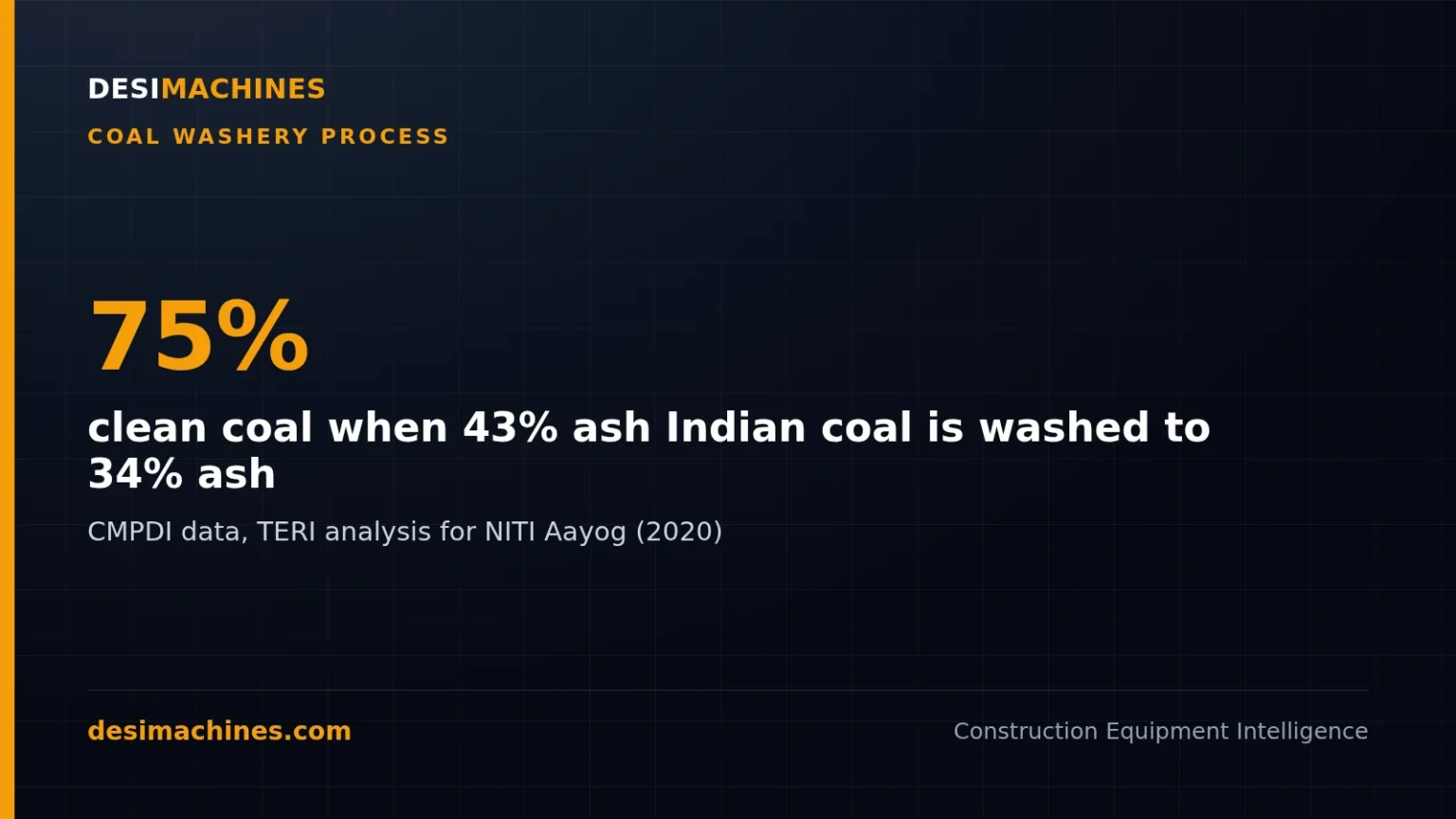
Wash Indian coal carrying 43 per cent ash down to 34 per cent and about 75 tonnes of every 100 come out as clean coal. Push the same coal down to 25 per cent ash and only about 49 tonnes do. That trade, cleaner coal against fewer tonnes, is what a coal washery runs on: the plant crushes and sizes run-of-mine coal, then separates the lighter coal from heavier stone and shale in water, using jigs, dense medium baths and cyclones, with spirals and flotation for the finest coal.
Those yield figures come from Central Mine Planning and Design Institute (CMPDI) washing data, worked into yield curves by The Energy and Resources Institute in its study for NITI Aayog, Economic and Environmental Impact of Coal Washing in India (2020).
This guide follows the coal through the plant in the order it travels. It explains why Indian coal needs washing at all, what each stage and machine does, how much clean coal a washery really gives, where the middlings and rejects go, and which machines work in the yard around it. It carries no rupee figures. Plant cost depends on tonnage and coal type, and that is a separate question from how the process works.
What is a coal washery?
A coal washery is a plant that lowers the ash in mined coal by physically separating the coal from the stone mixed in with it. Nothing is burnt and no chemicals change the coal. The plant only splits the feed into a cleaner part and a dirtier part. Miners also call it a coal preparation plant or a coal beneficiation plant.
A few words come up again and again:
Run-of-mine (ROM) coal is coal as it comes out of the mine, with the shale, sandstone and clay that the shovel picked up along with it.
Ash is what is left when coal burns: the mineral matter that gives no heat. A coal with 40 per cent ash is 40 per cent stone and clay by weight, as far as the boiler is concerned.
Clean coal (or washed coal) is the low-ash product. Middlings are the in-between part, too dirty for the main buyer but still able to burn. Rejects are the high-ash waste.
Yield is how many tonnes of clean coal come out of every 100 tonnes fed in. A washery can always lower the ash by throwing more away. The skill is lowering it without losing too much yield.
Why is Indian coal washed?
Because most Indian coal carries far more ash than the coal of other big producers, and ash costs money at every step after the mine.
The NITI Aayog study puts it plainly. Indian coal is Gondwana coal with 35 to 55 per cent ash and a low heat value. More than three quarters of it carries over 30 per cent ash. More than 90 per cent of Indian coal comes from opencast mines, and run-of-mine coal from these pits typically carries 35 to 50 per cent ash. The study links the two: big opencast shovels load the shale and stone around a seam along with the coal. The types of mines guide explains how these pits are laid out.
High ash hurts in three places. On the railway, every wagon of 40 per cent ash coal carries four tonnes in every ten that will give no heat. In the power plant, ash wears out parts faster, makes the coal harder to grind and leaves huge quantities of fly ash. In a steel plant, ash in coking coal ends up in the coke, and the furnace wants coke with as little ash as possible.
That is why coking coal for steel has long been washed, and why its grades are named after washing. The Indian Minerals Yearbook 2022 coal chapter of the Indian Bureau of Mines lists the coking coal grades by ash:
| Grade | Ash content |
|---|---|
| Steel Grade I | Not more than 15% |
| Steel Grade II | Over 15%, up to 18% |
| Washery Grade I | Over 18%, up to 21% |
| Washery Grade II | Over 21%, up to 24% |
| Washery Grade III | Over 24%, up to 28% |
| Washery Grade IV | Over 28%, up to 35% |
| Washery Grade V | Over 35%, up to 42% |
| Washery Grade VI | Over 42%, up to 49% |
Non-coking coal, the coal burnt in power stations, is graded by heat value instead (G1 to G17), and only part of it is washed. Whether a given seam is worth washing depends on its washability, which the next sections explain.
What are the stages of the coal washery process?
Every washery is designed around its own coal, but the order is much the same everywhere. Size the coal first, then wash each size range in the machine that suits it, then take the water out. The NITI Aayog study sorts coal into four size ranges for washing: coarse (over 10 mm), medium (about 1 to 10 mm), fine (1 mm down to 0.15 mm) and ultra-fine (below 0.15 mm).
| Stage | Main equipment | What it does |
|---|---|---|
| 1. Receiving and stockpiling | Dumpers or rail wagons, receiving hopper, wheel loaders and dozers at the stockpile | Brings ROM coal in and keeps a steady feed going to the plant |
| 2. Crushing | Coal crushers sized to the plant’s feed | Breaks big lumps down to the top size the washer can take |
| 3. Screening and de-shaling | Vibrating screens, barrel washers, ROM or coarse coal jigs | Splits the coal into size ranges and throws out the worst of the stone early |
| 4. Coarse and medium coal washing | Jigs, dense medium baths, dense medium cyclones | Separates coal from stone by density, the main washing step |
| 5. Fine coal washing (some plants) | Spirals, water-only cyclones, froth flotation cells | Cleans the fine coal that dense medium cannot handle well |
| 6. Magnetite recovery | Drain screens, magnetic separators | Recovers the magnetite powder from the dense medium so it can be used again |
| 7. Dewatering | Dewatering screens, centrifuges, thickeners, filters | Takes water out of clean coal, middlings and slurry so the water can be reused |
| 8. Load-out and reject handling | Conveyors, silos, wheel loaders, dozers on the reject dump | Sends clean coal to rail or road, middlings to their buyer, rejects to a dump or a buyer |
Not every plant has every stage. A simple non-coking washery may stop at a jig or a dense medium bath and send its fines out unwashed. A coking coal washery is more likely to add cyclones and flotation, because steel plants need low-ash coal. Crushing and screening work much as they do in a stone plant, and the crushing and screening plant guide explains those machines, screens included.
Figure 1: how coal moves through a typical coal washery (illustrative)
Read top to bottom. Middlings appear only in plants that make three products.
How do jigs, dense medium baths and cyclones separate coal from stone?
All three use one fact: coal is lighter than the stone mixed with it. In water, or in a liquid made heavier than water, the light coal stays up and the heavy stone goes down.
A jig is a tank of water that is pulsed up and down. Each pulse lifts the bed of coal and stone a little, and as it settles the heavy shale sinks to the bottom while cleaner coal rides on top. The two are drawn off at different levels. The NITI Aayog study notes that the Baum jig works best on coal of 10 to 35 mm and the Batac jig can also wash coal below 10 mm. Indian plants use coarse coal jigs, along with barrel washers, to de-shale ROM coal before the main wash.
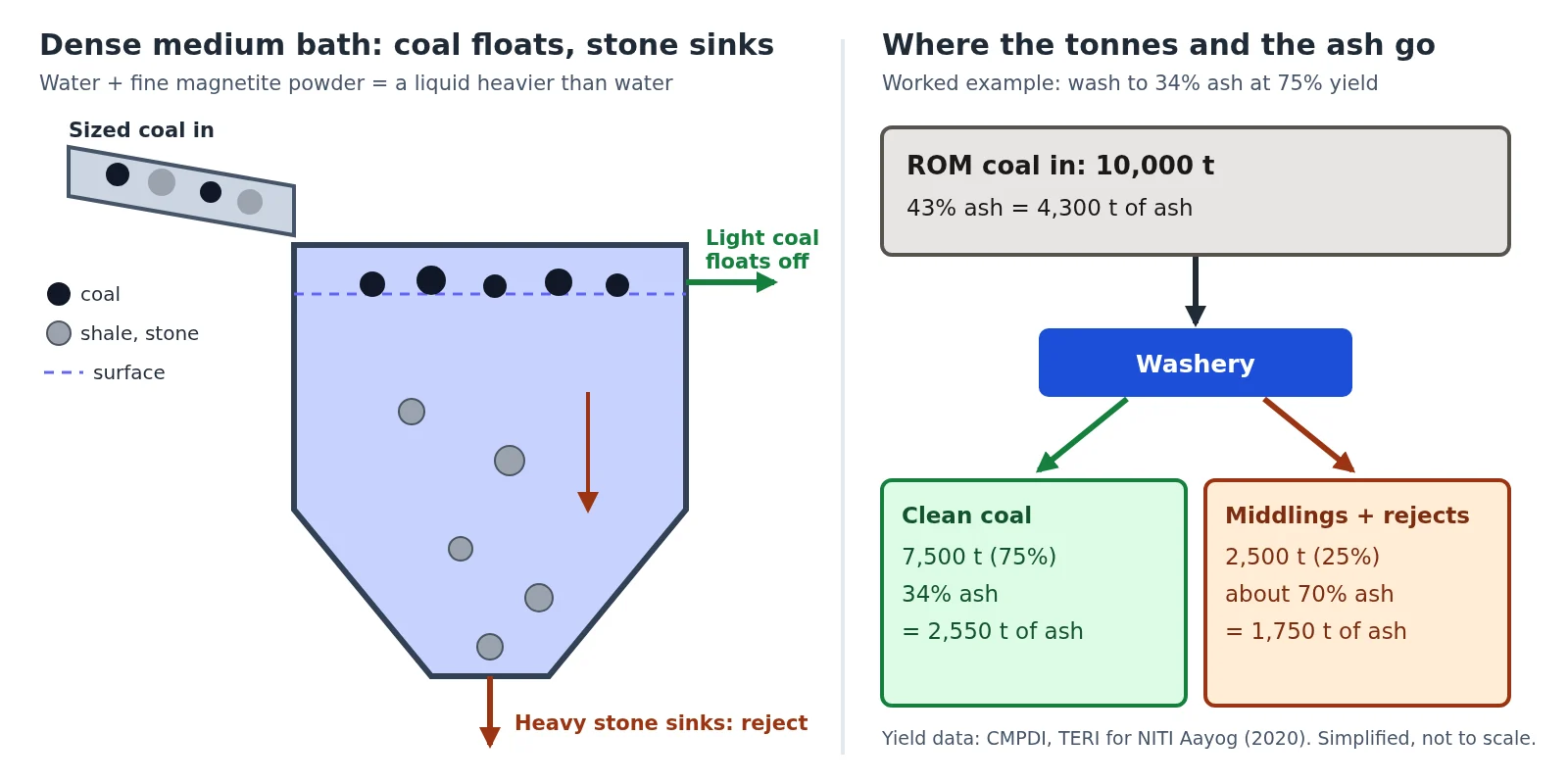
A dense medium bath does the same job more sharply. Instead of plain water, the coal goes into a suspension of fine magnetite powder (a heavy iron mineral) in water. The operator sets how heavy the suspension is. Anything lighter than that floats off as clean coal, and anything heavier sinks as reject. The study says dense medium washing typically rejects about 20 to 40 per cent of the ROM feed. Because the magnetite is costly, it is rinsed off the products over drain screens and pulled back out of the water with magnetic separators.
A dense medium cyclone is the same idea for smaller coal. The coal and magnetite slurry is pumped into a cone at speed so it spins. Heavy particles are thrown to the wall and leave at the bottom, and light coal leaves through the top. The study gives cyclone cut points (the density at which particles split) between 1.3 and 1.9, and calls the heavy media cyclone the most favoured process in India because it can wash difficult coal with a sharp separation.
How difficult a coal is to wash is measured by its near gravity material index (NGMI): the share of coal that sits close to the cut density and so is hard to sort. The study quotes this rule of thumb:
| NGMI | Type of coal | Usual process |
|---|---|---|
| 0 to 7 | Simple | Jig |
| 7 to 10 | Moderately difficult | Dense medium bath, tables, spirals |
| 10 to 15 | Difficult | Heavy media cyclone |
| 15 and above | Very difficult to formidable | Heavy media cyclone |
Indian coal tends to sit at the hard end. The study describes its washability as poor and puts its high rejection, often above 30 per cent, down to the way the ash is distributed through the coal.
How is fine coal washed?
Fine coal is washed with spirals, water-only cyclones and froth flotation, because particles this small settle too slowly for a dense medium to sort them well.
A spiral is a long corkscrew channel. Coal slurry runs down it, the heavier particles gather in a band on the inside and a splitter at the bottom divides the stream into coal and reject. A water-only cyclone spins plain water and fines, with no magnetite. Froth flotation works on a different property. Coal does not like to stay wet, so after a chemical reagent is added, air bubbles stick to the coal and carry it up into a froth that is skimmed off, while the stone stays in the water.
Flotation is costly and fiddly, and the NITI Aayog study says it is used mainly for metallurgical (coking) coal. The study also notes that fine coal treatment is not done at scale in India, and that ultra-fine treatment has not been taken up at all.
How much clean coal does a coal washery give?
Less than most people expect, and the yield falls fast as the target ash goes down.
The study’s yield curves, built on CMPDI data, give these figures for ROM coal carrying 43 per cent ash:
| Ash in washed coal | Clean coal yield | Coal that leaves as middlings or rejects |
|---|---|---|
| 34% | 75% | 25% |
| 32% | 70% | 30% |
| 28% | 58% | 42% |
| 25% | 49% | 51% |
Here is what the first row means in tonnes. Take 10,000 tonnes of ROM coal at 43 per cent ash. It holds 4,300 tonnes of ash. Wash it to 34 per cent at 75 per cent yield and you get 7,500 tonnes of clean coal holding 2,550 tonnes of ash. The other 2,500 tonnes, the reject stream, must then hold the remaining 1,750 tonnes of ash, which works out to 70 per cent ash. So a quarter of the tonnes leave the plant, and they take about 40 per cent of the ash with them. Lowering the target from 34 to 25 per cent ash costs another 26 tonnes of clean coal for every 100 fed in.
Plants that make three products split the waste further. The study quotes a trial of an air jig on Indian coal of 42 per cent ash that gave clean coal at 27 per cent ash (59 per cent yield), middlings at 55 per cent ash (22 per cent) and rejects at 73 per cent ash (19 per cent). On the plants reporting to the Indian Bureau of Mines for 2021-22, the yearbook gives washed coal at 19 to 22 per cent ash, middlings at 35 to 40 per cent and rejects mostly above 50 per cent, from raw coal of 24 to 33 per cent ash.
Two things follow for anyone planning around a washery. The tonnes on the despatch side are always well below the tonnes coming in, so the reject dump and the middlings yard grow every shift. And a lab washability test on the actual seam is the only way to know the yield before the plant is built.
What happens to middlings and rejects?
They are burnt where they can be and stored or reused where they cannot.
Middlings still carry useful heat and are sold as fuel for power plants. Rejects are harder. The NITI Aayog study says washery rejects typically carry more than 60 per cent ash and under 2,200 kcal per kg. The best home for them is a fluidised bed combustion (FBC) boiler, where coal burns in a bed of hot sand and ash kept moving by air from below. The study cites the Bureau of Energy Efficiency figure that an FBC boiler can fire coal with as much as 62 per cent ash and a heat value as low as 2,500 kcal per kg.
For rejects below that, a technical committee set up in 2018 suggested a 1,500 kcal per kg dividing line to the Ministry of Coal. Rejects at or above it may go to FBC and CFBC (circulating fluidised bed) power plants. Rejects below it may replace construction fill in highway, railway and dam embankments, land reclamation and brick making. The lowest-grade rejects are also used to backfill worked-out parts of mines.
Washing also uses a lot of water, which is why the last stage matters. Thickeners settle the fine solids out of the dirty water so the clear water goes back into the plant, and the settled slurry is pumped to a pond or filtered. The mine dewatering guide covers how pits deal with water on the mining side.
Can coal be washed without water?
Yes. Dry beneficiation sorts coal by density using air instead of water, and it suits dry areas, though it separates less sharply than wet washing.
The NITI Aayog study lists air jigs, air dense medium fluidised beds (a bed of fine magnetite kept floating by air, in which light coal rises and stone sinks) and compound dry separators that combine an air table with a fluidised bed. These work on coarse and medium coal, roughly 6 to 80 mm depending on the machine. Indian researchers tested an air dense medium bed on high-ash coal and brought ash down from 40 per cent to about 32 to 35.5 per cent at 60 to 72 per cent yield.
The trade-off is sharpness. The study gives wet methods a separation efficiency (Ep, where lower is better) of about 0.01 to 0.05 and dry methods about 0.07 to 0.25, and dry plants also need serious dust control. For a buyer the plain reading is this: dry de-shaling can take the worst stone out cheaply near the pit, but a plant chasing coking coal grades still washes wet.
Which machines work in and around a coal washery?
Inside the plant the equipment is fixed: crushers, screens, jigs, cyclones, pumps, thickeners and conveyors, all bought as part of the plant. Around it, the work is done by mobile machines, and that is where most of the daily hours go.
Coal reaches the plant from the pit by dumper, conveyor or wagon. The conveyor belt guide explains when a belt beats a dumper fleet, and the shovel and dumper combination guide shows how the pit side is matched. At the plant, wheel loaders build and reclaim stockpiles, feed the hopper and load out clean coal and middlings. Dozers push up the stockpiles and spread and level the reject dump.
| Machine | Job around a coal washery | Bucket or blade capacity | Operating weight |
|---|---|---|---|
| BEML BL40 | Stockpile reclaim, hopper feeding and load-out | 4.7 m³ bucket | 28,000 kg (28 tonnes) |
| Tata Hitachi ZW 370-5A | Stockpile reclaim and wagon or truck loading at a larger plant | 4.8 to 8.5 m³ bucket | 31,750 to 32,570 kg (about 32 tonnes) |
| BEML BD155 | Pushing up stockpiles and levelling the reject dump | 7.9 m³ blade | 38,000 kg (38 tonnes) |
| Komatsu D155A-6 | Stockpile and reject dump work at a larger plant | 9.4 m³ blade | 41,700 kg (about 42 tonnes) |
Coal is much lighter than ore or stone for the same volume, so a loader can carry a bigger bucket of coal than of rock. That is why loader buckets on the spec sheet are often quoted as a range. Ask the dealer for the coal bucket that suits your loader, not the rock bucket. Coal stockpiles also raise dust, and the dust suppression guide covers sprinklers and fog cannons for stockyards and haul roads.
The full range of wheel loaders and mining dozers is listed with specs, and you can send an enquiry for the class your yard needs.
Coking coal washeries cluster in Jharkhand, which the IBM yearbook says produces about 99 per cent of India’s coking coal. The same plant logic, crush, size, sort by density, dewater, is used on iron ore, and the iron ore beneficiation guide walks through that plant. The mining machinery page lists the machines, tenders and companies active in the sector, and every mining topic we cover is on the mining guide hub.
Running the stockyard or reject dump at a washery? Compare wheel loaders by bucket and weight, and ask for a quote on the size that fits your hopper and wagons.
Yield and ash figures are quoted from the NITI Aayog study and the Indian Bureau of Mines yearbook named above and describe their data sets, not any one plant. Machine figures are taken from our listings at the time of writing. Prices, specifications and features are indicative, vary by variant, location and date, and should always be confirmed with the official OEM or authorised dealer before any purchase decision. DesiMachines is not liable for decisions taken on the basis of information that may have changed after publication.
Machines, tenders and news for this industry: Quarry