
 Excavator
316 models
 Backhoe Loader
54 models
 Crane
68 models
 Concrete Mixer
79 models
 Wheel Loader
54 models
 Compactor / Roller
45 models
 Motor Grader
42 models

 Concrete Pump
66 models
 Skid Steer Loader
11 models


Aerial work platform safety comes down to stopping four things: the machine tipping over, a worker being thrown or falling out of the basket, a worker being crushed against a beam or slab overhead, and the platform touching a live power line. Each one is prevented by a routine done before the platform goes up: a pre-use check, a harness where the machine needs one, the ground and the wind checked against the maker’s limits, and a trained person on the ground who can bring the platform down.
This guide covers scissor lifts and boom lifts, also called man lifts, on Indian building, factory and warehouse jobs. It draws on the guidance of Britain’s Health and Safety Executive (HSE), the Indian harness standard IS 3521 and the limits Haulotte India prints for its platforms. For the types of platform and how to pick one, see aerial work platform types.
What are the main dangers on an aerial work platform?
There are five, all named in HSE’s guidance sheet GEIS6. The first four can kill the person in the basket; the fifth falls on the people below.
Table 1: The five dangers on an aerial work platform and what prevents each
| Danger | How it usually happens | What prevents it |
|---|---|---|
| Tipping over | A wheel sinks into soft ground, a trench or a manhole; raised on a slope; overloaded basket; strong wind | Ground checked first, tilt and overload alarms working, wind rating respected |
| Thrown or falling from the basket | On a boom, a jolt at the wheels whips the basket; a worker leans out or stands on the rails to reach further | Harness clipped to the basket anchor on booms; move the machine closer instead of reaching |
| Crushed against something overhead | The basket rises or swings into a beam, slab, duct or pipe rack and pins the operator against the controls | Slow control near structures, a secondary guarding device, extra training |
| Touching a power line | The boom or basket comes too close to an overhead wire while rising or swinging | Line switched off by its owner, or a safe distance kept and marked on the ground |
| Things falling on people below | A tool, bolt or piece of material drops from the basket | Area under the machine’s whole reach barricaded, tools on lanyards |
HSE also warns against two habits. Never balance material on the guardrails, and do not use the platform to step off onto a roof or slab unless a written risk assessment has planned it: the machine is built to carry people up and bring them back down, not to transfer them from one level to another.
What should you check before using a scissor lift or boom lift?
Check it every day before use: a walk-around with the platform down, then a test of every control. HSE puts this check on the trained operator and asks for a record. The maker’s checklist in the manual comes first; the table below is a starting list.
Table 2: A daily pre-use check for a scissor lift or boom lift
| Check | What to look for |
|---|---|
| Paperwork | Manual on the machine, latest inspection report, operator’s training card for this type |
| Walk-around | Tyres and wheel nuts, oil leaks, cracked or bent metal, guardrails, an entry gate that closes properly |
| Power | Battery charge and water level, or fuel and engine oil |
| Ground controls | Raise and lower from the base first; base emergency stop and emergency lowering work |
| Platform controls | Every movement stops when you let go; basket emergency stop works |
| Safety devices | Tilt alarm, overload alarm, pothole guards on a scissor lift, outriggers and their pads where fitted |
| Harness and lanyard | Webbing, stitching, buckles and hooks undamaged; anchor point solid |
If anything fails, HSE’s instruction is to isolate the controls, tag the machine and report it. On a hired machine, that means a call to the hire company, not a fix by the site mechanic.
Do you need a harness on a scissor lift or a boom lift?
On a boom lift, yes: everyone in the basket wears a full body harness clipped to the anchor point in the basket. On a scissor lift, the guardrails are the main protection, and a harness is worn when the site’s safety plan, the hire company or the maker’s manual asks for one, clipped only to an anchor point the maker has fitted.
A scissor lift goes straight up, so its basket stays over the base. A boom holds the basket at the end of a long arm, and HSE names being thrown out when the boom swings, jolts or tilts as one of the biggest risks on these machines.
HSE prefers work restraint: a lanyard short enough that the worker can never reach a spot where a fall could start, such as over the rail. Fall arrest, the other set-up, lets a fall begin and then stops it. Restraint stops it starting.
Figure 1: Work restraint in a boom lift basket
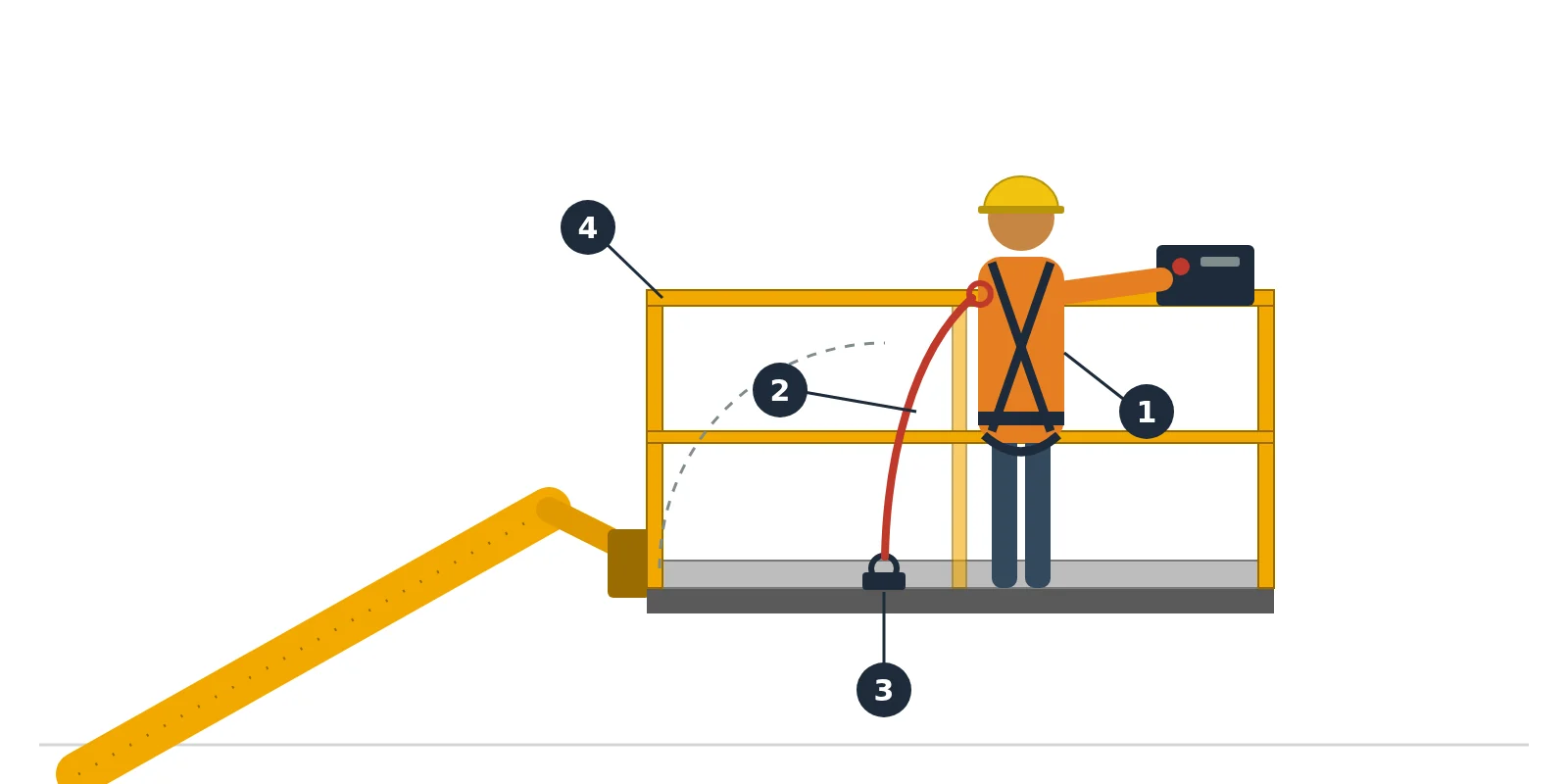
- Full body harness. Under IS 3521 (Part 1):2021, a letter “A” on the shoulder straps marks the attachment point for fall arrest.
- Restraint lanyard, short enough that the worker cannot reach over the guardrail.
- Anchor point fitted by the maker on the basket floor or frame.
- Guardrail and self-closing gate: the main protection on a scissor lift, backed up by the harness on a boom.
The drawing is simplified. Lanyard length and anchor position come from the machine’s manual.
Buy a harness made to IS 3521 (Part 1):2021, the Indian standard for full body harnesses, and ask for proof. The standard says:
- A waist belt or chest harness is not safe for stopping a fall.
- It covers one person whose total weight, tools included, is up to 100 kg. A heavier worker should ask the harness maker.
- The wearer checks it before every use; a competent person inspects it at least once a year.
- A harness that has stopped a fall is taken out of service, even if it looks fine.
HSE adds two exceptions. Do not use a self-retracting lanyard in a basket unless its maker has tested it for that use. Over water, where drowning is the bigger danger, wear a life jacket instead.
How many people, how much wind and how much slope can a platform take?
Only what its plate and sheet say, and the limits are smaller than most people expect. Haulotte’s Compact battery scissors in India carry three people indoors but one outdoors, where every person adds to the area the wind pushes on.
Table 3: Safety limits printed for Haulotte platforms sold in India (read 12 November 2026)
| Model | Type | Working height | People in the basket | Basket load | Tilt limit | Wind rating |
|---|---|---|---|---|---|---|
| Compact 12 | Battery scissor | 11.75 m | 3 indoors, 1 outdoors | 320 kg | 3.5° / 1.5° | Not on the India page |
| Compact 14 Dual | Battery scissor | 13.75 m indoors, 9.8 m outdoors | 3 indoors, 1 outdoors | 320 kg | 3.5° / 1.5° | Not on the India page |
| HS18 E | Rough-terrain battery scissor | 18 m | 4 | 750 kg | 5° / 2° | Not on the India page |
| HA16 RTJ PRO | Diesel articulating boom | 16 m | 2 | 230 kg | 5° | 45 km/h (12.5 m/s) |
| HA20 RTJ PRO | Diesel articulating boom | 20.5 m | 2 | 250 kg (350 kg option) | 4° (6° option) | 45 km/h (12.5 m/s) |
| HT28 RTJ PRO | Diesel telescopic boom | 27.9 m | 2 | 230 kg (350 kg option) | 4° | 45 km/h (12.5 m/s) |
Where two tilt figures are given, the first is front-to-back and the second is side-to-side. Every person, tool and piece of material counts towards the basket load, and HSE’s rule is plain: never switch off the overload system.
The tilt limit is tiny. Five degrees is a slope of about 9%, and a rutted yard can beat the 1.5 degrees allowed side-to-side on the small scissors. When the tilt alarm sounds, stop, lower and move to level ground. Gradeability on a sheet, often 25% to 45%, is the slope the machine drives up lowered, not the slope it can work on. And an indoor rating means indoor: HSE warns that a half-clad shed, or one with big doors open at both ends, can be as windy as outside.
Check the wind with an anemometer, a hand-held wind meter, before and during the work. A dust storm or pre-monsoon squall arrives in minutes, so come down when the sky changes.
How do you check the ground before raising the platform?
Walk the route and the work spot first. HSE’s list of what tips platforms over reads like any Indian site: trenches, manholes, loose backfill over a cable trench, waterlogged soil, kerbs and slab edges.
On a slab or basement roof, ask the site engineer for its load limit and check new concrete has cured. On soil, put spreader pads under outriggers. Pothole guards, bars that drop beside a scissor’s wheels as it rises, stop a wheel entering a small hole but do not make soft ground safe. Weights and ground figures by type are in scissor lift vs boom lift.
Barricade the whole area the boom can reach, not just around the wheels.
How do you stop a worker being crushed against a beam or slab?
Slow down near anything overhead, and pick a machine with a secondary guarding device for work under beams, slabs or pipe racks. Crushing, which HSE calls entrapment, happens when the basket pins the operator against the control panel and the control cannot be released.
That device is a bar, cage or sensor around the controls, meant to stop the movement or limit the harm. Haulotte lists its Activ’Shield Bar on the HA16 RTJ PRO and HT16 RTJ PRO booms and the HS15 E scissor. HSE adds three habits:
- The basket can keep moving for a moment after the lever is released, so approach a beam slowly.
- Never crouch over the panel to squeeze under an obstacle; lower and reposition.
- Work through steelwork, ducts or several floor levels needs extra training.
The articulating boom, which reaches up and over, suits work among structures; see boom lift types.
How close can an aerial platform work to an overhead power line?
Treat every overhead line as live until its owner confirms in writing that it is switched off. In India that owner is the electricity distribution company for most lines over roads and yards, or the transmission company for tower lines. A booked shutdown is the safest plan.
HSE’s note GS6 asks for any work within 10 m of a line, measured along the ground from below the nearest wire, to be planned. Where a line stays live, the British industry’s minimum keep-out zones are 1 m for low-voltage lines, 3 m for 11 kV and 33 kV, 6 m for 132 kV and 7 m for 275 kV and 400 kV. Treat them as the smallest gap and allow for sway. GS6 also warns that a tripped line can switch itself back on within seconds.
Only insulated machines built for line work, run by line crews, belong near live wires.
Who should operate an aerial platform, and what training is needed?
Only a person trained on that type of platform and then shown the exact model. HSE splits this in two. Training gives a card listing the platform types the operator may use, with an expiry date. Familiarisation, on site and recorded, covers that model’s controls, its safety devices and its emergency lowering.
The international training standard is ISO 18878. India has a national skill qualification for aerial work platform operators through the Infrastructure Equipment Skill Council; its hours and entry rules are in boom lift operator salary in India. A boom and a scissor handle differently, so check the card covers the machine supplied.
At least one person who stays at the base must also know that model’s ground controls and emergency lowering.
How do you bring an aerial platform down in an emergency?
From the ground controls at the base first, and if power has failed, with the emergency lowering system. Most platforms have a manual lowering valve or hand pump at the base; Haulotte lists an emergency hand pump, and emergency stops in the basket and at ground level, on its Star 10 mast lift.
HSE asks for a rescue plan before work starts: the trained people on site who will lower the platform, the service engineer’s number for a machine that will not come down, and regular practice.
IS 3521 also asks users to plan, before work starts, how a worker left hanging in a harness after a fall will be rescued quickly.
How often should the machine itself be inspected?
Every day by the operator (Table 2), and at fixed intervals by a competent person, who examines the structure, hydraulics and safety devices. Britain requires that examination at least every six months; the maker’s service schedule sets what is checked. Ask for a hired machine’s latest report and keep a copy.
The work-at-height rules for Indian sites changed with the labour code rules of 2025 and 2026; scaffolding safety norms in India sets out where they stand.
At day’s end, park the platform lowered on level ground, brakes on, key removed.
Lifting heavy material, not people? A platform is the wrong machine. A telehandler such as the JCB 530-70 or the ACE AT 30 carries the load; whether one can also carry people in a certified cage is covered in telehandler attachments. Compare telehandler models and prices or crane models and prices and talk to a verified dealer. Hiring a platform? How to rent construction equipment covers the paperwork; all guides are under aerial work platforms.
Sources
Read on 12 November 2026: Health and Safety Executive, The selection, management and use of mobile elevating work platforms (GEIS6, October 2014) and Avoiding danger from overhead power lines (GS6, fourth edition, May 2013); Bureau of Indian Standards, IS 3521 (Part 1):2021, Personal fall arrest systems, Part 1 Full body harness; Haulotte India’s product pages for the Compact 12, Compact 14 Dual, HS15 E, HS18 E, Star 10, HA16 RTJ PRO, HA20 RTJ PRO, HT16 RTJ PRO and HT28 RTJ PRO. HSE guidance and British rules are quoted as good practice, not Indian law. Aerial work platforms are not listed on DesiMachines, so no prices are given.
Prices, specifications and features are indicative, vary by variant, location and date, and should always be confirmed with the official OEM or authorised dealer before any purchase decision. DesiMachines is not liable for decisions taken on the basis of information that may have changed after publication.