
 Excavator
294 models
 Backhoe Loader
51 models
 Crane
68 models
 Concrete Mixer
79 models
 Wheel Loader
54 models
 Compactor / Roller
45 models
 Motor Grader
42 models

 Concrete Pump
66 models
 Skid Steer Loader
11 models


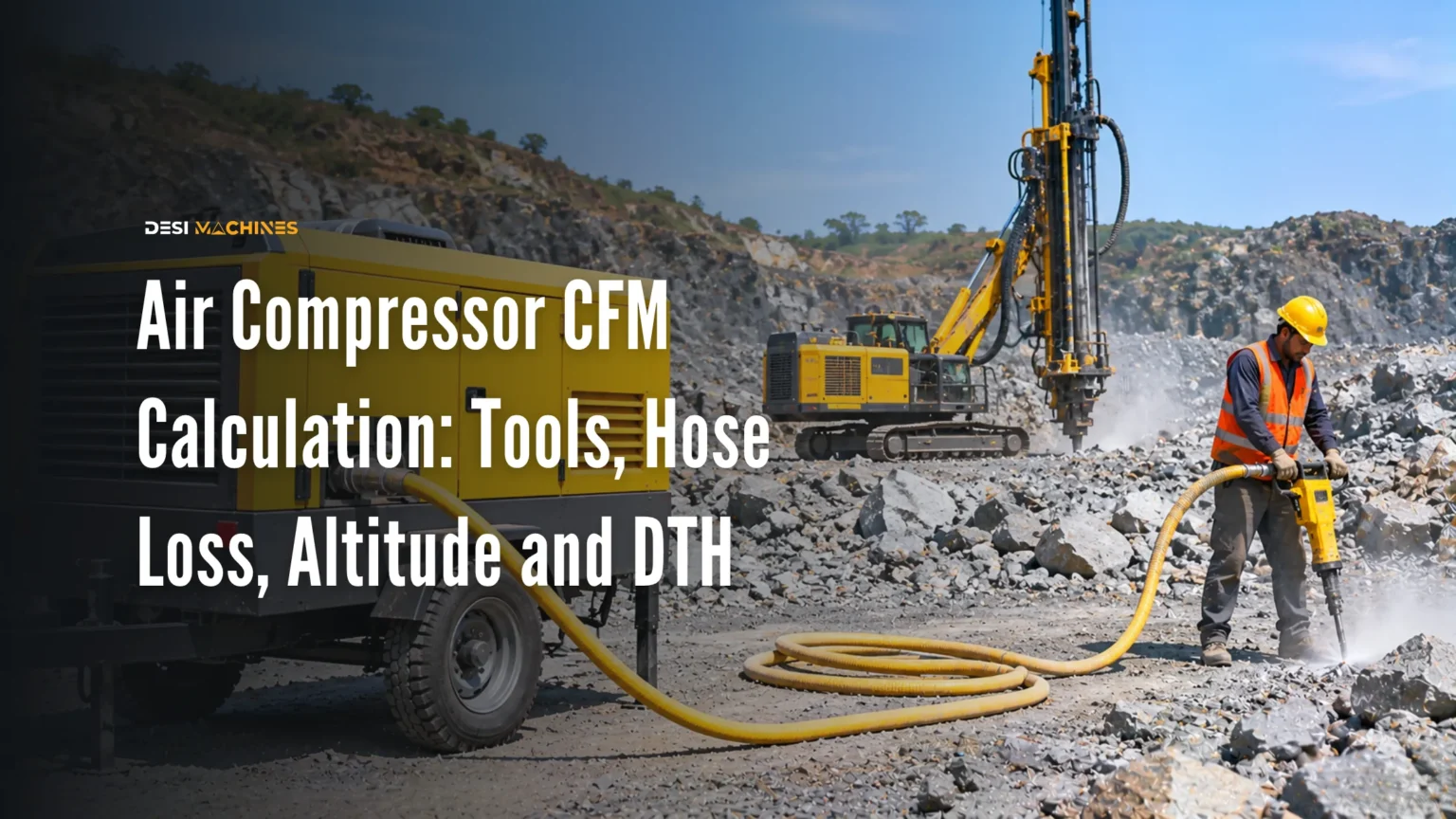
If three hand-held breakers will run off one trolley compressor on a hill road, their data sheets add up to about 246 cfm, yet the machine to ask for is closer to 330 cfm. The air compressor cfm calculation is: add the air of every tool that runs at the same time, add 10 to 15 per cent for leaks and wear, then correct for your hose and for the height of the site.
This guide works through each of those steps with real figures. It is the detailed companion to the guide on choosing an air compressor for construction and quarries, which explains the types of machine and how much air a breaker or rock drill uses. Here you will find the formula, the units to check, how much pressure a long hose costs you, how altitude and summer heat cut what a compressor delivers, and how much air a down-the-hole (DTH) hammer burns at each hole size. Two worked examples at the end put it all together.
How do you calculate air compressor cfm?
Use one line: compressor cfm = (sum of the cfm of every tool running at the same time) × 1.10 to 1.15. Then, if the site is high up or the hose run is long, step up again. Atlas Copco’s Indian guide on air requirements writes the same sum per tool as flow × load factor × number of units, and adds a margin of 10 to 15 per cent for leakage, pressure drop and future growth.
The load factor is the share of the shift a tool actually runs. Atlas Copco gives 20 to 30 per cent for intermittent tools such as drills and impact wrenches, which a worker picks up and puts down. It also warns that a load factor describes how hard one operator works one tool, and says nothing about how many tools run together. When several run at once, the compressor has to supply all of them at that moment, unless a large receiver tank sits between the compressor and the tools to cover the peak.
On a road or quarry job, a breaker crew holds the trigger for long stretches, and a trolley compressor usually feeds the hoses straight from its own outlet valves. So count every tool that can run at the same moment at its full data-sheet figure, and use a load factor only for the odd tool that runs now and then, like a blow pipe.
Work it in four steps:
- Write down each tool’s air use from its own sheet, in one unit. One litre a second (l/s) is 2.12 cfm, and one cubic metre a minute (m³/min) is 35.3 cfm.
- Add up the tools that can run together.
- Multiply by 1.10 to 1.15 for leaks, worn tools and couplings.
- Divide by the altitude factor if the site is high up (see below), and check that the compressor’s pressure covers the tool’s pressure plus the loss in the hose.
Which cfm figure should you compare: free air, scfm or the brochure figure?
Compare free air delivery (FAD) with the tools’ free air use, both at the pressure you will work at. FAD is the outside air the compressor takes in each minute and delivers, so it is the figure that can be set against a tool’s consumption.
The catch is the reference conditions. Wikipedia’s article on standard cubic feet per minute (scfm) shows that “standard” air is defined at 0, 15, 20 or 25 °C depending on the country and the industry, and at slightly different pressures. Atlas Copco’s air requirement tables, and Mincon’s DTH hammer charts, are both drawn at 20 °C and 1.013 bar. When a seller quotes a figure, ask three things: is it free air, at what working pressure, and at what inlet temperature and pressure? Two quotes that differ by 5 per cent can be the same machine measured two ways.
Pressure needs the same care. Most Indian sheets give bar, some give kg/cm² (0.98 bar) and imported tools give psi (14.5 psi is 1 bar). The conversion table in the air compressor for construction guide covers all of them.
How much pressure does a long hose cost you?
On a well laid-out line, the drop between the compressor outlet and the tool should stay under 0.6 to 1.0 bar. Atlas Copco’s pocket guide to air tool installation gives that limit for the shut-off valve, the air treatment, the couplings and the hose together, and works the example the other way round: to get 6.3 bar at the tool, the line has to start at about 7 bar.
Hose length and bore decide most of that loss. The same guide’s rule is to go one hose size up for a length of 5 to 10 m, two sizes up at 20 m, and three sizes up between 20 and 40 m. Every coupling adds a loss of its own: a short whip hose with an extra coupling can take 0.2 to 0.5 bar on its own, and splitting a 13 mm, 5 m hose into a whip plus a main hose cut its capacity from 21 l/s to 16 l/s, about 80 per cent.
A tool fed below its pressure does not simply use less air and carry on. It works more slowly. Atlas Copco’s test table shows how air use and output fall together as the pressure at the tool drops:
| Pressure at the tool (bar) | Air use against the rating | Atlas Copco’s advice |
|---|---|---|
| 8.0 | 125% | Turn the regulator down |
| 7.0 | 111% | Turn the regulator down |
| 6.3 | 100% | Rated performance |
| 6.0 | 96% | Raise the pressure or improve the air line |
| 5.0 | 77% | Raise the pressure or improve the air line |
| 4.0 | 61% | Raise the pressure or improve the air line |
Atlas Copco measured the cost on an impact wrench: 0.5 bar less at the tool made each job take 12.5 per cent longer. On a breaker, the same loss shows up as fewer, weaker blows and a crew that finishes the cut later in the day.
The hose itself has a pressure rating, and it matters most for drilling. Atlas Copco India’s range for hand-held tools is a useful guide to what is normal:
| Item | Bore or connection | Rated for |
|---|---|---|
| X-LITE flat hose with claw couplings | 20 mm (3/4 inch) and 25 mm (1 inch) | 20 bar working pressure |
| Round rubber hose | 6.3 to 25 mm (1/4 to 1 inch) | 16 bar |
| Large flat hose rolls | 40 and 50 mm (1.5 and 2 inch) | 14 bar |
| Large flat hose roll | 76 mm (3 inch) | 10 bar |
| CLG 30 line lubricator | 25 mm connection | 25 to 130 l/s (53 to 275 cfm) |
| VAM 5A water separator | In line | Up to 120 l/s (254 cfm) and 8 bar |
Two lessons follow from that table. A wide 76 mm hose carries plenty of air but is rated for only 10 bar, so it cannot carry 17 to 24 bar drilling air. And a water separator or lubricator rated below your total flow becomes a choke point, however big the compressor is.
Shotcrete has its own rule under IS 9012: at least 3 bar at the gun for a hose up to 30 m, plus 0.35 bar for every extra 15 m of hose and for every 7.5 m the nozzle sits above the gun. The shotcrete guide sets out the rest of that standard.
How do altitude and summer heat change the cfm you get?
Thin air cuts what a compressor delivers. Atlas Copco India’s note on high-altitude compressors, dated 2 July 2025, says the air becomes noticeably thinner above about 1,500 m, and gives an example: a machine that delivers 1,000 cfm at sea level may give only about 850 cfm at 2,000 m, a loss of 15 per cent. Many road and tunnel sites in the Himalayan states sit well above that height.
The engine loses power too. Atlas Copco’s compressed air wiki explains that a compressor with a pressure ratio of 8.0 at sea level runs at a ratio of 11.1 at 3,000 m to give the same working pressure, so it needs more power just when a diesel engine has less of it. Engine power falls faster than the compressor’s need, which means every compressor and engine pair has a maximum working height. Standard electric motors, the same page says, run to 1,000 m and 40 °C ambient with no loss of rating.
The tools feel the height as well. Mincon’s DTH hammer data sheets note that their air charts are drawn at sea level and 20 °C, and that lower air density at altitude increases the air a hammer consumes.
For a first check, divide your total by 0.85 for a site near 2,000 m, the loss in Atlas Copco’s example. Then ask the maker for the delivery and the highest working pressure at your site’s actual height, in writing.
Heat works against the machine in a different way. Atlas Copco tests its portable units at 45 °C and notes that a compressor that runs too hot may overheat and shut down. Hot, humid air also carries far more water than cool air, which loads the separator and filters. On a summer job in the plains, keep the cooler clean of dust, give the machine room to breathe away from other engines’ exhaust, and drain water from the line before it reaches a tool.
How much air does a DTH hammer need for each hole size?
A DTH hammer’s air use climbs in a straight line with pressure, and it climbs faster the bigger the hammer. A 6-inch hammer for a 152 mm hole uses roughly 275 cfm at 10 bar but about 900 cfm at 24 bar. The table below is read from the air charts on Mincon’s data sheets for five of its MP-series hammers, rounded to the nearest 25 cfm. Hole sizes are the bit range Mincon lists for each hammer family.
| Hammer (size class) | Hole size for the family | At 10.3 bar (150 psi) | At 17.2 bar (250 psi) | At 24.1 bar (350 psi) |
|---|---|---|---|---|
| MP35-DH (3-inch) | 85 to 105 mm | about 150 cfm (4.2 m³/min) | about 300 cfm (8.5 m³/min) | about 460 cfm (13.0 m³/min) |
| MP40-TD (4-inch) | 110 to 130 mm | about 225 cfm (6.4 m³/min) | about 425 cfm (12.0 m³/min) | about 625 cfm (17.7 m³/min) |
| MP50-QL (5-inch) | 127 to 152 mm | about 225 cfm (6.4 m³/min) | about 425 cfm (12.0 m³/min) | about 600 cfm (17.0 m³/min) |
| MP60-QL (6-inch) | 152 to 229 mm | about 275 cfm (7.8 m³/min) | about 575 cfm (16.3 m³/min) | about 900 cfm (25.5 m³/min) |
| MP80-QL (8-inch) | 203 to 254 mm | about 350 cfm (9.9 m³/min) | about 750 cfm (21.2 m³/min) | about 1,150 cfm (32.6 m³/min) |
Figure 1. DTH hammer air use against operating pressure
61014182226
Operating pressure (bar)
02505007501,0001,250
Air use (cfm)
1
2
3
4
1 = MP35-DH, 3-inch class (green). 2 = MP40-TD, 4-inch class (blue). 3 = MP60-QL, 6-inch class (orange). 4 = MP80-QL, 8-inch class (red). Lines drawn from the end points of each hammer’s chart on its Mincon data sheet. The MP50-QL, 5-inch class, sits almost on the MP40 line and is left off for clarity.
Three points come out of the chart. First, pressure is a choice with a price. Running the same 6-inch hammer at 24 bar instead of 17 bar asks for about 325 cfm more air, so a driller who wants faster holes from more pressure needs a much bigger compressor. Second, size class is only a guide: Mincon’s 5-inch MP50-QL uses about the same air as its 4-inch MP40-TD, so always read the chart for the hammer you will actually run. Third, these figures are only the hammer. The same air has to lift the cuttings out of the hole, which is why the rig maker’s figure for the hammer, bit and depth together is the one to size against. How DTH, top hammer and rotary drilling differ is covered in the guide to blast hole drilling, and which rigs use a compressor at all is in the guide to the drilling rig machine. When the hammer is cutting a rock socket for a pile instead, the choice between it and a rotary rig is covered in DTH vs rotary piling.
The chart also explains the size of borewell compressors. The Chicago Pneumatic CPS 950-300, launched in India for deep borewells, delivers 950 cfm at 300 psi (20.7 bar). On Mincon’s charts, that is about what the 8-inch hammer uses at 300 psi, and more than the 6-inch hammer’s roughly 750 cfm.
Worked example 1: a breaker crew on a hill road
A contractor is cutting rock and old concrete for a road widening at about 2,000 m. Three hand-held breakers will run together for most of the shift: two heavy Atlas Copco TEX 40PE breakers and one medium TEX 60PS. Each will sit on a 20 m hose from the compressor.
| Step | Working | Result |
|---|---|---|
| Tool air from the sheets | TEX 40PE 40 l/s (85 cfm) × 2, TEX 60PS 36 l/s (76 cfm) × 1 | 246 cfm |
| Margin for leaks and wear | 246 × 1.15 | about 283 cfm |
| Altitude, 2,000 m | 283 ÷ 0.85 | about 333 cfm |
| Pressure at the outlet | tool pressure plus up to 0.6 to 1.0 bar for hose and couplings | about 7 bar for tools rated at 6.3 bar |
A 185 cfm machine, the smallest size in ELGi’s diesel trolley range, would leave every breaker short. Even a machine near 250 cfm that looks right on paper falls short once the margin and the height are counted. The contractor should ask for about 330 cfm or more of free air at 7 bar, stated for a 2,000 m site.
The hose matters as much. On 20 m runs, Atlas Copco’s rule says to go up two hose sizes, so 25 mm (1 inch) hose is the safer choice over 20 mm. The crew’s 246 cfm is also close to the 254 cfm limit of a VAM 5A water separator, so a fourth breaker on the same line would need a bigger separator or a second line.
Worked example 2: a 152 mm borewell with a 6-inch DTH hammer
A borewell operator drills 152 mm (6-inch) holes in hard rock with a 6-inch class hammer and wants to run it at 17 bar. Mincon’s MP60-QL chart reads about 575 cfm at 17.2 bar.
- Hammer air at 17.2 bar: about 575 cfm.
- With a 10 to 15 per cent margin: about 635 to 660 cfm.
- For a hill site near 2,000 m: 660 ÷ 0.85, about 775 cfm.
A 600 cfm compressor, even at the right pressure, would slow this hammer down in the plains and leave it well short in the hills. A 750 to 800 cfm machine at 17 bar or more is the right class, and the rig maker should confirm the figure for the depth being drilled.
Compare that with the much smaller compressor a state schedule of rates allows for developing a finished well. The Chhattisgarh water resources department’s 2025 schedule, quoted in the guide to borewell rate per feet, has an item for development by a compressor of 7 m³ a minute, about 250 cfm. Flushing a finished hole needs far less air than drilling it, so do not judge a drilling compressor by a development figure.
If the compressor will run on electricity from a site genset instead of its own engine, the set has to start that motor too; the method is in generator size calculation for a site.
What mistakes make a compressor fall short on site?
Most shortfalls come from the same few slips:
- Comparing a tool’s figure with a compressor’s figure measured at different conditions or pressures.
- Counting tools by load factor when they all run together and no receiver tank covers the peak.
- Ignoring a long, narrow hose, an extra whip hose or a small water separator in the line.
- Sizing for the plains and then sending the machine to a site 2,000 m up.
- Turning the pressure up to make up for a weak line. Atlas Copco’s working pressure guide puts the cost at about 7 per cent more energy and 13 per cent more air lost through leaks for every extra bar, so fix the hose first.
If you need air for one job or one season, hiring a compressor with the right figure is usually cheaper than buying one too small. You can list or find machines through machines on rent, and the rental guide explains hire terms. For heavy breaking, a hydraulic rock breaker on a backhoe loader such as the JCB 3DX needs no compressor at all; browse backhoe loaders and excavators that can carry one. The full list of machines a small quarry runs beside its compressor is in the guide to quarry equipment.
Sources, read in November 2026: Atlas Copco India pages on high-altitude air compressor performance, compressed air requirements, working pressure and altitude dimensioning, its accessories range for hand-held tools and its TEX breaker data; Atlas Copco’s Pocket Guide to Air Tools Installation; Mincon’s MP-series DTH hammer product pages, including its 6 to 7 inch DTH hammers, and their data sheets; Wikipedia’s article on standard cubic feet per minute. Compressors are not listed on DesiMachines, so this guide names no prices.
Prices, specifications and features are indicative, vary by variant, location and date, and should always be confirmed with the official OEM or authorised dealer before any purchase decision. DesiMachines is not liable for decisions taken on the basis of information that may have changed after publication.