
 Excavator
294 models
 Backhoe Loader
51 models
 Crane
68 models
 Concrete Mixer
79 models
 Wheel Loader
54 models
 Compactor / Roller
45 models
 Motor Grader
42 models

 Concrete Pump
66 models
 Skid Steer Loader
11 models


The hole decides the drilling rig machine. Its width, its depth and the ground it has to pass through point to one of about nine kinds of rig, from a crawler rock drill making 76 mm blast holes in a quarry to a rotary piling rig boring a 1.5 m wide pile 40 metres down for a metro pier.
A drilling rig is a machine that turns, hammers or pushes a string of steel rods into the ground and brings the broken material back up, so that a clean hole is left behind. What goes into the hole afterwards changes with the job: explosive in a quarry, concrete and steel in a pile, a pump and pipe in a borewell, nothing at all in a soil test where the sample that comes out is the whole point. This guide explains the main parts of a rig, the rig families used in India and what each one is good for, how a piling rig differs from a rock drill, and the questions that settle which rig a job needs. No prices are quoted here.
What is a drilling rig machine?
A drilling rig machine is the complete unit that makes a hole: the carrier it rides on, the power that drives it, the tall frame that guides the drill, and the rods and bit that do the cutting. Wikipedia’s article on drilling rigs puts it the same way, as an integrated system that drills wells or holes for piling and other construction work into the ground.
Every rig has to solve two problems at once. It has to break the ground at the bottom of the hole, and it has to get the broken pieces (called cuttings) out of the way so the bit keeps meeting fresh ground.
It breaks the ground in one of three ways. It can turn a bit that cuts or scrapes, which is rotary drilling. It can strike the rock again and again, which is percussion drilling. Or it can do both, turning the bit a little between blows, which is how rock drills work. Soft soil only needs turning. Hard granite or basalt needs hammering.
The cuttings leave in one of four ways. Compressed air blows them up the hole. Water or a drilling mud (a thick mix of water and clay such as bentonite) carries them up. A spiral auger lifts them like a screw. Or a bucket on the end of the rods fills up and is lifted out, emptied and lowered again. The method of cleaning matters as much as the cutting, and it is often what separates one kind of rig from another.
People in India call these machines many things: drilling machine, drill rig, borewell machine, crawler drill, DTH machine, piling rig or rig machine. Several of those names point to very different machines, which is why the type table further down is worth reading before anyone asks for a quote.
What are the main parts of a drill rig?
A drill rig has a carrier, a power pack, a mast with a drilling head on it, a string of rods with a bit at the bottom, and something to clear the cuttings and dust. Figure 1 shows these parts on a crawler rock drill of the kind that works quarry benches and road cuttings.
Figure 1: The main parts of a crawler drill rig
- Crawler tracks. The carrier that moves the rig across a rough bench. Water-well rigs are usually truck-mounted instead, and some piling rigs and small rigs sit on wheels or a trailer.
- Power pack. A diesel engine driving hydraulic pumps, which power the tracks, the boom, the feed and the rotation. Some rigs, underground drill jumbos especially, run on electric motors.
- Cab or control panel, where the operator sets the angle of the mast, starts the hole and watches the depth.
- Compressor. It supplies air to blow out the cuttings and, on a DTH rig, to drive the hammer. Some rigs carry their own; others are fed by a portable compressor parked beside them.
- Boom. The arm that holds the mast out in front of the rig and lets it swing and tilt to the planned angle.
- Mast, also called the feed. The long guide frame along which the drilling head slides down as the hole gets deeper, pushing the rods forward.
- Rotation head. It turns the rods. On a top-hammer rig this is the hammer itself (also called a drifter), which strikes the rods as well as turning them.
- Rod changer. A rack or carousel holding spare rods, which adds a new rod each time the hole has gone one rod deeper.
- Dust hood and collector. A hood at the mouth of the hole sucks the dust into a filter box, or water is sprayed on the bit instead. Indian coal mine rules require water on the cutting edge or an approved device that does the same job.
- Drill string and bit. The joined rods (or pipes) and the bit at the bottom. On a DTH rig the hammer sits in the hole, just above the bit.
A piling rig has the same idea on a much bigger scale, with different names. Its mast stands upright and is much taller. The rotation unit is called the rotary drive, and it turns a kelly bar: a set of square or splined steel tubes that slide out of each other like a telescope, so one short bar can reach far down. An auger or a drilling bucket hangs on the end of the kelly. A main winch lifts the kelly and its full bucket out of the bore, and a second, auxiliary winch lifts the steel reinforcement cage and casing pipes.
What are the types of drill rigs?
The drill rigs used in India fall into about nine families. They differ in how they break the ground, how big a hole they make and where they are used. Table 1 sets them side by side. Hole sizes are from the sources named under the table; where a figure comes from one maker’s machines, it says so.
| Type of rig | How it makes the hole | Typical hole | Ground | Typical work in India |
|---|---|---|---|---|
| Top-hammer crawler drill | Hammer on the mast strikes and turns the rods | About 41 to 127 mm across; best on holes up to about 12 m (40 ft) deep | Rock | Shallow holes on quarry benches and road cuttings, presplit lines |
| DTH crawler drill | Air-driven hammer works inside the hole, right behind the bit | About 76 to 229 mm across; keeps its speed as the hole gets deeper | Hard rock | Deeper blast holes in quarries and opencast mines |
| Rotary blasthole drill | Heavy push (pulldown) on a turning tricone bit; no hammer | Normally over 152 mm across | Soft to hard rock | Large holes in big opencast mines and quarries |
| Rotary piling rig | Auger or bucket on a telescopic kelly bar; casing or bentonite mud holds the bore open | Piles at least 450 mm across under IS 2911; ACE-Sunward SA 175 to SA 250 rigs bore 1,500 to 2,000 mm across and 44 to 56 m deep | Soil and mixed ground | Metro and flyover piers, bridges, tall buildings |
| CFA rig (continuous flight auger) | Hollow auger screwed in to full depth, then concrete or grout pumped down its stem as it is withdrawn | Pile formed without any casing | Soil | Piles on crowded or noise-sensitive city sites |
| Water-well (borewell) rig | Truck-mounted; DTH hammer with high-pressure air in rock, or mud rotary in soft ground | Wells often several hundred metres deep; rods in 3, 6 or 8 m lengths | Soil and rock | Drinking-water and irrigation borewells |
| Soil investigation and core drilling rig | Auger, shell and auger, percussion or rotary boring; a diamond core barrel in rock | Shell and auger by hand rig up to 200 mm across and 25 m deep, to 50 m with a mechanised rig in alluvium | Soil and rock | Site investigation before foundations, dams and bridges; mineral exploration |
| Drill jumbo | One to three hydraulic drilling booms on a wheeled carrier, drilling the tunnel face | Short, nearly horizontal holes across the whole face | Rock, underground | Road, rail and hydro tunnels; underground mines |
| HDD rig (horizontal directional drilling) | Drills a shallow curved path under the ground from the surface, then pulls a pipe back through it | Small rigs: crossings of a few hundred feet | Soil | Cable, OFC, gas and water pipes under roads, rails and rivers |
Sources: hole sizes and depth for the three rock-drilling methods from the US Federal Highway Administration’s Rock Blasting and Overbreak Control manual (FHWA-HI-92-001), section 9.2; pile diameter and boring methods from IS 2911 (Part 1/Sec 2):2010; ACE-Sunward figures from ACE’s own piling rig pages; boring sizes for site investigation from IS 1892:1979, clause 3.6; CFA, water-well, jumbo and HDD descriptions from Wikipedia’s articles on piles, water wells, drilling jumbos and directional boring. All read on 4 November 2026.
The first three rows are rock drills, and they make holes for explosive. How their holes are sized, spaced and kept straight is set out in the guide to blast hole drilling, which compares top hammer, DTH and rotary in detail. The piling rows make holes for concrete. The rest make holes for water, for samples, for blasting a tunnel, or for a pipe.
Preparing a quarry bench or a piling platform before the rig arrives? Compare live excavator models and prices and connect with a dealer.
Which drill rig is used for rock and which for soil?
Rock is drilled by hammering or by heavy rotary push. Soil is drilled by turning an auger or a bucket, with the walls of the hole held up so they do not fall in.
In rock the problem is breaking the ground. A carbide button bit hit hard and often chips granite or basalt away, which is why top-hammer and DTH rigs rule quarries. The broken chips are small and dry, so air alone clears them. A rotary blasthole drill does the same job with weight instead of blows: it presses a tricone bit, three toothed cones that roll as it turns, into the rock and crushes it.
In soil the problem is the opposite. The ground is easy to cut but the hole wants to collapse, especially below the water table. IS 2911 (Part 1/Sec 2) describes the two answers used for bored piles in India: a steel casing pushed down with the hole, or a drilling mud such as bentonite that fills the hole and presses back against its sides. The mud may be pumped round continuously to carry the cuttings up (direct or reverse mud circulation) or simply left standing in the bore. In soft layers and loose sand the code asks for care with bailers and chisels, because lifting them out can suck the ground in behind them.
Mixed ground is where rig choice gets hard. A piling bore can pass through clay, then sand, then boulders, then weathered rock within a few metres. Piling crews keep several tools for that reason (auger, bucket, chisel, core barrel), and the soil investigation report decides which ones go to site.
How is a piling rig different from a rock drill rig?
A piling rig makes a few wide holes that will be filled with concrete. A rock drill makes many narrow holes that will be filled with explosive. Almost everything about the two machines follows from that difference.
Size is the first gap. IS 2911 (Part 1/Sec 2) sets 450 mm as the smallest bored cast in-situ pile and calls anything over 600 mm a large-diameter pile. The ACE-Sunward rigs sold in India by ACE (SA 175, SA 210 and SA 250) are listed by the maker for piles up to 1,500, 1,800 and 2,000 mm across and 44, 50 and 56 m deep, and the maker gives a torque range of 60 to 600 kN.m across them. A quarry DTH hole is a few inches across.
Accuracy is the second. IS 2911 asks that a vertical pile lean no more than 1.5 percent from the vertical (4 percent for a raker, or sloping, pile) and sit no more than 75 mm or one-sixth of its diameter, whichever is less, from its planned position at working level. For piles wider than 600 mm the allowance is 75 mm or one-tenth of the diameter, whichever is more. So the working platform has to be level and the mast checked for plumb before each bore starts.
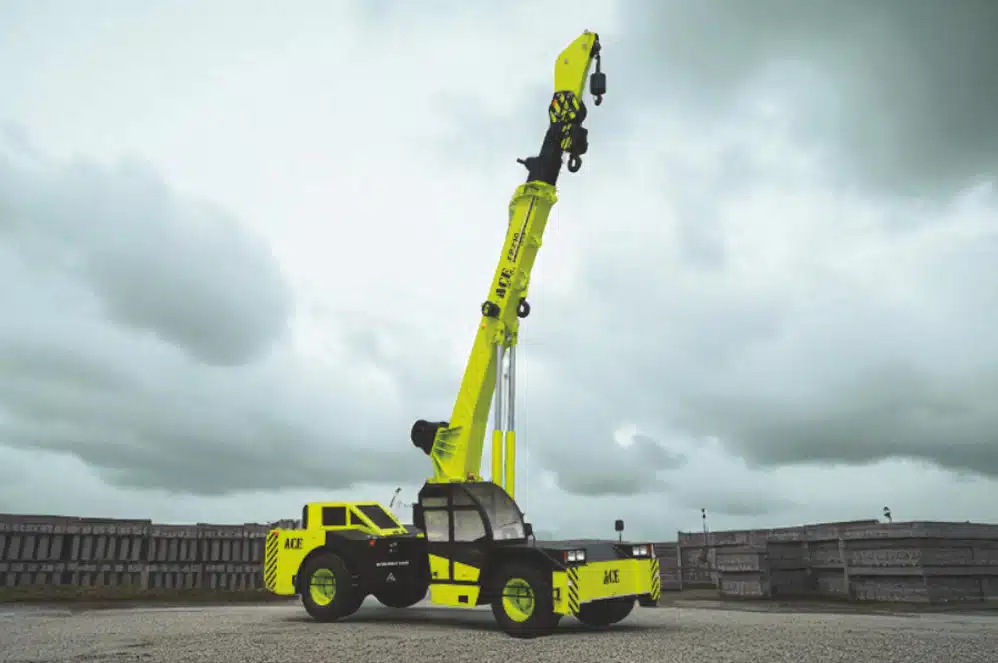
The third gap is what happens after drilling. The bore is cleaned (with a cleaning bucket on the kelly, the code says, when a rotary rig is used), the reinforcement cage is lowered, and concrete goes in through a tremie pipe that keeps it from mixing with the mud. A crane or the rig’s auxiliary winch handles the cage. Some cranes are built for this side of the work: the ACE FP 210 Piling Crane, a 20-tonne pick-and-carry crane, is listed for cage lowering, concreting and casing removal.
A piling job is priced per metre of pile, not per hole; how that rate is built is explained in the post on piling rate per meter. The companies that make rotary and hydraulic piling rigs for India are listed in piling rig manufacturers in India.
What is a borewell rig, and can it drill blast holes?
A borewell rig is a truck-mounted drilling rig made to drill one deep, narrow well for water. It usually drills rock with a DTH hammer driven by a large high-pressure compressor, and soft ground by mud rotary. Wikipedia’s water well article notes that drilled wells reach far deeper than dug wells, often several hundred metres, and that the drill string is built from steel tubes in 3, 6 or 8 m lengths screwed together.
It cannot legally drill blast holes in a coal mine. Regulation 216(3) of the Coal Mines Regulations, 2017 says truck-mounted drill machines designed for tube well drilling shall not be used, and only a proper blast hole drill machine designed for mining may be used in the mine. The two machines look alike from a distance, but a mining drill is built to drill hole after hole across a rough bench, with dust control and a mast that can be angled.
A drilled borewell is a different job from an open well. A wide, shallow open well is dug out with an excavator, as the guide to well digging with an excavator explains. What a borewell costs by depth and casing is covered in borewell rate per feet.
What does a soil investigation or core drilling rig do?
A soil investigation rig drills small holes to find out what lies under a site before anything is built on it. The sample that comes out of the hole is the product.
IS 1892:1979, the Indian code for subsurface investigation for foundations, lists the boring methods. A hand auger works to about 6 m in soft soil that stands on its own. A shell and auger hand rig drills up to 200 mm across and 25 m deep, and a mechanised rig can go to 50 m in alluvial ground. Percussion boring breaks the ground with repeated blows of a chisel, and rotary boring turns a bit with mud pumped down the rods. The same code says the holes should normally go down to one and a half times the width of the footing below foundation level.
Inside those holes the rig also runs field tests. The standard penetration test drives a thick-walled sampling tube into the bottom of the hole with a 63.5 kg hammer falling 75 cm, and counts the blows it takes to go each 15 cm. The blow count tells the designer how firm the ground is.
When the hole reaches rock, a core drill takes over. It cuts a ring with a diamond bit and leaves a solid cylinder of rock (the core) inside the barrel, to be lifted out and logged. IS 6926:1996 covers diamond core drilling for river valley projects and asks that core barrels and rods be picked from the same size letter, for example an NX core barrel with NW rods. In mineral exploration, the common wireline sizes are NQ, which cuts a 47.6 mm core, and HQ, 63.5 mm, according to Wikipedia’s article on exploration diamond drilling.
How do you choose the right drill rig for a job?
Start from the hole, not the machine. Answer the questions in Table 2 and the rig family usually picks itself; the maker and model come after.
| Question | What the answer points to |
|---|---|
| What goes in the hole? | Explosive: a rock drill. Concrete and steel: a piling rig. Water pipe: a borewell rig. Nothing, only a sample: an investigation or core rig. A pipe sideways under a road: an HDD rig. |
| How wide must it be? | A few inches: top hammer or DTH. Over 152 mm in big mines: rotary blasthole. 450 mm and up: a piling rig. |
| How deep? | Short holes up to about 12 m: top hammer is fine. Deeper rock holes: DTH or rotary. Deep piles: check the rig’s rated depth with every kelly section added. |
| What is the ground? | Hard rock: hammer or rotary with a tricone bit. Soil below the water table: casing or bentonite. Mixed: a rig that can change tools. |
| Which direction? | Vertical or angled from the surface, horizontal into a tunnel face, or a curve under an obstacle. Top hammer tilts most easily; rotary hardly at all. |
| Can the rig get there? | Narrow benches need a compact crawler. A piling rig needs a firm, level working platform. Large rigs move on a trailer, so check the road and the turning room. |
| Where do air, power and water come from? | A DTH rig needs a compressor matched to its hammer. Electric rigs need a supply on site or a generator. Wet drilling and bentonite need steady water. |
| Which rules apply? | Mines: the Coal or Metalliferous Mines Regulations and IS 4081 for blasting work. Piles: IS 2911. Investigation: IS 1892 and IS 6926. |
A drill rig never works alone, so plan the machines around it as part of the same decision. A DTH rig is only as good as its air; the guide to the air compressor for construction and quarries shows how cfm and pressure are matched to the tool. A remote site may also need a diesel generator for the construction site.
In a quarry an excavator levels the bench before drilling and loads the broken rock after the blast. On a small quarry both jobs suit a 20-tonne crawler excavator such as the Tata Hitachi EX 210 Infra (20,300 kg) or Tata Hitachi EX 200 Infra (19,800 to 20,000 kg); larger pits use mining excavators. Oversize boulders left by a poor pattern go to a hydraulic rock breaker, and the rest goes on to the crushing and screening plant. The whole drill-to-stockpile chain is drawn in the guide to quarry equipment.
On a piling site the rig sits among cranes, concrete trucks and a bentonite plant. The bridges and tunnels and railway and metro application pages list the machines those projects use alongside it.
What do Indian rules say about drilling?
Indian rules on drilling are mostly about dust, about misfires in blasting work, and about accuracy in foundations.
Dust comes first because drilling rock makes fine silica dust. Regulation 143 of the Coal Mines Regulations, 2017 asks for a jet of water on the cutting edge, or an approved device that does the same, throughout drilling, and says that in pneumatic drilling the water must be turned on before the compressed air. Wet drilling, dust collectors and the other controls are explained in the guide to dust suppression in mines.
Blasting work adds its own drilling rules. IS 4081:2013, the safety code for blasting and related drilling, bars drilling into the butt of an old hole and sets out how holes are marked, checked and handed over for charging. The clauses are walked through step by step in the blast hole drilling guide, and the spacing of holes and the explosive per hole are in the guide to powder factor in blasting.
For foundations the rulebook is IS 2911 (Part 1/Sec 2):2010, which sets the minimum pile diameter, the alignment and position tolerances quoted above, the drilling mud and the tremie concreting. For site investigation it is IS 1892:1979, with IS 6926 for diamond core drilling. Mine safety law is moving to the Occupational Safety, Health and Working Conditions Code, 2020, so check the current DGMS rules and the mine’s own standing orders before relying on any regulation quoted here.
More drilling and quarrying topics are collected on the mining guide hub, and battery and cable-powered machines for underground mines are covered in electric underground mining equipment. For the wider mining fleet, see mining equipment in India.
Drill rigs are not listed on DesiMachines, so no rig prices are given here and the only rig models named are the ones a maker’s own pages describe. Fitting out the bench, the loading face or the piling platform? Browse the full range of excavators and the cranes that work beside a rig, and talk to a verified dealer.
Sources
Rig definition and the water-well, CFA, drill jumbo, core drill, standard penetration test and directional boring descriptions are from Wikipedia’s articles on drilling rigs, water wells, piles, drilling jumbos, core drills, exploration diamond drilling, the standard penetration test and directional boring. Rock-drilling hole sizes and depth limits are from the FHWA Rock Blasting and Overbreak Control manual (FHWA-HI-92-001), section 9.2. Pile diameters, boring methods, drilling mud, cleaning and alignment tolerances are from IS 2911 (Part 1/Sec 2):2010, clauses 3.4, 3.6, 5.3, 5.4, 7.4 and 8.1. Boring methods, sizes and depth of exploration are from IS 1892:1979, clauses 2.3.2 and 3.6. Core barrel and rod matching is from IS 6926:1996, clause 3.10. The tube-well drill ban is regulation 216(3), and wet drilling regulation 143, of the Coal Mines Regulations, 2017. ACE-Sunward SA 175, SA 210 and SA 250 figures are from ace-cranes.com. All were read on 4 November 2026. ACE FP 210 lifting capacity and uses, and the Tata Hitachi operating weights, are from each machine’s listed specifications.
Prices, specifications and features are indicative, vary by variant, location and date, and should always be confirmed with the official OEM or authorised dealer before any purchase decision. DesiMachines is not liable for decisions taken on the basis of information that may have changed after publication.