Excavator
316 models
 Backhoe Loader
54 models
 Crane
68 models
 Concrete Mixer
79 models
 Wheel Loader
65 models
 Compactor / Roller
45 models
 Motor Grader
42 models

 Concrete Pump
66 models
 Skid Steer Loader
11 models


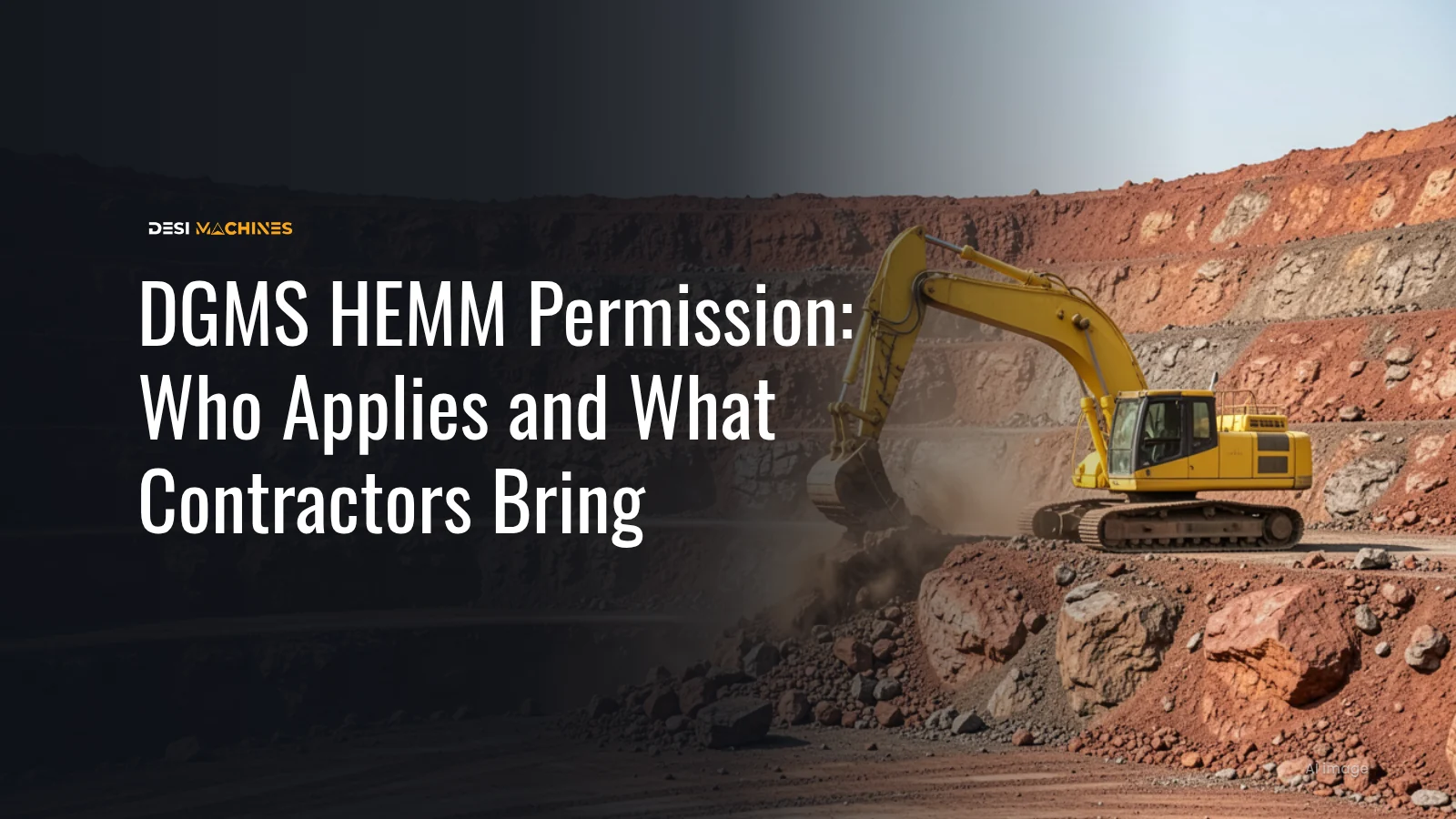
A DGMS HEMM permission is the mine’s to apply for, and the papers that go with it come from the contractor who brings the machine. The owner, agent or manager files on DGMS’s online portal through the Mine User login. The contractor supplies the machine with every safety device in G.S.R. 987(E), a daily inspection record, and operators the mine can test. DGMS (Tech) Circular 05 of 2026, dated 4 August 2026, tells mines that no truck, tipper or dumper shall be deployed unless all those devices are installed, tested and working. The law is moving to the OSH Code, so check the current DGMS circular before relying on any regulation number.
This guide is for the owner of a few dumpers, tippers or a 20-tonne-class excavator with a work order from a coal, iron-ore or stone mine. Everything below is from DGMS’s own circulars, notifications and portal manuals, as read on 23 November 2026. For how the machines themselves differ in mining work, see the guide to mining equipment.
Who applies for DGMS HEMM permission?
The mine applies. Regulation 106(2)(b) of the Metalliferous Mines Regulations, 1961 (MMR) covers a mine that proposes to work “by a system of deep-hole blasting and/or with the help of heavy machinery for its digging, excavation and removal” in a way that cannot keep to the normal bench limits. In that case the owner, agent or manager gives written notice of the method of working to the Chief Inspector and the Regional Inspector at least 60 days before starting. The work then follows whatever conditions the Chief Inspector sets in writing. The bench height guide explains the limits this permission relaxes.
DGMS’s portal manual uses this case as its example: “Application for Permission under Regulation 106(2)(b) of MMR, 1961 for adopting a system of Deep Hole Blasting and deployment of HEMM”, for a stone mine in Sahibganj, Jharkhand, and the user name on it is marked “(Owner)”. For a coal mine, the same portal offers the Coal Mines Regulations, 2017 as the regulation to choose.
A contractor has no route to file. Mine User registration asks for the mine code, the mine’s address and its Labour Identification Number, and DGMS approves it before any application. Those are the mine’s details, not yours.
What the DGMS permission portal shows from outside
The portal at approval-permission-dgms.gov.in, linked from the DGMS home page, lists three modules: Approval, Permission/Exemption/Relaxation, and NSA. Two logins sit under them.
- The Mine User login is for permissions and NSA. The mine writes a covering letter to the Director General and the zonal Deputy Director General, ticks Permission, Exemption or Relaxation, and picks the regulation.
- The Applicant login is the Approval side. Its form asks for production details, quality control and specifications: a manufacturer’s filing to get equipment approved. It is not for a dumper owner.
DGMS’s permission user manual for mine users shows the message “Your Application will be processed only after receipt of all the offline / online documents”, and its sample application sits at “Offline Document Pending”. If the mine is waiting on your machine papers, the permission waits too.
Mine and contractor: who brings what
The two current DGMS circulars on HEMM are addressed to owners, agents and managers, so the duty sits with the mine, which passes most of it down the contract.
| Item | What the mine must do | What the contractor brings | DGMS source |
|---|---|---|---|
| Permission or notice | Owner, agent or manager files on the portal | Machine list and capacities if asked; ask for a copy of the order and its conditions | MMR 1961 reg. 106(2)(b); portal manual |
| Safety devices | Deploy no truck, tipper or dumper unless all G.S.R. 987(E) devices are installed, tested and working | The devices fitted and working on each machine | Tech Circular 05 of 2026, item 1 |
| Daily check | Make sure brakes, steering, seat belts, reversing alarms, lights, cameras, blind-spot and proximity systems are checked before work and recorded | Operators who do the check every shift and a book that shows it | Tech Circular 05 of 2026, item 2 |
| Defects | Withdraw a defective machine at once until safety defects are fixed | Repairs and a fitter who can do them fast | Tech Circular 05 of 2026, item 3 |
| Operator competency | Train operators and test them through a board of people not connected with the training | Operators sent for training, plus the OEM’s operation and maintenance schedules | Tech Circular 7 of 2025, item 6 |
| Audits | Run regular audits against G.S.R. 987(E), haul road standards and traffic plans | Access to the machines and their records | Tech Circular 05 of 2026, item 10 |
The safety devices DGMS lists for HEMM
G.S.R. 987(E), dated 1 October 2018, was issued under regulation 216(2) of the Coal Mines Regulations, 2017. Its closing clause says every HEMM, including dumpers and trucks, shall have these devices “before putting them into operation in a Mine”. The DGMS (Tech) Circular 05 of 2026 of 4 August 2026 is addressed to coal and metal mines alike and applies the same list to every truck, tipper and dumper.
The general items for all HEMM include a roll-over protective structure (ROPS), a falling-object guard where there is a risk of falling objects, a seat belt with reminder, at least one fail-safe brake, a rear vision camera, blind-spot mirrors or camera, a warning system for operator fatigue, an audio-visual reversing alarm, reflectors on all sides, and a portable fire extinguisher in addition to an automatically operated fire detection and suppression system.
On top of those, the machine-specific lists add more:
- Dumpers: proximity warning device, auto dipping, load indicator, speed limiting device, dump body raised indicator with warning, body lock, retarder, rock ejectors for tandem tyres, canopy over the cabin and a battery or engine cut-off on the front lower side.
- Tippers and trucks: proximity warning device, auto dipping, load indicator, speed limiting device, exhaust or retarder brake, tail gate protection, dump body lock and stabilisers, and a canopy.
- Hydraulic excavators: an all-functions cut-off switch, swing brake and swing lock, parking brake, cylinder stoppers, a battery cut-off outside the cabin and a two-way communication system other than a mobile phone.
A road tipper or a construction-spec excavator may arrive without some of these. Take the list to your dealer before you sign the mine contract and get in writing which items a machine such as the 21.7-tonne Tata Hitachi ZAXIS 220LC carries from the factory and which have to be added. Circular 7 of 2025 also asks for proximity warning in line with amendment 1 of 2024 to IS 17055 (Part 6), the BIS standard for dumpers and tippers.
Why mines check dumpers so closely now
Circular 05 of 2026 gives the numbers. From 2023 to 2025, 39 of 118 fatal accidents in coal mines and 21 of 94 in metal mines involved dumpers, tippers, trucks and other wheeled machines. Added together, that is 60 of 212 fatal accidents, or about 28 in every 100. In 2026, up to 31 July, the share rose: 9 of 25 in coal and 8 of 25 in metal, so 17 of 50, or 34 in every 100. Most were run-overs or machines toppling, and Circular 7 of 2025 notes the machines were “deployed by departmental and outsourced” operations, hired ones included. Expect the mine’s safety officer to walk round your dumper with the G.S.R. 987(E) list before it enters the haul road.
Operators: what the mine will test
Both circulars say every person employed, or to be employed, to operate HEMM, tippers and dumpers included, must be trained and have competency evaluated by a board constituted by the management. The board must be people not connected with the training. Training modules are to follow the size, capacity, type and make of the machine and the OEM’s own operation and maintenance schedules.
Road-job experience does not carry over by itself. Send each operator’s details and your OEM manuals early, so the training and board test are booked before the machines arrive. Operators who later want a supervisor’s ticket should read about the mining foreman certificate.
A worked example: when the notice must go
Say a stone quarry gives you a work order on 23 November 2026 to start loading with high benches on 1 February 2027, and the quarry has never worked that way before. If MMR regulation 106(2)(b) applies, the notice must reach DGMS at least 60 days before the start. Sixty days before 1 February 2027 is 3 December 2026, which leaves the mine 10 days to file. If your machine details are part of that notice and you send them on day 12, the start date slips. Ask the mine on day one whether its permission is already in place and what it needs from you. For the lease side of a new quarry, see quarry lease; blasting permissions sit apart and are covered in blasting vibration limits.
Which law applies after the OSH Code?
The Occupational Safety, Health and Working Conditions Code, 2020 came into force on 21 November 2025 (S.O. 5321(E)) and repealed the Mines Act, 1952. The OSH and Working Conditions (Central) Rules, 2026 took effect on 8 May 2026. DGMS Legislative Circulars of 27 August 2026 record both dates. Section 143(3) of the Code keeps the old regulations and notifications in force, so far as they do not conflict with the Code, until the Central Government repeals them. This is how a circular dated August 2026 still enforces G.S.R. 987(E).
The replacement is in draft. The draft OSH and Working Conditions (Metalliferous Mines) Regulations, 2026 (G.S.R. 109(E), 4 February 2026) would put each machine under an operator authorised in writing by the manager and keep the independent competency test. One draft clause would accept a semi-automatic fire suppression system on trucks, tippers and dumpers of less than 35 tonnes capacity. DGMS’s gazette page still listed it as a draft on 23 November 2026.
Bidding for a coal company’s hiring tender? The tender side is covered in Coal India vendor registration and SCCL vendor registration.
What to keep ready before you mobilise a dumper or excavator
- A copy of the mine’s DGMS permission or order, with its conditions, or the mine’s written word that one is not needed for your work.
- For each machine, a ticked G.S.R. 987(E) list showing every device fitted and tested, with the dealer’s note for anything added after delivery.
- Working proximity warning, reversing alarm, cameras and automatic fire suppression on every dumper and tipper, checked the day before it leaves your yard.
- A daily pre-start inspection book for each machine, ready for the operator’s first shift.
- Each operator’s details, sent early, plus the OEM operation and maintenance manuals for the mine’s training and board test.
- A fitter and spares plan, because a machine with a safety defect is withdrawn until it is fixed.
Regulations, circulars and portal procedures change, and OSH Code regulations are due to replace the 1961 and 2017 rules. Confirm the current position with the mine manager or your DGMS zonal office before you mobilise. DesiMachines is not liable for decisions taken on information that may have changed after publication.