Excavator
294 models
Excavator
294 models  Backhoe Loader
51 models
Backhoe Loader
51 models  Crane
68 models
Crane
68 models  Concrete Mixer
79 models
Concrete Mixer
79 models  Wheel Loader
54 models
Wheel Loader
54 models  Compactor / Roller
45 models
Compactor / Roller
45 models  Motor Grader
42 models
Motor Grader
42 models  Dozer
41 models
Dozer
41 models  Concrete Pump
66 models
Concrete Pump
66 models  Skid Steer Loader
11 models
Skid Steer Loader
11 models  Telehandler
13 models
Telehandler
13 models 


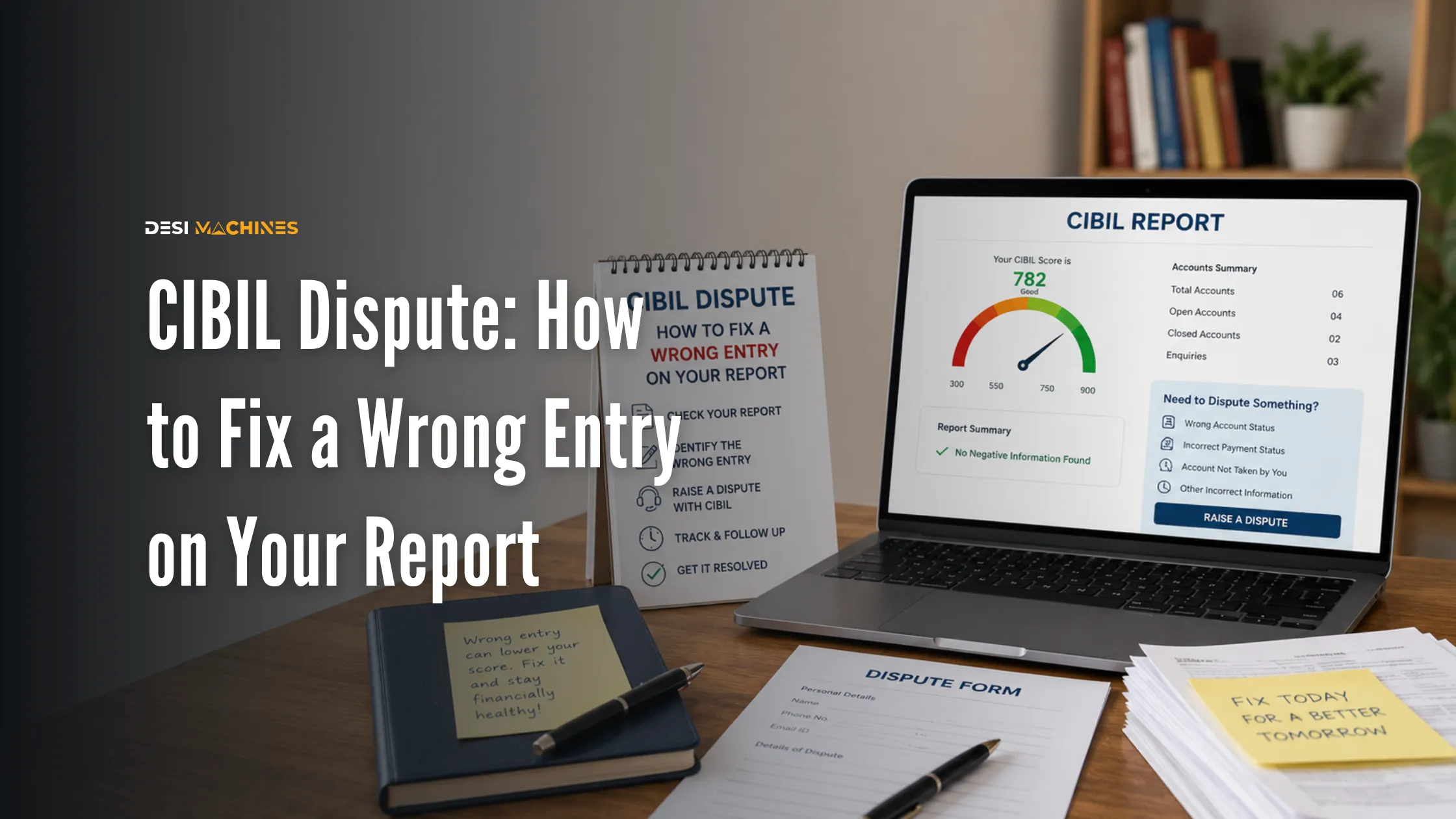
If a closed machine loan still shows as running, a CIBIL dispute is the fix, and the RBI puts a clock on it. Lenders report on four dates each month, so allow one full cycle before assuming an error. Once you file, the lender and the bureau have thirty calendar days between them, and if they miss it you are entitled to Rs 100 for every calendar day of delay.
Why this hits machine owners hardest
An owner clears the last instalment on a backhoe, gets the no-objection certificate, and goes to a lender three months later for the second machine. The file comes back declined, or priced as though the first loan is still running. It is, on paper. Nobody told the bureau it had ended.
For equipment finance this is more damaging than it looks. Your borrowing capacity is assessed against total outstanding exposure, so one phantom machine loan can quietly cost you the next one, or move you to a worse rate. Owners planning fleet growth often discover it at the worst possible moment, with a deal on the table and a deposit paid.
The good news is that the correction process is governed by rules with hard deadlines and a price attached to missing them. Most owners never invoke either.
First, check whether it is actually late
Before filing anything, understand the reporting rhythm, because a lot of “wrong” entries are simply entries that have not caught up yet.
Lenders submit credit information to the bureaus as on four reference dates every month: the 9th, the 16th, the 23rd and the last day of the month. For the three mid-month dates they send only incremental accounts, and they have four calendar days from each reference date to do it. The full file, covering every account on their books, goes across by the 5th day of the following month.
That full file matters for your case. It is required to include both the active accounts and the accounts where the relationship between the borrower and the lender has ended since the last reference date. A loan you closed belongs in that second group, so it should surface as closed once a complete cycle has run.
| Stage | Time allowed |
|---|---|
| Lender reports to the bureau | Reference dates on the 9th, 16th, 23rd and last day |
| Incremental records submitted | Within 4 calendar days of the reference date |
| Full monthly file submitted | By the 5th of the following month |
| Lender to send the correction after a complaint | 21 calendar days |
| Total resolution, lender plus bureau | 30 calendar days |
| Compensation if that is missed | Rs 100 per calendar day |
So give it a month from closure. If the entry is still wrong after a full cycle, it is not a lag, and the clock below is yours to start.
The thirty-day clock, and who owns which part of it
Once you file, you are entitled to a resolution within thirty calendar days from the date you first filed, whether you filed with the lender or with the bureau.
Inside those thirty days the rules split the work. The lender gets 21 calendar days to send the corrected information across. The bureau gets the remaining nine days to complete the resolution. That split is the reason the compensation, where it is due, is apportioned proportionately between whichever of them caused the delay. You do not have to work out who was at fault before you claim; you claim on the elapsed time.
You are also entitled to an answer either way. You must be advised of the action taken on the complaint in all cases, including where it has been rejected, and a rejection has to come with reasons. If your dispute goes quiet, that silence is itself a failure of the process rather than a dead end.
What the delay is worth: Rs 100 a day
This is the part almost nobody claims. Where a complaint is not resolved within thirty calendar days of the date it was first filed, the complainant is entitled to compensation of Rs 100 per calendar day.
It is not a large sum on a short delay. On a dispute that drags for three months it is meaningful, and more importantly it changes the conversation. A complaint that mentions the compensation entitlement, the 21-day and 30-day limits, and the date of first filing is handled differently from one that asks politely for help. Keep the acknowledgement and the date, because the date of initial filing is what the whole entitlement is calculated from.
Owners who are cleaning up a credit file before applying for the next machine should read this alongside our guide to CIBIL scores for a machinery loan, which covers the score itself rather than errors in the underlying record. If the aim is a new facility, comparing equipment finance options once the report is clean will get you a better answer than applying while it is wrong.
Filing a CIBIL dispute properly
Raise the dispute with the bureau, the lender, or both, and record the date. That date starts the thirty days.
Attach the proof that ends the argument rather than proof that merely supports it. For a closed machine loan that means the no-objection certificate and the loan closure statement. If the hypothecation has been removed from the registration certificate, include that too, because it independently establishes that the lender treated the loan as discharged; the process is covered in our guide to RC transfer and hypothecation removal.
State exactly what is wrong and what it should say. “Account number ending 4471 shows as active with an outstanding balance; it was closed on 14 March and should show as closed with nil outstanding” is a complaint that can be actioned. “My CIBIL is wrong” is not.
One caution on settled accounts. If you closed the loan through a negotiated settlement rather than by paying in full, the account is meant to reflect that, and having it reported accurately is not the same as having it reported as a clean closure. What a settlement does and what it costs is set out in our guide to machine loan settlements. Disputing an accurate settlement entry will fail, and should.
Act on a wrong CIBIL entry within the deadline
A wrong entry on a credit report is one of the few problems in equipment finance with a fixed deadline and a defined penalty attached. Wait one reporting cycle to be sure the entry is genuinely wrong. Then file, note the date, and hold both the lender and the bureau to the thirty days.
If they miss it, the Rs 100 per calendar day is yours to claim, and asking for it tends to accelerate everything else. If the lender still will not correct the record, the next rung is a complaint to the RBI Ombudsman. Owners who fix the record before applying, rather than after being declined, avoid the whole problem; if you are planning the next machine, get the report clean first and then look at what closing a loan early actually costs and at finance options for the next purchase.
Source: the Reserve Bank of India (Non-Banking Financial Companies – Credit Information Reporting) Directions, 2025, as updated to 1 July 2026, read with the Credit Information Companies (Regulation) Act, 2005.
Rates, schemes, specifications and prices change – confirm current terms with the OEM, dealer, bank or insurer before deciding. Nothing here is legal or financial advice on your specific account.