Excavator
294 models
Excavator
294 models  Backhoe Loader
51 models
Backhoe Loader
51 models  Crane
68 models
Crane
68 models  Concrete Mixer
79 models
Concrete Mixer
79 models  Wheel Loader
54 models
Wheel Loader
54 models  Compactor / Roller
45 models
Compactor / Roller
45 models  Motor Grader
42 models
Motor Grader
42 models  Dozer
41 models
Dozer
41 models  Concrete Pump
66 models
Concrete Pump
66 models  Skid Steer Loader
11 models
Skid Steer Loader
11 models  Telehandler
13 models
Telehandler
13 models 


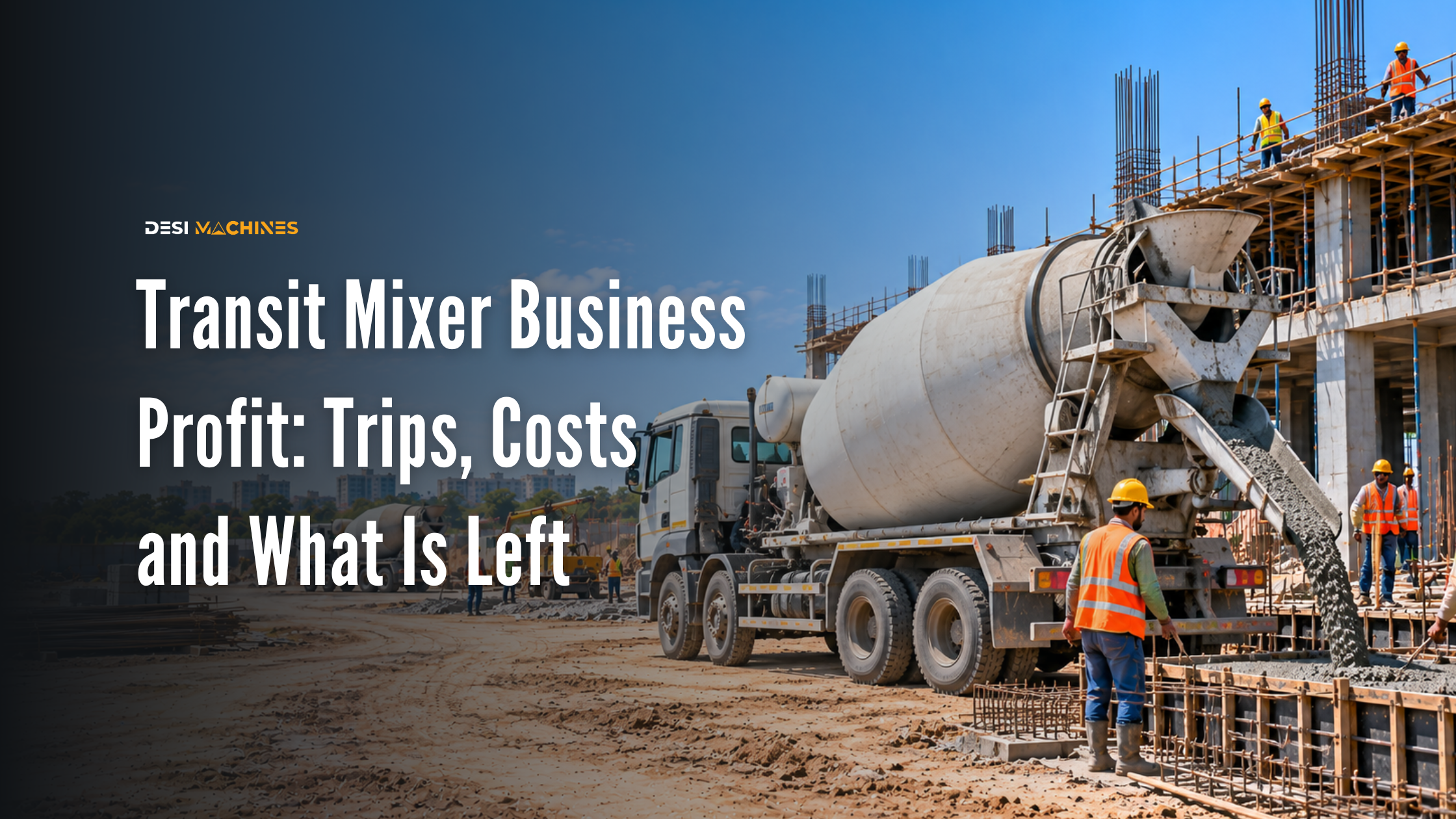
The RMC plant business is a logistics business wearing a manufacturing badge. The batching plant is the part everyone prices first and the part that matters least: your earnings come from cubic metres actually delivered, and those are capped by how many transit mixers you run, how long each round trip takes, and how far you can cart concrete before the mix starts setting. Budget the delivery fleet before the plant — transit mixers in our catalogue sit between roughly Rs 33.50-37.50 Lakh and Rs 48-52 Lakh each (indicative, as of Oct 2026), and a plant without enough of them is an expensive silo.
Ask ten people planning a ready-mix plant what it costs, and nine will quote you a plant price. Ask them how many cubic metres a day they will dispatch, at what average lead, with how many mixers, and the conversation usually stops. That second question is the business; the first one is a line item in it.
We do not list batching plants on DesiMachines, so this piece quotes no plant price. What we can give you is the arithmetic the plant price sits inside, and real current prices for every other machine the business needs.
What an RMC plant business really costs to set up
Four heads make up the investment, and they are rarely budgeted in the right order.
The plant itself comes with silos, a control cabin, a loading arrangement and a foundation. The land under it has to take heavy vehicle movement all day, be close enough to your market to stay inside the delivery window, and be far enough from housing to survive the noise and dust objections. Those two heads are site-specific and nobody can price them for you.
The delivery fleet is the head you can price today, and it is usually the largest. Our catalogue carries these, with prices as listed:
| Machine | Role | Price band (indicative, Oct 2026) |
|---|---|---|
| Mahindra Blazo X 28 | Transit mixer, entry of the range | Rs 33.50 – 37.50 Lakh |
| Tata LPK 2821.K FE+ RMC | Transit mixer | Rs 35.50 – 39.50 Lakh |
| Eicher Pro 6028TM | Transit mixer | Rs 44.20 – 46.33 Lakh |
| Ashok Leyland AVTR 2820 6×4 RMC | Transit mixer, 6×4 | Rs 46.50 – 49.50 Lakh |
| AJAX ASP 3009 | Line pump, smallest in the range | Rs 12 – 15 Lakh |
| AJAX ASP 5009 | Line pump, mid range | Rs 18 – 23 Lakh |
| AJAX ASP 10012 | Line pump, top of the range | Rs 40 – 50 Lakh |
Run the simplest case. Four mixers at the Tata band and one mid-range pump comes to roughly Rs 1.6 crore to Rs 1.8 crore of rolling stock (indicative, worked from the bands above) before you have poured anything, bought land, or paid for the plant. That is the number to carry into a finance conversation, and it is why the fleet decides whether the project is viable at all.
The fourth head is working capital, and it is the one that kills new entrants. You buy cement and aggregate for cash and you sell concrete to builders on credit. The gap between those two is a standing overdraft requirement that nobody puts in the project report.
The per-cubic-metre sum
Everything above is fixed cost. The operating question is simpler: what does one cubic metre cost you to make and deliver, and what will the market pay?
Build the cost side from these heads, in this order, using your own quoted rates rather than anybody’s published average:
Start with materials: cement, coarse and fine aggregate, admixture and water, priced per cubic metre at the design mix you actually sell most of. This is the bulk of the cost and it moves with cement prices, so re-check it monthly rather than once in the project report.
Then plant operation, which covers power, the plant operator, the loader operator, and the wheel loader’s own fuel and maintenance for feeding aggregate into the hoppers. Then delivery: mixer diesel, driver, tyres and maintenance, divided by the cubic metres that mixer actually carried. Lead distance enters your cost at this line, and it enters hard. Pumping gets its own head only where you supply placing as well as concrete, and it is usually billed to the customer separately.
The last head is fixed cost recovery — EMI, insurance, salaries, rent and licence costs, divided by the cubic metres you expect to dispatch in the month.
That last line is the whole business. A plant that dispatches 2,000 cubic metres in a month spreads its fixed cost over 2,000 units; the same plant at 800 spreads it over 800. The difference in cost per cubic metre between those two months is larger than any discount you will ever negotiate on cement, which is why the shape of this business looks much like stone crushing, where utilisation and haul distance decide the profit long before the rate does.
Haul radius is the real capacity limit
A batching plant’s rated output is a plant-room number. The number that governs your market is how far a loaded mixer can travel before the concrete has to be discharged, and that is set by the initial setting time of the mix rather than by the truck.
Work it in minutes, not kilometres, because minutes are what the mix measures. Then convert to kilometres using your own road conditions at the hour you actually dispatch. A site twelve kilometres away across a city at nine in the morning can be further, in the only unit that matters, than a site thirty kilometres away on a highway at midnight.
Two consequences follow. Your addressable market is a circle, not a region, and a competitor who sets up inside your circle takes volume you cannot win back on price. And a single plant’s growth path is capped: past a point you add a second plant nearer the work rather than more mixers at the first one.
The clearances to settle before the arithmetic
A ready-mix plant is a stationary industrial unit, which puts it inside the consent regime. You will need consent to establish and then consent to operate from the State Pollution Control Board, under the Water (Prevention and Control of Pollution) Act, 1974 and the Air (Prevention and Control of Pollution) Act, 1981. The category your plant falls into, the fee and the conditions attached are decided by your own state board, so confirm them with that board before you sign for land.
Add the land-use permission, a three-phase industrial power connection, the water source and its own permissions, and vehicle registrations for the fleet. In the National Capital Region, also read how the GRAP air-quality stages shut construction work down in winter, because a plant whose customers cannot pour is a plant that cannot dispatch.
The smaller version of the same idea
Not every concrete business needs a plant. A contractor who mainly wants control over his own pours, rather than a supply business selling to others, often does better with a self-loading mixer: one machine that loads, batches, mixes and places, run by one operator.
The Schwing Stetter SLM 2600 sits at around Rs 35-37 Lakh and the AJAX ARGO 4500 at around Rs 44-46 Lakh (both indicative, as of Oct 2026) — one machine, against a plant plus a fleet plus land. The output is lower and the business is different, but the entry cost is an order of magnitude apart, and for a contractor pouring his own structures the economics frequently favour it.
Compare the full range of concrete mixers and concrete pumps against your actual monthly pour volume before deciding which business you are in.
What we are not quoting
No plant price, because we do not list batching plants and a figure we cannot source is worth nothing to you. No cost or selling rate per cubic metre, because both move with cement prices, aggregate royalty and local competition, and a national average would mislead every reader in a different direction. No payback period, because it is a function of the three numbers only you can supply: your lead distance, your monthly dispatch and your working capital cost.
The bottom line
Price the fleet before the plant, and size the fleet from your round-trip cycle rather than from the plant’s rating. Settle the state board’s consent conditions before you commit to land, because a site that cannot get consent to operate is worth nothing at any price. Then build the per-cubic-metre cost from your own quoted material rates and divide your real fixed costs by a dispatch figure you can defend, not the one in the brochure.
Get the fleet costing right first: compare current transit mixer and self-loading mixer models and prices, work out what the monthly outgo looks like against an equipment finance structure, and talk to a verified dealer before you fix a plant size.
Rates, schemes, specifications and prices change — confirm current terms with the OEM, dealer, bank or insurer before deciding. Prices shown are indicative bands taken from our listings at the time of writing, vary by variant, location and date, and should be confirmed with the dealer before any purchase decision.