Excavator
294 models
Excavator
294 models  Backhoe Loader
51 models
Backhoe Loader
51 models  Crane
68 models
Crane
68 models  Concrete Mixer
79 models
Concrete Mixer
79 models  Wheel Loader
54 models
Wheel Loader
54 models  Compactor / Roller
45 models
Compactor / Roller
45 models  Motor Grader
42 models
Motor Grader
42 models  Dozer
41 models
Dozer
41 models  Concrete Pump
66 models
Concrete Pump
66 models  Skid Steer Loader
11 models
Skid Steer Loader
11 models  Telehandler
13 models
Telehandler
13 models 


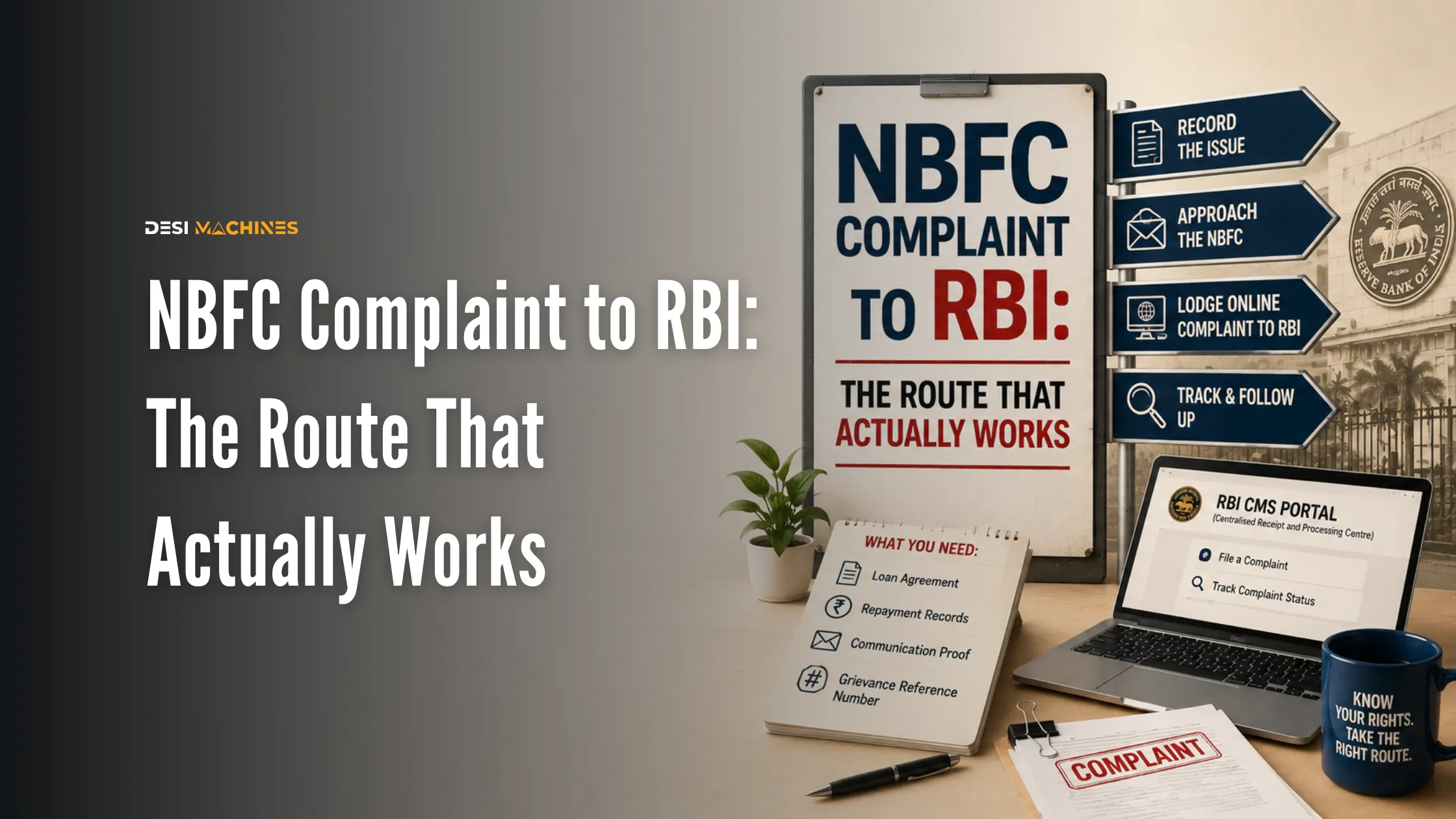
An nbfc complaint to rbi is the last rung of a ladder, not the first. Write to the lender and hold it to the 30-day deadline for a final decision. Since January 2026 an NBFC covered by the framework must auto-escalate any complaint it rejects or only partly resolves to an internal ombudsman before replying, and that reply must tell you it was reviewed and point you to the Reserve Bank’s portal at cms.rbi.org.in. Skipping the lower rungs is what makes most complaints take longer, not less.
The situation this is written for
The machine is running. The dispute is paperwork. A charge on the statement nobody will itemise, an NOC that has not arrived four months after the last EMI, a foreclosure quote that keeps changing, a wrong entry that has already reached your credit file. You have called the executive who sold you the loan, who no longer handles it, and emailed an address that generates a ticket number and no reply.
Owners at this point usually do one of two things. They give up, and absorb the cost. Or they post about it and copy the Reserve Bank on an email, which is not a filing and starts no clock.
There is a defined route, it has deadlines that belong to the lender rather than to you, and it changed in your favour in January 2026.
Step one: make it a complaint, with a date on it
A phone call is not a complaint. What you want is something dated, in writing, that identifies the account and states what you want done.
Keep it to one page. Loan account number, machine and registration if relevant, what happened with dates, what you are asking for, and what you have attached. Send it to the grievance redressal officer rather than to the branch, and keep the acknowledgement.
The Reserve Bank publishes the grievance contact details that every registered NBFC has filed with it, including the equipment and commercial vehicle financiers most machine owners deal with. That published list is the address to use, because it is the one the lender has told its regulator to use.
The reason the date matters is the deadline it starts. The NBFC must ensure that its final decision is communicated to you within 30 days of receiving the complaint. Not an acknowledgement within 30 days. A decision.
Step two: the review that now happens without you asking
This is the part that is new, and most guidance written before 2026 does not have it.
Under the Reserve Bank of India (Non-Banking Financial Companies – Internal Ombudsman) Directions, 2026, a covered NBFC has to run a fully automated complaints system in which every complaint that is wholly rejected or partially resolved is escalated automatically to an internal ombudsman for review before the answer reaches you. The lender is only allowed to record a complaint under three headings, fully resolved, partially resolved or wholly rejected, so a rejection cannot be filed away as something vaguer.
The reviewer is deliberately kept at arm’s length from the business. The internal ombudsman is a retired or serving officer of general manager rank or equivalent with at least seven years in banking, non-banking finance, regulation, supervision or consumer protection, cannot have worked for that NBFC or its group before, is appointed on a fixed term of at least three years, and reports functionally to the board rather than to the business. The office is not allowed to take complaints from the public directly. It only sees what the NBFC has already refused.
Three consequences matter to an owner:
A complaint cannot be closed by the same branch or unit that rejected it, and a rejection has to be reviewed at a fairly senior level before it even goes to the internal ombudsman. If the internal ombudsman agrees with the lender, the reply to you must say so explicitly, which is how you know the review happened. And where the complaint is still rejected or partly resolved after that review, the NBFC has to advise you of the option of approaching the RBI Ombudsman and give you the portal address and the processing centre’s details in the same reply.
The internal ombudsman can also recommend compensation, both under the lender’s own policy and, for consequential loss and for the time, expense and harassment involved, in line with the Reserve Bank’s ombudsman scheme.
Not every lender is covered, so check first
The framework applies to deposit-taking NBFCs with ten or more branches, and to non-deposit-taking NBFCs with an asset size of Rs 5,000 crore and above that have a public customer interface. It does not apply to a lender that is in insolvency proceedings, in liquidation or under Reserve Bank directions.
Most of the large equipment financiers sit inside that boundary. Smaller regional NBFCs and some captive financiers do not, and for those the ladder is shorter: the lender’s own grievance machinery, then the RBI Ombudsman. Knowing which you are dealing with saves you a month of waiting for a review that was never going to happen.
Step three: filing the nbfc complaint to rbi
The Reserve Bank runs a single Complaint Management System at cms.rbi.org.in covering complaints against regulated entities, with a Centralised Receipt and Processing Centre for complaints sent physically or by email. That is where the filing happens, and it is free.
| Stage | Who acts | What to watch |
|---|---|---|
| Written complaint to the lender | You | Keep the dated acknowledgement |
| Final decision to you | The NBFC | Due within 30 days |
| Automatic review of a rejection | Internal ombudsman | Reply must state it was reviewed |
| Escalation to the RBI Ombudsman | You | cms.rbi.org.in, after the lender’s reply or its silence |
One detail is quietly useful. When a complaint is escalated to the RBI Ombudsman, the NBFC must include the internal ombudsman’s decision in what it submits, and if the complaint was never reviewed internally it has to go back and get those comments. The lender cannot present a cleaner version of the file upstairs than the one it decided on.
Some disputes sit outside the process altogether. Anything already decided by or pending before a court, a consumer commission or arbitration is excluded, along with the lender’s internal administrative and staff matters. A purely commercial decision, such as declining to lend to you, is not a complaint. A service failure inside a commercial decision is, and that distinction covers most real grievances: the charge that was never disclosed, the document not released, the statement that does not reconcile.
Where the common machine finance disputes belong
Most of what reaches this ladder has a specific rule behind it, and quoting that rule in your complaint is worth more than the strength of your language.
If the argument is about a penalty on a bounced instalment, the limits on what can be charged and whether it can grow are set out in EMI bounce charges on a machine loan. If it is about what a foreclosure actually costs, the current position is in equipment loan foreclosure charges. If the lender has begun recovery action, what it can and cannot do is covered in machine loan default.
Two frequent disputes belong somewhere else entirely. A wrong entry in your credit record has its own statutory remedy and its own clock, described in disputing a wrong CIBIL entry, and complaints for which that remedy exists are outside the internal ombudsman’s scope. A stuck hypothecation removal after closure is usually a document problem rather than a grievance, and the sequence is set out in RC transfer for construction equipment. If your quarrel is with an insurer rather than a lender, the ladder is a different one and runs through the insurance ombudsman, as explained in what to do when an equipment insurance claim is rejected.
How to escalate an NBFC complaint to the RBI
Escalation works when it is boring. A dated written complaint, the 30-day deadline held to, the reply read for whether it says the internal ombudsman reviewed it, and only then the filing on the Reserve Bank’s portal. The rules changed in your favour in January 2026 precisely because rejections used to be final at the desk that made them, and now they are not.
If the underlying problem is that the facility was wrong for the machine in the first place, it is worth comparing what is currently available in equipment finance before you refinance into the same shape again.
Rules, schemes and lender policies change, and this is general information rather than advice on your specific dispute. Confirm the current position and the applicable timelines with your bank or NBFC, or with the Reserve Bank’s own published material, before you act on it.