Excavator
316 models
 Backhoe Loader
54 models
 Crane
68 models
 Concrete Mixer
79 models
 Wheel Loader
65 models
 Compactor / Roller
45 models
 Motor Grader
42 models

 Concrete Pump
66 models
 Skid Steer Loader
11 models


10% of the interest part of every EMI is what TDS on loan interest costs a machine owner whose lender is an NBFC, and the duty sits on you, the borrower. Under section 393(1) of the Income-tax Act, 2025 (Table serial number 5(iii)), a firm, LLP or company must deduct it, and so must a proprietor or HUF whose business turnover crossed Rs 1 crore in the previous tax year, once the year’s interest to that lender passes Rs 10,000. Interest paid to a bank is exempt. The principal part of the EMI is never touched.
If you are still choosing between lenders, the equipment finance page explains how a machine loan enquiry works and what to keep ready. This piece is for the owner who already has an NBFC loan on an excavator or backhoe and a CA asking why no TDS has been cut on it.
The Income-tax Act, 2025 replaced the 1961 Act from 1 April 2026. The rule that used to live in section 194A now sits in one row of the TDS table in section 393. The substance is familiar. The section numbers on your vouchers and returns have changed.
Do you have to deduct TDS on loan interest paid to an NBFC?
Two tests decide it: who you are, and who the lender is.
Table serial number 5(iii) of section 393(1) covers “any income being interest other than interest on securities” paid by a specified person. Section 402(37) defines a specified person as any person that is not an individual or HUF, or an individual or HUF whose total sales, gross receipts or turnover from business exceeded one crore rupees (fifty lakh rupees for a profession) in the tax year before the one in which the interest is credited or paid. There is no separate audit test in the text. Turnover is the line.
| Who owns the machine and the loan | Lender is an NBFC | Lender is a bank |
|---|---|---|
| Partnership firm, LLP or private limited company (any turnover) | Deduct 10% once interest crosses Rs 10,000 | No TDS |
| Proprietor or HUF, business turnover above Rs 1 crore last tax year | Deduct 10% once interest crosses Rs 10,000 | No TDS |
| Proprietor or HUF, business turnover Rs 1 crore or less last tax year | No TDS | No TDS |
A one-machine owner who crosses Rs 1 crore in a good year picks up the duty from the next tax year. Watch for that, because the first year is when it gets missed.
Why a bank loan is exempt and an NBFC loan is not
Section 393(4) carries a table headed “For no deduction at source”. Serial number 7 says no tax is deducted on interest credited or paid to any banking company, a financial corporation set up under a Central or State Act, LIC, UTI, an insurance company, or an institution the Central Government notified for this purpose before 1 April 2020. Section 402(5) defines a banking company as one to which the Banking Regulation Act, 1949 applies.
An NBFC is a company registered with the RBI as a non-banking financial company. It is not a banking company in that sense, so the bank exemption does not reach it. A finance company can carry a well-known group name and still be an NBFC. Read the lender’s legal name on the sanction letter. If the lender says it falls in the notified list, ask for that in writing before you stop deducting. The rate gap between the two kinds of lender is covered in bank vs NBFC equipment loan interest rates; the TDS duty is one more cost of the NBFC side that rate tables leave out.
The rate, the Rs 10,000 limit and what counts as interest
The Act does not print a percentage in serial number 5(iii). It says “rates in force”, and section 2(90) sends you to the Finance Act of the relevant year. For tax year 2026-27, Part II of the First Schedule to the Finance Bill, 2026 sets 10% on “interest other than Interest on securities”, both for a domestic company payee and for other resident payees. The Finance Ministry’s memorandum on the Bill says these TDS rates stay the same as in the Finance Act, 2025.
The threshold is Rs 10,000 for the tax year. Section 393(1)(a) then requires deduction on the entire amount once the limit is crossed. At 12% a year, even a Rs 5 lakh loan runs up about Rs 5,000 of interest a month and crosses Rs 10,000 in the third month, so in practice every NBFC machine loan held by a specified person is caught.
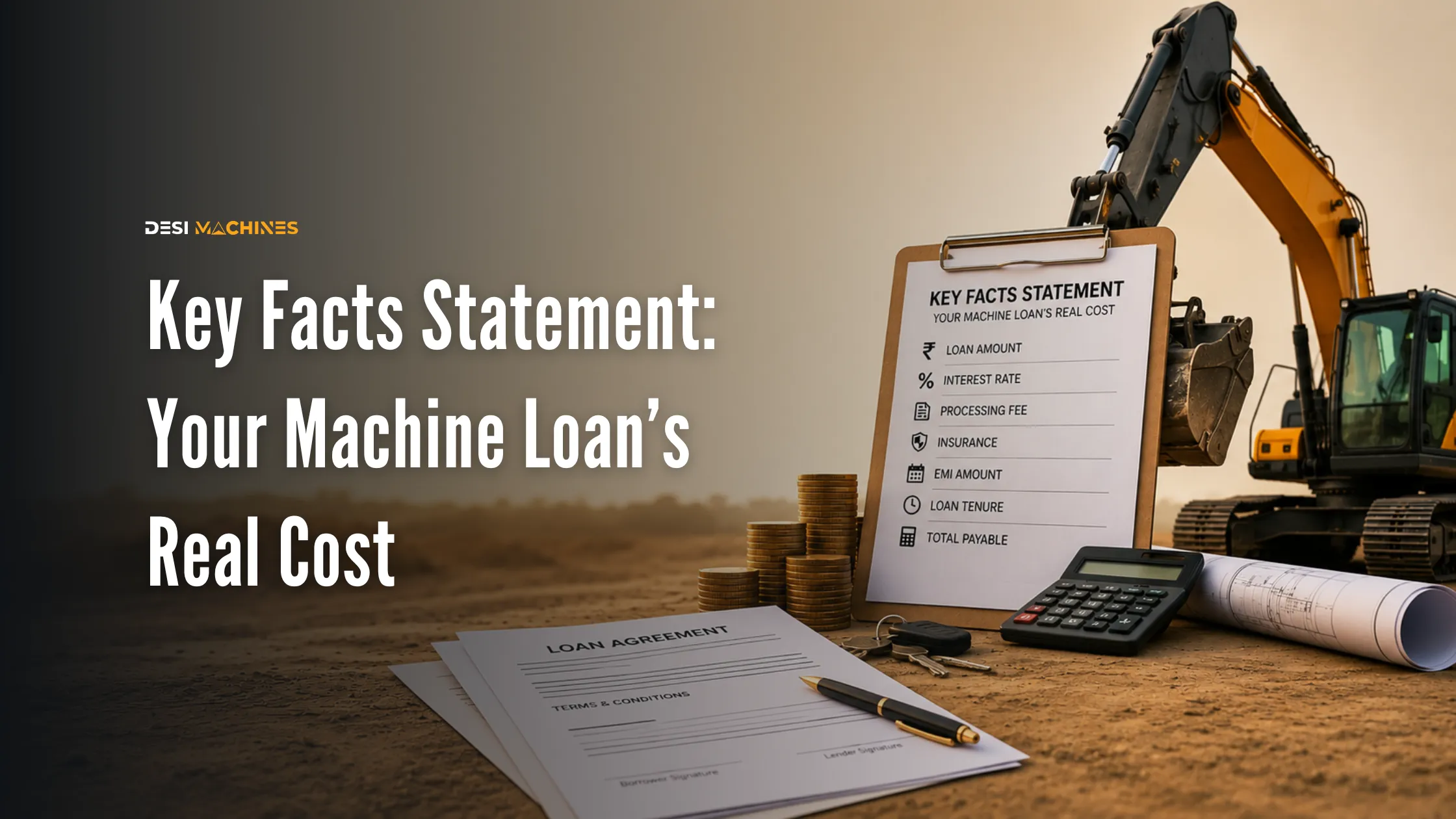
Only the interest part of the EMI is income of the lender. The principal part is the lender’s own money coming back, and no TDS applies to it. One wrinkle: section 2(59) defines interest to include “service fee or any other charges for the moneys borrowed”. A processing fee or documentation charge may fall inside that definition. The fee break-up in the Key Facts Statement for your machine loan is where to find it; settle the treatment with your CA before the first quarter closes.
Timing follows section 393(1)(c): tax is deducted when the interest is credited to the lender’s account in your books or when it is paid, whichever is earlier.
Worked example: a Rs 30 lakh excavator loan
Take a partnership firm that buys an excavator with a Rs 30 lakh NBFC loan over 48 months. Assume 12% a year on a reducing balance; this rate is only for the arithmetic and is not a quote. The EMI works out to Rs 79,002. Here is the first tax year, with all 12 EMIs falling inside it:
| Item | EMI 1 | EMI 12 | Year one (12 EMIs) |
|---|---|---|---|
| EMI | Rs 79,002 | Rs 79,002 | Rs 9,48,024 |
| Interest part | Rs 30,000 | Rs 24,332 | Rs 3,26,554 |
| Principal part | Rs 49,002 | Rs 54,670 | Rs 6,21,470 |
| TDS at 10% of interest | Rs 3,000 | Rs 2,433 | Rs 32,655 |
| Net paid to the NBFC if TDS is cut from the EMI | Rs 76,002 | Rs 76,569 | Rs 9,15,369 |
The TDS falls every month because the interest share falls as the loan reduces. That is why the deduction can never be a flat figure keyed into the mandate once. It has to follow the repayment schedule line by line.
The short EMI: how to settle it with the NBFC
This is where owners and lenders fall out. The NBFC’s system expects Rs 79,002. You pay Rs 76,002 and send Rs 3,000 to the government. Until the lender can see that Rs 3,000 against its own PAN, its books show you short, and a shortfall can attract the charges explained in EMI bounce charges on a machine loan.
There are two ways to run it, and the lender’s TDS process decides which one you are on:
- Pay the net EMI. You pay the EMI less TDS, and the lender marks the gap as TDS receivable until your certificate arrives.
- Pay the full EMI and claim the TDS back. The mandate debits the full Rs 79,002. You still deposit the TDS from your own funds, then ask the NBFC to refund it once the credit shows up on its side, usually against your quarterly certificates.
Ask the lender in writing which route it follows before the first EMI after you become liable. Either way, the lender only sees the credit after you complete your side, which under the Income-tax Rules, 2026 runs like this:
- Get a TAN. Section 397(1) requires a tax deduction and collection account number, and serial number 5(iii) is not in the list of deductions excused from it.
- Deposit the tax by the 7th of the following month, and by 30 April for interest credited or paid in March (Rule 218).
- File the quarterly TDS statement in Form No. 140 by 31 July, 31 October, 31 January and 31 May (Rule 219).
- Issue Form No. 131 to the NBFC within fifteen days of each statement’s due date (Rule 215).
The certificate is what closes the lender’s open item. Contractors who sit on the other side of this, waiting for a client’s certificate, will recognise the routine from Form 16A for contractors. If a deduction comes out wrong, Note 2 to serial numbers 5(ii) and 5(iii) lets the payer increase or reduce a later deduction in the same tax year to adjust the excess or shortfall. If the NBFC holds a lower or nil deduction certificate from its Assessing Officer under section 395(1), you deduct at the rate it shows while it is valid; ask for a copy.
What skipping it costs you
Section 35(b)(i) disallows 30% of any sum payable to a resident on which TDS was due but not deducted, or deducted but not paid by the return due date. In the example, 30% of Rs 3,26,554 is Rs 97,966 of interest added back to the firm’s income for that year. The amount comes back as a deduction only in the year the tax is finally paid.
Section 398 adds interest at 1% a month from the date tax was deductible to the date it is deducted, and 1.5% a month from deduction to payment. The payer is treated as an assessee in default. Section 398(2) offers relief if the NBFC has already included the interest in its return and paid tax on it, backed by an accountant’s certificate in the prescribed form. That relief takes paperwork from the lender, and it is easier to deduct on time.
The same machine usually brings other TDS duties. Workshop bills are covered in TDS on machinery repair and maintenance, and hire payments in TDS on machinery hire charges.
Checklist before your next EMI date
- Check last tax year’s turnover. A firm or company is always in; a proprietor is in above Rs 1 crore.
- Read the lender’s legal name on the sanction letter. Bank: no TDS. NBFC: TDS, unless it shows it is a notified institution.
- Get the full repayment schedule and compute 10% of each month’s interest, not of the EMI.
- Ask your CA whether the processing fee goes into the TDS base under section 2(59).
- Agree in writing with the NBFC whether you pay net or pay full and claim back.
- Deposit by the 7th, file Form No. 140 each quarter, and send Form No. 131 to the lender.
For the loan itself, from documents to repayment terms, start at equipment finance for machine buyers.
Tax rules, rates and thresholds change, and the 10% rate is set each year by the Finance Act. The 12% rate in the example is an assumption for arithmetic only. Confirm the current position with your chartered accountant and your lender before you act. DesiMachines is not liable for decisions taken on information that may have changed after publication.