Excavator
316 models
 Backhoe Loader
54 models
 Crane
68 models
 Concrete Mixer
79 models
 Wheel Loader
65 models
 Compactor / Roller
45 models
 Motor Grader
42 models

 Concrete Pump
66 models
 Skid Steer Loader
11 models



There is no GST on loan interest. Serial number 27 of Notification 12/2017-Central Tax (Rate) exempts loans “in so far as the consideration is represented by way of interest or discount”, so the interest inside your machine loan EMI carries nil GST, and the principal part is simply your own money coming back. The processing fee, documentation charge and similar service charges are taxed at 18%. Penal charges levied under RBI’s 2023 rules carry no GST, according to CBIC Circular No. 245/02/2025-GST. If you are GST-registered and the loan funds your business, the fee GST comes back to you as input tax credit.
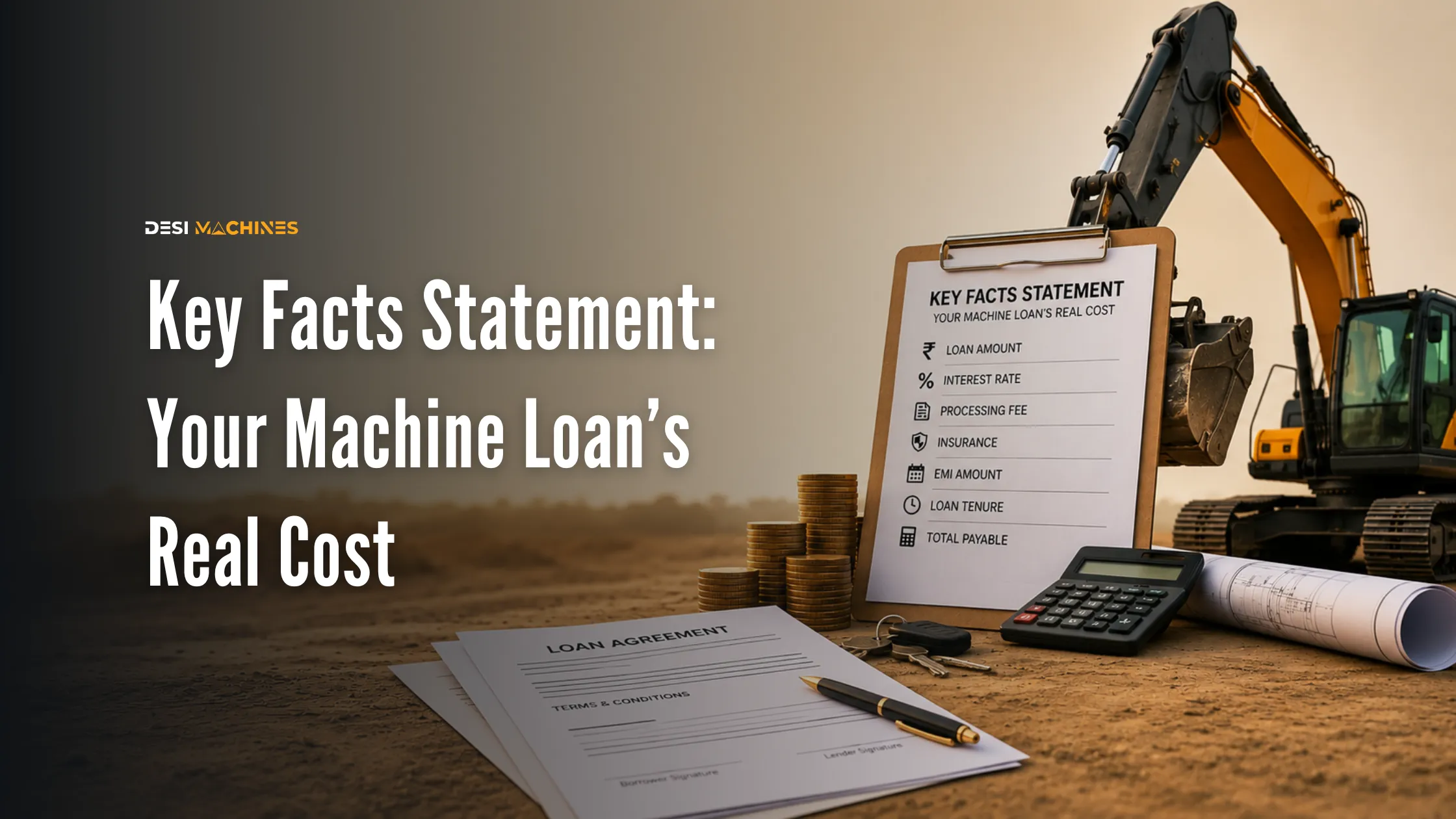
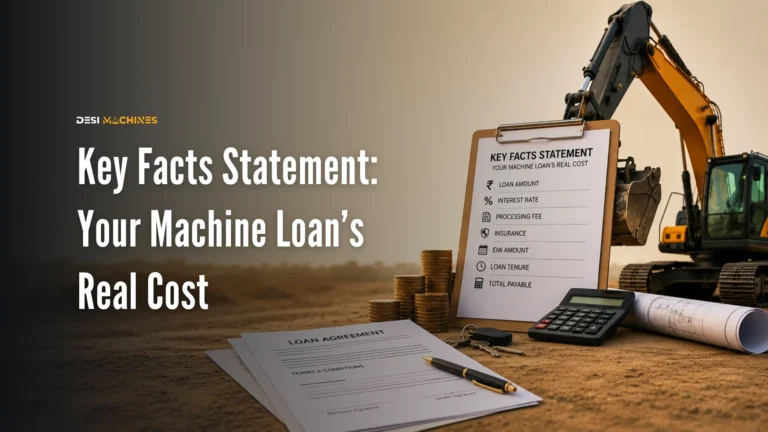
The sanction letter for a Rs 30 lakh backhoe loan runs to two pages, with a Key Fact Statement stapled behind it. Under fees, one line reads “processing fee 1% plus GST”. Further down, the repayment schedule lists 48 instalments of Rs 79,002, and no GST appears anywhere on that page. The owner rings the firm’s accountant to ask why one line attracts tax and the other does not. If you are still choosing where to borrow, start with equipment finance options, which set out how a machine loan is put together. This piece answers the tax question on each line of that letter.
Is GST charged on a machine loan EMI?
No. Every EMI has two parts, and neither of them is taxed.
The principal part is repayment of money you borrowed. Section 2(102) of the CGST Act defines “services” as “anything other than goods, money and securities”. Handing borrowed money back is not a supply, so there is nothing to tax.
The interest part is a supply by the lender, but it is exempt. Notification No. 12/2017-Central Tax (Rate), dated 28 June 2017, lists at serial number 27, under Heading 9971, “Services by way of (a) extending deposits, loans or advances in so far as the consideration is represented by way of interest or discount (other than interest involved in credit card services)”, with a central tax rate of Nil. The entry does not care whether the lender is a bank or an NBFC.
That entry survived the recent changes. Notification 16/2025-Central Tax (Rate), dated 17 September 2025 and in force from 22 September 2025, added exemptions for individual life and health insurance and left serial number 27 alone. So did the next amendment, Notification 07/2026-Central Tax (Rate) of 27 October 2026. As read on 21 November 2026, the interest exemption stands as written in 2017.
Why GST on loan interest is nil but the processing fee is taxed
The answer sits in a definition most people never read. Paragraph 2 of the same notification defines interest at clause (zk):
“interest” means interest payable in any manner in respect of any moneys borrowed or debt incurred (including a deposit, claim or other similar right or obligation) “but does not include any service fee or other charge in respect of the moneys borrowed or debt incurred or in respect of any credit facility which has not been utilised”.
So the exemption is drawn tightly around interest. A processing fee, a documentation charge, a login fee or an annual account charge is a “service fee or other charge” on the money borrowed. It falls outside serial number 27 and is taxed as an ordinary financial service.
The rate comes from Notification 11/2017-Central Tax (Rate), serial number 15, Heading 9971, which lists financial and related services. After the amendments since 2017, the residual item, item (vii), “Financial and related services other than” the specific items above it, carries 9% central tax. The state charges the same 9% on an intra-state bill, so the fee line on your sanction letter shows 18%. If the lender bills from another state, it charges the full 18% as integrated tax instead.
What about the rate changes of 22 September 2025? For financial services, Notification 15/2025-Central Tax (Rate) changed one line: third-party insurance of goods carriages, item (vi), moved to 2.5% central tax. The residual line covering loan fees was untouched, so fee GST was 18% before that date and is 18% after it.
Each charge on a machine loan, and its GST
| Line on the sanction letter or statement | GST | Basis |
|---|---|---|
| Principal part of each EMI | Not a supply | Section 2(102), CGST Act |
| Interest part of each EMI | Nil | Notification 12/2017-CT(R), serial 27 |
| Processing fee | 18% | Clause (zk) of 12/2017 keeps it out of “interest”; 11/2017-CT(R), serial 15(vii) |
| Documentation or administration charge | 18% | Same as processing fee |
| Penal charge for a missed EMI, under RBI’s 2023 rules | No GST | Circular 245/02/2025-GST, para 2.5 |
| Cheque dishonour fine | Not taxable | Circular 178/10/2022-GST, para 7.3 |
| Foreclosure or pre-payment charge | Unsettled | See the section below |
One row that does not belong here is interest you charge a client who pays your hire bill late. That is your income, and section 15(2)(d) adds it to the value of your own supply. The mechanics are in GST on interest on delayed payment.
Penal charges and bounce charges after a missed EMI
RBI’s circular “Fair Lending Practice – Penal Charges in Loan Accounts”, dated 18 August 2023, told banks and NBFCs that a penalty for breaching material loan terms “shall be treated as ‘penal charges’ and shall not be levied in the form of ‘penal interest'”, from 1 January 2024. How those charges must be disclosed and capped is covered in EMI bounce charges on a machine loan.
Some tax officers then argued that a penal charge paid the lender for “tolerating” a default, making it taxable. On the GST Council’s recommendation at its 55th meeting, CBIC issued Circular No. 245/02/2025-GST on 28 January 2025. Paragraph 2.5 says “no GST is payable on the penal charges levied by Regulated Entities, in compliance with RBI directions dated 18.08.2023, for non-compliance with material terms and conditions of loan contract by the borrower.” The text of Circular 245/02/2025-GST is on the GST Council website.
A bounced cheque is covered by an older circular. Circular No. 178/10/2022-GST, dated 3 August 2022, says at paragraph 7.3 that a fine or penalty “that the supplier or a banker imposes, for dishonour of a cheque” is “not a consideration for any service and not taxable.”
Read the label on each statement line. A penal charge under the RBI rules, or a cheque dishonour fine, should carry no GST. If a missed EMI is billed under another name with 18% added, ask in writing which rule the lender relied on.
Foreclosure charges: the line where the documents disagree
Paying a machine loan off early can attract a pre-payment or foreclosure charge, and the GST position here is genuinely less clean.
On one side, clause (zk) keeps “any service fee or other charge” out of the meaning of interest, which points towards 18%. On the other side, Circular 178/10/2022-GST, paragraph 7.1.6, names pre-payment penalties charged by banks, treats them as consideration for a facility that is “ancillary to the principal supply”, and adds: “Naturally, such payments will not be taxable if the principal supply is exempt.” Lending at interest is exempt.
If you are planning an early exit, ask the lender how it will bill GST on the charge and put the answer in front of your chartered accountant before you pay. The charge itself is the bigger number; foreclosure charges on an equipment loan covers how lenders set it.
A Rs 30 lakh backhoe loan, worked through
Take the owner in the opening scene. These figures are illustrative: a 1% processing fee, a Rs 2,500 documentation charge, and 12% a year over 48 months, a rate assumed here only to make the arithmetic concrete. Your own sanction letter carries your own numbers.
| Item | Amount | GST |
|---|---|---|
| Loan sanctioned | Rs 30,00,000 | Not a supply |
| Processing fee at 1% | Rs 30,000 | Rs 5,400 |
| Documentation charge | Rs 2,500 | Rs 450 |
| EMI, 48 months at 12% | Rs 79,002 a month | Nil |
| Total interest over the loan | about Rs 7,92,072 | Nil (serial 27) |
| Total GST on the loan | Rs 5,850 |
On an intra-state bill, the Rs 5,850 splits into Rs 2,925 central tax and Rs 2,925 state tax. If the lender deducts the fees and their GST from the disbursal, the dealer receives Rs 29,61,650 while the EMI is still worked out on Rs 30 lakh. That gap is exactly the cost the Key Fact Statement for a machine loan is meant to show you before you sign.
About Rs 7.92 lakh of interest flows through this loan without a rupee of GST on it. The tax sits only on the Rs 32,500 of fees.
Now the part generic answers skip. If this owner is registered under GST and hires the backhoe out on taxable invoices, the Rs 5,850 is input tax the owner can set against the GST collected on the hire bills. The real cost of the fees falls from Rs 38,350 to Rs 32,500. If the owner is not registered, or pays tax under the composition scheme, the Rs 5,850 is simply a cost.
Claiming the fee GST back as input tax credit
Section 16(1) of the CGST Act, as consolidated on 26 May 2025, entitles every registered person to “take credit of input tax charged on any supply of goods or services or both to him which are used or intended to be used in the course or furtherance of his business”. A loan taken to buy a machine for hire or contract work meets that test. Section 16(2) then sets the conditions, and three matter on a loan fee:
- You hold the lender’s tax invoice. Give the lender your GSTIN before disbursal so the fee is billed to the business.
- The lender has reported that invoice and it has been communicated to you, under clause (aa). Until it shows in your credit statement, the credit is not available.
- The tax has been paid to the government and you have filed your own return.
There is a deadline too. Section 16(4) bars credit on an invoice after 30 November following the end of the financial year it belongs to, or after you file the annual return, whichever is earlier. A fee charged in May 2026 has to be claimed by 30 November 2027 at the latest.
The composition route closes this door. Section 10(4) says a person paying tax under composition “shall not collect any tax from the recipient on supplies made by him nor shall he be entitled to any credit of input tax.” For the wider picture on credit across a fleet, see GST input credit on construction equipment, and for the trade-off itself, the GST composition scheme for contractors.
Before you sign, ask the lender for every fee as a figure with its GST shown separately, then weigh the machine loan options with the after-credit cost in hand.
Tax rules, rates and thresholds change, and the figures in the worked example are illustrative. Confirm the current position with your chartered accountant, bank or finance company before you act. DesiMachines is not liable for decisions taken on information that may have changed after publication.