Excavator
294 models
Excavator
294 models  Backhoe Loader
51 models
Backhoe Loader
51 models  Crane
68 models
Crane
68 models  Concrete Mixer
79 models
Concrete Mixer
79 models  Wheel Loader
54 models
Wheel Loader
54 models  Compactor / Roller
45 models
Compactor / Roller
45 models  Motor Grader
42 models
Motor Grader
42 models  Dozer
41 models
Dozer
41 models  Concrete Pump
66 models
Concrete Pump
66 models  Skid Steer Loader
11 models
Skid Steer Loader
11 models  Telehandler
13 models
Telehandler
13 models 


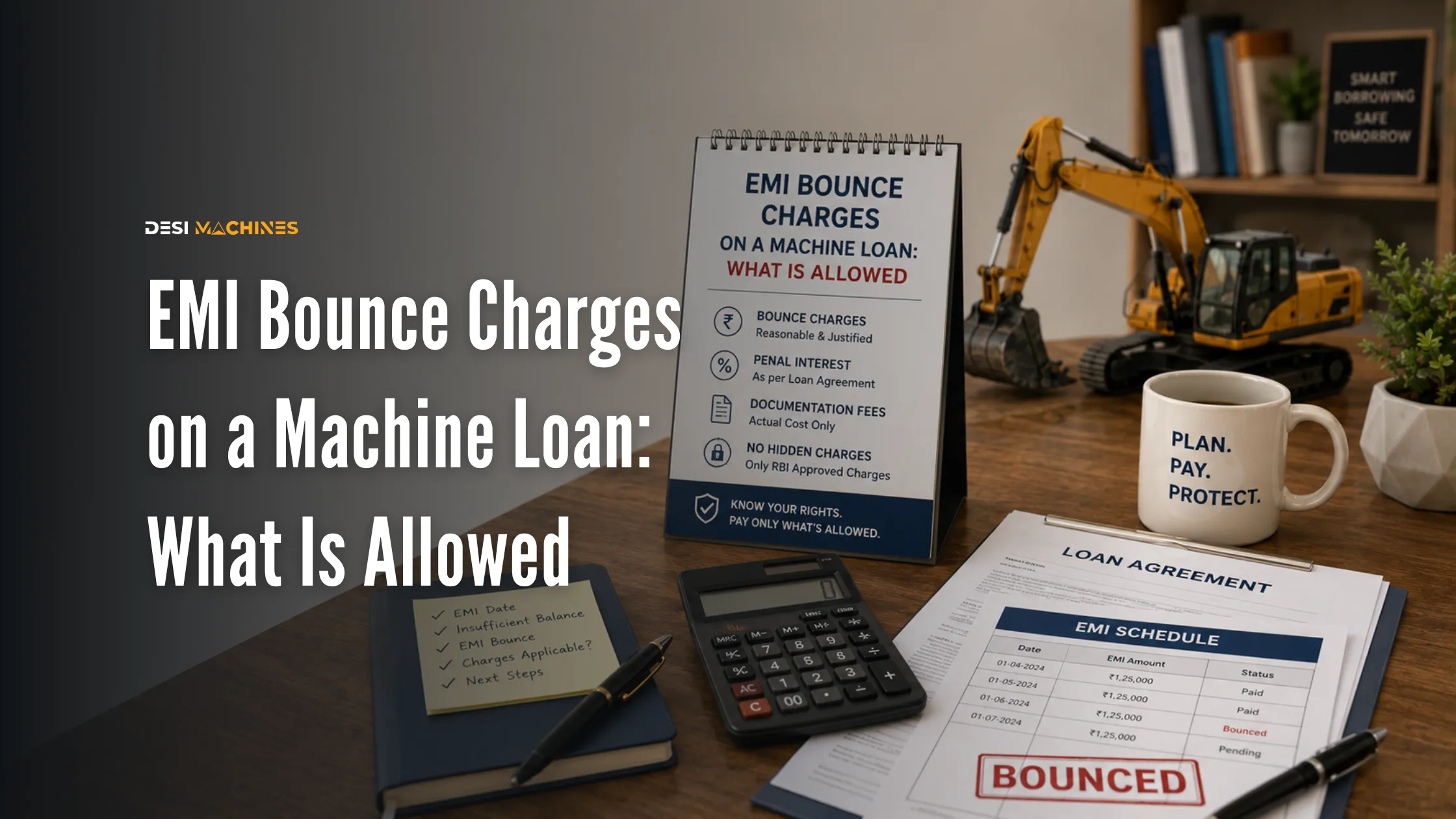
When a machine EMI bounces, what the lender adds must be a penal charge and not penal interest. That distinction matters because emi bounce charges cannot be capitalised: no interest runs on them, and no fresh penalty can be stacked on an unpaid penalty. There is no prescribed cap, but the amount has to be reasonable, charged only on the amount in default, and disclosed to you in the loan agreement and Key Fact Statement before you sign.
The distinction the statement never explains
A cheque or mandate bounces on the 5th, cash comes in on the 20th, and the next statement carries a number nobody at the branch can break down. Owners generally pay it and move on, which is exactly why the rules here are worth knowing: they are precise, they are recent, and they are almost never volunteered.
The rules distinguish sharply between two things that look identical on a statement.
Penal interest is an additional rate loaded onto your loan’s interest rate. Because it is a rate, it runs on the balance and compounds with everything else. Penal charges are a levy for breaching a term of the contract. The instruction is that any penalty for non-compliance with material terms shall be treated as a penal charge and shall not be levied as penal interest added to the rate of interest.
Default in repayment counts as exactly that kind of non-compliance. So when your EMI bounces, the penalty must arrive as a charge, not as a higher rate.
Why penal charges cannot grow
This is the practical consequence, and it is the part that protects an owner in a bad quarter.
There is to be no capitalisation of penal charges, which means no further interest is computed on them. On top of that, additional or fresh penal charges cannot be levied on an earlier outstanding amount of penal charges. Put those together and an unpaid bounce charge sits still. It does not breed.
One honest qualification, because owners sometimes over-read this. The lender may still charge interest on unpaid interest, including on an unpaid EMI, at the contracted rate of interest until the default is remedied. What it cannot do is apply a penal rate to that. Normal compounding of interest in the loan account carries on as it always did; the penalty layer is what has been fenced off.
| What the lender does | Permitted? |
|---|---|
| Levies a fixed charge for the bounced EMI | Yes, if reasonable and disclosed |
| Adds a penal rate on top of your interest rate | No |
| Charges interest on the bounce charge | No |
| Adds a new penalty on an unpaid penalty | No |
| Charges interest on the unpaid EMI at the contracted rate | Yes |
| Levies the charge on the full outstanding, not just the overdue amount | No, only on the amount in default |
That final row is the one to check on your own statement. Penal charges are to be levied only on the amount under default, and in a non-discriminatory manner under a board-approved policy. A percentage applied to the whole outstanding loan rather than to the missed instalment is not what the rules contemplate.
How much is too much
There is no cap. No upper limit for penal charges has been prescribed, and it is fair to say so plainly rather than imply a ceiling exists.
What exists instead is a standard. The quantum has to be reasonable and commensurate with the non-compliance, and must not be discriminatory within a particular loan or product category. Lenders may vary charges by loan size within a category, but the structure has to be uniform irrespective of the constitution of the borrower. A proprietorship should not be paying a stiffer bounce charge than a private limited company on the same product.
The rules also record the intent: penal charges exist to instil credit discipline and are not meant to be used as a revenue enhancement tool. That sentence is a useful thing to quote in a written complaint where the charge is plainly disproportionate to a single missed instalment.
If bounces are becoming a pattern rather than an accident, the charge is the smaller problem. What the lender can do next is set out in our guide to machine loan default and the lender’s powers, and owners at that stage should also understand what a loan settlement really costs before anyone suggests one.
What you should have been told
Disclosure is where most lenders are weakest, and where an owner has the clearest ground to stand on.
The quantum and the reason for penal charges must be disclosed to you upfront in the loan agreement and in the Key Fact Statement, and displayed on the lender’s website under interest rates and service charges. The rules then close the obvious loophole: providing a reference to the schedule of penal charges displayed on the website, inside the sanction letter or loan agreement, shall not suffice. The actual numbers have to be in front of you.
There is a continuing obligation too. Whenever reminders for non-compliance are sent, the applicable penal charges have to be communicated, and any instance of a penal charge being levied, along with the reason for it, must also be communicated. A charge that simply appears on a statement, with no reason given and no prior reminder that named it, does not meet that standard.
For older loans, the switchover to this regime happens on the next review or renewal date, so a long-running facility may have moved across more recently than you realise. It is worth asking which regime your account is on, especially if you are also comparing what banks and NBFCs charge on equipment loans.
Checking and challenging emi bounce charges
Pull the loan agreement and the Key Fact Statement first, and find the penal charge clause. If the quantum is not there in figures, that is your opening point.
Then read the statement against the six rows in the table above. The three things worth checking are whether the levy is described as a charge or as an interest rate, whether it has been applied to the overdue instalment or to the whole outstanding, and whether anything has been charged on a previously unpaid charge.
Put the complaint in writing to the lender, quoting the clause and the dates. Keep it factual and keep the acknowledgement. If a wrong charge has already flowed through to your credit record, correcting that is a separate process with its own deadlines, which we cover in our guide to fixing a wrong entry on your credit report.
If the lender will not itemise the charge or simply stops replying, the argument has a defined route above the branch, with a 30-day deadline and an internal review that a rejection now has to survive. That ladder is set out in the NBFC complaint route.
What a lender may charge on a bounced EMI
A bounced EMI on a machine loan costs money, and it should. What it should not do is quietly turn into a second loan. The penalty must arrive as a charge rather than as a rate, it must sit on the overdue amount alone, and nothing may be charged on top of it.
Read the Key Fact Statement before you sign rather than after the first bounce, because the disclosure obligation is at its strongest at that moment. Owners planning a purchase can compare equipment finance options and lender terms and ask for the penal charge schedule in figures as part of the same conversation. If the bounces have already run on, know exactly when an overdue instalment turns the account into an NPA.
Source: the Reserve Bank of India (Non-Banking Financial Companies – Responsible Business Conduct) Directions, 2025, as updated to 1 July 2026.
Rates, schemes, specifications and prices change – confirm current terms with the OEM, dealer, bank or insurer before deciding. Nothing here is legal or financial advice on your specific account.