Excavator
294 models
Excavator
294 models  Backhoe Loader
51 models
Backhoe Loader
51 models  Crane
68 models
Crane
68 models  Concrete Mixer
79 models
Concrete Mixer
79 models  Wheel Loader
54 models
Wheel Loader
54 models  Compactor / Roller
45 models
Compactor / Roller
45 models  Motor Grader
42 models
Motor Grader
42 models  Dozer
41 models
Dozer
41 models  Concrete Pump
66 models
Concrete Pump
66 models  Skid Steer Loader
11 models
Skid Steer Loader
11 models  Telehandler
13 models
Telehandler
13 models 


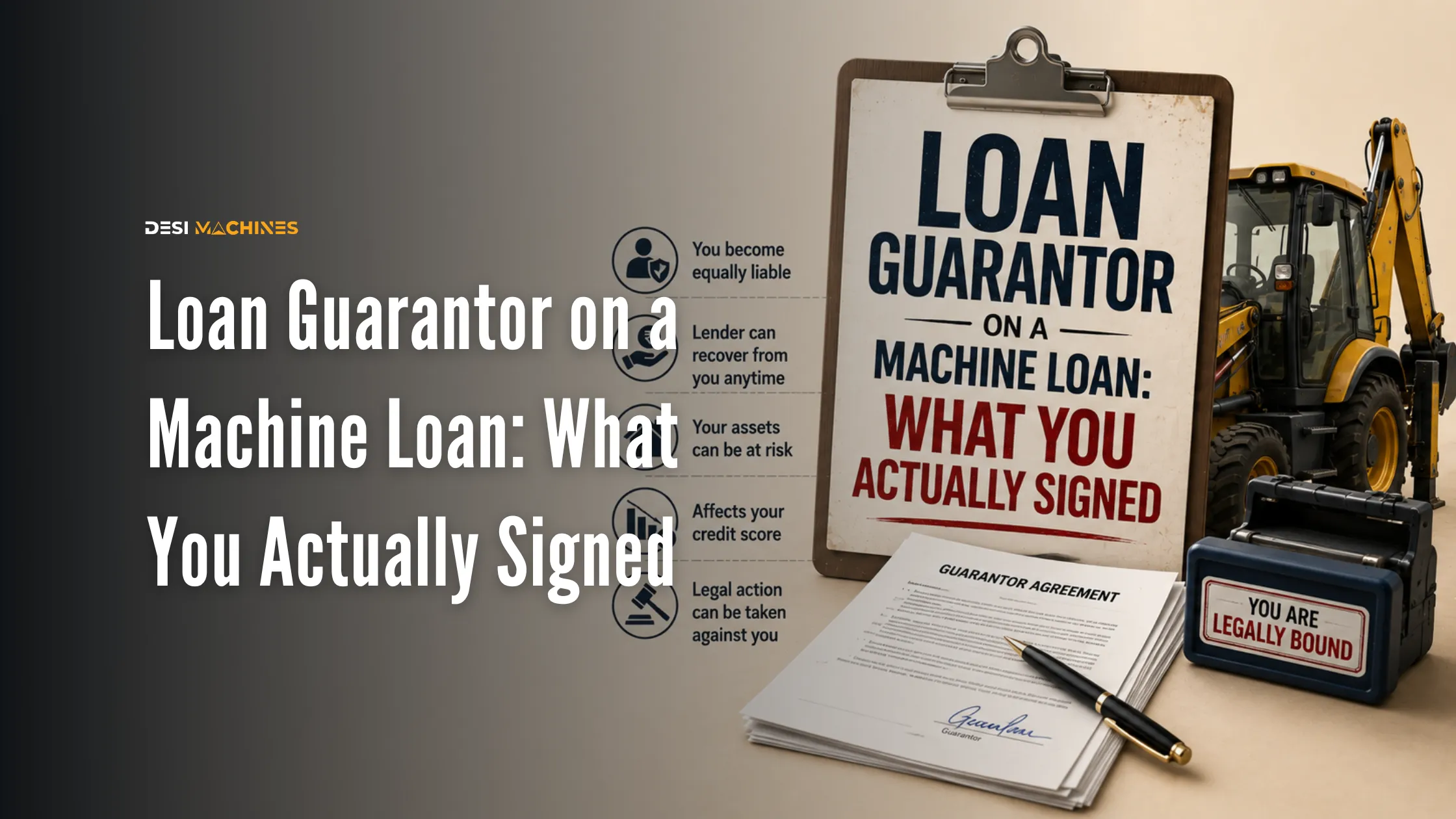
Signing as a loan guarantor on someone else’s machine loan makes your liability coextensive with the borrower’s under Section 128 of the Indian Contract Act. The lender does not have to seize the machine or exhaust its remedies against the borrower before it comes to you, and once it makes a claim your liability is immediate. Refusing to honour an invoked guarantee, when you have the means, is itself treated as wilful default and can put your name in front of every RBI-regulated lender in the country.
The favour nobody explains properly
It usually happens over tea. A friend in the same line, or a cousin with two tippers, is one signature short of a sanction. The finance executive says the file only needs a guarantor with a clean record, that it is a formality, that nothing will ever come to you.
Three of those four statements are true. The file does need you, your record is why, and in most cases nothing does come to you. The word that is doing the damage is formality.
A guarantee is not a character reference. The Reserve Bank’s 2025 directions define a guarantor plainly as a person or entity who has guaranteed the credit facility, and then set out what that means when things go wrong. It is worth reading that part before you sign, not after.
What a loan guarantor is actually liable for
The governing sentence is short. Under Section 128 of the Indian Contract Act, 1872, the liability of the guarantor is coextensive with that of the principal debtor, unless the contract provides otherwise.
Coextensive is the whole point. It does not mean you are liable for a share. It does not mean you are liable if the borrower cannot be found. It means your liability is the same size and the same shape as his. If he owes the outstanding principal, the interest and the charges, so do you.
The phrase unless it is otherwise provided by the contract is the only door here, and it is the document you are being asked to sign that decides whether it is open. A guarantee limited to a stated amount, or to a stated period, is possible. It has to be written into the deed. It is not the default.
The lender does not have to chase the borrower first
This is the part that surprises people, and the directions are explicit about it.
When a default happens in making payment or repayment by the principal debtor, the lender shall be able to proceed against the guarantor even without exhausting the remedies against the principal debtor. And where the lender has made a claim on the guarantor on account of the borrower’s default, the liability of the guarantor is immediate.
So the sequence most guarantors assume, that the lender will first repossess the machine, sell it, apply the proceeds and only then come to them for a shortfall, is not a sequence the lender owes them. It may well happen in that order. It does not have to. If you are the party with the recoverable assets and the borrower is not, you may hear from the lender first.
Both the commercial bank directions and the NBFC directions issued in 2025 carry this paragraph in identical words, so the answer does not change with the kind of lender that financed the machine. Given how much construction equipment in India is financed by NBFCs rather than banks, that is worth knowing in advance.
What refusing a demand does to your own name
A guarantor who decides to sit tight is not simply declining to pay a debt. Under these directions, wilful default by a guarantor is deemed to have occurred if the guarantor does not honour the guarantee when it is invoked by the lender, despite having sufficient means to make payment of the dues.
That opens a formal process, not an argument at the branch. An identification committee examines the evidence and issues a show-cause notice, and you have 21 days to reply. If it proposes classification, you get 15 days to make a written representation to a review committee, and the review committee must offer you a personal hearing before it passes a reasoned order. It is an in-house proceeding, which is why the directions also state that you cannot be represented by a lawyer in it.
Lenders examine the wilful default aspect in non-performing accounts with an outstanding of Rs 25 lakh and above, which covers a very large share of machine loans. Separately, guarantors who fail to honour their commitments when invoked are reported to the credit information companies as large defaulters or wilful defaulters, so this reaches your credit record through a route that has nothing to do with your own repayment history.
The doors that close afterwards
The consequences of a wilful defaulter classification are not limited to the lender you fell out with, and they outlast the payment.
| Consequence | How long it runs |
|---|---|
| No additional credit facility from the lender, to you or to any entity you are associated with | While your name is on the list |
| The bar on additional credit continues after your name is removed | 1 year after removal |
| No credit facility for floating a new venture | 5 years after removal |
| Restructuring of your existing facilities | Governed by the stressed assets directions, not by negotiation |
Two details in that table are easy to miss. The bar reaches any entity you are associated with as a promoter, a director, or a person in charge of its management, so a classification against you individually can travel into the firm you run. And the restrictions on further finance apply across all entities regulated by the Reserve Bank, not only to the category of lender that classified you.
If you are weighing what a damaged credit record costs a machine owner in practice, the mechanics of that are set out in our note on the CIBIL score for a machinery loan, and the separate question of a wrong entry is covered in disputing a wrong CIBIL entry.
Before you sign: five questions worth asking
None of this makes guaranteeing a loan a bad decision. Small contractors get their first machine financed because someone with a record vouched for them, and that is how the trade has always worked. It makes it a decision, which is different from a favour.
What is the amount, and is my guarantee capped at it? If the deed is unlimited, you are standing behind whatever the account grows into, including charges you never saw.
Where is this machine going to work? A guarantee is a bet on the borrower’s cash flow, and machine cash flow is site-dependent. An owner with a signed order from a contractor who pays in 45 days is a different risk from one hoping for spot hire.
What is his repayment record now? Not his reputation. His record. If you cannot ask that question comfortably, you have your answer about the relationship.
What will this do to my own borrowing? A contingent liability sits on your file. If you plan to add a machine of your own in the next two years, price that in before you sign, because the lender assessing your equipment loan eligibility certainly will.
What is my exit? Ask, in writing, what the lender requires to release a guarantor. Usually it is full repayment or an acceptable substitute. Get the answer on paper. If the loan is later closed early, the rules on equipment loan foreclosure charges decide what that costs the borrower, and your release should follow it.
If the borrower is already behind, do not wait for the notice to arrive. What the lender can and cannot do at that stage is set out in machine loan default, and the negotiated route out is covered in machine loan settlement. A guarantor who joins those conversations early has options. One who is told after the account turns non-performing usually has one.
Read the guarantee deed before you sign for a loan
Being a loan guarantor means accepting the borrower’s liability as your own, in full, without the protection of being asked second. That is a real commitment and it deserves the same scrutiny you would give a machine purchase: read the deed, ask for a cap, check the borrower’s record rather than his reputation, and know what your exit looks like before you need it.
If you are the one raising finance and want to understand what a lender is weighing on your file, compare the current equipment finance options and speak to a lender before the paperwork is drawn up rather than after. If a guarantee has already been invoked on you, read where refusing it leads: a wilful defaulter classification in your own name.
Rates, schemes, regulations and prices change, and the summary above is general information, not legal or financial advice on your specific facility. Confirm current terms and the exact wording of any guarantee deed with your bank, NBFC or a qualified professional before you sign.