
 Excavator
316 models
 Backhoe Loader
54 models
 Crane
68 models
 Concrete Mixer
79 models
 Wheel Loader
65 models
 Compactor / Roller
45 models
 Motor Grader
42 models

 Concrete Pump
66 models
 Skid Steer Loader
11 models


Sand used for plaster, brickwork and concrete in India can have a fineness modulus anywhere from about 1.2 for fine plaster sand to 4.0 for the coarsest sand that IS 383 accepts in concrete, and that single number tells you how coarse the sand is. The fineness modulus of sand (FM for short) is worked out from a sieve test: add up the cumulative percentage of sand held back on each of six standard sieves, from 4.75 mm down to 150 micron, and divide by 100. The higher the answer, the coarser the sand.
This guide shows which sieves to use and how to run the test to IS 2386 (Part 1), works the formula through a real-looking sieve sheet, gives the FM range each IS 383 grading zone allows, and says which FM the Indian Standards ask for in plaster, masonry and concrete. It also covers how to fix sand that is too fine by blending.
Key points
- FM is the sum of the cumulative percentages retained on the 4.75 mm, 2.36 mm, 1.18 mm, 600 micron, 300 micron and 150 micron sieves, divided by 100.
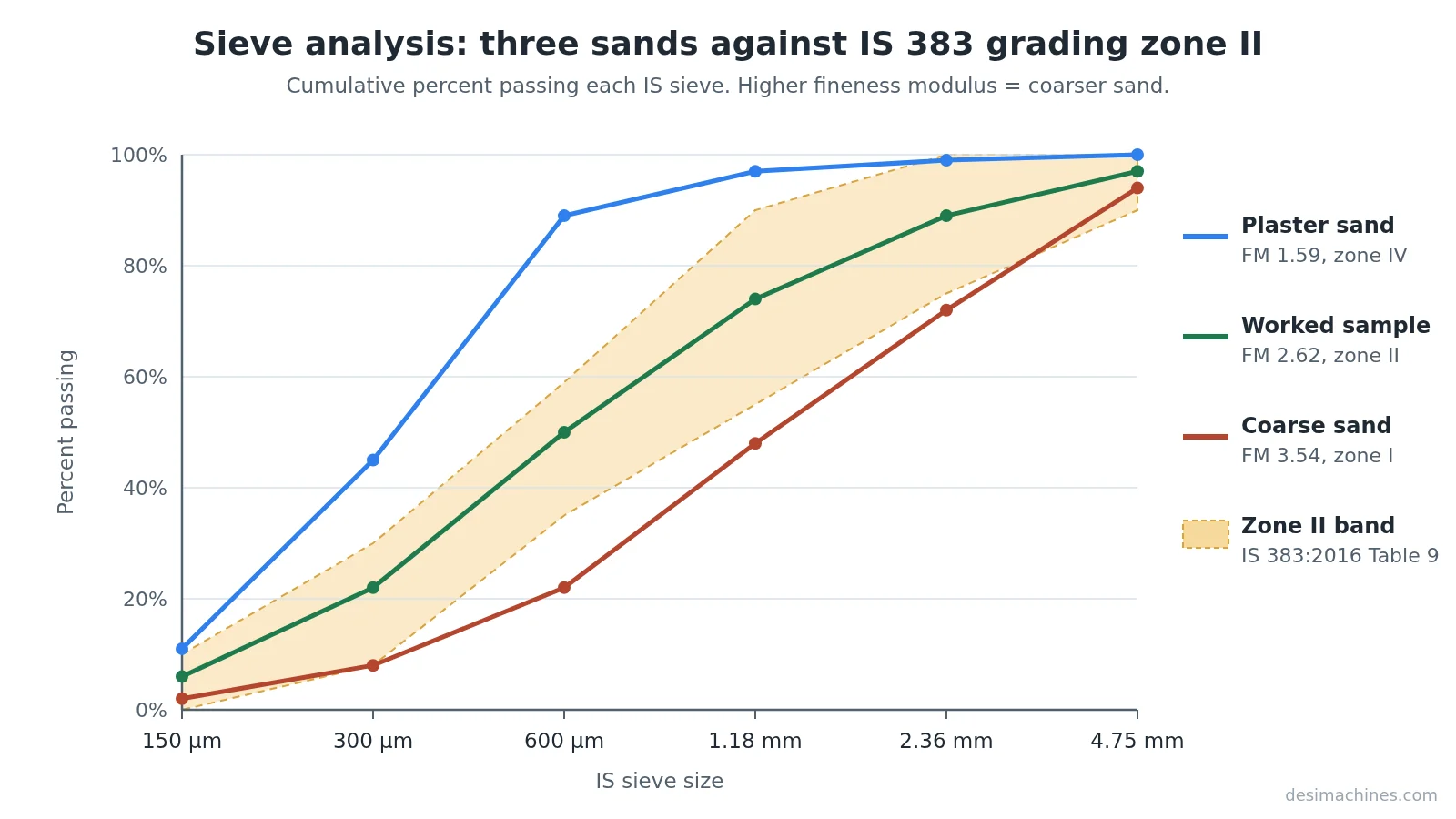
- The worked sample in this guide retains 3, 11, 26, 50, 78 and 94 percent on those sieves, so its FM is 262 ÷ 100 = 2.62, and it falls in grading zone II.
- IS 1542 asks for plaster sand with an FM of at least 1.5 for natural sand and 1.4 for crushed sand.
- The same FM can come from different gradings, so always check the grading zone as well as the number.
What is the fineness modulus of sand?
The fineness modulus is a number that describes how coarse or fine a sand is. IS 1661, the Indian code for cement and lime plaster, defines it as the figure found by taking the percentage of material left on each of a series of sieves, from 40 mm down to 150 micron, adding those percentages and dividing by 100. A micron is one thousandth of a millimetre, so a 150 micron sieve has holes 0.15 mm wide.
Think of it as an average size score. Coarse sand stays behind on the upper sieves, so it collects high percentages on every sieve and the total is large. Fine sand runs through most sieves, so the percentages are small and the total is small.
FM has a weakness that every buyer should know. A smooth, even sand and a gappy one, with a lot of coarse grains and a lot of dust but little in between, can land on the same figure. That is why IS 383:2016, the Indian Standard for concrete aggregates, does not grade sand by FM at all. It sorts sand into four grading zones by the percentage that passes each sieve. FM is a quick summary; the zone is the test that decides whether sand is fit for concrete.
Which sieves are used to find the fineness modulus of sand?
For sand, six sieves do the work: 4.75 mm, 2.36 mm, 1.18 mm, 600 micron, 300 micron and 150 micron. Each one has holes about half the size of the one above it. The larger sieves in the IS 1661 definition (10 mm and up) hold back nothing from sand, so they add zero and can be left out. The 75 micron sieve and the pan underneath are not part of the FM count; the 75 micron sieve belongs to a separate wash test for dust and silt.
IS 2386 (Part 1):1963 sets out how the sieving is done. The rules that matter most on a sand sample are in the table below.
Table 1: Sieving rules for sand from IS 2386 (Part 1):1963
| Point | What IS 2386 (Part 1) says |
|---|---|
| Minimum sample (Table IV) | 0.2 kg for material with a 4.75 mm maximum size, taken by quartering or with a sample divider |
| Drying (cl 2.4.1) | Air-dry the sample at room temperature or by heating at 100°C to 110°C before weighing |
| Shaking (cl 2.4.2) | Each sieve shaken until no more than a trace passes, and for at least two minutes; never press sand through by hand |
| Machine sieving (Note 3) | At least 10 minutes when a nest of sieves is shaken on a machine |
| Overloading (Table III) | On a 20 cm sieve, no more than 200 g left on 2.36 mm, 100 g on 1.18 mm, 75 g on 600 micron, 50 g on 300 micron and 40 g on 150 micron; sieve a large sample in parts |
| Reporting (cl 2.6) | Cumulative percentage passing each sieve, to the nearest whole number |
The overload limits are easy to break with sand. A 500 g sample of ordinary concrete sand can leave 140 g on the 300 micron sieve, nearly three times what a 20 cm sieve may carry, so tip it through in two or three lots and add the weights.
How do you calculate the fineness modulus of sand?
The formula uses cumulative percentages, not the weight on each sieve by itself:
Fineness modulus = (sum of cumulative percentage retained on the six sieves) ÷ 100
Work it in four steps. Weigh what stays on each sieve. Turn each weight into a percentage of the whole sample. Make the percentages cumulative by adding each one to everything above it. Then add the six cumulative figures and divide by 100.
Here is a full sheet for a 500 g sample of river sand.
Table 2: Worked sieve analysis and fineness modulus of a 500 g sand sample
| IS sieve | Weight retained (g) | Percent retained | Cumulative percent retained | Cumulative percent passing |
|---|---|---|---|---|
| 4.75 mm | 15 | 3 | 3 | 97 |
| 2.36 mm | 40 | 8 | 11 | 89 |
| 1.18 mm | 75 | 15 | 26 | 74 |
| 600 micron | 120 | 24 | 50 | 50 |
| 300 micron | 140 | 28 | 78 | 22 |
| 150 micron | 80 | 16 | 94 | 6 |
| Pan (not counted) | 30 | 6 | – | – |
| Total | 500 | 100 | 262 | – |
FM = 262 ÷ 100 = 2.62. Now hold the passing column against IS 383 Table 9: 97, 89, 74, 50, 22 and 6 percent all sit inside the zone II limits, so this is zone II sand with an FM of 2.62.
The most common mistake is to add the plain percent retained column instead of the cumulative one. On this sheet that gives 3 + 8 + 15 + 24 + 28 + 16 = 94, and an “FM” of 0.94, which is no real sand at all. The second mistake is to count the pan or the 75 micron sieve. Leave both out.
What is the fineness modulus of sand for zone 2 and the other zones?
IS 383 does not print an FM for any zone, but the zone limits fix the range an FM can take. We worked it out from Table 9 of IS 383:2016: take the passing limits for each sieve, turn them into cumulative percent retained, and add them up at the coarse edge and the fine edge of the zone. The midpoint column uses the middle of each sieve’s range.
Table 3: Fineness modulus range allowed by each IS 383 grading zone (our arithmetic from IS 383:2016 Table 9)
| Grading zone | How the sand reads | Lowest FM the limits allow | FM at the middle of the zone | Highest FM the limits allow |
|---|---|---|---|---|
| Zone I | Coarsest | 2.71 | 3.36 | 4.00 |
| Zone II | Coarse to medium | 2.11 | 2.74 | 3.37 |
| Zone III | Medium to fine | 1.71 | 2.25 | 2.78 |
| Zone IV | Finest | 1.35 | 1.80 | 2.25 |
Two things stand out. First, the zones overlap: an FM of 2.7 could be zone I, II or III, so the number alone cannot place a sand in a zone. Second, the edge values are worst cases. A real sand rarely sits on the coarse limit of every sieve at once, so most zone II sands land well inside 2.11 to 3.37, around the 2.74 middle.
The sieve-by-sieve limits for all four zones, and the extra allowance IS 383 gives crushed sand on the 150 micron sieve, are set out in the guide to quarry dust and M-sand grading zones.
What fineness modulus of sand is right for plaster, masonry and concrete?
Each job has its own Indian Standard, and they treat FM differently. Plaster codes name an FM; the masonry and concrete codes control grading only.
Table 4: What the Indian Standards ask of sand by use
| Use | Standard | What it asks for |
|---|---|---|
| Wall and ceiling plaster | IS 1542:1992, cl 5.2 and Table 1 | FM not less than 1.5 for natural sand and 1.4 for crushed stone or crushed gravel sand; its grading table allows FM of about 1.2 to 2.2 |
| Single-coat plaster | IS 1661:1972, Table 2 Note 2 | FM as far as possible 1.5, sand in grading zone IV |
| Under coats of two- or three-coat plaster | IS 1661:1972, Table 2 Note 1 | Coarse sand in grading zone II with FM not less than 2.0 |
| Masonry mortar | IS 2116:1980, Table 1 | Grading limits only (100 percent through 4.75 mm, up to 15 percent through 150 micron); those limits allow FM from 1.15 to 2.95 by our arithmetic |
| Concrete | IS 383:2016, cl 6.3 and Table 9 | Any of zones I to IV; zone IV not in reinforced concrete unless trial mixes prove it |
For plaster, IS 1661 also notes that the strength of a plaster mix falls as the FM of its sand falls, and that fine sand can be brought up by mixing in coarse sand. The cement and sand needed per square metre are worked out in the plaster quantity calculation guide.
For concrete, IS 383 says sand from any zone can make good concrete, but the mix has to follow the sand. Its Note 3 asks for less sand in proportion to stone as the sand gets finer, from zone I towards zone IV. So a mix written for zone II sand should be checked again before it is used with zone III or zone IV sand.
How do you correct sand that is too fine or too coarse?
Blend it. IS 1542 cl 5.4 and IS 2116 cl 4.4 both say the right grading can often be had by screening, by blending two sands, or by blending sand with crushed stone screenings. Because FM is built from percentages, the FM of a blend is the weighted average of the two FMs by weight:
FM of blend = (FM of sand 1 × share of sand 1) + (FM of sand 2 × share of sand 2)
Turned round, the share of coarse sand needed is (target FM − fine FM) ÷ (coarse FM − fine FM). Take a fine sand with FM 1.59 and a coarse sand with FM 3.54, and a target of 2.6. The coarse share is (2.6 − 1.59) ÷ (3.54 − 1.59) = 1.01 ÷ 1.95 = 0.52. So mix 52 parts coarse sand with 48 parts fine sand by weight.
Table 5: Blending a fine and a coarse sand to reach zone II (our worked example)
| Percent passing | 4.75 mm | 2.36 mm | 1.18 mm | 600 micron | 300 micron | 150 micron | FM |
|---|---|---|---|---|---|---|---|
| Fine sand | 100 | 99 | 97 | 89 | 45 | 11 | 1.59 (zone IV) |
| Coarse sand | 94 | 72 | 48 | 22 | 8 | 2 | 3.54 (zone I) |
| Blend, 48 fine : 52 coarse | 97 | 85 | 72 | 54 | 26 | 6 | 2.60 (zone II) |
| IS 383 zone II limits | 90-100 | 75-100 | 55-90 | 35-59 | 8-30 | 0-10 | – |
Always sieve the blend before you trust it. Hitting the target FM does not prove the blend sits inside a zone on every sieve; this one does, but another pair of sands might not.
On a quarry or M-sand plant the grading is set by the crusher and the screens instead. A VSI crusher shapes crushed stone into sand-sized grains, and a vibrating screen takes out the oversize. Ask the plant for a recent sieve report with the zone written on it before you place a large order.
What is the fineness modulus of coarse aggregate?
The same method works for stone, with the larger sieves added: 80 mm, 40 mm, 20 mm and 10 mm, then 4.75 mm down to 150 micron. Almost all of a 20 mm stone stays on the 4.75 mm sieve, so the five sieves below it each count as 100 percent, and the FM of coarse aggregate comes out far higher than that of sand.
A worked case: a 20 mm aggregate sample that keeps 0 percent on 40 mm, 4 percent on 20 mm, 62 percent on 10 mm and 96 percent on 4.75 mm and 100 percent on each of the five finer sieves (all cumulative) has an FM of (0 + 4 + 62 + 96 + 500) ÷ 100 = 6.62. IS 2386 Table IV asks for at least 2 kg of sample when the largest stone is 20 mm. Figures quoted from American references, about 6.75 to 8.00 for coarse aggregate, use a different sieve series (9.5, 19 and 37.5 mm) and cannot be compared directly with an FM worked on IS sieves.
What each stone size is used for, and how graded and single-size aggregate differ, is in the guide to aggregate size in concrete.
Why does the fineness modulus matter on a building site?
Fine sand has a great deal more grain surface for the cement paste to coat than coarse sand. Every one of those surfaces needs paste, so a sand that is too fine tends to push up the water or the cement a mix needs for the same workability. Extra water costs strength; the water cement ratio guide shows how much. A change in sand also shows up at once in the slump test of concrete, so a slump that suddenly drops with the same mix is a reason to sieve the new load.
Grading and cleanliness are two different checks. A sand can have a good FM and still carry too much silt, so run the silt content test of sand at the gate as well.
It matters most where sand goes into the mix straight from the heap. A self-loading mixer such as the Fiori DBS 4300 or the Tarle SLM 4300 scoops its sand from the site stockpile, so whatever grading that pile has goes into every batch. Sieve the pile when a new supplier or a new source starts. Compare self-loading concrete mixers and talk to a dealer about the machine that suits your pour.
The sieving method above follows IS 2386 (Part 1):1963, the grading zones are from IS 383:2016, the plaster figures from IS 1542:1992 and IS 1661:1972, and the masonry grading from IS 2116:1980. The FM ranges by zone and by IS 2116 grading, the worked sieve sheet and the blend are our own arithmetic from those tables. More guides on sand, cement and concrete sit on the building materials guide hub, and the machines that mix it are listed under concrete mixer models and prices.
Prices, specifications and features are indicative, vary by variant, location and date, and should always be confirmed with the official OEM or authorised dealer before any purchase decision. Test methods, limits and code clauses should be confirmed against the current edition of the Indian Standard named in your contract. DesiMachines is not liable for decisions taken on the basis of information that may have changed after publication.
Machines, tenders and news for this industry: Building Construction