
 Excavator
294 models
 Backhoe Loader
51 models
 Crane
68 models
 Concrete Mixer
79 models
 Wheel Loader
54 models
 Compactor / Roller
45 models
 Motor Grader
42 models

 Concrete Pump
66 models
 Skid Steer Loader
11 models


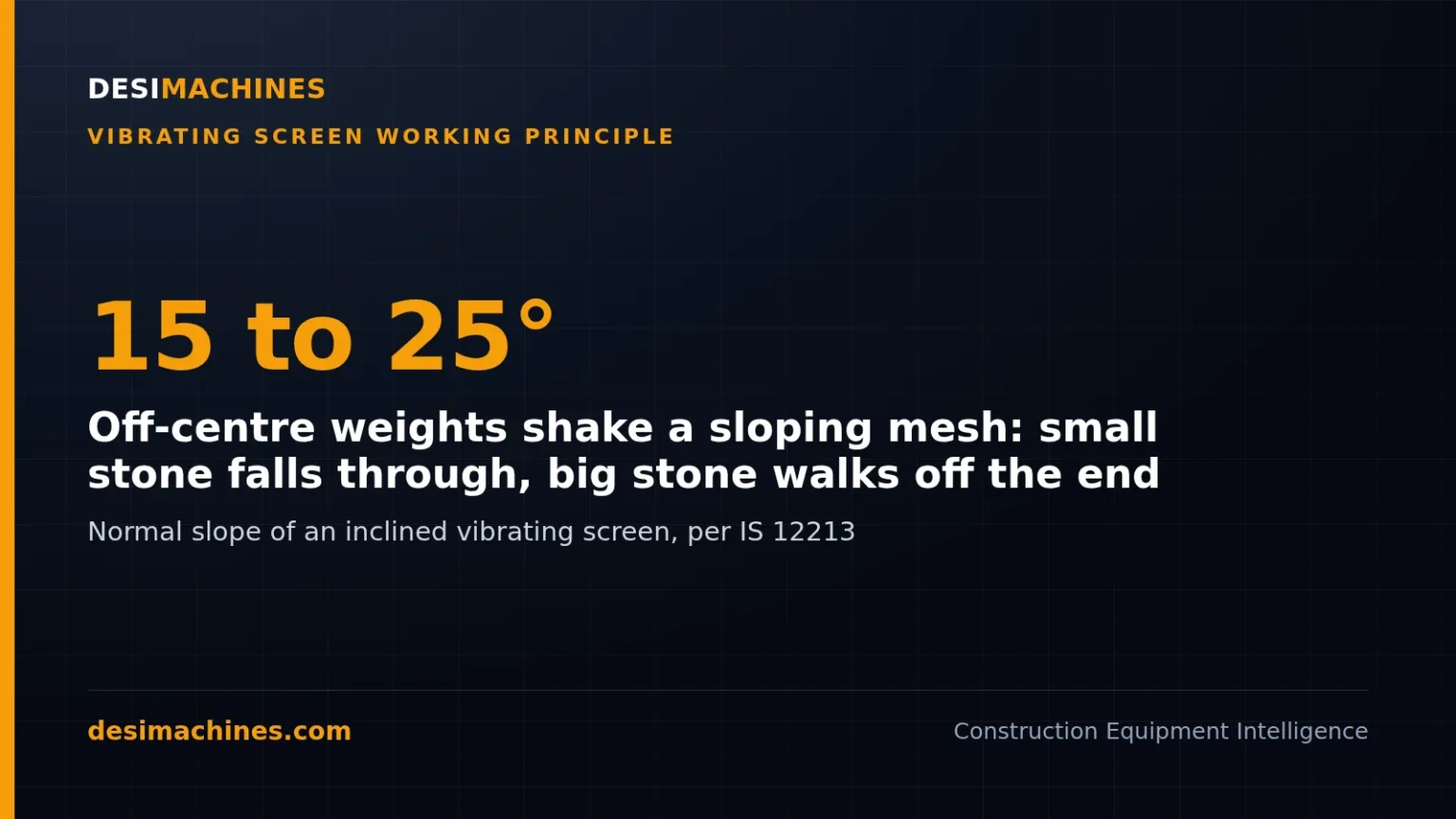
A vibrating screen works by shaking crushed stone across a sloping steel mesh. A motor spins an off-centre weight, the spring-mounted box moves in a small circle or a short straight line several hundred times a minute, stones smaller than the holes drop through, and the bigger ones travel off the far end.
That is how one machine turns a mixed heap of crusher output into separate piles of 40 mm, 20 mm and 10 mm stone and dust. This guide explains the vibrating screen working principle the way the Indian Standard for these machines, IS 12213 (Code for Mechanical Vibrating Screens), sets it out: the parts, the two main kinds of motion, why the box is tilted, what stroke and speed do, how the mesh opening decides the size you sell, and what to check when a screen stops sorting properly.
How does a vibrating screen work?
IS 12213 gives the principle in a few lines (clause 4). The vibrations are given to the screen box by unbalanced masses. The motion is either circular or a straight line. Material is fed in at one end, the undersize falls through the deck, and the oversize moves on to the end.
An unbalanced mass is simply a heavy weight bolted off-centre on a shaft. When the shaft spins, the weight keeps pulling it outwards, so the shaft and everything bolted to it is dragged round in a small circle. A ceiling fan with one bent blade wobbles for the same reason. In a screen this wobble is wanted. The whole box sits on springs so it is free to move, and the springs stop most of the shaking from reaching the frame and the ground.
Three things then happen to the stone on the deck, one after the other:
- Each turn of the shaft lifts the stone a little and throws it forward down the slope.
- The shaking sorts the layer of stone by size. IS 5742, the Indian glossary of screening terms, calls this stratification: big pieces rise to the top of the bed, and small pieces sift down through the gaps to the bottom, where the mesh is.
- A small stone that reaches the mesh gets many chances to find a hole as it hops along the deck. If it fits, it drops through to the next deck or into a chute.
Without the shaking, a sloping mesh would work like a slide: the fines would ride down on top of the big stones and never reach the holes.
What are the parts of a vibrating screen?
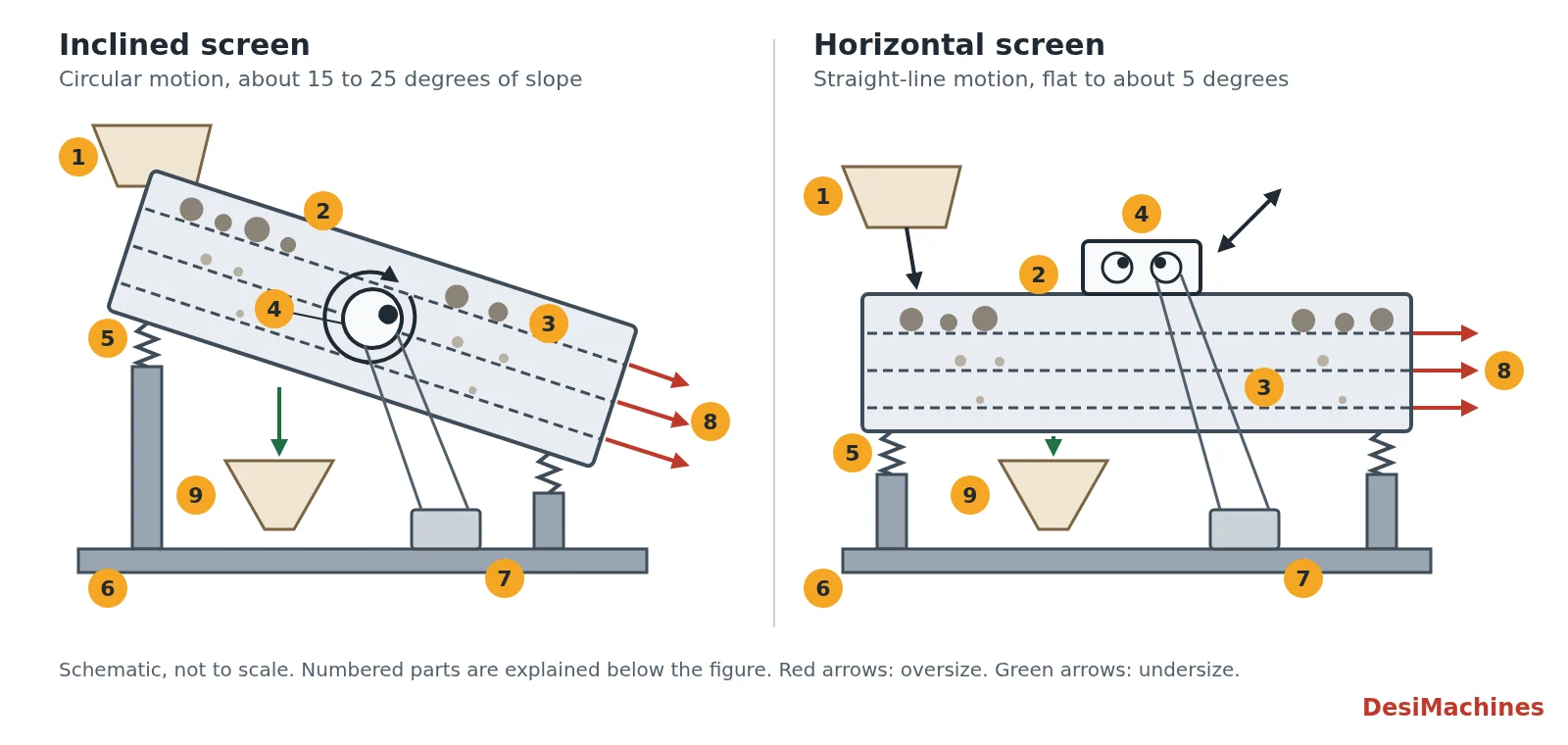
IS 12213 (clause 5) lists five main parts: the vibrating box, the vibrator unit, the screening surface, the supporting frame or dust cover, and the drive. Table 1 adds the smaller parts a buyer hears about on site.
| Part | What it is | What it does |
|---|---|---|
| Screen box (basket or live frame) | Two side plates joined by cross members, bolted or welded | Carries the decks and moves as one piece |
| Decks and screen cloth | Woven wire cloth, perforated plate or grizzly bars; one to four decks | The holes that do the sorting; each deck makes one cut |
| Vibrator (exciter) | A shaft with adjustable unbalanced masses, running in vibration-duty bearings | Makes the motion; moving the weights changes the stroke |
| Springs | V-springs or vertical springs, on a base frame or hung from above | Let the box move and keep the shaking off the structure |
| Base frame | Sturdy steel frame under the springs | Holds the screen; it must not vibrate at the same rate as the screen |
| Drive | Electric motor and V-belts, or a motor with a universal coupling | Turns the vibrator shaft |
| Feed box | Chute at the top end | Spreads stone across the full width of the deck |
| Dust cover (optional) | Hood over the box with inspection doors and a vent | Holds dust in and connects to a dust collector |
| Discharge chutes | One chute or belt per product | Send each size to its own stockpile |
Table 1. Parts of a vibrating screen, from IS 12213:1987 clauses 2, 3 and 5.
Two details are worth knowing. First, the standard places the vibrator through or near the screen’s centre of gravity (its balance point), so the whole box moves evenly instead of rocking. Second, a circular-motion screen may have a two-bearing or a four-bearing vibrator. In the two-bearing type the shaft runs only in bearings on the side plates. The four-bearing type adds two outboard bearings on the fixed frame, so the shaft works like a crank and forces the same stroke even when the load on the deck changes.
The standard also asks for guards on the pulleys, belts and spinning weights (clause 7.1).
What are the types of vibrating screen?
Screens are grouped mainly by how the box moves and how steeply it is tilted. IS 12213 names circular, straight-line and gyratory motion, and horizontal and inclined screens. IS 5742 adds the high-speed screen and the grizzly.
| Type | Motion | Slope | Where it is used |
|---|---|---|---|
| Inclined (circle-throw) | Circular, from one shaft with unbalanced masses | 15 to 25 degrees normally (IS 12213); 10 to 36 degrees across all inclined screens (IS 5742) | The main sizing screen in most stone crusher plants |
| Horizontal (linear) | Straight line at about 45 degrees to the deck, from two shafts turning in opposite directions | Flat to 5 degrees (IS 12213); up to 8 degrees (IS 5742) | Low headroom, mobile plants, fine and accurate finishing cuts |
| Elliptical (oval) | Oval, from three shafts or a special vibrator | Flat or inclined, depending on the design | Where an adjustable throw helps; McLanahan’s triple-shaft design sets the throw angle between 30 and 60 degrees |
| High-speed | Circular or straight line, above 20 Hz (1,200 vibrations a minute) | Inclined; Puzzolana’s banana design uses a high slope | Fine screening, such as taking dust out of crusher sand |
| Grizzly | Vibrating or fixed bars, or rollers | Not fixed by the standards | Large pieces, over about 100 mm, ahead of the primary crusher |
Table 2. Types of vibrating screen. Motions and slopes from IS 12213:1987 clauses 3 and 5 and IS 5742:2022 clauses 2.2.16 to 2.2.23; uses from the makers’ pages named in the text.
Indian makers’ ranges match this split. Propel’s MVS screens are circular-motion inclined screens with a standard slope of 18 degrees and one to four decks, and its Dual Slope 1860 uses elliptical motion. Puzzolana sells inclined PVS screens and a banana-type high-speed screen for fine work.
What is the difference between inclined and horizontal vibrating screens?
The difference is what moves the stone forward. On an inclined screen, gravity does most of it. The circular motion only has to lift and loosen the stone, so the screen needs less power and a smaller stroke. On a horizontal screen there is no slope to help, so the straight-line throw at about 45 degrees has to push every piece along. That takes more power and a longer stroke, according to US screen maker McLanahan’s published guidance.
An inclined screen clears stone quickly and handles high tonnage, which is why McLanahan calls it the most popular type for aggregate work. A horizontal screen keeps stone on the deck longer, which gives more accurate sizing, and it stands lower, which suits mobile plants and sheds with little headroom.
Slope is also a setting. McLanahan notes that some screens are run uphill to slow the stone for a fine cut, as long as the bed of stone does not get too deep. Too steep a slope does the opposite: stone races off the end before the fines can pass.
What do stroke, speed and g-force mean on a vibrating screen?
Stroke, also called throw, is the distance between the two extreme positions of the box as it vibrates. IS 5742 (clause 2.2.52) sets it at twice the amplitude. On a circle-throw screen the stroke is the diameter of the small circle each point on the side plate traces. Speed is how fast the vibrator shaft turns, in revolutions per minute (rpm). One turn is one vibration, so 900 rpm is 15 vibrations a second, or 15 Hz.
Both are set by the maker and can be changed. Propel adjusts stroke on its MVS screens through the counterweights. McLanahan changes speed by fitting a different motor pulley, and quotes 800 to 950 rpm for its two-bearing circle-throw screens and 700 to 900 rpm on its MAX range. It also notes that throw goes down as shaft speed goes up.
The two together decide g-force: how hard the deck throws the stone compared with gravity. A g-force of 3 means that at the top of each stroke the deck is accelerating three times as hard as gravity. The formula, with stroke in metres, is:
g-force = (stroke ÷ 2) × (2π × rpm ÷ 60)² ÷ 9.81
With stroke in millimetres, the same formula shortens to g-force ≈ stroke × rpm² ÷ 1,789,000. Table 3 works it through.
| Stroke | 700 rpm | 800 rpm | 900 rpm |
|---|---|---|---|
| 6 mm | 1.6 g | 2.1 g | 2.7 g |
| 8 mm | 2.2 g | 2.9 g | 3.6 g |
| 10 mm | 2.7 g | 3.6 g | 4.5 g |
Table 3. G-force for a circular stroke at three speeds. Our own arithmetic from the formula above; the strokes are examples, not a maker’s setting.
Two things stand out. Speed counts twice, because it is squared: 10 percent more rpm gives about 21 percent more g-force. And a longer stroke at a lower speed can match a shorter stroke at a higher one. The rule of thumb that follows is coarse stone wants a long stroke at low speed, and fine stone a short stroke at high speed. McLanahan puts typical speeds at around 600 rpm for material up to 150 mm and up to about 1,000 rpm for fine material at 6 mm. It also warns that more speed shortens bearing life, so speed is never a free fix.
How does the mesh opening decide the product size?
IS 5742 defines a particle’s size as the smallest sieve opening it will pass through when it is turned the most favourable way (clause 2.1.9). So a “20 mm” stone is one that will pass a 20 mm opening when turned the right way. The mesh on the deck is what makes that cut. The crusher mainly decides how much of the feed falls near each size.
A few terms come up when you order mesh:
- Aperture is the clear gap between two wires, not the distance from wire centre to wire centre.
- Open area is the share of the deck that is hole. McLanahan puts woven wire cloth at 50 to 70 percent, and polyurethane panels at 30 to 40 percent less, in exchange for longer wear life.
- Hole shapes listed in IS 8658 are square, rectangular, long slot and round. A slot mesh, where the opening is more than three times as long as it is wide, lets long, flat pieces slip through lengthwise, so it needs care where stone shape matters.
The slope matters too. A stone falls straight down, so on a tilted deck it sees the hole a little shorter than it is. At 18 degrees, a 20 mm opening measures about 19 mm along the level (cos 18° is 0.95), and the wire takes a little more. This is why the opening should be chosen against a sieve test of the stone you actually sell, not against the size printed on the order.
Stones close to the hole size, which IS 5742 calls near-size material, are the hardest to separate. They bounce several times before they fall, or they jam. Two practices help. A relieving deck, a coarser deck mounted above with holes at least twice the size of the one below, takes load off the fine deck. And the bed of stone should stay shallow: McLanahan’s figure is a depth of no more than four times the mesh opening.
Which size goes into slabs, footings and roads is a separate question, covered in the guide to aggregate sizes for concrete. The dust and sand side is explained in quarry dust and M-sand.
Where does the vibrating screen sit in a crusher plant?
Usually in two or three places. A grizzly ahead of the jaw crusher takes out the stone that does not need crushing. The main screen sorts what comes out of the secondary cone crusher and, in a closed circuit, sends oversize back to the cone. In plants making crusher sand, another screen follows the VSI. How the decks split the products and how the return loop works are explained in the guide to the crushing and screening plant. What each crusher does is in jaw crusher vs cone crusher vs VSI.
Screens also work wet. IS 12213 includes dewatering, and Propel offers its MVS screens with spray pipes for wet screening, which rinses clay and dust off the stone. In mineral plants the same machines size and wash ore, as in iron ore beneficiation.
Size and power follow the tonnage. Puzzolana’s PVS screens run from 1,220 mm wide with an 11 kW motor to 2,420 mm wide with 22 to 37 kW, depending on the number of decks (maker’s pages, read November 2026). McLanahan’s rule is that width sets how much stone the deck can carry, while length sets how cleanly it separates, with length usually 2.5 to 3 times the width. To work out the tonnes per hour a screen must handle, see crusher plant capacity. The motor also counts towards your generator size calculation.
Every product pile a screen makes has to be loaded out. That is usually a wheel loader’s job, with machines such as the JCB 455-5N and the LiuGong 856H MAX working the stockpiles. If you are setting up that side of the plant, compare wheel loader models and prices and talk to a dealer.
Why does a vibrating screen stop sorting properly?
Most screen trouble shows up in the stockpile first: wrong-sized stone where it should not be. Table 4 lists the common signs, starting from what an operator sees.
| What you see | Likely cause | What to check |
|---|---|---|
| Oversize pieces in a finished stockpile | Torn or worn mesh, or a panel lifted at its tension rail | Stop and inspect each deck; replace the damaged panel |
| Holes covered by a crust of damp fines | Blinding, from moisture and dust | More speed or stroke, or a more flexible mesh such as polyurethane; ask the maker before changing settings |
| Stones stuck in the holes | Pegging, from near-size pieces | More stroke to lift them out, a different hole shape, or rubber or polyurethane panels |
| Good small stone leaving with the oversize | Bed too deep, feed above the rating, or slope too steep | Keep the bed under four times the opening; check the feed rate against the rating |
| One side of the deck wears out first | Feed landing on one side, or a weak spring | Feed box spreading across the full width; the springs |
| Hot or noisy vibrator bearings | Lubrication, or wear | Grease or oil as the maker specifies; bearing temperature |
| The supporting steel shakes or cracks | Base frame vibrating close to the screen’s own rate | Ask the maker; do not just raise the speed |
| Belts slip or jump at start-up | V-belt stretch from start and stop bounces | Belt tension on the pivoted motor base |
Table 4. Common vibrating screen faults. Terms from IS 5742:2022 clauses 2.3.1 and 2.3.8; frame, feed box and belt points from IS 12213:1987 clauses 5.6 and 5.7; remedies for blinding, pegging and bed depth from McLanahan’s published guidance.
Blinding and pegging look alike but have different fixes. Blinding (IS 5742 clause 2.3.1) is fine particles sticking to the mesh until the holes close, which is common with damp quarry dust in the monsoon. Pegging (clause 2.3.8) is pieces wedged in the holes; McLanahan calls it plugging. Its advice is that more stroke lifts wedged pieces out and more speed gives fines less time to stick. Each has a cost: more stroke puts more stress on the screen, and more speed shortens bearing life. Changing the crusher setting is its last resort.
It also helps to know the screen’s normal stroke. IS 12213 asks the maker to record the amplitude of vibration and the bearing temperature in the test run (Appendix A). On site, a stroke card stuck to the side plate shows the stroke while the screen runs: the printed dot blurs into a circle on a circle-throw screen and into a line on a linear one. If the stroke has changed since commissioning, that is a reason to call the maker before the mesh or bearings fail. Dust from screens is controlled as part of the plant’s wider plan, set out in dust suppression in mines and quarries.
What should you tell a maker before buying a vibrating screen?
Two Indian Standards set out the information both sides should exchange. IS 8658:1978 (reaffirmed 2006) is the purchaser’s data sheet, and IS 8580:1977 (reaffirmed 1999) is the supplier’s. They are old, but both still read as a sensible checklist.
From the buyer, IS 8658 asks for the material and the job (scalping, sizing, dewatering or washing); whether the feed is dry, damp, clayey or flaky; a sieve analysis of the feed, or a 5 kg sample if you have none; the largest piece, bulk density and moisture; the product sizes wanted; normal and maximum tonnes per hour, including any circulating load; hours of running a day; spray water and power supply; and the space available.
From the maker, IS 8580 asks for power absorbed; horizontal or inclined, the angle, and whether it can be changed; amplitude and frequency; mesh type, opening and thickness; bearings and lubrication; the screen’s mass; and the dynamic load it will pass to the structure. That last figure decides how strong your steel or concrete support has to be.
IS 12213 adds how a screen should be described on the order (clause 7.4): horizontal or inclined, its job, width and length, number of decks, dust cover or base frame, and type of vibration. A quote that leaves any of these out is worth asking about.
Where the figures in this guide come from. The principle, parts, motions, slopes and construction points are from IS 12213:1987, Code for Mechanical Vibrating Screens (reaffirmed 2003). Definitions of stroke, amplitude, frequency, open area, blinding, pegging, stratification and the screen types are from IS 5742:2022, Glossary of Terms Relating to Industrial Screen and Screening. The buying checklist is from IS 8658:1978 and IS 8580:1977. Speeds, slopes, open-area ranges, bed depth and the blinding and pegging remedies are from McLanahan’s screen pages, and the Indian screen ranges from Propel’s and Puzzolana’s product pages, all read in November 2026. The g-force table is our own arithmetic.
More guides on quarries, blasting and mine machines are in the mining guides, and crusher plant topics are in the crusher guides. When your plant is ready to load out, compare wheel loaders and speak to a dealer near your site.
Prices, specifications and features are indicative, vary by variant, location and date, and should always be confirmed with the official OEM or authorised dealer before any purchase decision. DesiMachines is not liable for decisions taken on the basis of information that may have changed after publication.
Machines, tenders and news for this industry: Mining · Quarry
