
 Excavator
316 models
 Backhoe Loader
54 models
 Crane
68 models
 Concrete Mixer
79 models
 Wheel Loader
65 models
 Compactor / Roller
45 models
 Motor Grader
42 models

 Concrete Pump
66 models
 Skid Steer Loader
11 models


A VSI crusher throws stone off a rotor spinning at 45 to 75 metres a second, and the stone breaks when it hits a wall of other stone or a ring of steel anvils. Because the stone is broken by speed and not squeezed, it comes out cubical, which is why almost every Indian plant that sells shaped chips or crushed sand ends with one.
VSI stands for vertical shaft impactor (also written vertical shaft impact crusher). The shaft that spins the rotor stands upright, and the machine sits at the third or fourth stage of a plant, after the jaw and cone crushers have done the heavy breaking.
This guide is for a quarry owner adding a sand line, or a crusher operator who has just been handed one. It explains how a VSI works, the two kinds of crushing chamber, the sizes Indian makers sell, how rotor speed changes the sand, which parts wear out and what to check before you buy. Where the VSI fits in a whole plant is in the guide to the crushing and screening plant. No prices are quoted here.
What is a VSI crusher?
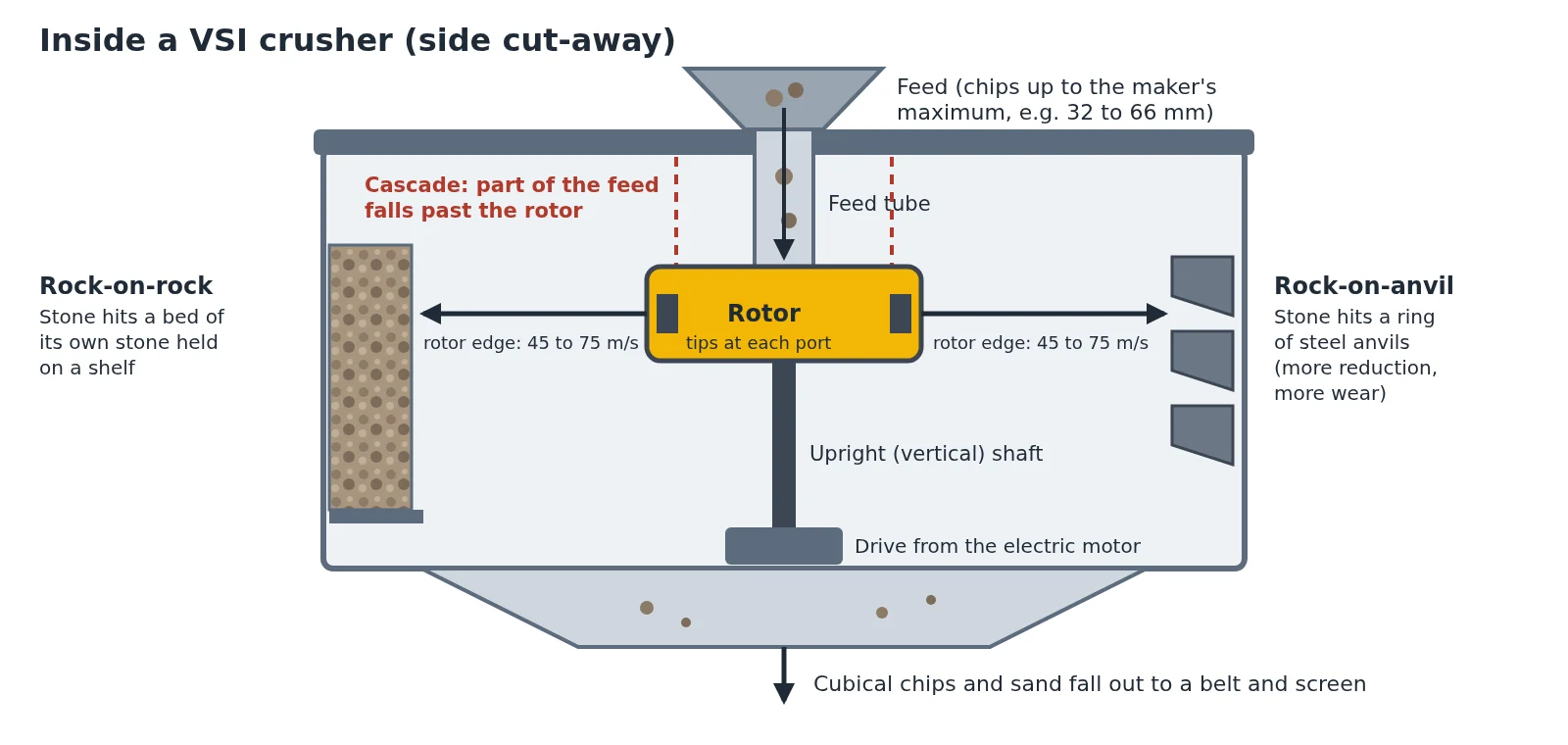
A VSI crusher is an impact crusher with an upright shaft. A motor spins a closed rotor on that shaft, stone is fed into the middle of the rotor from above, and the rotor flings it outwards into the crushing chamber that rings it.
It is a different machine from the two crushers before it in a plant. A jaw crusher and a cone crusher break stone by squeezing it between steel surfaces. A VSI uses speed. Wikipedia’s article on crushers explains the difference well: rock has natural cracks all through it, and when it is thrown hard against a surface it splits along those cracks, so the pieces come out even and cubical. Squeezed rock breaks less predictably and gives more flat and long pieces.
That is the whole reason a plant buys one: shape, and sand from small chips. It does little of the size reduction. Puzzolana, the Hyderabad crusher maker, describes its VSI range as the preferred choice for third or fourth stage crushing, and Metso says its Barmac VSI crushers are applied in the last crushing phase in most cases.
There is also a horizontal shaft impactor (HSI), which hits the stone with hammers fixed on a rotor that turns on a flat shaft. The HSI is a bigger-reduction machine for softer stone such as limestone; the VSI is the shaping machine.
How does a VSI crusher work?
The working principle has five steps, and they follow the path of one stone.
- Stone from the screen or the cone crusher drops down the feed tube in the middle of the crusher’s roof.
- It lands in the centre of the rotor, a closed, drum-shaped wheel with three, four or five openings (called ports) round its edge.
- The spinning rotor carries the stone outwards and throws it out through the ports. Metso says stone can leave its Barmac rotor at up to 80 m/s (262 feet a second).
- The stone hits the wall of the crushing chamber, which is either a bed of stone held on a shelf (rock-on-rock) or a ring of steel anvils (rock-on-anvil), and breaks along its cracks.
- The broken stone falls out under the crusher onto a belt that takes it to a screen. Pieces that are still too big are sent back for another pass.
Inside a rock-on-rock rotor, stone also packs into pockets along the rotor’s inner walls. That packed stone takes most of the rubbing, so the stone in flight is mostly wearing against other stone. Metso calls this autogenous crushing, meaning the feed is used to crush itself.
Many VSI crushers have a second way in, called the cascade. A share of the feed is let down around the outside of the rotor, so it falls as a curtain and is hit by the stone flying out of the rotor. Metso says the cascade lets the operator trade off output and power use and adjust the grading and shape of the product. Propel, the Coimbatore crusher maker, offers a similar parallel flow system on its AVVI series, which it says raises capacity and gives fewer very fine particles.
If your plant has more fines than it can sell, opening the cascade is one of the first adjustments to try.
Rock-on-rock or rock-on-anvil: which should you use?
Use rock-on-rock when shape is what you sell and wear cost matters most. Use rock-on-anvil when you need more size reduction, finer sand or a coarser feed broken down.
In the rock-on-rock chamber, stone builds up on a shelf round the wall and forms a bed. Thrown stone hits that bed, so stone wears against stone. In the rock-on-anvil chamber, the bed is replaced with a ring of steel anvils (Metso calls it an anvil ring), and thrown stone hits steel. Wikipedia calls the anvil kind a shoe and anvil VSI.
Metso, whose Barmac B Series comes as rock-on-rock with anvils as an option, puts the trade-off plainly. Rock-on-rock needs less energy and wears less, and it says that, applied correctly, it gives the lowest wear cost per tonne of any impact crushing method. Anvils give a bigger reduction and finer product, but wear costs rise a little because the anvils must be replaced from time to time.
| Rock-on-rock (autogenous) | Rock-on-anvil (shoe and anvil) | |
|---|---|---|
| What the stone hits | A bed of its own stone on the chamber wall | A ring of steel anvils |
| Reduction ratio (feed size to product size) | 2:1 to 5:1 | 6:1 to 8:1 |
| Rock hardness | Soft to very hard | Medium hard to very hard |
| Abrasive rock | No limit | Slightly abrasive |
| Moisture | Dry or wet, not sticky | Dry or wet, not sticky |
| Wear cost | Lowest; parts last longer | A little higher; anvils are replaced from time to time |
| Best for | Shaping chips, sand from hard abrasive rock such as granite and basalt | Finer sand, more reduction, coarser feed |
Ratios, hardness, abrasion and moisture are from the crusher selection table in Wikipedia’s article on crushers. The wear and energy points are from Metso.
A reduction ratio of 4:1 means stone of about 40 mm comes out at about 10 mm. Compare that with a horizontal shaft impactor, which the same table puts at 10:1 to 25:1. A VSI does little of the size reduction in a plant. It finishes the stone.
You are not always locked into one. Propel’s bigger AVVI models take either a rock-on-rock or a rock-on-anvil cartridge, Metso fits anvils to its Barmac on request, and Puzzolana describes its VSI range as built for rock on rock and rock on metal.
What size stone can a VSI take, and how much does it make?
Indian VSI crushers take a feed of about 20 to 66 mm and make roughly 40 to 730 tonnes an hour, depending on the model. The feed limit matters more than the output: stone bigger than the rotor’s ports can take blocks the rotor and wears it fast, so the cone crusher and screen ahead of it must keep the feed under the limit.
| Maker and model | Maximum feed | Capacity | Rotor diameter | Rotor speed | Motor | Chamber |
|---|---|---|---|---|---|---|
| Propel AVVI 55 (smallest) | 32 mm | 40 to 80 TPH | 680 mm | 45 to 60 m/s | 55 kW (75 hp) | Rock-on-rock |
| Propel AVVI 160 | 43 mm | 130 to 190 TPH | 710 mm | 45 to 70 m/s | 160 kW | Rock-on-rock |
| Propel AVVI 190 | 58 mm | 120 to 260 TPH | 880 mm | 45 to 70 m/s | 187 kW (250 hp) | Rock-on-rock or rock-on-anvil |
| Propel AVVI 630 (largest) | 66 mm | 530 to 730 TPH | 990 mm | 45 to 75 m/s | 2 x 315 kW (2 x 425 hp) | Rock-on-rock or rock-on-anvil |
| Puzzolana PMVSI 500 (smallest) | 20 to 25 mm | 50 to 90 TPH | Not specified | Not specified | Not specified | Rock on rock or rock on metal |
| Puzzolana PMVSI 750 MDR | 25 to 40 mm | 160 to 250 TPH | Not specified | Not specified | Not specified | Rock on rock or rock on metal |
| Puzzolana PMVSI 950 MDR (largest) | 25 to 45 mm | 350 to 400 TPH | Not specified | Not specified | Not specified | Rock on rock or rock on metal |
Propel’s figures are from its vertical shaft impactor page, which notes that capacity varies with the application. Puzzolana’s are from its vertical shaft impact crusher page, which lists seven models. Propel’s AVVI weights run from 4,200 kg (4.2 tonnes) for the AVVI 55 to 15,400 kg (15.4 tonnes) for the AVVI 630, so even the biggest of them is lighter than Propel’s AVJ 811 jaw crusher, which weighs 20,700 kg.
Two things to notice in the table. First, capacity bands overlap and are wide, because output depends on the rock, the feed grading, how much goes through the cascade and how fine you want the sand. Second, power climbs fast with size: the largest Propel model runs two 315 kW motors. A VSI is usually run on grid power; if your site has only diesel, the guide to generator size calculation shows how to size a set for big electric motors. How tonnes an hour add up across a whole plant is in the guide to crusher plant capacity.
How does rotor speed change the sand?
Faster rotor, finer and better-shaped product, more wear. Makers quote rotor speed as tip speed, the speed of the rotor’s edge in metres a second, and Propel’s range of 45 to 75 m/s means the stone is hit far harder at the top of that range than the numbers suggest.
The reason is simple physics. The energy a flying stone carries is half its mass times its speed squared. So:
| Rotor diameter | Tip speed | Rotor rpm | Energy per kg of stone |
|---|---|---|---|
| 880 mm | 45 m/s | about 977 rpm | about 1,010 joules |
| 880 mm | 70 m/s | about 1,519 rpm | about 2,450 joules |
| 990 mm | 75 m/s | about 1,447 rpm | about 2,810 joules |
| 680 mm | 60 m/s | about 1,685 rpm | about 1,800 joules |
How we worked it out: rpm = tip speed x 60 / (3.1416 x rotor diameter in metres); energy per kg = tip speed x tip speed / 2. These are the speeds of the rotor’s edge, so treat them as a guide to how the settings compare, not as the exact speed of every stone.
Going from 45 to 70 m/s on the same 880 mm rotor puts about 2.4 times as much energy into every kilogram of stone. That is why speed is the main dial on a VSI. Turn it up and you get more sand and better shape from the same feed, but the tips and wear plates also wear faster and the motor draws more power. Turn it down for chips where you want fewer fines. Metso notes that its Barmac speed is adjustable for exactly this reason, so the crusher can make very fine products when needed.
Ask the maker how speed is changed on your model, and over what range, before you plan on adjusting it.
What are the wear parts in a VSI crusher?
The parts that wear are the ones the stone touches at speed: the rotor tips, the wear plates inside and round the rotor, the feed tube, and the anvils if the crusher has them. Metso lists these wear parts for its Barmac VSI crushers:
| Wear part | Where it sits and what it does |
|---|---|
| Rotor tip sets and back-up tips | At each port, where the stone leaves the rotor at full speed |
| Tip and cavity wear plates | Round each port, protecting the rotor body |
| Upper and lower wear plates; top and bottom lipped wear plates | Lining the inside of the rotor |
| Feed tube and feed eye ring | Guiding the stone down into the centre of the rotor |
| Trail plates | Inside a rock-on-rock rotor, where the packed bed of stone builds up |
| Anvil ring and anvils | Round the chamber wall, on rock-on-anvil machines only |
Google in India suggests “vsi crusher tips” among the first searches for this machine, and for good reason: the tips take some of the hardest wear in the machine. Three habits help them last:
- Keep the feed under the maker’s maximum size. Oversize stone hammers the tips and can crack them.
- Look at the tips and wear plates at every planned stop, and log the hours, so you learn how long a set lasts on your rock.
- Fit tips as the matched set the maker sells, never one at a time. A rotor turning at around 1,500 rpm with one side heavier than the other shakes, and that shaking reaches the bearings.
The wear on a rock-on-rock machine is mostly in the rotor; on an anvil machine the anvils add a second wear item. How jaw plates, cone liners and blow bars wear on the other crushers in the plant is covered in the guide to crusher wear parts. No part prices are given here; ask the maker or dealer for a cost per tonne on your own rock.
VSI vs cone crusher: when do you need a VSI?
You need a VSI when your buyers pay for shape or for crushed sand. If you sell only rough metal for fill or sub-base, a jaw and a cone are usually enough.
A cone crusher squeezes stone, so it makes more of the reduction but gives more flat and long pieces, especially at fine settings. The VSI comes after it and fixes the shape. This is what buyers mean by VSI aggregate against non-VSI aggregate: chips that have been through a VSI are cubical, and chips straight off a cone can be flaky. Propel says the better shape from its VSI fills the gaps between stones better, so concrete needs less cement, and that its machine produces shapes as per the Ministry of Road Transport and Highways (MoRTH) standards. Concrete and road jobs that check shape are where VSI chips earn more.
Crushed sand (manufactured sand, or M-sand) is the other big reason. Metso says its Barmac crushers accept fines in the feed and shape accurately, which makes them suitable for sand. In a sand line the VSI is followed by a screen and often a sand washer. How M-sand differs from quarry dust, and the limits on fine dust in sand, are explained in the guide to quarry dust and M-sand.
A VSI is not the only way to make sand. Puzzolana also sells a fine cone crusher it calls the Sander, built for manufactured sand, in sizes from 55 to 250 tonnes an hour. A fine cone suits some rocks and some buyers; ask a maker to test your stone in both if sand is the main product.
The full comparison of jaw, cone and VSI, stage by stage and by rock type, is in the guide to jaw crusher vs cone crusher vs VSI.
What should you check before buying or running a VSI crusher?
Start from what you will sell and the rock you have, then match the machine. Work through these in order:
- Decide what you will sell: shaped chips, sand or both. Sand from hard rock points to a rock-on-rock machine with room to switch to anvils.
- Match the chamber to your rock’s hardness and abrasion (Table 1). Sticky, clayey feed is a problem for any VSI, so wash or screen it out first.
- Check the largest stone your cone and screen will send against the maker’s maximum feed (Table 2).
- Size the tonnes an hour from the stage before it, remembering that part of the flow may go round the VSI. On hard rock, expect the lower end of the maker’s band.
- Find out the motor rating and whether your grid line can take its starting current.
- Ask how rotor speed is changed and what range you get.
- Ask which parts wear first, how long they last on rock like yours, and whether the maker stocks them near you.
- Ask how the roof opens and how the rotor is lifted out. Metso’s Barmac has an inspection door, a roof lifter and a rotor service arm, and Propel offers a roof lifting mechanism as an option.
- Plan the dust control, and a sand washer if you sell washed sand.
A VSI does not work on its own. Wheel loaders keep the surge bin and stockpiles moving and load the finished sand into trucks, and excavators feed the primary crusher at the start of the line. Browse the range of wheel loaders and the range of excavators, or read how a mobile crusher compares with a stationary plant if you are still deciding the layout. The money side of a crushing unit is in the blog on stone crusher business profit, and buying on credit is covered under construction equipment finance. More guides are in the crusher guide section.
Sources: Propel AVVI figures, the parallel flow system, the roof lifter, the cement and MoRTH points are from Propel Industries’ vertical shaft impactor page, and the AVJ 811 weight from its Profast jaw page, read in November 2026. Puzzolana PMVSI and Sander figures are from Puzzolana’s vertical shaft impact crusher and Sander pages, read in November 2026. Rock-on-rock and anvil crushing, the 80 m/s rotor exit speed, the cascade, wear cost and applications are from Metso’s Barmac B Series page and Barmac B7150SE page (dated November 2022 by Metso); the wear part list is from Metso’s impact crusher parts page. The selection table and the cracks explanation are from Wikipedia’s article on crushers. The rpm and energy figures in Table 3 are our own arithmetic.
Prices, specifications and features are indicative, vary by variant, location and date, and should always be confirmed with the official OEM or authorised dealer before any purchase decision. DesiMachines is not liable for decisions taken on the basis of information that may have changed after publication.