
 Excavator
294 models
Excavator
294 models  Backhoe Loader
51 models
Backhoe Loader
51 models  Crane
68 models
Crane
68 models  Concrete Mixer
79 models
Concrete Mixer
79 models  Wheel Loader
54 models
Wheel Loader
54 models  Compactor / Roller
45 models
Compactor / Roller
45 models  Motor Grader
42 models
Motor Grader
42 models  Concrete Pump
66 models
Concrete Pump
66 models  Skid Steer Loader
11 models
Skid Steer Loader
11 models  Telehandler
13 models
Telehandler
13 models  Dozer
Dozer 


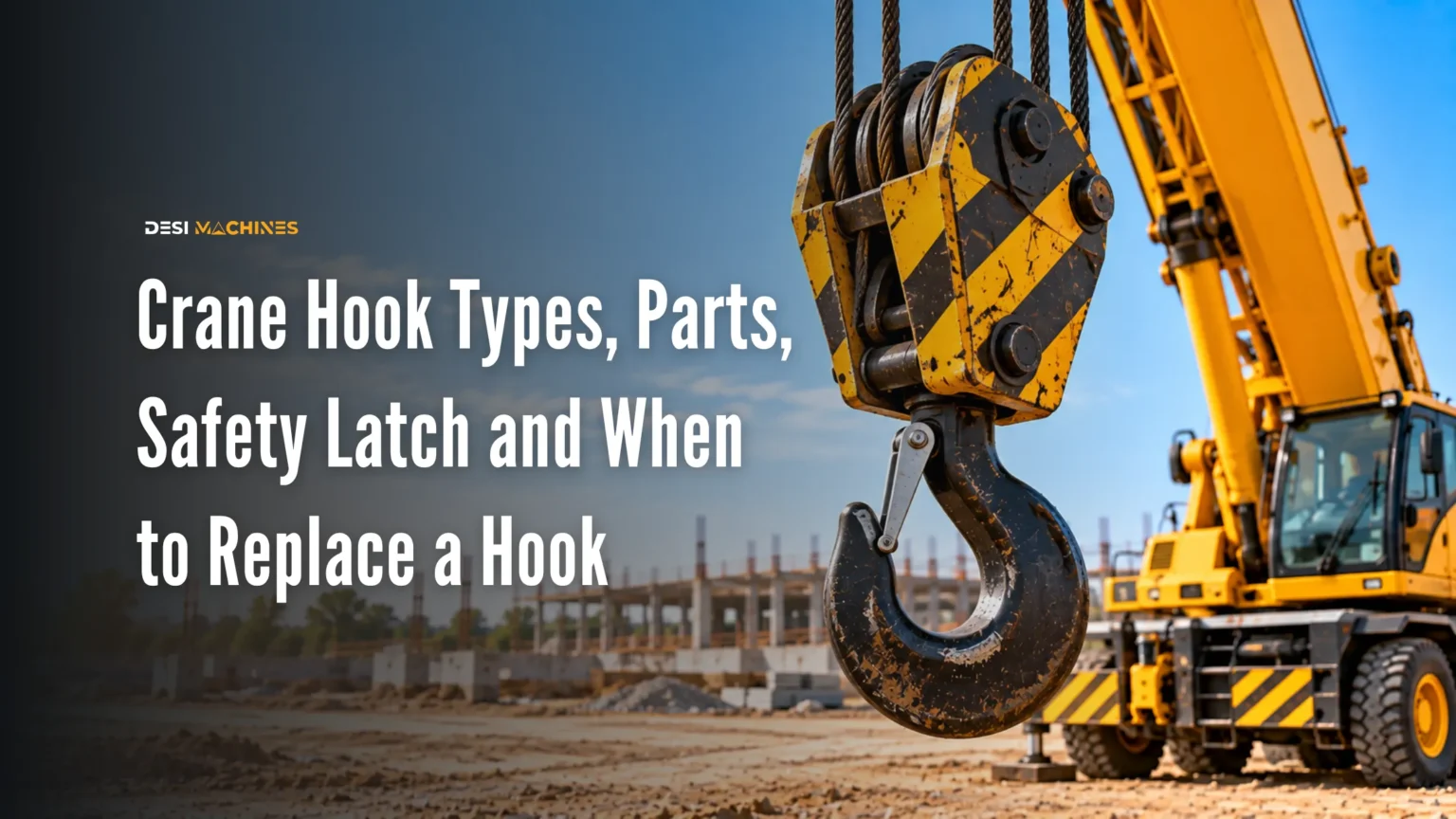
A crane hook comes in two basic types: a single hook with one point, which is what hydra cranes and most mobile cranes carry, and a double or ramshorn hook with two points, used on heavier cranes. On a hydra the hook hangs from a hook block with pulleys, turns on a bearing, and carries a spring-loaded safety latch across its mouth. A hook must come off the crane when its throat has opened more than 5% (up to a maximum of 6 mm), when it is visibly twisted, or when wear has taken away more than 10% of the metal, under the US hook standard ASME B30.10.
The hook is the last piece of steel between the crane and the load, and it is inspected less often than the rope above it. This guide explains the hook types and parts, what the marks on a hook mean, what the latch is for, and the signs that a hook has done its work. How the hook block, sheaves and rope falls work on a hydra is already covered in hydra crane parts explained, so it is kept short here.
What are the types of crane hook?
Hooks are grouped two ways: by how many points they have, and by how they attach to the crane.
| Type | What it looks like | Where you see it |
|---|---|---|
| Single hook | One curved point; the German standard DIN 15401 covers it | Hydra and Farana cranes, truck cranes, most mobile cranes |
| Double or ramshorn hook | Two points back to back, so the load splits across both; covered by DIN 15402 | Heavier cranes, where slings can hang evenly on each side |
| Shank hook | A straight threaded stem rises from the hook and is held by a nut | Inside a hook block, where the stem passes through the crosshead |
| Eye hook | A closed eye at the top instead of a stem | On sling and chain ends, and on some small hoists |
| Swivel hook | An eye or shank on a swivel, so the hook turns freely | Rigging where the load must be turned by hand |
| Self-locking hook | The latch locks shut and must be released by hand to open | Where a sling must not come off by accident |
On a hydra, the working hook is normally a single shank hook with a latch, fitted in the hook block. A single hook is enough for the way most hydra lifts are rigged, with one or two sling legs gathered at one point.
What are the parts of a crane hook?
People searching for a crane hook drawing usually want the names of the parts. From top to bottom:
- Shank or eye: the part that connects the hook to the block or to a sling.
- Back: the outer curve, where the metal is thickest.
- Saddle or bowl: the bottom of the curve, where the sling actually sits and the load acts. This is where wear shows first.
- Throat: the opening between the point and the shank. It is the dimension you measure to check whether the hook has stretched.
- Point or tip: the free end of the hook.
- Safety latch: the spring-loaded gate that closes the throat.
In a hook block, the shank passes up through a crosshead and is held by a nut resting on a thrust bearing. That bearing lets the hook turn under load, so the load can be lined up without twisting the rope. Above it sit the sheaves (pulleys) that the wire rope runs over; more lines of rope through the block means more lifting power at a slower hook speed.
What is the safety latch on a crane hook for?
The latch stops a sling, shackle or chain from jumping out of the hook when the load goes slack, bounces or is set down unevenly. It is not built to carry load. A sling that rests on the latch is a sling that is about to slip off.
Check it every shift: it should spring shut on its own and close the throat fully. A latch that is bent, missing, jammed open or tied back with wire is a common sight on Indian sites, and it removes the one thing keeping a slack sling on the hook. ASME B30.10 treats a damaged latch that no longer closes the throat as a reason to take the hook out of service, where a latch is required. The crane safety rules guide puts the hook and latch on the every-shift checklist.
What do the marks stamped on a crane hook mean?
A hook should carry, forged or stamped into it, the maker’s name or mark and its rated load. Hooks made to the DIN standards also carry a hook number, which fixes its size, and a strength class; DIN 15402 ramshorn hooks come in classes M, P, S, T and V. Many hooks also show a heat or batch number so the steel can be traced back to its test certificate.
If the maker’s mark or the rated load can no longer be read, ASME B30.10 says the hook comes off. A hook with no rating cannot be matched to the crane’s load chart, and the load chart guide explains why the hook block’s own weight must be counted as part of the load.
When should a crane hook be replaced?
The removal criteria in ASME B30.10 are the most widely used checklist:
| Check | Take the hook out of service when |
|---|---|
| Throat opening | It has opened by more than 5% of the original, and never more than 6 mm (1/4 inch), unless the maker sets a different limit |
| Twist or bend | Any bend or twist you can see from the flat plane of the hook |
| Wear | More than 10% of the original section is worn away, usually at the saddle, or on the load pin |
| Cracks and damage | Any crack, nick or gouge; heavy pitting or rust |
| Latch and locking | A damaged latch that does not close the throat; a self-locking hook that does not lock |
| Heat and changes | Signs of heat, any welding, drilling, grinding or other changes |
| Threads and fixing | Worn or damaged shank threads; a loose or missing nut or retaining pin |
| Markings | Maker’s mark or rated load missing or unreadable |
The throat check only works if you know where you started. When a hook is new, or when you take over a machine, measure the throat opening and write it in the crane’s register, or punch two small marks across the throat and record the gap between them. A throat that has grown is a hook that has been overloaded or side-loaded, even if nobody admits it.
Also turn the hook by hand with no load on it. It should swivel freely and without grinding. A hook that sticks or wobbles points to a worn or dry thrust bearing; the greasing guide lists the hook block among a hydra’s grease points. Never heat a hook to bend it back, weld a crack, or grind out a gouge. A stretched or cracked hook is replaced, not repaired. Indian rules also expect lifting machines and tackle to be examined by a competent person at least once every twelve months.
What does a hydra crane hook cost?
Very few sellers list a price for a hook made for hydra cranes. In listings we checked on IndiaMART on 29 September 2026, a 6-ton hydra crane hook (hook only, painted mild steel) was listed at ₹2,600, and a hydra crane hook of about 10 inches with a latch, in EN8 carbon steel, at ₹4,000; that second listing gave conflicting load figures, so ask for the rated load in writing. Complete hook blocks with sheaves for hydras were not openly priced, and the many overhead (EOT) crane hooks on the same pages are a different product, so they are left out.
When you buy a replacement hook, match the rated load and the shank size of the old one, insist on a test certificate, and have the crane examined before it lifts again.
This is a general guide based on machine size class. Always confirm the fit with your machine’s operator manual or the manufacturer before buying or fitting.
For the machines, see hydra cranes, the used hydra crane buying guide for checking the hook on a second-hand machine, and the full crane guide.
Prices, specifications and fitments are indicative, vary by maker, model, city and date, and should be confirmed with the manufacturer or an authorised dealer before buying. DesiMachines is not liable for decisions taken on the basis of information that may have changed after publication.