Excavator
316 models
 Backhoe Loader
54 models
 Crane
68 models
 Concrete Mixer
79 models
 Wheel Loader
65 models
 Compactor / Roller
45 models
 Motor Grader
42 models

 Concrete Pump
66 models
 Skid Steer Loader
11 models


If a hydraulic rotary piling rig, 23 tonnes even in its smallest common size, will not fit on your plot or will not pay for a handful of piles, the holes can still be bored by DMC piling. In DMC piling a tripod, a winch, a heavy chisel and a mud pump do the work, and bentonite slurry pumped down through hollow drill rods carries the broken soil back up and out of the hole.
DMC stands for direct mud circulation. The Indian code for bored piles, IS 2911 (Part 1/Sec 2):2010, names it in clause 5.3 as one of the ways a pile hole is bored, beside rotary rigs and reverse circulation. Published method descriptions for Indian sites pitch it at cramped plots, such as industrial and power plants crowded with pipelines, where a big rig cannot reach.
This guide is for a site engineer, a builder or a small contractor who has a piling drawing in hand and a DMC offer on the table. It explains how the rig works, the equipment it needs, the method step by step, the numbers IS 2911 sets at each stage, what goes wrong in a DMC bore and how to spot it, and when a hydraulic rotary rig is the better choice. No prices are quoted here; what a pile costs per metre is built up in the guide to the piling rate per meter.
What is DMC piling, and how does it work?
DMC piling is a way of boring the hole for a bored cast-in-situ pile. IS 2911 defines that pile as one formed by boring a hole in the ground, holding the hole open with a steel casing or with drilling mud, and then filling it with reinforced concrete. DMC is the boring part, and it uses drilling mud.
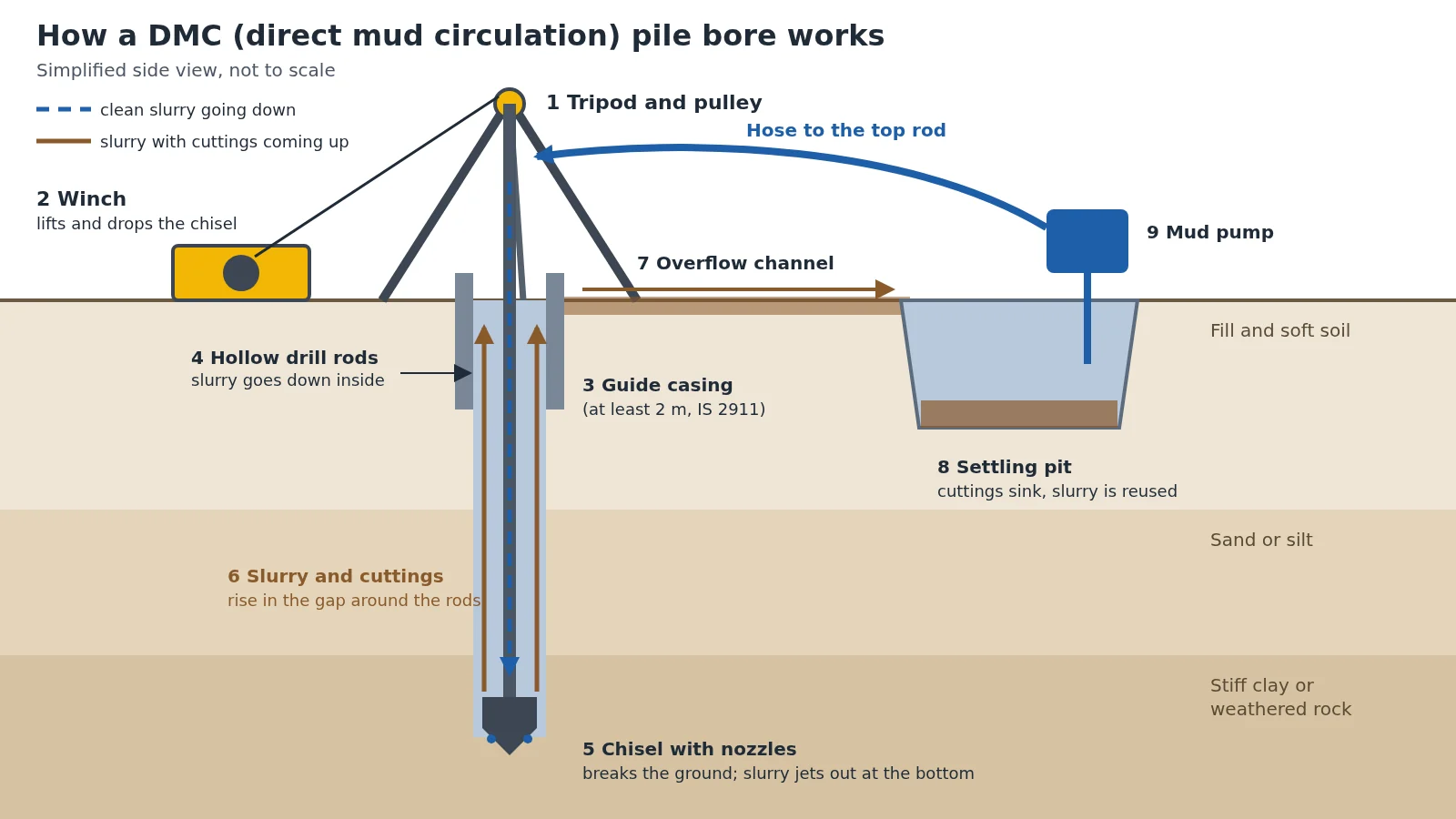
The boring itself is percussion. A heavy steel chisel hangs from a wire rope that runs over a pulley at the top of a three-legged tripod and down to a winch. The winch lifts the chisel and lets it drop, again and again, and each blow breaks up the soil or soft rock at the bottom of the hole. The chisel is screwed to the bottom of a string of hollow drill rods, and the crew adds one more rod each time the hole goes deeper.
The circulation is what gives the method its name. A mud pump sits in a pit of bentonite slurry, a mix of a special clay and water. A hose carries the slurry to the top rod, it travels down inside the rods, and it shoots out through small nozzles in the chisel at the bottom of the hole. The hole fills up, and the slurry rises in the gap between the rods and the wall, picking up the broken soil on the way. At the top it overflows the guide casing into a small channel, which leads it to a settling pit. There the heavy cuttings sink, and the cleaner slurry goes back to the pump to make the trip again.
The slurry does a second job, and it matters as much as the first. It holds the walls of the hole up. Annex D of IS 2911 explains why: bentonite is thixotropic, which means it behaves like a liquid while it is moving and sets into a soft jelly when it is left still. In sand, the slurry pushes a little way into the wall and forms a thin skin that seals it, which the code calls a plastering effect. In clay it does not soak in, and the weight of the column of slurry in the hole is what holds the wall.
Direct circulation has a twin, reverse circulation. In the reverse method the slurry runs down the outside of the drill pipe and comes back up inside it, pulled by a suction pump or lifted by compressed air blown into the pipe. Liebherr, which builds rigs for deep foundations, describes the reverse method for bores up to about 3.2 m across, with the cuttings carried up inside the drill rod. For small piles, the direct method needs nothing more than the pump and the rods already on site.
What equipment does a DMC piling rig use?
A DMC rig is a set of separate pieces brought to site on a truck, not one machine. Table 1 lists what a crew sets up for each pile and what is worth checking on each item.
| Item | What it does | What to check on site |
|---|---|---|
| Tripod with pulley | Holds the pulley over the pile centre. A plumb bob hung from the pulley marks the centre. | Legs on firm, level packing; plumb bob on the pile mark |
| Winch | Lifts and drops the chisel, lifts the rods out, and lowers the cage and the tremie pipe | Wire rope not frayed or kinked; brake holds the load |
| Chisel | Breaks the soil or soft rock with its weight; slurry jets out of its nozzles | Width matches the pile diameter on the drawing; nozzles open |
| Hollow drill rods (wash pipe) | Carry the slurry down to the chisel; added one by one as the hole deepens | Joints tight and not leaking at the top of the hole |
| Guide casing | Steel pipe at the top of the hole that stops loose top soil falling in and keeps the chisel on line | At least 2 m long (IS 2911 cl 8.1.3), plumb and centred |
| Mud pump and hose | Pumps slurry from the pit into the top rod, and mixes fresh bentonite with water | Delivers enough flow to lift the cuttings out of the hole |
| Mixing pit, channel and settling pit | Store, carry back and clean the slurry | Room on the plot; a way to dispose of the settled spoil |
| Tremie pipe with hopper | Carries concrete to the bottom of the hole under the slurry | Watertight joints; diameter right for the aggregate (Table 2) |
| Slurry test kit | Mud balance for density, Marsh cone for thickness, pH paper | On site and used before every concrete pour |
The rig never works alone. The pits have to be dug and the settled spoil has to be loaded out, which is work for a backhoe loader such as the JCB 3DX. Concrete has to arrive without a break, so a pour is usually planned around one or more transit mixers; how they work is in the guide to the transit mixer. Where the cages are long or heavy, a pick-and-carry crane lowers them. The ACE FP 210 Piling Crane is one built for that side of the work, listed with a 20-tonne maximum lifting capacity.
How a DMC rig sits beside the other families of drilling machine, rotary, DTH and core rigs, is set out in the guide to types of drilling rigs.
What is the DMC piling method, step by step?
The order below follows IS 2911 (Part 1/Sec 2):2010, clauses 8.1 to 8.4 and Annex D. Your structural drawings and the engineer-in-charge set the pile diameter, the depth and the founding level; the method is how the crew gets there.
- The pile centre is marked from the drawing, the tripod is stood over it, and the plumb bob from the pulley is brought onto the mark.
- A steel casing is driven or set at the top of the hole, centred and plumb. The code asks for at least 2 m of temporary casing on every bored pile, and more where the top soil is loose fill or the ground water is high (clause 8.1.3).
- The channel and the settling pit are dug, and bentonite is mixed with fresh water, using the pump to circulate it (Annex D-3).
- The chisel goes down with the pump running, and rods are added as the hole deepens. The crew notes the depth at which each soil layer changes and how long the chisel works in rock, because the code asks for a record of boring and chiselling for every pile.
- Once the hole is at the depth the engineer has fixed, the heavier loose material at the bottom is removed with a cleaning tool.
- The reinforcement cage goes down centred in the hole, followed by the tremie pipe.
- Fresh bentonite slurry is pumped down through the tremie until coarse material stops coming up with the overflow (clause 8.3.1). The slurry in the hole must be brought down to a density of 1.12 g/ml or less before concreting (Annex D).
- A plug in the tremie keeps the first concrete apart from the slurry. Concrete is poured into the hopper, the plug is released, and the concrete fills the hole from the bottom up, pushing the slurry up and out to the pit. The tremie stays at least 1 m inside the rising concrete the whole time (clause 8.4).
- Concrete is taken up to ground level, or at least 1 m above the cut-off level, so the weak top layer can be cut away later (clause 8.4.4). The temporary casing is then pulled out.
Which tool breaks which ground, and what a crew does when the chisel meets hard rock, is covered in DTH piling vs rotary piling.
What does IS 2911 ask for at each stage of a DMC pile?
IS 2911 (Part 1/Sec 2):2010 is the Indian code for bored cast-in-situ concrete piles. Table 2 gathers the figures a site engineer checks on a DMC pile, with the clause for each, so you can hold your method statement against the code. The full set of slurry limits (liquid limit, viscosity, pH) and the MoRTH bridge limits beside them are in the guide to bentonite in piling.
| Stage | What the code says | Clause |
|---|---|---|
| Pile size | Minimum pile diameter 450 mm; 600 mm or less is a small diameter pile | 3.6 |
| Guide casing | At least 2 m of temporary casing on every bored pile | 8.1.3 |
| Position, piles up to 600 mm | Off the design position by no more than 75 mm or D/6, whichever is less | 8.1.2 |
| Position, piles over 600 mm | No more than 75 mm or D/10, whichever is more | 8.1.2 |
| Verticality | Tilt no more than 1.5 percent for a vertical pile | 8.1.2 |
| Slurry before concreting | Density brought down to 1.12 g/ml or less (fresh slurry 1.03 to 1.10 g/ml) | Annex D-3 |
| Concrete | Grade M 25 or above; cement at least 400 kg per m³ (not below 350 kg with a proper mix design and admixture); slump 150 to 180 mm | 7.3 |
| Tremie size | At least 200 mm across for 25 mm aggregate, at least 150 mm for 20 mm aggregate; 200 mm preferred for piles over 600 mm | 8.4(c) |
| Tremie in the concrete | Always at least 1 m inside the concrete in the hole | 8.4(e) |
| A break in the pour | Resume within 1 or 2 hours; the tremie stays in the concrete and is raised and lowered meanwhile | 8.4.1 |
| Top of the pour | Up to ground level, or at least 1 m above cut-off level when placed by tremie | 8.4.4 |
The position rule is tighter on small piles than it first looks. As our own arithmetic: on a 450 mm pile, D/6 is 75 mm, so the limit is 75 mm. On a 600 mm pile, D/6 is 100 mm, but the code takes the smaller figure, so the limit is still 75 mm. Above 600 mm the code switches to the larger figure, so a 1,000 mm pile may be up to 100 mm out. Check your method statement against clause 8.1.2: some copies in circulation print D/2, which would let a 600 mm pile sit 300 mm off its mark.
The 150 to 180 mm slump is far wetter than the concrete in a slab or column, because tremie concrete has to flow and settle under its own weight with no vibrator. How the slump cone test is done on site is explained in the guide to the slump test.
What goes wrong in a DMC bore, and how do you spot it?
Most DMC problems show up first in the slurry or in the depth readings, long before anything is visible in the finished pile. Table 3 lists the common ones, each tied to what IS 2911 says about it.
| Problem | The sign | What to do |
|---|---|---|
| Wall caving in loose sand or soft layers | The chisel stops short of a depth already reached; far more spoil in the pit than the hole should give | IS 2911 cl 5.3 warns that lifting tools in loose sand can suck the ground in; lift with care, keep the slurry level up, and ask the engineer about a longer casing (cl 8.1.3) |
| Slurry losing into the ground | The level in the hole or the pit drops suddenly | Stop and top up; loose gravel and open rock joints can take far more slurry than normal |
| Slurry too heavy | Mud balance reads well above the fresh-mix figure; contaminated slurry can rise to 1.25 g/ml (Annex D) | Keep flushing with fresh slurry until it reads 1.12 g/ml or less before concreting |
| Chisel stuck on rock or a boulder | Depth gained per hour falls sharply | Record the chiselling time for the pile; for long rock sockets compare a DTH or rotary rig |
| Tremie pulled out of the concrete | The level of concrete in the hole does not rise as the hopper empties | Re-insert the tremie 60 to 100 cm into the old concrete before resuming (cl 8.4.2) |
| Concrete supply stops mid-pour | Gap between transit mixers | Resume within 1 or 2 hours; keep the tremie in the concrete and move it up and down (cl 8.4.1) |
A pile that ends up outside the position or verticality limits is a matter for the designer. The code says such piles are replaced or supplemented by extra piles where a redesign of the pile cap cannot take up the error (clause 8.1.2).
DMC or hydraulic rotary rig: which should you choose?
The job decides, not the method. Table 4 sets the two side by side. The rotary rig figures come from the SANY India range quoted in the guide to piling rig specifications.
| Point | DMC (tripod and winch) | Hydraulic rotary rig |
|---|---|---|
| How it breaks the ground | Chisel dropped by a winch (percussion) | Auger or bucket turned on a kelly bar |
| How the cuttings come out | Carried up by the circulating slurry | Lifted out in the bucket or on the auger, pass by pass |
| Bentonite | Needed on every pile; it carries the cuttings | Needed in loose or wet ground; casing alone may do in firm clay |
| Size on site | Tripod, winch, pump and pits; brought in on a truck | A tracked machine of about 23 tonnes in the smallest SANY size, over 160 tonnes in the largest |
| Pile diameter | Set by the chisel the contractor owns | Up to 1.1 m on the smallest SANY rig and 3.0 m on the largest |
| Ground it needs to stand on | Light; works on tight and cluttered plots | A firm, level working platform for a heavy machine |
DMC makes sense when the plot is tight, when the piles are few and small, or when pipes, buildings or overhead lines leave no room for a heavy machine, as in industrial and power plants. It needs more hands, more slurry and more space for pits, and its pace depends on the crew.
A rotary rig makes sense for a long programme of piles, for large diameters, and where the bored spoil has to be handled cleanly. Bringing a tracked machine of that weight to site costs far more than bringing a tripod set on a truck, so a rotary rig pays back only over many metres of pile. How a tripod rig, a rotary rig and a DTH rig each move the rate per metre is worked through in the guide to the piling rate per meter, and what bentonite adds to each pile is in the guide to bentonite price.
What should you check before you hire a DMC piling contractor?
- Start from the soil investigation report. It tells you where the loose sand, the water table and the rock are, and so how long the casing has to be and where chiselling will slow the job.
- Ask for the chisel sizes the contractor owns, and match them to the pile diameters on the drawing.
- Ask to see the slurry test kit, a mud balance and a Marsh cone at least, and who will use it before each pour.
- Check that the plot has room for the mixing pit, the channel and the settling pit, and agree where the settled spoil will go.
- Check the tremie diameter against the aggregate size in the concrete mix (Table 2).
- Agree the record sheet for each pile: depths of each layer, chiselling time, slurry readings and concrete quantity.
- Plan the concrete supply so the pour does not stop; line up enough transit mixers for the biggest pile.
The final say on diameter, depth and founding level stays with your structural engineer. The choice of method and contractor is yours.
Piling sites run on more than the rig. Compare the range of cranes for lifting cages and casing, and backhoe loaders for the pits and the spoil. More guides on boring and piling machines are in the drill rig section.
Sources: the definition of a bored pile, the boring methods, the casing, tolerance, cleaning, concrete and tremie rules and the bentonite requirements are from IS 2911 (Part 1/Sec 2):2010, clauses 3.4, 3.6, 5.3, 5.4, 7.3, 8.1, 8.3 and 8.4 and Annex D. The DMC equipment list and sequence agree with the method descriptions published by The Constructor and Build Construct, read November 2026. The reverse circulation figure is from Liebherr’s description of the method, read November 2026. Rotary rig figures are from SANY India’s piling rig pages as quoted in our piling rig specifications guide, and the ACE FP 210 lifting capacity from its model listing, checked November 2026. The tolerance examples are our own arithmetic.
Prices, specifications and features are indicative, vary by variant, location and date, and should always be confirmed with the official OEM or authorised dealer before any purchase decision. DesiMachines is not liable for decisions taken on the basis of information that may have changed after publication.