Excavator
294 models
 Backhoe Loader
51 models
 Crane
68 models
 Concrete Mixer
79 models
 Wheel Loader
54 models
 Compactor / Roller
45 models
 Motor Grader
42 models

 Concrete Pump
66 models
 Skid Steer Loader
11 models


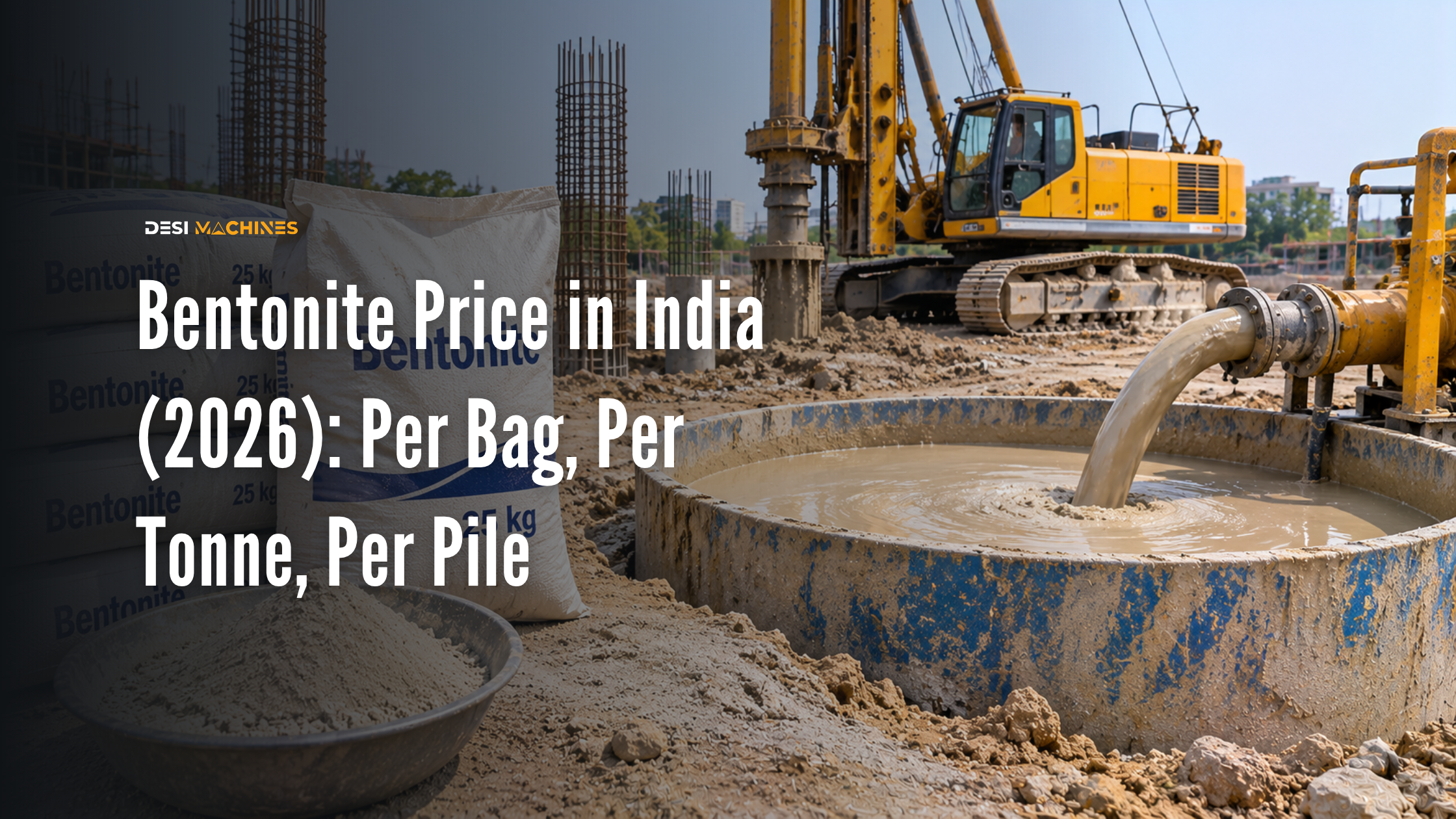
The bentonite price in India’s newest official rate books runs from about Rs 4,238 to Rs 6,050 a tonne for construction bentonite, which is Rs 4.24 to 6.05 a kg or roughly Rs 212 to 303 for a 50 kg bag, before freight (Tamil Nadu and Puducherry quote ex-GST); older Chhattisgarh and Haryana books list Rs 2,643 to 3,522. Kerala PWD’s October to December 2026 market rates list Rs 4,238.50 to Rs 5,000 a tonne, Tamil Nadu’s 2025-26 schedule Rs 6.05 a kg and Puducherry’s 2024-25 schedule Rs 6,000 a tonne. A bored pile uses about 50 kg for every cubic metre of concrete on the MoRTH data book norm, so a 600 mm pile takes about 14 kg a metre. No rate book prices API 13A or OCMA drilling grade.
How many bags of bentonite does a 600 mm bored pile take? About six 50 kg bags for a 20 m pile, if you use the norm in the MoRTH Standard Data Book. At the official rates below, that is roughly Rs 1,260 to 1,800 of bentonite for the whole pile.
That is small next to the rig’s day, which is why bentonite rarely gets its own line in a quote. Run short in loose sand, though, and the bore collapses.
Bentonite price in the official rate books
State public works departments publish basic material rates for estimating. Five carry a bentonite line; the per-bag column is our arithmetic at 50 kg a bag:
| Rate book and date | Item as listed | Official rate | Per 50 kg bag |
|---|---|---|---|
| Kerala PWD market rates, Oct-Dec 2026 (published 6-12 Oct 2026) | 7183 Bentonite, per tonne | Rs 4,238.50 (Trivandrum) to Rs 5,000 (Ernakulam) | about Rs 212 to 250 |
| Tamil Nadu SOR 2025-26 (from 22 Jul 2025) | M-0281 Bentonite powder for construction quality | Rs 6.05 a kg | Rs 302.50 |
| Puducherry PSR 2024-25 (from 14 Aug 2024) | 7183 Bentonite | Rs 6,000 a tonne | Rs 300 |
| Chhattisgarh WRD SOR (from 1 May 2025) | Bentonite | Rs 3,522 a tonne | about Rs 176 |
| Haryana HSR 2023 (premium date 1 Apr 2023) | B0071 Bentonite, per tonne | Rs 2,643 a tonne | about Rs 132 |
The Kerala figures are the newest, and Kozhikode and Thrissur both sit at Rs 4,500. The Tamil Nadu Schedule of Rates 2025-26 and the Puducherry rates exclude GST; Kerala’s table does not say. Haryana’s book also lists bentonite at Rs 3 a kg in its road materials, and one Uttarakhand block sheet (Roorkee, from 24 August 2024) lists Rs 55 a kg, about nine times Tamil Nadu’s rate. Treat a figure that far out as a question to ask, not a price to copy.
These are estimating rates, not quotes. Your price depends on the grade, the distance from the mine and the size of the order, and freight on a heavy, low-value powder can add a real share.
Which grade you are actually buying
Tamil Nadu’s item says construction quality, and the other books name no grade at all. None of them names or prices API 13A or OCMA drilling grade, which oilfield and HDD buyers often specify. If your contract calls for that grade, the price comes from your supplier.
Trade data shows how wide the spread between grades can be. The Indian Bureau of Mines’ Indian Minerals Yearbook 2024 records 16,60,359 tonnes of bentonite exported in 2023-24 (provisional) at a value of Rs 779.1 crore, about Rs 4,700 a tonne, and 1,35,448 tonnes imported for Rs 205.9 crore, about Rs 15,200 a tonne (our averages). Those are averages across every grade and use, but they show that “bentonite” on an invoice can mean very different products.
On tax, plain bentonite falls under heading 2508 (other clays), which Notification 9/2025-Central Tax (Rate) of 17 September 2025 lists at 2.5 per cent central tax, so 5 per cent in all. Blended or polymer-treated drilling products may carry a different HSN code, so check the one on the invoice.
How much bentonite a bored pile uses
The MoRTH Standard Data Book (2019) gives the cleanest official norm. For a 750 mm bored cast-in-situ pile it allows 574.5 kg of bentonite per 25 m of pile, against 11.49 cubic metres of concrete. For a 1,500 mm pile it allows 2,297.29 kg against 45.946 cubic metres. Both work out to 50 kg of bentonite per cubic metre of pile concrete, or about 23 kg a metre and 92 kg a metre.
Apply the same norm to the 600 mm pile in the opening question. This is our arithmetic, not a data book item:
| 600 mm pile, 20 m long | Figure |
|---|---|
| Concrete, including 1 m pile head (as the data book counts it) | 5.94 cubic metres |
| Bentonite at 50 kg per cubic metre | 297 kg, about six 50 kg bags |
| Cost at Rs 4,238.50 a tonne (Kerala, Trivandrum) | about Rs 1,258 |
| Cost at Rs 6.05 a kg (Tamil Nadu) | about Rs 1,796 |
| Per metre of bore | about 14 kg, Rs 60 to 86 |
Ground that swallows slurry, such as loose gravel or open rock joints, can take far more than the norm. Keep a bag count against each pile number for the first ten piles and you will know your own figure.
The data book also allows six hours of bentonite pump time per 25 m of 750 mm pile. Tamil Nadu prices a bentonite pump at Rs 4,485.80 a day and Kerala’s current rates run from Rs 6,100 to Rs 8,810 a day. On the rotary rigs described in types of drilling rigs, the pump and the mixing tank cost more over a job than the powder does.
What IS 2911 asks of the slurry
Buying cheap bentonite is false economy if the slurry fails the tests. The Bureau of Indian Standards’ pile code, IS 2911 (Part 1/Sec 2):2010, sets the requirements in its Annex D, and the MoRTH bridge specification sets its own:
| Property | IS 2911 (Part 1/Sec 2):2010, Annex D | MoRTH Specifications, 5th revision, clause 1115.2.3 |
|---|---|---|
| Liquid limit of bentonite | 400 per cent or more | not less than 400 per cent |
| Density of slurry | 1.03 to 1.10 g/ml fresh; bring down to 1.12 or less before concreting | limit to 1.05 g/cc |
| Marsh cone viscosity | 30 to 60 seconds, up to 90 in special cases | 30 to 40 |
| pH | 9 to 11.5 | 9.5 to 12 |
| Silt or sand content | no limit stated in Annex D | silt under 1 per cent |
A bag that cannot reach a 400 per cent liquid limit needs more powder per cubic metre to hit the density and viscosity, so the cheap bag can cost more per pile. Ask the supplier for a test certificate against these properties, and keep a Marsh cone and a mud balance on site.
Why bentonite sits inside the piling rate
On government work you rarely bill bentonite on its own. Chhattisgarh’s building schedule of 10 June 2026 prices a bored pile per metre “including the cost of boring with, bentonite solution and temporary casing”, and Puducherry’s pile items read the same way. Maharashtra’s SSR 2022-23 is the exception: item 22.56 pays for a bentonite slurry process separately at Rs 80 a running metre.
So check the item wording before you quote. Where bentonite is included, it belongs in the consumables line of your cost build-up, as set out in the piling rate per metre. Rotary rigs on wet soil need it; a DTH rig in sound rock often does not, which is part of the choice explained in DTH vs rotary piling.
On a bored-pile site the rig usually works with a service crane that lowers the cage and holds the tremie, such as the ACE FP 210 piling crane. If you are weighing a rig of your own, the makers are listed in piling rig manufacturers in India.
Bentonite in HDD crossings
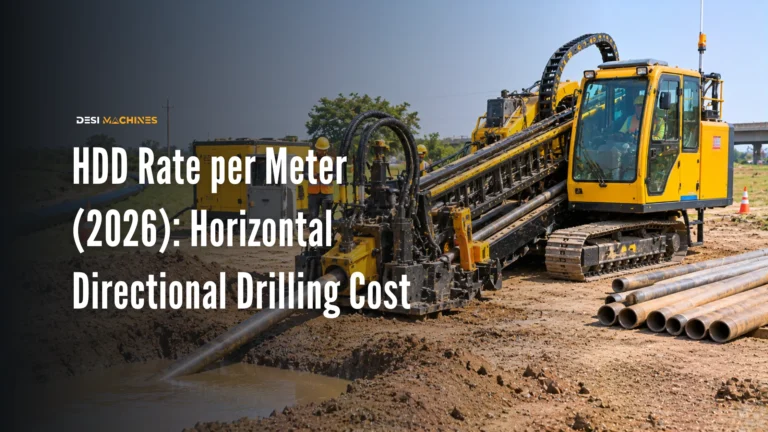
In horizontal directional drilling the mud carries the cuttings out along the whole bore and holds the reamed hole open, so it is a running consumable for the full length of the shot. No official rate book gives an HDD bentonite norm. GAIL’s JLPL pipeline tender of 17 October 2026 folds “disposal of corrosion inhibited water & bentonite” into the HDD scope rather than paying for bentonite as its own item. Your mud plan, reamer size and strata set the quantity, and the cost lands inside the per-metre figure explained in HDD rate per metre. Polymers and other additives are covered in the list of construction chemical companies in India.
Open piling and pipeline-crossing tenders, where this bentonite line gets priced, are on the live tenders and opportunities list.
Rates, schedules of rates, tax and specifications change, and a rate book figure is not a supplier quote. Confirm the current price, grade and test certificate with your supplier, and the item wording with the client, engineer or main contractor, before you price a job.