Excavator
316 models
 Backhoe Loader
54 models
 Crane
68 models
 Concrete Mixer
79 models
 Wheel Loader
65 models
 Compactor / Roller
45 models
 Motor Grader
42 models

 Concrete Pump
66 models
 Skid Steer Loader
11 models


Most rotary piling rigs sold in India bore piles from about 1.1 m to 3 m across and from about 20 m to more than 100 m deep, and the rig’s torque class decides where in that range it sits. SANY India’s own list, for example, runs from a 23-tonne rig rated at 70 kNm that bores 1,100 mm piles to a 162-tonne rig rated at 445 kNm that bores 3,000 mm piles down to 116 m.
Those four numbers (diameter, depth, torque and weight) are what a piling rig specification sheet is mostly about. Each one changes what the rig can do on your site, and each one hides a condition in small print.
This guide is for a contractor, site engineer or owner who has a pile drawing in hand and two or three rig offers on the table. It explains what each figure on the sheet means, groups today’s rigs into size classes with the makers’ own numbers, shows why most sheets print two depths, and ends with a checklist for matching a rig to your piles. What the different families of drill rig are, and how a piling rig is built, is covered in the guide to types of drilling rig machines.
What do the numbers on a piling rig specification sheet mean?
A piling rig sheet usually leads with six figures. Here is what each one tells you, in plain words.
- Maximum drilling diameter. The widest pile the rig can bore, in millimetres. It is the width of the drilling tool, so a 1,500 mm (1.5 m) figure means a 1,500 mm bucket or auger. Some makers quote it for an uncased bore and some for a cased one, and the two are not the same.
- Maximum drilling depth. How deep the rig can reach with its longest kelly bar. A kelly bar is the set of steel tubes that slide out of each other like a telescope and carry the tool down the hole. Most sheets print two depths, for reasons explained below.
- Rated output torque. The turning force at the rotary drive, the gearbox that spins the kelly. It is given in kNm (kilonewton-metres). More torque turns a wider tool through harder ground.
- Stroke. How far the crowd system can push the rotary drive down the mast in one go. Crowd is the downward push that presses the tool into the ground.
- Engine power. The diesel engine’s output in kW. It drives the hydraulic pumps that run everything else.
- Operating weight. The rig’s working weight in tonnes. It decides how the rig travels to site and what ground it can stand on.
A rig that bores 1.5 m piles is not “smaller” than a rig that bores 1.8 m piles in every way that matters. The second may be shallower, heavier or need a different kelly. Read the whole line, not the headline number.
Indian piles are not built to the rig, the rig is chosen for the piles. IS 2911 (Part 1/Sec 2):2010, the Indian code for bored cast in-situ concrete piles, sets 450 mm as the smallest pile diameter and calls piles over 600 mm across large diameter piles. So even the smallest rig in this guide is wide enough for a code pile. The question is always how wide and how deep the biggest pile on your drawing is.
What are the specifications of a piling rig, size by size?
SANY India publishes the most complete single ladder of rigs sold here, from its smallest to its largest, with the same six figures for each. That makes it a useful ruler for the whole market. The figures below are exactly as SANY prints them on its Indian site.
| Model | Rated torque (kNm) | Max. pile diameter | Max. drilling depth (two kelly figures) | Operating weight | Engine power |
|---|---|---|---|---|---|
| SR65 C10 | 70 | 1,100 mm (1.1 m) | 20 / 27 m | 23 t (23,000 kg) | 84 kW |
| SR140 C10 | 140 | 1,300 mm (1.3 m) | 45 m | 37 t (37,000 kg) | 133 kW |
| SR155 C10 | 155 | 1,500 mm (1.5 m) | 56 / 44 m | 48 t (48,000 kg) | 147 kW |
| SR185 C10 | 190 | 1,800 mm (1.8 m) | 59 / 47 m | 63 t (63,000 kg) | 212 kW |
| SR215 C10 | 220 | 1,800 mm (1.8 m) | 64 / 51 m | 65 t (65,000 kg) | 212 kW |
| SR235 S | 235 | 2,000 mm (2.0 m) | 68 / 54 m | 81 t (81,000 kg) | 257 kW |
| SR285R C10 | 285 | 2,300 mm (2.3 m) | 94 / 61 m | 100 t (100,000 kg) | 300 kW |
| SR360R H10 | 360 | 2,500 mm (2.5 m) | 100 / 65 m | 120 t (120,000 kg) | Not specified on the page |
| SR405R H10 | 405 | 2,800 mm (2.8 m) | 103 / 84 m | 131 t (131,000 kg) | 377 kW |
| SR445R H10 | 445 | 3,000 mm (3.0 m) | 116 / 95 m | 162 t (162,000 kg) | 377 kW |
Read down the table and a pattern appears. Every step up in torque buys a wider pile and a deeper reach, and costs weight. Doubling the torque from 70 to about 155 kNm takes the pile from 1.1 m to 1.5 m and the weight from 23 to 48 tonnes. Going from 155 to 285 kNm takes it to 2.3 m and 100 tonnes.
SANY also says something about how these rigs are used here. It calls the SR155 C10 the most selling piling rig model in India, with more than 230 machines working across the country. It pitches the SR65 C10 at small bored piles for low-rise urban housing, the SR285R C10 at hard soil on expressways, bridges and high-rise buildings, and the SR445R H10 at bridges and high-speed railways. Those are the maker’s own claims, but they match the sizes.
One naming trap catches buyers. SANY’s SR rigs and its SY excavators share numbers but are different machines: a search for a “SANY 215 piling rig” is a search for the SR215 C10, not the SANY SY215C excavator, which digs but does not bore piles.
What are the size classes of piling rigs?
No Indian standard sorts piling rigs into classes, so the grouping below is ours. It puts each maker’s published figures side by side by torque, because torque is the one number every maker prints the same way. Use it to see what class of rig a pile needs, then check the exact model sheet.
| Class (our grouping) | Torque | Typical largest pile | Typical deepest pile | Operating weight | Examples, as each maker states them |
|---|---|---|---|---|---|
| Compact | Under 100 kNm | About 1.1 m | 20 to 27 m | About 23 t | SANY SR65 C10: 1,100 mm, 27 m, 70 kNm |
| Light | 140 to 160 kNm | 1.3 to 1.5 m | 44 to 56 m | 37 to 48 t | SANY SR155 C10: 1,500 mm, 56 m. Bauer BG 15 H: 150 kNm, 1,500 mm, 44 m. ACE-Sunward SA 175: 1,500 mm, 44 m |
| Medium | 185 to 260 kNm | 1.5 to 2.0 m, more on some | 34 to 68 m | 52 to 81 t | SANY SR235 S: 2,000 mm, 68 m. ACE-Sunward SA 250: 2,000 mm, 56 m. Bauer BG 23 H: 235 kNm, 1,500 mm uncased, 53.7 m. Liebherr LB 20.1: 200 kNm, 1,500 mm, 34.5 m, 52.8 t |
| Heavy | 280 to 350 kNm | 2.0 to 2.5 m, more on some | 72 to 100 m | 71 to 111 t | SANY SR285R C10: 2,300 mm, 94 m. Soilmec SR-75: 293 kNm, 2,300 mm, 93 m, 71 t. Bauer BG 33: 342 kNm, 2,500 mm uncased, 72.4 m. Liebherr LB 35.1: 347 kNm, 4,100 mm, 77.5 m |
| Very heavy | 360 kNm and up | 2.5 to 4.8 m | 95 to 126 m | 120 to 178 t | SANY SR445R H10: 3,000 mm, 116 m. Bauer BG 55: 553 kNm, 3,700 mm uncased, 126 m. Liebherr LB 55: 557 kNm, 4,800 mm, 120.4 m, 162.5 to 178.2 t |
Two things in this table are worth slowing down for.
First, makers do not measure diameter the same way. Bauer states its diameters for an uncased bore, while Liebherr’s widest figures (4,100 mm on the LB 35.1) are far bigger than SANY’s at a similar torque. A sheet that does not say how the figure was measured should be asked about before it is compared with another.
Second, the depth in this table is the deepest the maker prints, and that is almost always the deeper of two kelly options. Which brings us to the most misread number on the sheet.
Why does a piling rig show two drilling depths?
A depth like “68 / 54 m” gives the rig’s reach with two different kelly bars. SANY’s page for the SR235 S says the rig is offered with a friction kelly or an interlocking kelly, and the two figures go with those two bars.
- Friction kelly. The tubes drive each other through rails that grip by friction, with no lock between them. This is the version with the longer reach.
- Interlocking kelly. Each tube can be locked to the next, so the rig’s downward push travels down the bar along with its turning force. Bauer, whose standard kelly bars are of this fully lockable type, describes a kelly as carrying the rotary drive’s torque and the crowd system’s push to the tool at the same time. That push is what hard ground and rock sockets need, and this version reaches less deep.
Bauer’s kelly bar catalogue (April 2026) gives the sum behind every depth figure: drilling depth equals the kelly’s extended length plus the tool length, minus the height of the rotary drive above ground. The tools on the end of the kelly, and how each is sized to the pile and the casing, are covered in the guide to piling rig drilling tools. It gives separate extended lengths for a kelly that is unlocked and one that is locked, which is why one rig carries two depths. Eimco Elecon’s EC216 brochure shows the gap plainly: 41 m with its standard four-section interlocking kelly and 61 m with a five-section friction kelly.
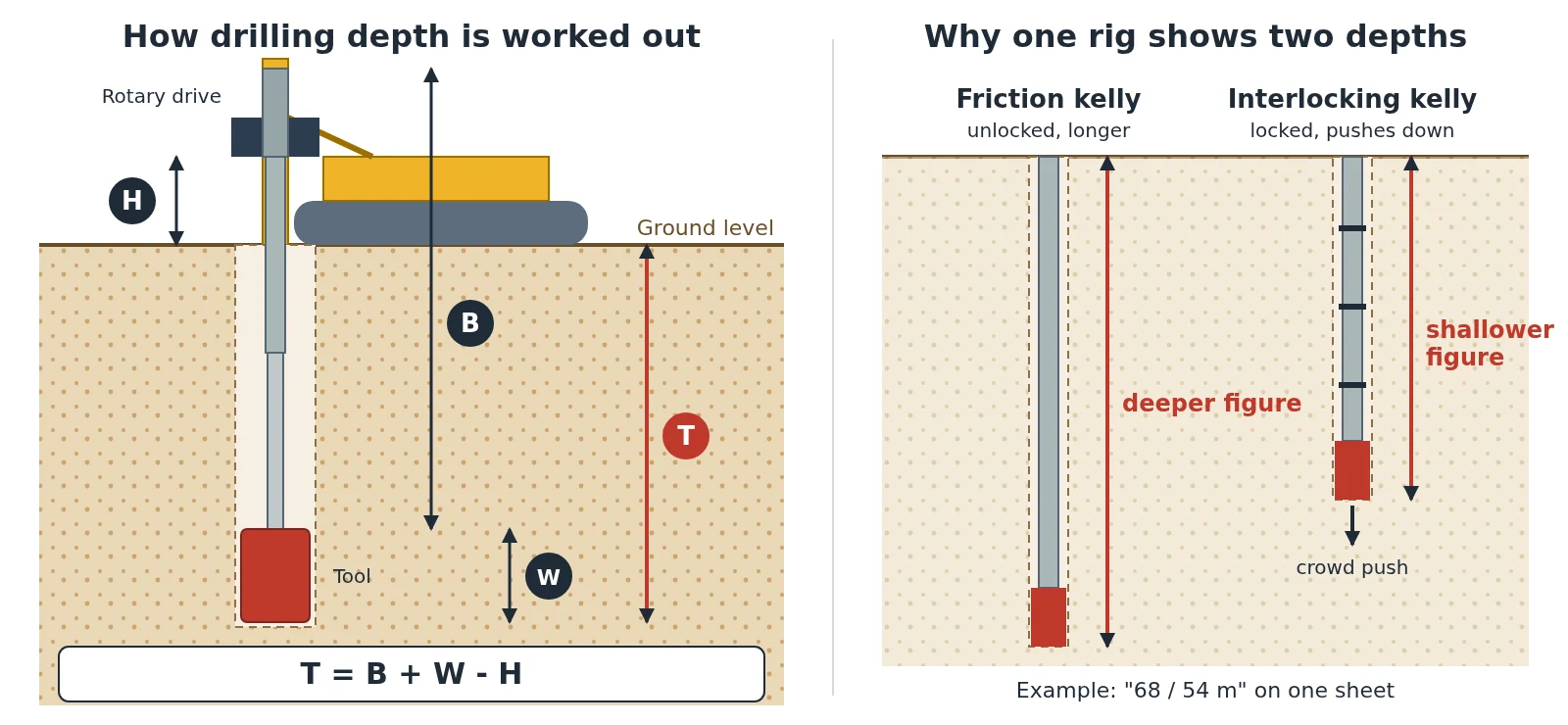
| Label | Part | What it means for depth |
|---|---|---|
| B | Kelly bar, fully extended | Longer when unlocked (friction use) than when every section is locked |
| W | Drilling tool (bucket, auger or core barrel) | Adds its own length below the kelly |
| H | Height of the rotary drive above ground | Is taken away, because that much kelly is still above the ground |
| T | Drilling depth | T = B + W – H |
So when an offer says a rig “goes to 68 m”, ask with which kelly, and whether that kelly is the one being sent. If your piles end in a rock socket, the depth that matters is the interlocking figure, which on the SR285R C10 is 61 m rather than 94 m.
How much torque does a piling rig need?
Enough to turn a tool of your pile’s full diameter through the hardest layer in your soil report, with some left over. Torque has to rise with both diameter and hardness, because a wider tool has more steel cutting at the edge, further from the centre.
Table 1 gives a fair rough guide for soil. In SANY’s range, about 155 kNm goes with 1.5 m piles, about 235 kNm with 2.0 m and about 445 kNm with 3.0 m. Those are the rigs’ maximums, so a rig working near its top diameter in stiff ground is working hard.
Rock changes the sum. Bauer’s catalogue notes that drilling in rock puts enormous loads on the kelly from high torque, axial force and vibration, and sells a heavy-duty kelly for it. SANY pitches its largest rig at hard rock and deep holes because its crowd force, torque and lifting force are balanced for it. When the rotary drive’s torque is not enough to drive a casing into the ground, Liebherr notes, a hydraulic casing oscillator is brought in to do it. For a short socket into hard granite or basalt, a down-the-hole (DTH) hammer may beat a rotary rig altogether, and that choice is laid out in DTH piling vs rotary piling.
A last unit note. Some Indian sheets still give torque in kgf.m (kilogram-force metres). One kNm is about 102 kgf.m, so Eimco Elecon’s EC216 rig, listed in its brochure at 21,500 kgf.m, works out at roughly 211 kNm, which puts it in the medium class.
How heavy is a piling rig, and why does weight matter on site?
Piling rigs in India weigh from about 23 tonnes (23,000 kg) to well over 150 tonnes (150,000 kg). SANY’s range runs from 23 t for the SR65 C10 to 162 t for the SR445R H10, and Liebherr lists its LB 55 at 162.5 to 178.2 t depending on how it is fitted.
Weight is the price of reach. A tall mast and a long, heavy kelly need a heavy base to stay upright, so the deeper and wider the rig, the more it weighs. That weight has three costs for the site.
- Ground. The rig stands on its tracks while the mast is up and the kelly is swinging. Soft fill or a waterlogged plot needs a firm working platform first. Liebherr even lists a ground-pressure display among its operator aids.
- Transport. Even a light rig is a heavy load on the road. Soilmec gives a minimum transport weight of 41 t for its SR-45 with the kelly fitted, and 50.5 t for the SR-75.
- Access. A 100-tonne rig needs a road, a gate and a turning space that a 48-tonne rig does not. In a city lane, the compact class is often the only one that fits.
The rig also never works alone. A crane lowers the steel cage and pulls the casing, and on many Indian sites that is a pick-and-carry piling crane such as the ACE FP 210 piling crane, a 20-tonne crane that ACE lists for cage lowering, concreting and casing removal. Plan its ground and access with the rig’s.
Is a rig’s CFA capacity the same as its kelly capacity?
No, and the gap is large. CFA means continuous flight auger: the rig screws a long hollow auger into the ground in one go and pumps concrete down its centre as it lifts out. Many rigs can do both kelly piles and CFA piles, but the CFA figures are much smaller.
| Rig | Kelly piling: max. diameter and depth | CFA piling: max. diameter and depth |
|---|---|---|
| SANY SR285 MIII | 2,200 mm; 94 / 61 m | 600 to 1,200 mm |
| Soilmec SR-75 | 2,300 mm; 93 m | 1,200 mm; 29 m |
So a rig bought for 2 m kelly piles is a roughly 1 m CFA rig. If your drawing calls for CFA piles, read the CFA line of the sheet, not the headline.
How do you choose the right piling rig size for a job?
Start from the drawing and the soil report, not the rig list. Work through these six checks in order.
- Largest pile diameter on the drawing. Pick a rig whose stated maximum is comfortably above it, and confirm whether that maximum is cased or uncased.
- Deepest pile, measured from the working platform. If the platform sits above the cut-off level, add that height to the pile length.
- Hardest layer and rock socket. If the pile ends in rock, use the interlocking-kelly depth and look for a rig whose torque is not at its limit for your diameter.
- Kelly or CFA. If CFA piles are specified, check the CFA diameter and depth, which are much smaller.
- Weight against ground and access. Check the operating weight against your platform, the road in and the gate. In tight sites, look at compact rigs and the makers’ low-headroom versions: SANY sells multi-function rigs with a low headroom mode, and Bauer makes a particularly short lockable kelly for sites with restricted height.
- The support machines. A crane for cages and casing, an excavator for the platform and spoil, and a bentonite plant if the bore needs support fluid. On small piles bored without a rotary rig, the slurry also carries the cuttings out, as the guide to DMC piling explains.
The rig is usually paid for per metre of pile, and what goes into that rate (rig hours, chisel hours, concrete and steel) is explained in the post on the piling rate per meter. If you need the support fluid priced, the bentonite price post covers it. The companies that make and sell rotary rigs in India, with one sample model each, are listed in piling rig manufacturers in India.
For the machines that work beside the rig, browse the cranes on DesiMachines and the range of excavators that build working platforms and clear spoil, and see how piling fits into a whole project in the guide to the metro construction process. More drilling guides sit in the drill rig guide section.
Sources: rig figures in Tables 1 and 4 are from SANY India’s piling rig and multi-functional rig pages (sany.in, checked 13 November 2026), including the SANY India piling rig range. Other figures are from the makers’ own product pages on the same date: Bauer BG 15 H, BG 23 H, BG 33 and BG 55 (equipment.bauer.de), Liebherr LB series and its kelly drilling method page (liebherr.com), Soilmec SR-75 and SR-45 (soilmec.com) and ACE-Sunward SA 175 and SA 250 (ace-cranes.com). The depth formula and kelly descriptions are from Bauer’s kelly bar catalogue (April 2026). The Eimco Elecon EC216 torque and kelly depths are from its brochure (2020). The 450 mm minimum and the 600 mm large-diameter line are from IS 2911 (Part 1/Sec 2):2010. The size classes in Table 2 and the kgf.m conversion are our own working from those figures.
Prices, specifications and features are indicative, vary by variant, location and date, and should always be confirmed with the official OEM or authorised dealer before any purchase decision. DesiMachines is not liable for decisions taken on the basis of information that may have changed after publication.