
 Excavator
294 models
Excavator
294 models  Backhoe Loader
51 models
Backhoe Loader
51 models  Crane
68 models
Crane
68 models  Concrete Mixer
79 models
Concrete Mixer
79 models  Wheel Loader
54 models
Wheel Loader
54 models  Compactor / Roller
45 models
Compactor / Roller
45 models  Motor Grader
42 models
Motor Grader
42 models  Dozer
41 models
Dozer
41 models  Concrete Pump
66 models
Concrete Pump
66 models  Skid Steer Loader
11 models
Skid Steer Loader
11 models  Telehandler
13 models
Telehandler
13 models 


There is no electric JCB backhoe loader. JCB’s own electric machine range covers nine kinds of machine and a backhoe loader is not one of them, and not a single one of the 51 backhoe loaders listed in India runs on anything but diesel. If you want an electric earthmover you can order here today, it will be an excavator.
That is the short answer, and it is worth knowing before you spend a week chasing a dealer. The longer answer is more useful, because JCB has published why the backhoe is not electric, what it is doing instead, and which of its machines are. All three change what you should actually ask for.
One note on the word. On an Indian site “JCB” means a backhoe loader whatever badge is on it, the same way “Poclain” means an excavator. This page uses it that way too.
Is there an electric JCB backhoe loader?
No, and the gap is a deliberate engineering decision rather than an oversight.
JCB’s Electric Solutions range lists nine machine families: articulated booms, industrial forklifts, dumpsters, scissor lifts, mini excavators, generators, site dumpers, telescopic handlers and wheel loaders. Backhoe loaders are absent from that list. Every one of the nine is either a compact machine or a machine that works in one spot.
In our own listings the picture matches. Of the 51 backhoe loaders listed in India, every single one is diesel. The 13 electric machines we list are all electric excavators, plus eleven stationary concrete pumps that run off a motor instead of an engine. Nothing in the backhoe loader class.
Which JCB machines are electric, then?
Seven models, all of them small, and JCB publishes a charge time for each. The range is sold as E-TECH. None of these is listed in India, so they are named here for information, not as machines you can order from us.
| Machine | What it is | Company-stated charge time |
|---|---|---|
| 19C-1E | Mini excavator | 2 hours 30 minutes |
| 525-60E | Telehandler | 1 hour 50 minutes |
| HTD-5E | Tracked dumpster | 75 minutes on a 230 V lead, 2 hours 45 minutes on 110 V |
| 1T-2E | Site dumper | 2 hours 30 minutes, 20 to 80 per cent |
| Teletruk 30-19E and 35-22E | Industrial forklifts | 8 hours, 20 to 100 per cent |
| 403E | Compact wheel loader | Not stated on the charging list |
Charge times as published by JCB on its sustainability pages, read October 2026. The HTD-5E is stated as not compatible with the universal fast charger.
Read the list as a shape, not as a catalogue. Micro excavator, small telehandler, two-wheeled dumper, forklift, compact loader. Every machine on it either works inside a building, inside a city, or inside a yard where a charging point can be bolted to a wall.
Can you buy an electric JCB in India?
One kind, and it is not an earthmover. JCB India’s own product range runs to thirteen machine categories, and the only electric entry among them is the scissor lift range. JCB states those are made in India and exported, fitted with deep-cycle lead-acid batteries, and that each platform reaches a full charge in eight hours.
A scissor lift is an access platform: a cage on a folding frame that lifts people and tools straight up to work at height. Useful machine, no digging in it.
So the honest position in October 2026 is that JCB sells one electric machine family in India, and a buyer looking for an electric digger or an electric loader has to look at other makers.
Why has nobody built an electric backhoe loader?
Because of the shift, not the technology. JCB has put its reasoning in writing: while battery power suits compact machines and urban sites, it is not always suitable for replacing mid-range and larger machines, which need a lot more energy to work a full shift.
A backhoe loader is the hardest possible case for that argument. It digs, it loads, it breaks, and then it drives itself on a public road to the next job, which no excavator does. The fuel a backhoe loader really burns in a day goes into all four of those, and the road travel is the part a battery handles worst, because it is energy spent without doing any work. A machine that parks in a different village every week also has nowhere fixed to charge.
JCB’s answer for the backhoe is a different fuel. It revealed a hydrogen combustion engine in early 2021, and in February 2023 the UK government approved its first hydrogen-powered digger for use on UK roads. JCB describes that backhoe loader as the first of its kind. Hydrogen keeps the diesel working pattern, fill and go, which is exactly the pattern a backhoe needs.
None of this is on sale in India, and no Indian approval for a hydrogen machine has been published. Treat it as the direction of travel, not as a purchase option.
What electric earthmoving machine can you actually buy in India?
An excavator, in sizes from 2,750 kg up to 175,000 kg. Thirteen are listed, from five makers, and six of them carry a published price band.
The table below is the ordering view. Prices are the bands shown on each machine’s own listing, quoted as they stand.
| Machine | Operating weight | Rated power | Bucket | Price band, indicative, as of Oct 2026 |
|---|---|---|---|---|
| Liugong 9027FE EV | 2,750 kg (2.75 tonne) | 21.1 HP (16.5 kW) | 0.08 m³ | ₹30 to 33 Lakh |
| Liugong 908FE EV | 7,600 kg (7.6 tonne) | 63 HP (47 kW) | 0.32 m³ | ₹33 to 38 Lakh |
| SANY SY215EP | 21,900 kg (21.9 tonne) | 201 HP (150 kW) | 1.5 m³ | Price on request |
| Liugong 922FE Cable | 22,000 kg (22 tonne) | 140 HP (105 kW) | 1.15 m³ | ₹62 to 70 Lakh |
| Liugong 922FE Battery | 24,100 kg (24.1 tonne) | 140 HP (105 kW) | 1.0 m³ | ₹62 to 70 Lakh |
| Liugong 926FE EV | 26,000 kg (26 tonne) | 201 HP (150 kW) | 1.3 m³ | ₹72 to 80 Lakh |
| SANY SY375EP | 37,800 kg (37.8 tonne) | 269 HP (200 kW) | 1.9 m³ | Price on request |
| Liugong 939FE EV | 39,000 kg (39 tonne) | 325 HP (250 kW) | 2.0 m³ | ₹1.10 to 1.15 Crore |
| Volvo EC500 Electric | 47,846 kg (47.8 tonne) | 335 HP (250 kW) | 3.03 m³ | Price on request |
| BEML BE1000E-1 | 95,000 kg (95 tonne) | 536 HP (400 kW) | 3.1 to 5.55 m³ | Price on request |
| Liebherr R 992 E | 90,550 to 97,100 kg | 544 HP (400 kW) | 2.0 to 6.8 m³ | Price on request |
| Liebherr R 998 SME-E | 90,550 to 97,100 kg | 544 HP (400 kW) | 2.0 to 6.8 m³ | Price on request |
| BEML BE1800E | 175,000 kg (175 tonne) | 2 x 402 HP (2 x 300 kW) | 10.5 to 12.0 m³ | Price on request |
The smallest two are the ones worth a contractor’s attention. A 7,600 kg electric excavator is in the same weight bracket as a JCB 3DX, which tells you the class is reachable; what is missing is a machine that also drives itself to the next site.
Compare live electric excavator models and prices and talk to a dealer about what is in stock near you.
Battery or cable: two very different machines
Both get called electric and they suit opposite jobs. Liugong sells the same 22 tonne machine in both forms, which makes the difference easy to see.
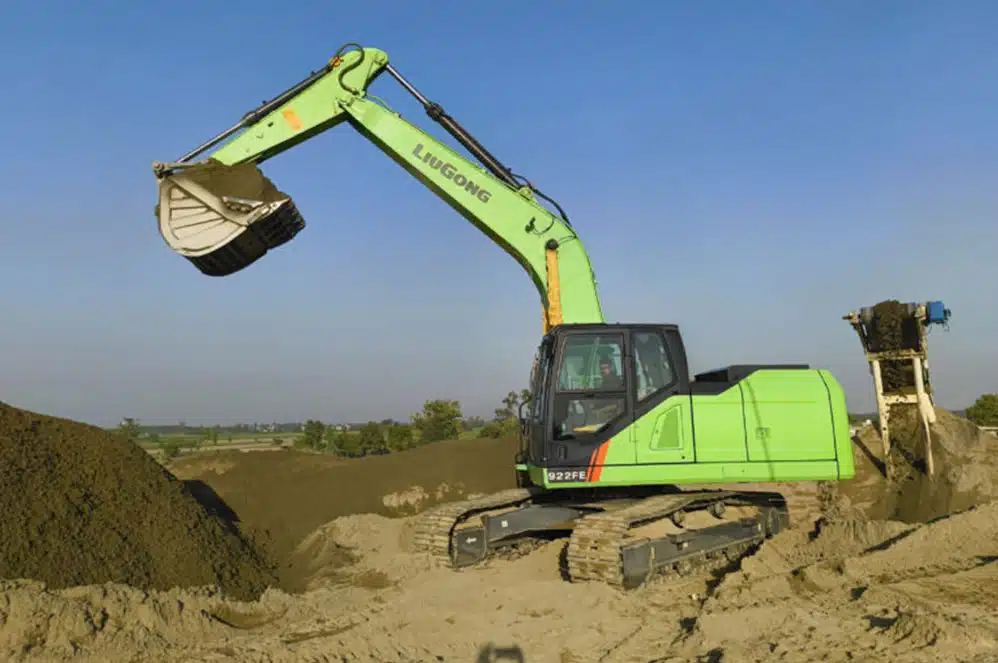
The 922FE Battery carries its energy on board, in a lithium iron phosphate pack, and works anywhere a charger can reach it. The 922FE Cable has no traction pack at all. It runs off mains power through a trailing cable, so it never stops to charge and never runs flat, but it can only work within the length of that cable.
Cable machines are a mining and quarry answer. The big Liebherr and BEML shovels in the table above are all mains-fed for the same reason: a face that does not move, a power line that already exists, and a shift that never ends. On a road or housing job neither of those conditions holds, which is why the battery machines are the relevant half of the list for most buyers.
What do you gain, and what do you give up?
Honest both ways. Nothing here is a reason to buy or not buy on its own.
| What you gain | What you give up |
|---|---|
| No exhaust at the machine, so it can work inside a shed, a basement or a tunnel with far less ventilation | A much higher purchase price than the diesel machine of the same size |
| Quiet enough for night work in a residential area and for hospital or school sites | A charging connection you have to arrange, and a site power load to go with it |
| Cheaper energy per hour where you have a commercial power connection | Shift planning around charge time instead of a two minute diesel fill |
| No engine oil, filters, fuel filters or exhaust after-treatment to service | Service reach: far fewer trained technicians and spares in district towns |
| No diesel to be pilfered from the tank overnight | No resale history, so the second-hand value is a guess |
The energy saving is real but it is not the whole sum. Our own working through of electric against diesel running cost sets out the arithmetic for a specific machine and tariff, including the part the brochures leave out.
What should you ask before you place an order?
Seven questions, and the first two decide most deals.
How many working hours on one charge, doing my work? Not the pack size, the hours. Ask for it in the duty you actually run, trenching or loading, because a machine idling between trucks lasts far longer than one digging hard rock.
What charger, what supply, and who pays for the connection? A single-phase domestic line will not charge a 22 tonne machine. You need to know the charger’s power draw, whether your site sanction covers it, and what the electricity board will charge to raise the load.
What is the battery warranty, in years and in cycles, and what does a replacement pack cost? Get it in the order paper. This is the single largest unknown in the ownership cost.
Where is the nearest technician who has worked on this model? Ask for the town, not the state. High-voltage work on these machines is not a roadside repair.
What is the full specification sheet? Worth knowing that no machine in our electric listings publishes a battery capacity in kWh or a charging time in its specification table. Those two figures have to come from the dealer in writing, which is the clearest sign of how new this class still is in India.
Will it fit the work I already have? If your machine does road travel between villages every week, the diesel backhoe loader is still the right tool, and a 2WD or 4WD decision matters more to you than fuel type. If your work is one fixed site with a power connection, the electric excavator case gets strong quickly.
How will it be funded? The higher upfront figure changes the monthly outgo, so run it through equipment finance before comparing it against a diesel machine’s price.
Where this leaves a buyer looking for an electric JCB
If the machine you want is a tractor-loader-backhoe, buy diesel, because there is no electric one to buy and the maker of the original has said why. If what you want is the electric part, an excavator is where the choice exists, and the 7,600 kg class is close enough in size to a backhoe to be worth pricing.
The other electric machines reaching Indian sites are not earthmovers at all. We have set out the current position on electric forklifts, on electric dumpers and tippers, and on electric truck prices and subsidy, and there is a wider reading of the market in our list of the most advanced electric excavators.
Browse the full range of backhoe loaders and excavators listed in India, and send an enquiry to compare a diesel and an electric quote side by side.
Prices, specifications and features are indicative, vary by variant, location and date, and should always be confirmed with the official OEM or authorised dealer before any purchase decision. DesiMachines is not liable for decisions taken on the basis of information that may have changed after publication.