
 Excavator
294 models
Excavator
294 models  Backhoe Loader
51 models
Backhoe Loader
51 models  Crane
68 models
Crane
68 models  Concrete Mixer
79 models
Concrete Mixer
79 models  Wheel Loader
54 models
Wheel Loader
54 models  Compactor / Roller
45 models
Compactor / Roller
45 models  Motor Grader
42 models
Motor Grader
42 models  Concrete Pump
66 models
Concrete Pump
66 models  Skid Steer Loader
11 models
Skid Steer Loader
11 models  Telehandler
13 models
Telehandler
13 models 


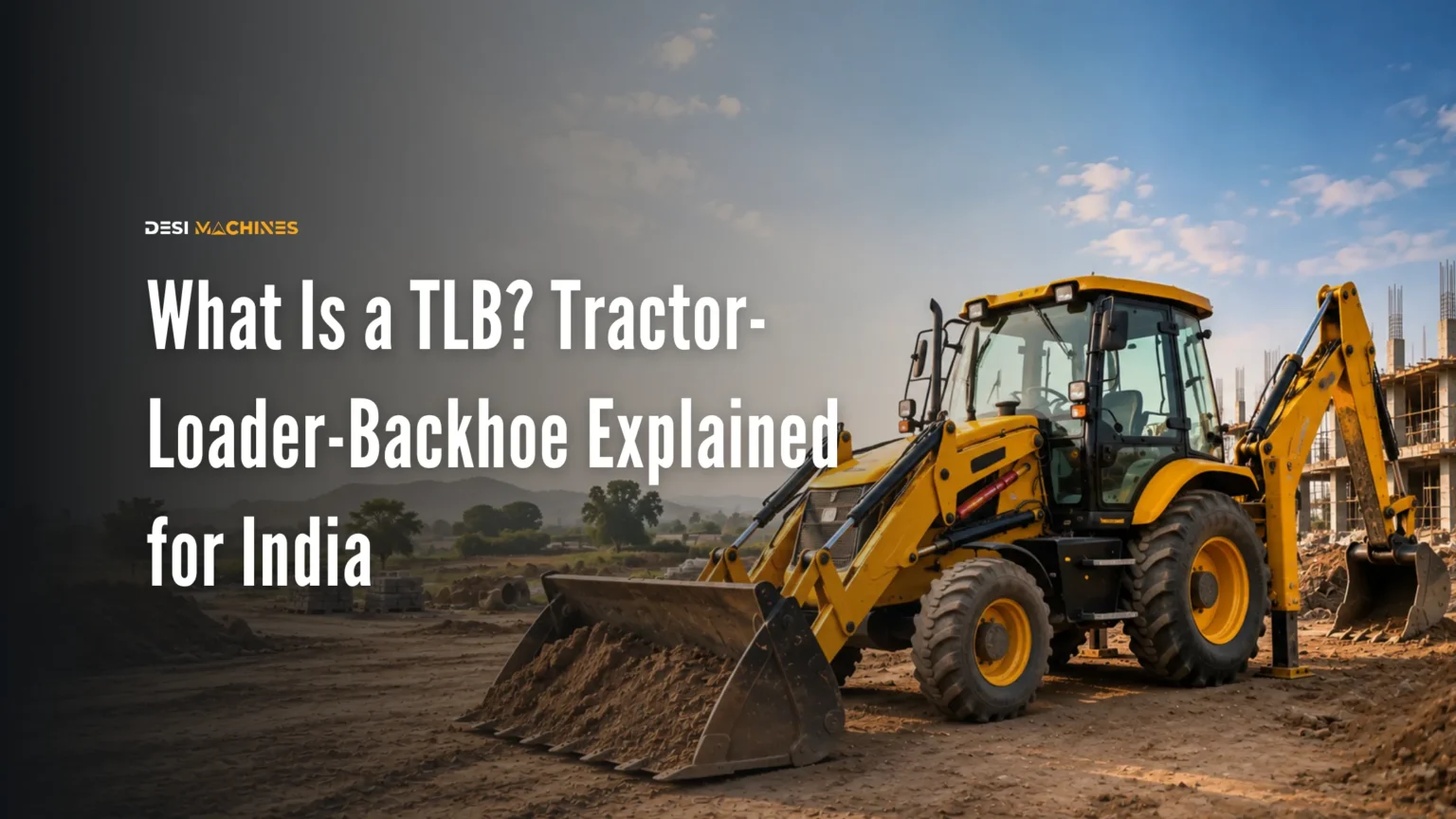
A TLB is a tractor-loader-backhoe — the full technical name for the machine most people in India simply call a backhoe loader, or a JCB. It is one machine built on a tractor-style chassis with a loading bucket at the front and a digging arm at the back, so a single operator can load, dig, break and carry without changing machines. The three words in the name are the three parts: tractor (the base), loader (the front bucket), backhoe (the rear digging arm).
What is a TLB (tractor-loader-backhoe)?
A TLB is a wheeled machine with a front loader bucket and a rear backhoe, built as one unit on a tractor-type frame. The operator sits in a cab in the middle and swivels the seat: face forward to load and carry with the front bucket, turn around to dig with the rear arm. Two stabiliser legs drop at the back to hold the machine steady while the backhoe works.
Every part of the name earns its place:
- Tractor: the base machine. A diesel engine, four wheels and a road-legal drivetrain, so the machine can drive itself from one job to the next instead of riding a trailer.
- Loader: the front bucket, used to scoop loose soil, sand, aggregate and rubble, load a tipper, level a plot and carry material across a site.
- Backhoe: the rear arm with its own smaller bucket, which digs downward toward the machine. “Backhoe” describes both the arm and the way it hoes back through the earth.
In India the machine is usually spoken of by brand name rather than by class, which is why so many contractors say “JCB” for any backhoe loader, the same way they say “Poclain” for an excavator. Our blog explains how those brand names became everyday words. TLB is the correct trade term underneath all of them.
Is a TLB the same as a backhoe loader?
Yes. TLB and backhoe loader are two names for the same machine. Tender documents, spec sheets and export listings tend to use TLB, while dealers, operators and everyday site talk in India use backhoe loader — or just JCB. Nothing about the machine changes with the name.
You will also hear a few older or regional terms for the same thing: loader backhoe, digger, and in some yards simply “the backhoe”. If you are reading a tender that asks for a “TLB, 74 HP, 4WD”, it is asking for a standard backhoe loader. Our backhoe loader guide covers the machine’s parts and working principle in detail.
The confusion is worth clearing up because it costs money. Buyers searching only for “backhoe loader” miss listings and tenders written as TLB, and the other way round.
What is the difference between a TLB and a tractor with a backhoe attachment?
A TLB is a purpose-built machine; a tractor with a backhoe attachment is a farm tractor with a digging arm bolted on. They look similar from a distance and they are not the same thing at all. This is the single most common mix-up among first-time buyers, and getting it wrong is expensive.
| Point of difference | TLB / backhoe loader | Tractor with backhoe attachment |
|---|---|---|
| Chassis | Built as one machine for digging loads; frame, axles and hydraulics sized for it | Farm tractor frame carrying loads it was not designed for |
| Hydraulics | Dedicated high-flow system feeding loader and backhoe | Shares the tractor’s lighter hydraulic system; slower cycles |
| Operator position | Swivel seat inside a cab, full controls for both ends | Operator moves or twists to reach a separate control stand |
| Digging depth | Typically 3 to 5.4 metres on Indian models | Usually 2 to 3 metres |
| Stability | Heavy machine with proper stabiliser legs | Lighter; can lift or shift under load in hard ground |
| Best suited to | Daily contracting, hire work, municipal and site jobs | Occasional farm and estate digging alongside tractor work |
| Cost | Higher, but built for continuous commercial hours | Lower, but earns less and wears the tractor |
The rule of thumb is simple. If digging is how you earn, buy a TLB. If you already own a tractor and dig a few hours a month on your own land, an attachment may be enough. What does not work is running an attachment on daily contract hours: the tractor’s transmission and hydraulics were never built for it, and the repair bill arrives long before the machine has paid for itself.
What can a TLB do on an Indian site?
A TLB earns its keep because it replaces two or three machines on jobs that are too small to justify keeping each one. On a normal working day in India it will dig, load, carry, backfill and level, and then drive itself to the next site.
- Trenching for water pipelines, sewerage, cable ducts and drainage. This is the job it does best.
- Foundation digging for houses, boundary walls, small commercial buildings and tanks.
- Loading soil, sand, stone and rubble into tippers and tractor trolleys with the front bucket.
- Backfilling and levelling after the pipe or foundation goes in, using the same front bucket.
- Road and municipal work: patch repair, culvert clearing, drain cleaning, debris removal.
- Breaking concrete and hard surfaces when a hydraulic breaker is fitted in place of the rear bucket.
That range is why the backhoe loader is the machine most rural and small-town contractors buy first. It also explains why hire demand is steady: a TLB can be booked for a half-day drain job in a way a 20 tonne excavator cannot. The attachments that widen this range further — breakers, augers, grabs, blades — are set out in our backhoe loader attachments guide.
How much does a TLB cost in India?
Backhoe loaders in India generally sit in a ₹22–40 Lakh band as of August 2026 (indicative segment range), depending on engine power, 2WD or 4WD, cab specification and brand. The table below shows where a few machines from our listings fall inside that band.
| Model | Indicative Price (Aug 2026) | Where It Fits |
|---|---|---|
| JCB 3DX | ₹28.5–31.5 Lakh | The 49 HP machine most Indian sites run: general construction, contractors and rental fleets. Not the cheapest way into the class, though: the CASE 770 NXe Series opens the segment at ₹22–24 Lakh (indicative, as of August 2026). |
| Mahindra EarthMaster SX | ₹28.0–31.0 Lakh | Value-for-money option with both 2WD and 4WD variants, suitable for contractors, infrastructure work, and mixed terrain. |
| Bull CH76 Challenger | ₹26.6–29.4 Lakh | The lowest priced of these four, at 55 HP, and carries the biggest loader bucket in our listings at 1.26 m³. |
| Tata Hitachi Shinrai Power | ₹34.2–37.8 Lakh | Premium heavy-duty machine for infrastructure projects, mining support, and continuous high-hour operations. |
All four figures are indicative as of August 2026 and move with variant, state taxes, attachments and dealer. Two things shift the price more than anything else: 4WD versus 2WD, and engine power. Whether you need four-wheel drive at all depends on your ground, and we work through that choice in 2WD vs 4WD backhoe loaders. Most buyers finance the machine rather than paying outright; our equipment finance and EMI options show how the monthly figure changes with down payment and tenure.
A used machine is the other route into the class, and a sound five-year-old TLB from a careful owner often beats a new budget model. The checks that matter are in our used backhoe loader buying guide.
TLB or excavator: which one should you buy?
Buy a TLB when your work is varied and spread out; buy an excavator when your work is deep, heavy digging in one place. That is the whole decision in a sentence, and most buyers who regret their purchase got it the wrong way round.
A TLB wins on flexibility. It drives itself between sites, loads as well as digs, and handles the small municipal and plot jobs that make up most rural contracting. An excavator wins on raw digging: more depth, more reach, more earth per hour, and far better for tipper loading all day. A mini excavator, on the other hand, fits into gates and compounds a TLB cannot enter, and the whole weight range is set out in our guide to excavator size classes.
Three questions usually settle it:
- How many sites a month? Many small ones favour a TLB, because you save the trailer charge every time.
- How deep do you dig? Past about 5.4 metres, which is the deepest rear-arm reach in our listings, only an excavator will do.
- Do you also need to load and carry? A TLB does both ends; an excavator needs a loader working alongside it.
Our comparison of backhoe versus excavator goes into this at length. If bulk loading is the real job rather than digging, look at the wheel loader range instead — a wheel loader moves far more material per hour but cannot dig a trench.
What should you check before buying a TLB?
Check the machine against your ground, your jobs and your dealer, in that order. A TLB is bought for eight to ten years of work, so the details that look small at the showroom decide what the machine earns.
- 2WD or 4WD. Soft, wet, sandy or sloping ground needs 4WD. Hard, level urban work usually does not, and 2WD costs less to buy and to run.
- Engine power and digging depth. Across our listings TLBs run 49 to 100 HP and dig 3 to 5.4 metres. Match this to the deepest trench you are actually paid to dig, not the deepest you can imagine.
- Loader bucket capacity. Roughly 1.1 m³ is standard across our listings, with the whole range running about 0.6 to 1.26 m³. A bigger bucket loads faster but needs the hydraulics and the machine weight to carry it.
- Dealer and parts reach. Check that a service point and parts stock exist within a few hours of where you work. On a machine down in a village, distance is the real cost.
- Servicing you can keep up with. A TLB rewards routine care and punishes neglect; the intervals are in our backhoe loader maintenance schedule.
For the working numbers behind that choice, see backhoe loader bucket capacity, dig depth and dump height compared across the machines sold in India.
When you have settled the specification, compare the machines and current prices across the backhoe loader range, and get a written quote from an authorised dealer before you commit.
Prices, specifications and features are indicative, vary by variant, location and date, and should always be confirmed with the official OEM or authorised dealer before any purchase decision. DesiMachines is not liable for decisions taken on the basis of information that may have changed after publication. Price figures are taken from our listings at the time of writing.

