
 Excavator
316 models
 Backhoe Loader
54 models
 Crane
68 models
 Concrete Mixer
79 models
 Wheel Loader
54 models
 Compactor / Roller
45 models
 Motor Grader
42 models

 Concrete Pump
66 models
 Skid Steer Loader
11 models


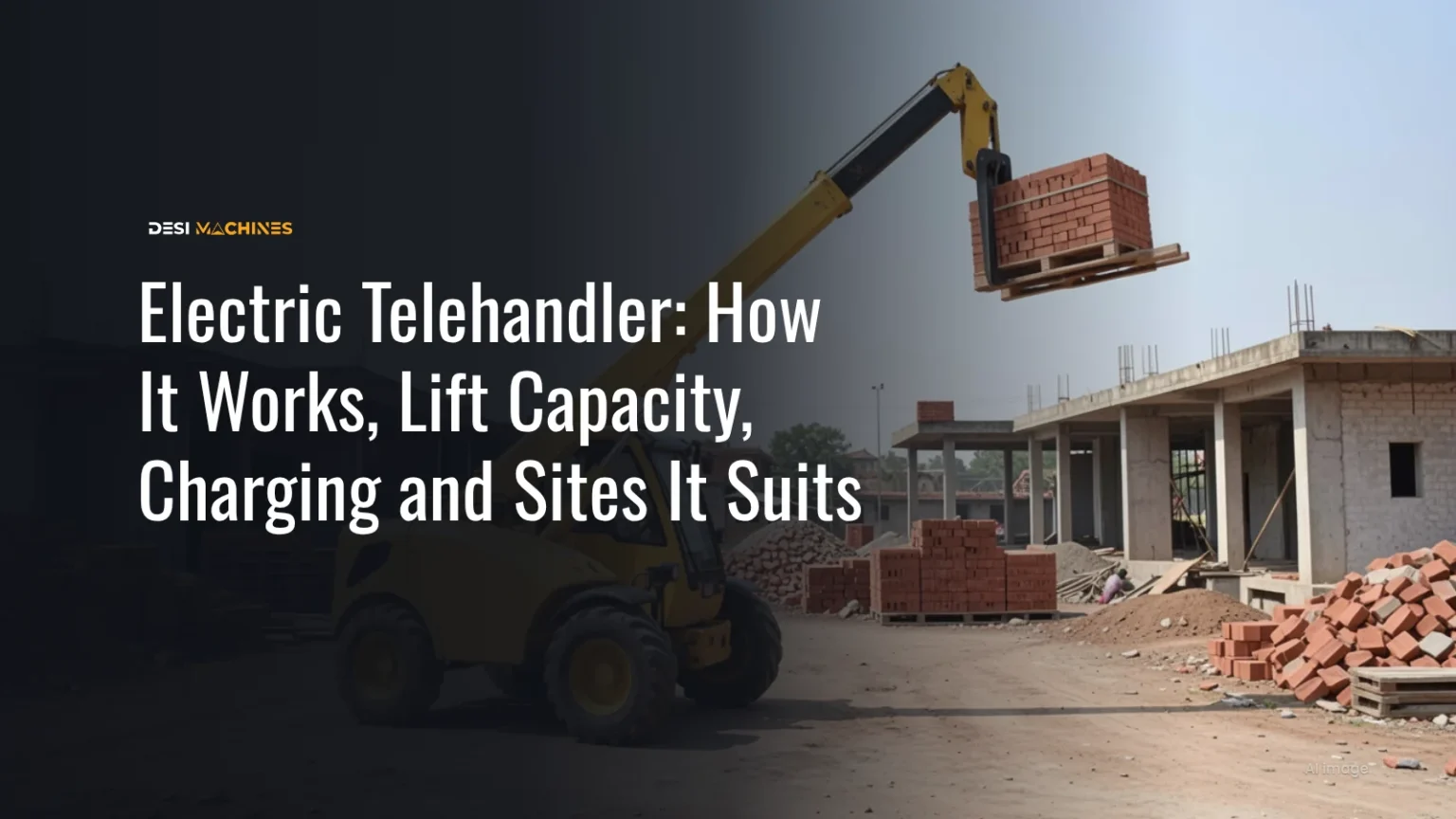
JCB’s battery-powered 525-60E lifts 2,500 kg (2.5 tonnes) to 6 metres, exactly what its diesel twin, the 525-60, lifts on the same maker’s page. An electric telehandler is a telescopic handler whose diesel engine has been replaced by a battery pack and electric motors, so it picks, carries and places loads with no exhaust and very little noise.
The lift stays the same. The working day changes: how long the battery lasts, how fast it charges and how quickly the machine travels between jobs. None of the 13 telehandlers listed on DesiMachines is electric yet, and JCB’s India telehandler range shows only the diesel 530-70, 530-110 and 540-70 as of November 2026. So this guide explains how the battery version works, puts the makers’ published figures next to the diesel machines you can buy in India, and lists the sites where electric makes sense and the checks to make first. If the machine itself is new to you, start with the complete telehandler guide.
How does an electric telehandler lift and drive without an engine?
A diesel telehandler has one engine doing two jobs. It turns the gearbox that drives the wheels, and it turns the hydraulic pump that pushes oil into the cylinders that raise, extend and tilt the boom. An electric telehandler splits those two jobs between two electric motors, both fed from one battery.
Faresin of Italy, which says it built the first mass-produced fully electric telehandler, describes the layout plainly. On its compact 6.26 Full Electric a 20 kW motor on the front axle drives the wheels, and a separate 10 kW motor on the rear axle drives the hydraulic pump. The battery sits where the engine used to be. Its larger models use the same idea with bigger parts: a 51 kW drive motor and a 23 kW hydraulic motor.
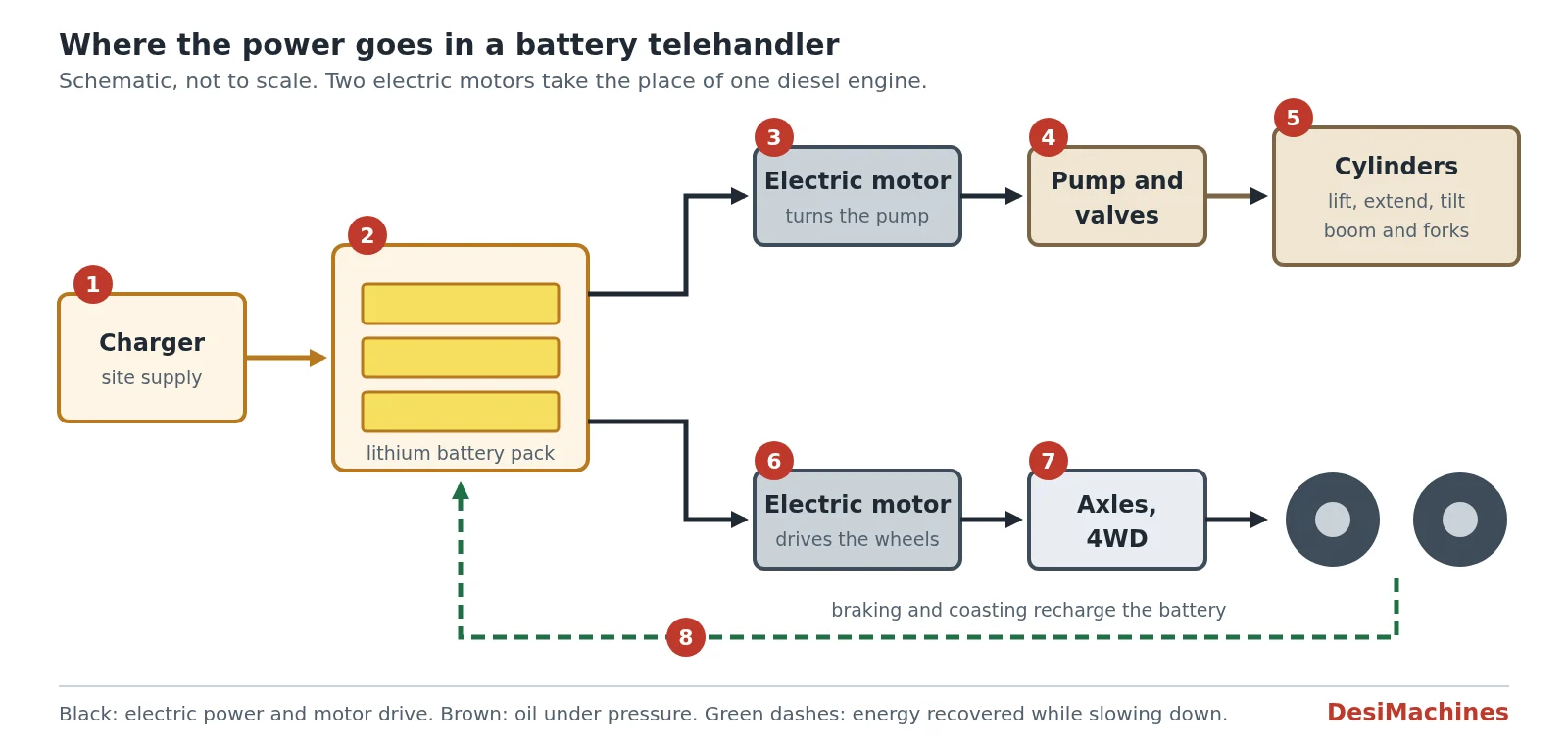
So on Faresin’s machines the boom still works on oil. The forks, the cylinders, the valves and the load chart all work the way they do on a diesel machine, and an operator who knows one will find the other familiar. What has gone is the engine, with its fuel tank, fuel filters, exhaust and engine oil.
Two electric features matter on site. The first is regenerative braking: when the operator brakes or lifts a foot off the pedal, the drive motor works as a generator and sends some energy back into the battery. Faresin says the gain is largest on long downhill runs. The second is that a motor only draws power when it moves. Faresin’s electric machines switch themselves off after 10 minutes of standing still, so a machine waiting for the next truck is not burning anything.
Does a battery telehandler lift as much as a diesel one?
In the compact class, yes. The table puts JCB’s electric and diesel twins beside Faresin’s electric 6.26 and the smallest JCB telehandler sold in India.
| Figure | JCB 525-60E (electric) | JCB 525-60 (diesel) | Faresin 6.26 Full Electric | JCB 530-70 (diesel, listed) |
|---|---|---|---|---|
| Maximum lift capacity | 2,500 kg | 2,500 kg | 2,600 kg | 3,000 kg |
| Maximum lift height | 6 m | 6 m | 5.8 m | 7 m |
| Maximum forward reach | 3.5 m | 3.06 m | 3.2 m | 3.8 m |
| Power | 22 kW | 55 kW engine | 20 kW drive + 10 kW hydraulic | 54 kW (74 HP) engine |
| Energy store | 24 kWh battery | Diesel tank | 25, 33.8 or 43 kWh battery | 110 litre diesel tank |
| Top travel speed | 15 km/h | 15 km/h | 12 km/h | 30 km/h |
| Weight | 5,145 kg | 5,490 kg | 4,800 kg | 7,220 kg |
Sources: JCB 525-60E and 525-60 from jcb.com (UK); Faresin 6.26 from faresin.com; JCB 530-70 from its product listing. Makers’ published figures as of November 2026.
Read the JCB pair closely. The electric machine has 22 kW against the diesel’s 55 kW, less than half, and it still lifts the same 2.5 tonnes to the same 6 m at the same 15 km/h. That is because lift capacity is set by the boom, the chassis and the machine’s stability, which is why every telehandler carries a load chart. Power decides how fast things move. JCB does not publish boom cycle times for either model, so ask the dealer to show you a full lift on both before you judge speed.
Weight comes out the other way from what most buyers expect. JCB’s electric twin is 345 kg lighter than its diesel one, so on this pair the battery adds nothing to carry or to transport.
In the tall class the picture changes. Faresin’s largest electric models lift 4 to 4.5 tonnes to heights of 13.6 to 16.4 metres. That is close to the tallest fixed-boom diesels sold in India, but not quite level:
| Figure | Faresin 17.40 Full Electric | Manitou MXT 1740 K (diesel, listed) | SANY STH1056A (diesel, listed) |
|---|---|---|---|
| Maximum lift capacity | 4,000 kg | 4,000 kg | 4,540 kg |
| Maximum lift height | 16.4 m | 17.4 m | 17.1 m |
| Maximum forward reach | 12.6 m | 13.48 m | 13.1 m |
| Power | 51 kW drive + 23 kW hydraulic | 54.8 kW engine | 90 kW engine |
| Top travel speed | 25 km/h | 26 km/h | 32 km/h |
Sources: Faresin 17.40 from faresin.com; Manitou and SANY from their product listings. Figures as of November 2026.
Two limits follow. The electric models named here are all fixed-boom machines, so if your job needs a rotating telehandler, like the listed Manitou MRT-X 2570, there is no battery equivalent among them. And every model in both tables is a forward-reach machine, so the forks still lose capacity as the boom goes out. An electric drive does not change that physics.
How long does an electric telehandler run on one charge?
It depends on the battery size and how hard the machine works, and the makers say so openly. JCB says the 24 kWh battery in the 525-60E “powers an average working shift”, and adds that this depends on the air temperature and the work. Faresin gives hours by battery and by duty:
| Machine and battery | Heavy, continuous work | Light work | Charging time the maker gives |
|---|---|---|---|
| Faresin 6.26, 25 kWh (330 Ah) | About 3 hours | Not stated | About 2 hours on the optional 17.2 kW charger |
| Faresin 6.26, 33.8 kWh (440 Ah) | About 4 hours | Not stated | Varies with charger |
| Faresin 6.26, 43 kWh (560 Ah) | About 6 hours | Up to 11 hours | Varies with charger |
| Faresin 14.42, 17.40, 17.45, 45.6 kWh | 3.5 hours | 8 hours | 5 hours on the 11 kW charger, 3.5 hours on the 22 kW |
| JCB 525-60E, 24 kWh | “An average working shift” | 11 hours at 110 V, 5 hours at 230 V, 1 hour 50 minutes at 415 V or on JCB’s fast charger | |
Faresin’s heavy-duty hours are in its Eco mode. Sources: faresin.com and jcb.com, November 2026.
The gap between the columns is the whole story. A machine that loads trucks non-stop with a full bucket can empty in half the time of one that moves a pallet every few minutes. Faresin lists what eats the charge: the starting charge, the weather, the load, the attachment, the ground, how the operator drives and whether the cab air conditioning is on.
The JCB charging times also tell an Indian buyer something useful. In India, 230 V is an ordinary single-phase socket and 415 V is a three-phase industrial supply. On a single-phase socket the 525-60E needs about 5 hours, which means an overnight charge. On three-phase it needs under 2 hours. Your site’s supply, and your sanctioned load from the electricity board, therefore decide how the shift has to be planned. The guide to charging an electric machine on site covers supply, chargers and diesel generators in detail.
On energy use, Faresin publishes one comparison: on a standard cycle its 6.26 uses on average 6.4 kWh, where the diesel version of the same machine burns 3.5 litres an hour, which it puts at about 15 kWh of fuel energy. To turn that into rupees, multiply the kWh by your own tariff and the litres by your own diesel price. The worked method for doing that properly is in the cost of owning an electric machine guide.
Which jobs and sites suit an electric telehandler?
The machine earns its place wherever a diesel is unwelcome. JCB says the 525-60E can work indoors and in emission-restricted zones without extraction equipment, and that its low noise suits night work. Faresin lists enclosed spaces, crowded areas, train stations, airport areas, historic town centres and greenhouses. On Indian sites that points to jobs like these:
- Fit-out and maintenance inside factories, warehouses, malls and exhibition halls, where exhaust fumes stay trapped under the roof.
- Night work in cities, near hospitals, schools and housing, where a diesel’s noise brings complaints.
- Railway stations, metro stations and airport buildings, which often limit fumes and noise.
- Dairy sheds, poultry farms and greenhouses, where animals or crops share the air with the machine. Faresin also builds an electric mixer wagon for cattle feeding, so farm use is part of its plan.
- Fixed yards and plants with a three-phase supply close by, where the machine never travels far and can charge at every break.
Telehandlers already do this work on Indian sites. What changes is where they are allowed to do it. The uses of a telehandler stay the same, and the site conditions that suit electric machines apply here in full.
A few jobs still point to diesel. Long travel between scattered work points is one, because the compact electric machines top out at 12 to 15 km/h. Remote sites with no three-phase supply are another. So are all-day bucket work and lifts above 16.4 metres, where Faresin’s tallest electric model stops. If you need to lift people, not material, compare an electric scissor lift first. If the loads are pallets on a flat warehouse floor, an electric forklift does that job for less.
What are the pros and cons of an electric telehandler?
| What you gain | What you give up |
|---|---|
| No exhaust where the machine works, so indoor jobs need no fume extraction (JCB) | A working day limited by the battery: about 3 to 6 hours of heavy work on Faresin’s 6.26, depending on battery size |
| Very low noise, which opens up night work and work near people | Charging time and a site supply to charge from, ideally three-phase |
| Same lift as the diesel twin in the compact class: 2,500 kg to 6 m on both JCB models | Lower top speed: 12 to 15 km/h on the compact electric models, against 23 to 34 km/h on the fixed-boom diesels listed in India |
| Less servicing: no engine oil or fuel filters to change; JCB quotes 500-hour service intervals on the 525-60E | Less height at the top end, 16.4 m against 17.1 to 17.4 m on the tallest listed diesels, and no rotating model among the electric ones named here |
| Lower energy use on Faresin’s own comparison: 6.4 kWh on a standard cycle, against 3.5 litres of diesel an hour (about 15 kWh) for the diesel version | No electric telehandler sold through Indian listings yet, so dealer support, spares and resale are untested here |
What makes an electric telehandler hard to run in India today?
Heat is the first problem, and few buyers think of it. Faresin rates its electric telehandlers for work between minus 10 and plus 40 °C, and asks owners to store them between 0 and 40 °C, plugged in. Summer afternoons on the plains of north and central India often pass 40 °C. Ask any maker for the working temperature range in writing, and what the machine does when the battery gets too hot: whether it slows down, stops or keeps going.
Site power is the second. A machine that needs three-phase supply for a short charge is easy to run in a factory and hard to run on a new plot with only a temporary connection. Check the supply before you plan the job, not after the machine arrives.
Then come cost and support. Neither JCB nor Faresin publishes an Indian price for these models, and none of them is sold through DesiMachines or JCB’s India telehandler range as of November 2026, so any machine would have to be brought in through a dealer. That means asking who services a high-voltage battery system (435 volts on Faresin’s larger models) near your site, how long a battery fault would take to fix and what the battery warranty covers. Faresin says a full battery replacement should be rare and must be done by trained, authorised people. That is reassuring about the battery, and it also means a local mechanic cannot do the job.
Resale is the last unknown. There is no used market for electric telehandlers in India yet, so nobody can tell you what one will fetch after five years. Price that risk into the decision. The general electric versus diesel comparison sets out the same trade-offs across all machine types.
What should you check before buying or hiring one?
- Get the load chart for the electric version itself. Do not assume it matches the diesel twin, and read the capacity at your real reach and height, never the headline figure alone.
- Ask for runtime on your kind of work, in heavy and light duty, the way Faresin publishes it. Test a full shift if you can.
- Find out which charger the machine needs and what supply that charger needs: single-phase or three-phase, its power in kW and the charging time on each. Faresin advises normal charging over fast charging, and stopping fast charges at 80 percent, to look after the battery.
- Get the working temperature range in writing and compare it with your hottest month.
- Read the battery warranty: years, hours and the capacity the maker promises at the end. The electric machine buying checklist lists the clauses to look for.
- Check that your forks, buckets and jibs fit. Faresin’s machines take Euro and Faresin quick-hitch tools, and the telehandler attachments guide explains what each tool does.
- Find the nearest trained engineer and ask how spares reach you. The standard telehandler parts on the boom and axles are the same kind of parts as on a diesel; the battery, motors and controller are not.
If the numbers do not work out today, a diesel telehandler bought now is not a bad choice. Many sites will run both for years. Construction equipment finance works the same way for either.
Which telehandlers and electric machines can you buy in India today?
Every telehandler listed in India is diesel. In the compact class, the JCB 530-70 lifts 3,000 kg to 7 m and the JCB 540-70 lifts 4,000 kg to the same height. For more height, the ACE AT 30 reaches 11.2 m, the JCB 530-110 11 m and the SANY STH634A 10.4 m. You can set two of them side by side in the JCB 530-70 vs SANY STH634A comparison.
On the electric side, the machines listed in India today are excavators and concrete pumps. They range from the compact LiuGong 9027FE EV and the 22-tonne class SANY SY215EP to the Volvo EC500 Electric, plus mains-powered pumps like the Schwing Stetter SP 1200 E. See the full list of electric excavators, and the rest of the series in the electric construction machines guide.
Ready to compare? Browse telehandler models and prices, and send an enquiry to ask the dealer whether a battery model can be arranged for your site.
Sources: JCB’s 525-60E product page on jcb.com, UK edition (figures, charging times and duty notes, read November 2026); Faresin Industries’ 6.26 Full Electric, Big Range Full Electric and Full Electric FAQ pages on faresin.com (battery, runtime, charging, energy use and temperature range, read November 2026); JCB’s India telehandler range on jcb.com. Indian machine figures are from their DesiMachines product listings.
Prices, specifications and features are indicative, vary by variant, location and date, and should always be confirmed with the official OEM or authorised dealer before any purchase decision. DesiMachines is not liable for decisions taken on the basis of information that may have changed after publication.