
 Excavator
294 models
 Backhoe Loader
51 models
 Crane
68 models
 Concrete Mixer
79 models
 Wheel Loader
54 models
 Compactor / Roller
45 models
 Motor Grader
42 models

 Concrete Pump
66 models
 Skid Steer Loader
11 models


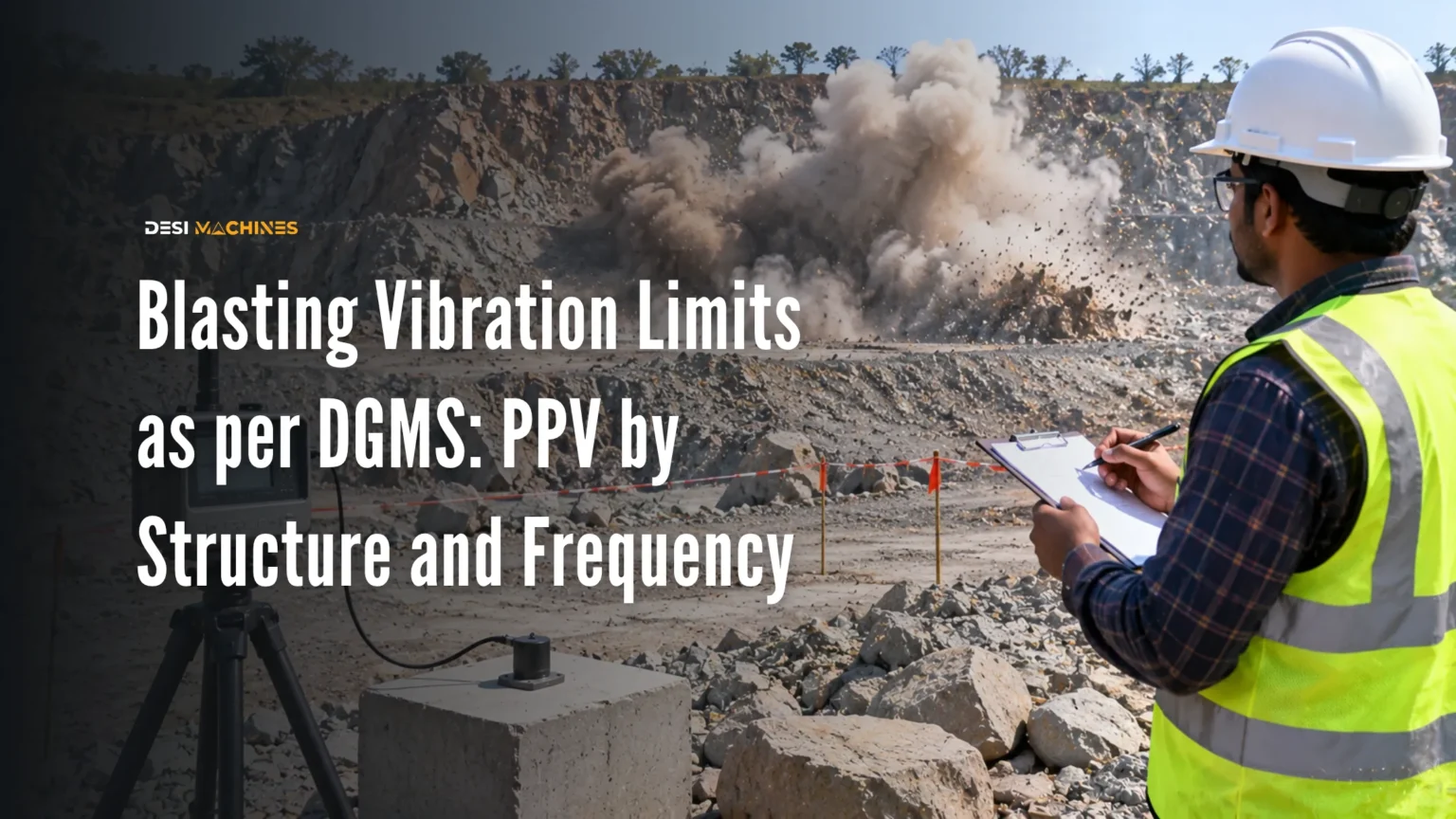
When a village beside a quarry complains of cracked walls after a blast, the DGMS test is how fast the ground under the house moved. For an ordinary mud or brick house that the mine does not own, the limit is 5 mm/s if the vibration’s dominant frequency is below 8 Hz, 10 mm/s between 8 and 25 Hz, and 15 mm/s above 25 Hz.
Those figures come from DGMS (Tech) (S&T) Circular No. 7 of 1997, dated 29 August 1997, issued by the Directorate General of Mines Safety to all mines. The circular sets a limit for five kinds of building, explains how the reading is taken with a seismograph, and lists what a mine can change in the blast to stay under it.
This guide covers the limits, what PPV (peak particle velocity) means, why frequency changes the limit, how a reading is taken and how scaled distance links the charge to the reading. How much explosive goes into each hole is worked out in the guide to powder factor in blasting.
What are the blasting vibration limits as per DGMS?
The DGMS limits are maximum values of peak particle velocity, measured on the ground next to the foundation of a building, in millimetres per second (mm/s). The circular splits buildings into two groups. Buildings that do not belong to the mine owner get the lower limits. Buildings that belong to the owner and are built only for the life of the project get higher ones, because the mine accepts that they may suffer some damage, as long as it stays repairable.
Inside each group the limit depends on the type of building and on the dominant frequency of the vibration, which is how many times the ground shakes back and forth in a second, measured in hertz (Hz).
Table 1: Permissible peak particle velocity at the foundation level of structures in mining areas, mm/s (DGMS Circular 7 of 1997)
| Type of structure | Below 8 Hz | 8 to 25 Hz | Above 25 Hz |
|---|---|---|---|
| (A) Buildings and structures not belonging to the owner | |||
| Domestic houses and structures (mud, brick and cement) | 5 | 10 | 15 |
| Industrial buildings (RCC and framed structures) | 10 | 20 | 25 |
| Objects of historical importance and sensitive structures | 2 | 5 | 10 |
| (B) Buildings belonging to the owner with a limited span of life | |||
| Domestic houses and structures (mud, brick and cement) | 10 | 15 | 25 |
| Industrial buildings (RCC and framed structures) | 15 | 25 | 50 |
The circular’s word for the mud-built house is kuchha. RCC means reinforced cement concrete. Historical monuments and sensitive structures get the tightest limit of all, 2 mm/s at low frequency, less than half of what an ordinary village house is allowed.
The circular was issued under the Mines Act, 1952. That Act has since been replaced by the Occupational Safety, Health and Working Conditions Code, 2020, in force from 21 November 2025. Indian blast-vibration studies have measured against the 1997 table for years, but before you rely on it, check the limit written into your own mine’s permission and ask the regional DGMS office whether a newer circular applies.
What is PPV in blasting?
PPV, peak particle velocity, is the highest speed at which a point on the ground moves while the blast vibration passes through it. It is not the speed of the wave itself. The wave itself crosses the ground at hundreds to thousands of metres a second, while the soil under a house only moves back and forth a fraction of a millimetre at a few millimetres a second.
A blast seismograph records this movement in three directions at right angles to each other: vertical, longitudinal (along the line from the blast to the sensor) and transverse (across that line). The largest of the three readings is normally taken as the PPV. Some instruments also print a vector sum of the three, which comes out higher, so check which number a report gives before comparing it with the table.
Both Indian documents on the subject settle on velocity. The DGMS circular calls peak particle velocity the best criterion yet found for judging blast vibration damage. IS 6922:1973, the older BIS standard, says the same: the peak ground particle velocity at the structure is a good general index of damage.
Why does the vibration limit change with frequency?
The limit is lower at low frequency because buildings themselves sway at low frequency. Floors, partition walls, ceilings and windows each behave like a weight on a spring and have a natural frequency of their own, about 4 to 24 Hz according to the circular. Brick and concrete buildings generally sit between 8 and 16 Hz.
When the ground shakes at close to that frequency, the building picks up the motion and adds to it, in the way a child on a swing goes higher when pushed at the right moment. This is resonance. A low-frequency vibration with a small PPV can therefore do more harm than a high-frequency one with a bigger PPV.
Frequency also depends on the kind of blasting. The US Federal Highway Administration’s rock blasting manual notes that construction blasting tends to give high-frequency vibration, while large surface mine blasts tend to give low-frequency vibration, the range that houses respond to most. That is one reason distance alone does not settle whether a blast is safe.
Figure 1: DGMS limits for buildings not owned by the mine, by dominant frequency
0102030
PPV limit, mm/s
5102
10205
152510
Below 8 Hz8 to 25 HzAbove 25 Hz
Domestic houses
Industrial (RCC, framed)
Historical, sensitive
Yellow bars are domestic houses, blue bars industrial RCC and framed buildings, red bars objects of historical importance and sensitive structures. All three are the not-owned group, part (A) of Table 1. Every limit doubles or more from the lowest frequency band to the highest.
What damage does blasting vibration cause to buildings?
Blasting vibration damage starts as fine plaster cracks and, at high levels, can weaken the structure itself. The DGMS circular grades it in four steps.
Table 2: The four categories of blast damage in DGMS Circular 7 of 1997
| Category | What it looks like |
|---|---|
| No appreciable damage | No noticeable cracks |
| Threshold damage | Fine cracks, fall of plaster, old cracks opening and lengthening, joints loosening, loose objects dislodged |
| Minor damage | Surface damage that does not affect the strength of the building: hairline cracks in masonry around openings and near partitions, broken windows, loose mortar falling |
| Major damage | Several large cracks, serious weakening of the building, shifting of the foundation, fall of masonry |
Not every crack near a quarry is a blast crack. The circular points out that all buildings crack from heat, humidity, wind and changes in soil moisture, and that old cracks in mud houses widen with the seasons whether or not anyone blasts. Blast vibration can then widen and lengthen cracks that were already there. In brick houses the cracks show up where walls meet each other or the roof, and at window corners. Multi-storey buildings are more sensitive than single-storey ones, and steel structures take the most.
This is why IS 6922 advises a survey of existing cracks in nearby buildings before blasting starts, with telltales (small markers fixed across a crack) so that any later widening can be measured, not argued over.
How is blasting vibration measured?
Blasting vibration is measured with a blast seismograph, a battery-run instrument with a three-direction sensor (a triaxial transducer, often called a geophone) that starts recording on its own when the ground moves. The DGMS circular asks for an instrument that is light, portable and digital, with sensors that read evenly up to 500 Hz and record particle velocities up to 100 mm/s.
A reading is taken like this:
- Place the sensor on solid, undisturbed ground near the building, pressed well into contact with the ground. Loose fill or a hollow floor gives a false reading.
- To see how the building itself responds, fix sensors horizontally on its walls, floors and ceiling as well.
- Set the trigger level so the instrument wakes up with the blast, then fire the blast as planned.
- Read the record. It shows three traces, one for each direction, and often a fourth for sound. The highest peak gives the PPV, and the spacing of the waves gives the frequency.
- Compare the PPV, at its frequency, with the right row of Table 1.
For a study good enough to set safe charges, the circular asks for at least 15 observation points from at least 10 blasts, analysed by least squares regression, the standard way of fitting a line through scattered readings.
What is scaled distance, and how is PPV predicted from it?
Scaled distance is the distance from the blast to the building divided by the square root of the largest charge fired in any one delay. In metric units it is written in m/kg½. A bigger scaled distance means a smaller vibration.
Scaled distance = D ÷ √Q, where D is the distance in metres and Q is the maximum charge per delay in kg.
The DGMS circular uses this square-root form when the blast and the measurement are both on the surface, or both underground. When the blast is on the surface and the reading is taken underground, it uses the cube root of the charge instead.
The charge that counts is the charge per delay, not the whole blast. Holes fired at the same instant act as one big charge. Delay detonators fire the holes one after another, so each delay’s charge shakes the ground on its own. That is how a large blast can stay inside the limit.
To predict PPV, the mine fits its own readings to a curve of the form PPV = K × (scaled distance)−B. K and B are site constants, and they change with rock, soil and blast design, so they must come from blasts measured at that site. A figure copied from another mine is a guess.
The arithmetic below shows how quickly the charge per delay matters. Without knowing K and B it does not tell you the PPV, but it shows the trend.
Table 3: Scaled distance for a building 200 m from the blast, and the distance needed to hold a scaled distance of 20 m/kg½
| Maximum charge per delay | Scaled distance at 200 m | Distance needed for a scaled distance of 20 |
|---|---|---|
| 25 kg | 40.0 | 100 m |
| 50 kg | 28.3 | 141 m |
| 100 kg | 20.0 | 200 m |
| 200 kg | 14.1 | 283 m |
Doubling the charge per delay cuts the scaled distance by about 30 per cent. To get it back, the building would have to be about 41 per cent further away. Since the building cannot move, the charge per delay is what changes.
How does a quarry keep blasting vibration within the limit?
A quarry stays within the limit mainly by cutting the charge fired per delay and by designing the blast so that more of the explosive breaks rock and less shakes the ground. The circular notes that only 20 to 30 per cent of the energy of commercial explosives goes into breaking rock in mines. The rest travels into the ground.
The measures the circular lists are:
- a safe charge per delay, worked out from the site’s own readings
- in-hole delays with non-electric initiation, so holes fire one after another
- the right burden (the rock between a hole and the free face) and holes inclined to match the slope of the bench, covered in the guides to blast hole drilling and bench height in opencast mining
- deck charges and air decks, which split the charge in a hole into parts separated by stemming or an air gap
- sequential blasting and proper stemming (the inert material packed into the top of the hole)
- clearing loose rock from the blast site, and controlled blasting with muffling of the holes, which also stops flyrock
The circular also asks for a plan of the area marking owned and not-owned buildings in different shades, with their construction details, and zones at 50 m, 100 m, 200 m and 300 m around them. Where deep-hole blasting is being brought near houses for the first time, a research or academic institute should run experimental blasts well before the houses fall inside the blasting danger zone, and its report sets the safe charge for each zone. After that the mine is expected to monitor its own blasts and train its blasting crew to do it. Some explosives makers and blasting service firms offer vibration monitoring along with blast design; the post on explosives companies in India lists them.
When even a small charge per delay cannot stay under the limit, for example at a quarry face right next to a temple or a school, the rock has to be broken without explosives. An excavator fitted with a hydraulic rock breaker breaks it piece by piece, and softer, layered rock can be ripped by a dozer. Both are slower than blasting, and neither fires an explosive charge, which is what the DGMS limits are written for.
Breaking rock near houses? Compare rock breakers for excavators and talk to a dealer about the right carrier for your face.
How do the DGMS limits compare with IS 6922?
IS 6922:1973 allows far higher vibration than the DGMS circular, because it was written for a different job. The BIS standard deals with blasts in drill holes below the ground surface, which it calls underground blasting, near engineered structures such as buildings, bridges, retaining walls and dams in brick, stone and concrete. Its limit for threshold damage is 50 mm/s on soil, weathered or soft rock and 70 mm/s on hard rock when the velocity is calculated from its formula, and 70 and 100 mm/s when it is measured by monitoring.
The DGMS table is built around people living next to mines: mud and brick houses, old cracked walls, historical buildings, and the low-frequency vibration that large opencast blasts give. That is why its lowest figure is 2 mm/s and its domestic limit starts at 5 mm/s. For a mine or quarry near homes, the DGMS figure is the one to plan to.
Table 4: DGMS Circular 7 of 1997 and IS 6922:1973 side by side
| Point | DGMS Circular 7 of 1997 | IS 6922:1973 |
|---|---|---|
| Written for | Surface structures near mines | Structures near drill-hole blasts in rock excavation and quarrying |
| Measure used | Peak particle velocity, by dominant frequency | Peak ground particle velocity |
| Depends on frequency? | Yes, three bands | No |
| Lowest limit | 2 mm/s (historical, below 8 Hz) | 50 mm/s (soil or soft rock, calculated) |
| Ordinary houses | 5 to 15 mm/s if not owned by the mine | No separate class |
| Survey before blasting | Plan of structures and 50 to 300 m zones | Survey of existing cracks with telltales |
Blast design starts with the drilling, so read blast hole drilling and then powder factor. The permissions a stone quarry needs before its first blast are in the guide to quarry lease in India, the machines a quarry runs on are in quarry equipment, and the difference between opencast and underground working is in types of mines. More guides are on the mining guide hub.
Loading blasted rock at the face? Browse mining excavators and connect with a dealer near your site.
Where the figures in this guide come from. The limits, damage categories, natural frequencies, instrument and survey rules and the control measures are from DGMS (Tech) (S&T) Circular No. 7 of 1997, read in full; a copy is published by CMPDI, Coal India’s planning and design arm. The table was checked against Table 4 of a 2021 Current Science paper on blast vibration near an opencast mine, which reproduces it with the same values. The comparison figures and the crack survey advice are from IS 6922:1973, Criteria for Safety and Design of Structures Subject to Underground Blasts, clauses 0.4, 3.2 and 4.1. The note on frequency by type of blasting is from the US Federal Highway Administration’s Rock Blasting and Overbreak Control manual (FHWA-HI-92-001), chapter 10. Table 3 is our own arithmetic.
Prices, specifications and features are indicative, vary by variant, location and date, and should always be confirmed with the official OEM or authorised dealer before any purchase decision. DesiMachines is not liable for decisions taken on the basis of information that may have changed after publication.
Machines, tenders and news for this industry: Mining · Quarry
