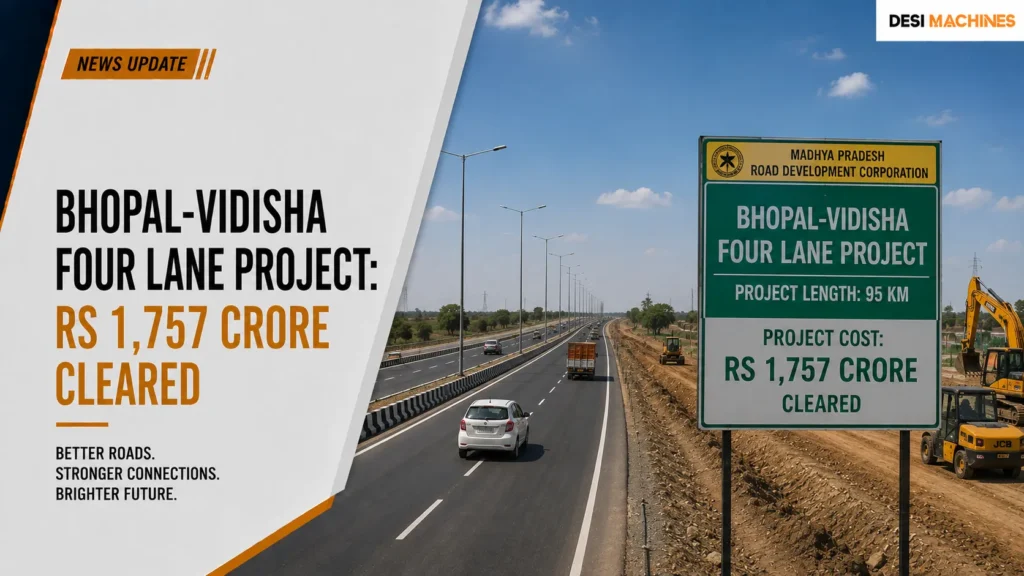
Madhya Pradesh has cleared Rs 1,757.55 crore to widen the 44.83 km Bhopal-Vidisha road to four lanes with paved shoulders. For anyone running earthmoving or paving iron in central Madhya Pradesh, the number that matters is not the headline. It is the division: roughly Rs 39 crore a kilometre on a road that already exists, which tells you where the money is going and which machines will actually be on site.
The quick facts
- Rs 1,757.55 crore sanctioned by the Madhya Pradesh cabinet on 11 August 2026, chaired by Chief Minister Mohan Yadav.
- 44.83 km, upgrading the existing two-lane Bhopal-Vidisha road to four lanes with paved shoulders.
- Runs from the Bhanpur T-junction on Bhopal’s Ayodhya Bypass to the Sanchi-Salamatpur junction, through Choprakala, Sukhi Sevaniya, Dob, Balrampur and Deewanganj.
- Same cabinet sitting also cleared six-laning of the Bhopal bypass, alongside a Rs 47,990 crore spending package across health, forestry and agriculture.
What Madhya Pradesh approved
The sanction came out of the 11 August cabinet meeting in Bhopal. Amar Ujala’s Bhopal desk carried the decision with the full alignment and the exact figure, and the ANI wire filed the same cost and length the same evening. Neither the tender nor the execution model has been published yet, though several carriers describe the project as a hybrid annuity job. Until the bid document appears, treat the model as unsettled.
What does Rs 39 crore a kilometre actually buy?
Divide the sanction by the length and you get about Rs 39.2 crore per km. That is a heavy rate for widening a road that is already there. Compare it with two sanctions we covered recently: Assam’s Guwahati-Tezpur corridor ran near Rs 66 crore a km, but that is an access-controlled greenfield build with 45 bridges and 19 flyovers. Rajasthan’s missing-link programme came in at roughly Rs 32.7 lakh a km, which is patch and repair work.
This one sits nowhere near either. A straight two-to-four-lane widening does not normally cost this much, so most of the money is sitting somewhere other than pavement. On a corridor that leaves Bhopal’s Ayodhya Bypass, threads past settlements at Sukhi Sevaniya and Deewanganj, and lands at Sanchi, the obvious candidates are land, utility diversion, service roads, drains and structures.
Our take: read this as an urban-interface job, not a haulage job. The mass earthmoving window on 45 km of existing formation is short and will close inside the first year. What runs long is the concrete and the constrained work: piling and cranes at grade separators, batching plants and transit mixers, and small-footprint backhoe loaders doing drain and utility work in traffic. Fleet owners who bid this expecting eighteen months of bulk cut-and-fill will be idle by month ten.
The classes that do earn their keep across the full term are pavers, tandem and pneumatic compactors, and motor graders for shoulder and service-road formation. Hydraulic excavators in the 8 to 21 tonne band suit this better than the 30 tonne class, because the work is trenching, benching and structure excavation rather than borrow-pit output. If you own big iron, this corridor is a hire-out opportunity for a season, not a reason to add units.
What to watch
- The tender and its execution model. A hybrid annuity award pushes mobilisation out by months against a straight EPC package.
- Package splitting. If 44.83 km is let as two or three packages, the fleet requirement per winner drops sharply and the hire market opens up.
- The Bhopal bypass six-laning cleared at the same meeting. Two overlapping jobs on the same city edge would tighten local availability of pavers and transit mixers.
Pricing a fleet for this corridor? Compare excavator, grader and compactor models on specification and running cost before you commit, and check finance terms on DesiMachines before the tender lands.
FAQ
When will work on the Bhopal-Vidisha four lane project start?
No start date has been announced. The cabinet approved the money on 11 August 2026; tendering, award and land handover come after that, and none of those stages has been notified.
Which machines will the project need most?
Pavers, compactors and motor graders run across the full build. Excavators and backhoe loaders concentrate in the early earthwork, drainage and utility-shifting phase. Piling rigs, cranes and concrete plant follow at the structures.
Is the execution model confirmed?
Not from an official document. Carriers describe it as a hybrid annuity project, but the state has not published a tender, so the model and the package split remain open.
Related on DesiMachines: Rajasthan Missing Link Roads: Rs 2,101 Crore for 3,232 Roads
Source: Amar Ujala

 Excavator
294 models
Excavator
294 models  Backhoe Loader
51 models
Backhoe Loader
51 models  Crane
68 models
Crane
68 models  Concrete Mixer
79 models
Concrete Mixer
79 models  Wheel Loader
54 models
Wheel Loader
54 models  Compactor / Roller
45 models
Compactor / Roller
45 models  Motor Grader
42 models
Motor Grader
42 models  Concrete Pump
66 models
Concrete Pump
66 models  Skid Steer Loader
11 models
Skid Steer Loader
11 models  Telehandler
13 models
Telehandler
13 models  Dozer
Dozer