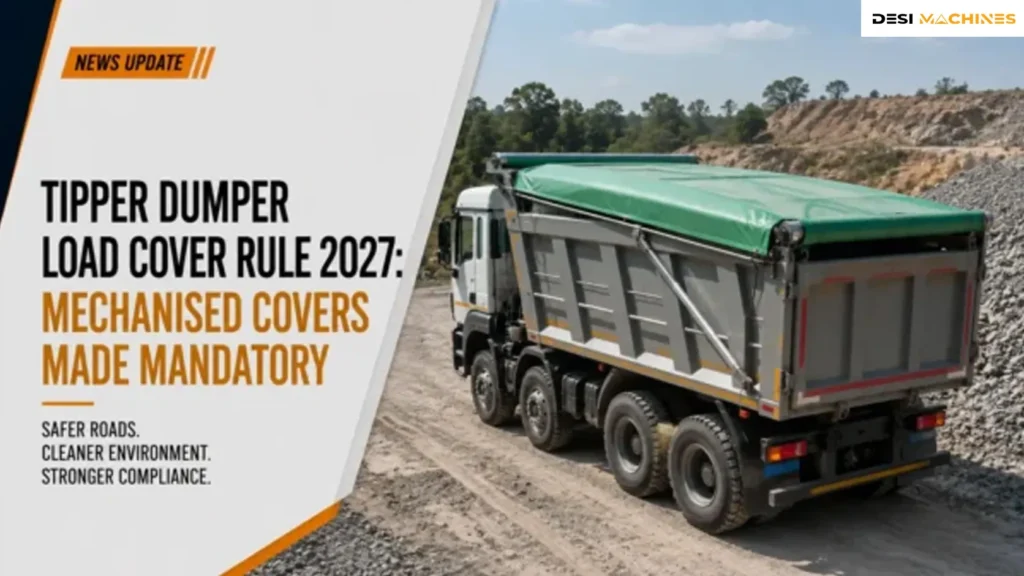
If you run tippers or dumpers, the Central Motor Vehicles Rules have just picked up a line item that will land on your next body-building invoice. From 1 April 2027, every tipper and dumper on Indian roads must carry a mechanised cover over its load body, plus an alert in the cab that tells the driver when that cover is open. That is about seven months of ordering time away, which makes the tipper dumper load cover rule 2027 a specification question now rather than a compliance scramble later.
The quick facts
- The Ministry of Road Transport and Highways has notified the Central Motor Vehicles (Twelfth Amendment) Rules, 2026 through G.S.R. 712(E), dated 28 July 2026.
- A new Rule 138-B requires every tipper and dumper to carry a mechanism that covers the load body from the top and fully encloses the material being carried.
- The cover may be electrically, electro-mechanically, hydraulically or mechanically operated, and an audio-visual warning inside the cab must tell the driver if it is left open while the vehicle is moving.
- Rule 93 has been amended so the containment system is left out when the vehicle’s overall height is measured. Compliance date: 1 April 2027.
What the ministry notified
The amendment closes a consultation that opened with a draft in March 2026. Autocar Professional, whose policy desk carried it first, reports the mandate as covering tippers and dumpers, with the ministry framing it around spillage and dust thrown off construction and mining loads. Millennium Post and Autopunditz carry the same notification number, the same 1 April 2027 date and the same two technical requirements. No penalty schedule specific to Rule 138-B appears in any of the reports we read.
Who actually pays for this?
Not the chassis price list, in most cases. An Indian tipper is usually a chassis from a truck maker with a load body fabricated locally, so a powered cover and a cab alert are a body-shop and wiring job. Expect it in the fabricator’s quote and in the on-road price of a fully built tipper, not as a headline revision from the truck OEM. Ask your body-builder for a cover-inclusive quote before signing anything for delivery near the deadline.
What it means for buyers
The most useful clause in the amendment is the quiet one. Tipper bodies here are built right up to the statutory height limit because every extra inch is volume, and volume is what a haulage rate is priced on. A cover mechanism bolted on top would normally have pushed the vehicle over that limit and forced a shallower body. By taking the containment system out of the height calculation under Rule 93, the ministry has kept the payload where it was. Capacity preserved, cost added, rather than both.
The second thing to sort out is scope. This sits inside the Central Motor Vehicles Rules, which follow road registration, so a rigid off-highway rear dump truck inside a mine lease is a different animal from a registered on-road tipper. Confirm which side of that line your machine sits on before budgeting. And if you are quoting aggregate or overburden haulage into 2027-28, client tenders may ask for compliant fleets well before the state transport departments do.
Our take: a modest per-vehicle cost with an awkward timing edge. A tipper ordered late in 2026 for delivery early in 2027 gets registered just ahead of the date and could look dated on a resale forecourt beside a compliant unit. If your replacement cycle lands near next April, specifying the cover now beats retrofitting later, and it protects the residual. Fold the body cost into the loan rather than paying it separately, and our equipment finance guide covers how that shifts the margin money. Nothing here touches the loading side: excavators and backhoe loaders sit under the separate BS-CEV emission framework, not the CMVR line this amendment amends.
What to watch
- Whether the gazetted text binds already-registered tippers and dumpers or only new vehicles from the compliance date. The reports do not settle it, and it is the single question worth asking your RTO.
- Body-builder quotes for a powered cover and cab alert once fabricators price the requirement, which is when the real per-vehicle number becomes visible.
- Any state enforcement drive ahead of April 2027, and whether large aggregate and mining buyers start writing compliance into haulage contracts first.
Planning a fleet purchase before the deadline? Compare machine classes, sizes and running costs on DesiMachines before you commit, and check what the finance side looks like. Start with our machine comparison tool.
FAQ
When do mechanised load covers become mandatory for tippers and dumpers?
From 1 April 2027, under the Central Motor Vehicles (Twelfth Amendment) Rules, 2026, notified through G.S.R. 712(E) dated 28 July 2026.
Will the cover reduce my load body height or payload?
It should not. Rule 93 has been amended so that the load-body containment system fitted under Rule 138-B is excluded when the overall height of a tipper or dumper is determined, which is what stops the mechanism from eating into body depth.
Does this apply to a tipper I already own?
The reports describe the requirement as applying to tippers and dumpers on the road from 1 April 2027, but they do not spell out how already-registered vehicles are treated. Confirm that with your regional transport office and your body-builder before planning a retrofit.
Related on DesiMachines: Tipper, dumper or backhoe: which one actually earns more on the money you put in
Source: Autocar Professional

 Excavator
294 models
Excavator
294 models  Backhoe Loader
51 models
Backhoe Loader
51 models  Crane
68 models
Crane
68 models  Concrete Mixer
79 models
Concrete Mixer
79 models  Wheel Loader
54 models
Wheel Loader
54 models  Compactor / Roller
45 models
Compactor / Roller
45 models  Motor Grader
42 models
Motor Grader
42 models  Concrete Pump
66 models
Concrete Pump
66 models  Skid Steer Loader
11 models
Skid Steer Loader
11 models  Telehandler
13 models
Telehandler
13 models  Dozer
Dozer