
 Excavator
294 models
 Backhoe Loader
51 models
 Crane
68 models
 Concrete Mixer
79 models
 Wheel Loader
54 models
 Compactor / Roller
45 models
 Motor Grader
42 models
 Dozer
41 models
 Concrete Pump
66 models
 Skid Steer Loader
11 models
 Telehandler
13 models


Cold milling of bituminous pavement is the removal of the top of an old bitumen road to a fixed depth, at normal air temperature, by a machine with a spinning steel drum covered in carbide-tipped teeth. It takes off the cracked, rutted or bleeding layer, keeps the road at its old level, and leaves a rough, clean face that a new layer can grip.
Site engineers also call it milling, cold planing or profiling. The Indian Roads Congress covers it in section 6.1 of IRC:120-2015, Recommended Practice for Recycling of Bituminous Pavements, and the MoRTH Specifications for Road and Bridge Works (Fifth Revision) call for it in clauses 501.8 and 519. The limits on this page come from those two documents. Where a contract sets its own figures, the contract wins.
What is cold milling of bituminous pavement?
Cold milling is the controlled removal of an existing bituminous layer to a depth decided in advance. IRC:120 describes the tool: replaceable tungsten carbide cutting teeth mounted on a rotor drum, driven by the milling machine’s own engine. The code calls milling the most common way of taking back old bituminous material from a road.
The word cold separates it from hot milling. In the cold process the road is cut as it stands. In the hot process, which MoRTH clause 519.4.2 describes, the surface is first heated by infrared or hot air and a milling drum follows to lift the softened layer, with the road surface not allowed above 200 °C for more than 5 minutes. Hot milling is part of hot in-place recycling, a different job done by a train of special machines.
Three words come up on every milling job. Millings are the broken pieces the machine lifts off the road. Plant operators call them RAP, short for reclaimed asphalt pavement; IRC:120 uses RBM, reclaimed bituminous material, for the same thing. An overlay is the new bituminous layer laid on top once milling is done.
Why is a road milled before a new layer goes on?
A road is milled first so the new layer goes onto sound material at the right level. Laying fresh bitumen straight over a damaged road saves work on the day, but ruts and cracks in the old layer tend to show through the new one.
There are five common reasons to mill:
- To hold the levels. Every overlay raises the road. Kerbs, drain inlets, manhole covers, bridge expansion joints and the clearance under a flyover do not move. Overlay after overlay without milling slowly buries the kerb and leaves drain inlets standing above the road. Milling the old layer off first keeps the finished road at its old height.
- To remove damage that would copy into the new layer. Ruts (grooves pressed into the wheel paths), bleeding (bitumen rising to the surface and turning it shiny and soft) and ravelling (stones coming loose) all sit in the top layer. Cover them and the new layer cracks or ruts along the same lines.
- To take off high spots. MoRTH clause 501.8.3.4 says any high spots in the existing black-topped surface shall be removed by a milling machine or another approved method before the profile corrective course, the layer that corrects the road’s shape, goes down. If that correction is 40 mm or less at its thickest, MoRTH lets it be laid as one with the overlay; above that it is a separate layer.
- To give the new layer a grip. A milled face is rough and clean. IRC:120 asks for a texture that gives a good bond when a new layer is laid over it.
- To recover material. The millings are stone already coated in bitumen. Kept clean, they go back into new mix and save fresh aggregate and binder.
How does a milling machine cut the road?
A milling machine cuts by hammering the road with teeth on a fast-turning drum. IRC:120 gives the drum speed as about 200 rpm. Each tooth strikes the surface and breaks it, ripping through the mastic, the bitumen-and-fines paste that holds the stones, and through some of the stones as well.
The teeth are set in tool holders that run round the drum in spiral rows. The spiral moves the broken material toward the centre of the drum, where a conveyor picks it up. On most modern machines the conveyor runs out of the front and drops the millings straight into a tipper driving ahead of the machine. Water is sprayed onto the drum as it turns, to cool the teeth and to keep dust down. IRC:120 lists dust control as one of the things a milling job must plan for.
The cutting depth is held by sensors that follow a string line, a laser or the old road beside the cut. Machines with automatic depth control can hold the cut to within about 5 mm of the target level.
Two settings decide the size of the millings: the depth of the cut and the forward speed of the machine. IRC:120 adds a third, the gradation bar on the machine, which limits how big the pieces can be. Because the teeth break some of the stones, millings always come out finer than the layer was when it was laid.
The teeth wear out and are changed. How often depends on the type and hardness of the material being cut, and the interval can be anything from a few hours to several days. A tooth that hits a manhole cover or a buried valve chamber can break its holder as well.
Milling machines are specialist machines that most contractors hire; why a machine used a few times in a contractor’s life is almost always hired is set out in the guide to the equipment rental market in India.
How deep is a road milled?
No single milling depth is standard. The depth is shown on the contract drawings and comes from the road investigation: you mill as deep as the damage goes, and no deeper.
The layer thicknesses in MoRTH give a feel for the numbers. A bituminous concrete (BC) wearing course goes down in a single layer 30 mm, 40 mm or 50 mm thick under clause 507.1, and a single layer of dense bituminous macadam (DBM) is 50 mm to 100 mm thick under clause 505.1. Taking off a worn wearing course is a cut in the first range. A cut that reaches into the DBM below is deeper. How these layers stack from the soil up is in the guide to road construction layers.
IRC:120 adds a check that is easy to miss. After the cut, look for scabbing: thin, weakly bonded slivers of the old layer left stuck to the milled face. If you find them, the code says the milling depth should be adjusted to take the scab off, because an overlay laid on it performs poorly.
If the cracks run all the way through the bitumen into the stone base, milling the top is not enough. The road then needs its base rebuilt, and full depth reclamation, which works 100 mm to 300 mm deep, is explained in the guide to FDR technology in road construction.
Table 1: Cold milling figures and limits at a glance
| What it covers | Figure or limit | Source |
|---|---|---|
| Milling drum speed | About 200 rpm | IRC:120 clause 6.1 |
| Finished milled surface | Within 6 to 8 mm of the true profile, along and across the road, under a 3 m straightedge | IRC:120 clause 6.1 |
| Rubbish in the millings (soil, base, fabric, debris) | 1% at most | IRC:120 clause 6.1 |
| Fines in millings (passing the 75 micron sieve) | Typically 10% to 20% | IRC:120 Annex 1, Appendix 3 |
| Height of a millings stockpile | 3 m at most | MoRTH clause 519.4.3 |
| Profile correction laid as one with the overlay | Up to 40 mm at its thickest | MoRTH clause 501.8.3.4 |
| Tack coat on a bituminous surface | 0.20 to 0.30 kg per m² | MoRTH Table 500-5 |
| Hot milling surface temperature | Not above 200 °C for more than 5 minutes | MoRTH clause 519.4.2 |
What should a milled surface look like?
A good milled surface is level, evenly textured and free of loose material. IRC:120 sets the level: within 6 to 8 mm of the true profile, both along and across the road, when checked with a 3 m straightedge laid on the surface.
The texture should look the same across the whole width. Worn or broken teeth on the drum leave a patchy finish with deeper grooves in places. That makes a thin overlay hard to compact, and IRC:120 points out a safety risk too: if the milled road is left open to traffic, a deep and uneven texture can be dangerous for motorcycles. Where traffic runs on the milled face, the engineer should cap the peak-to-valley depth of the grooves.
Sometimes the milled surface is the final surface, with no overlay. IRC:120 then asks for continuous or broken grooves, or another approved pattern, so tyres get enough grip. A finer finish comes from micro milling, which uses a special drum carrying three to four times as many teeth as a normal one.
Before the overlay, the milled face is swept and blown clean, and a tack coat, a thin spray of bitumen emulsion that glues the new layer to the old, goes on. MoRTH Table 500-5 sets 0.20 to 0.30 kg per m² on a bituminous surface. How the spray is checked on site, with a tray test, is in the guide to prime coat and tack coat.
What happens to the milled material (RAP)?
Millings go to a stockpile and come back as part of a new bituminous mix. IRC:120 calls them the most valuable material in the plant yard and sets rules for keeping them that way.
Keep them clean. Deep cuts and milling on shoulders are where soil, base stone and old paving fabric get in, and contaminated millings should be used only as shoulder material and stockpiled separately. Tipper drivers should clean their truck beds before they haul millings, and should be told where to tip so building rubble never lands on the RAP pile. The loader operator at the yard watches the pile and digs out any rubbish at once.
Keep the pile low. MoRTH clause 519.4.3 limits a stockpile of reclaimed bituminous material to 3 m in height.
Do not crush them more than you must. Millings from one job are usually very even in grading and binder content, and they already carry 10% to 20% fines from the milling itself. IRC:120’s advice is to use them as they come, or screen out the oversize pieces. Crushing is the last choice, because it makes more dust and leaves more stone faces with no bitumen on them.
The old bitumen in the millings has hardened with age. When it goes back into hot mix, softer fresh bitumen or a rejuvenator, an additive that softens old binder, brings the blend back to the grade the job needs; the grades themselves are explained in the guide to bitumen grades for road construction. MoRTH clause 519 sets the checks:
- For estimating, a bituminous macadam or DBM mix made in a central plant is assumed to take no more than 60% reclaimed material (clause 519.2.1).
- Above 10% reclaimed material, the binder recovered from the millings must show a penetration value above 15 before mixing (clause 519.2.5).
- At least one sample is taken for every 500 m of two-lane carriageway (clause 519.2.2).
IRC:120 is more cautious for hot in-plant recycling, where millings are mixed with fresh stone and bitumen in a hot mix plant: not more than 50%, and 30% is the widely accepted share. In cold in-place recycling the milling and the mixing happen in one pass of a single machine or train, and the material never leaves the road.
Is milling better than scarifying or breaking the old layer?
Milling is the better way to take off a bituminous layer when the levels matter or the material is to be reused. The other methods still have their place, and the table shows where each one fits.
Table 2: Ways to remove an old bituminous layer
| Method | How it works | Suits | Limits |
|---|---|---|---|
| Cold milling | A toothed drum cuts the layer to a set depth and loads it into tippers | Full lanes, city roads where levels must hold, jobs where the RAP will be recycled | Needs a hired milling machine and enough tippers; covers and chambers must be marked first |
| Scarifying or ripping | Scarifiers, grid rollers or rippers break the layer, which is loaded and hauled for crushing (MoRTH 519.4.1) | Thin or granular surfaces, rural roads | Lumps must be crushed before reuse; MoRTH 501.8.3.2 asks for any disturbed layer below to be reworked and compacted |
| Breaking out with a backhoe loader, excavator or dozer | The machine breaks the old layer out in pieces (IRC:120 clause 6.2) | Small patches and failed spots | Slow; large lumps that need re-crushing and turn sticky in hot weather; can damage the layer below |
| Hot in-place recycling | The surface is heated, milled, remixed and relaid in one train | Surface damage only | No more than 50 mm of bituminous layer, 75 mm if a softer binder was used originally (IRC:120 clause 1.10) |
| Full depth reclamation | The whole pavement is pulverised and stabilised in place as a new base | Cracks that reach the stone base | A base, not a surface; always gets a new wearing course |
For patch work the backhoe loader is still the everyday machine. A backhoe loader such as the JCB 3DX digs out failed spots down to firm material, cleans up around kerbs and loads the debris, while the milling machine handles the running lanes.
Which machines work in a milling and overlay job?
A milling and overlay job runs as one train of machines, each keeping pace with the next.
Figure 1: The order of work on a milling and overlay job
1. Mark covers and set the depth 2. Mill and load tippers 3. Check level and texture 4. Sweep and blow clean 5. Spray tack coat 6. Pave the overlay 7. Roll: breakdown, intermediate, finish
The milling machine leads, with tippers queued for the millings. A late tipper stops the milling machine and everything behind it. A mechanical broom and an air blower clean the cut, and a bitumen distributor sprays the tack coat. The paver lays the new mix, fed by tippers from the hot mix plant, where a wheel loader keeps the cold feed bins full and moves the RAP stockpile.
Rolling follows MoRTH clause 501.6, exactly as on any new bituminous layer. Breakdown rolling is done with 8 to 10 tonne smooth-wheel rollers. Intermediate rolling uses the same class, a vibratory roller, or a pneumatic-tyred roller of 12 to 15 tonnes with tyre pressure of at least 0.56 MPa. Finish rolling uses 6 to 8 tonne smooth-wheel tandem rollers. Rollers stay under 5 km per hour and overlap each pass by at least a third of the roll width.
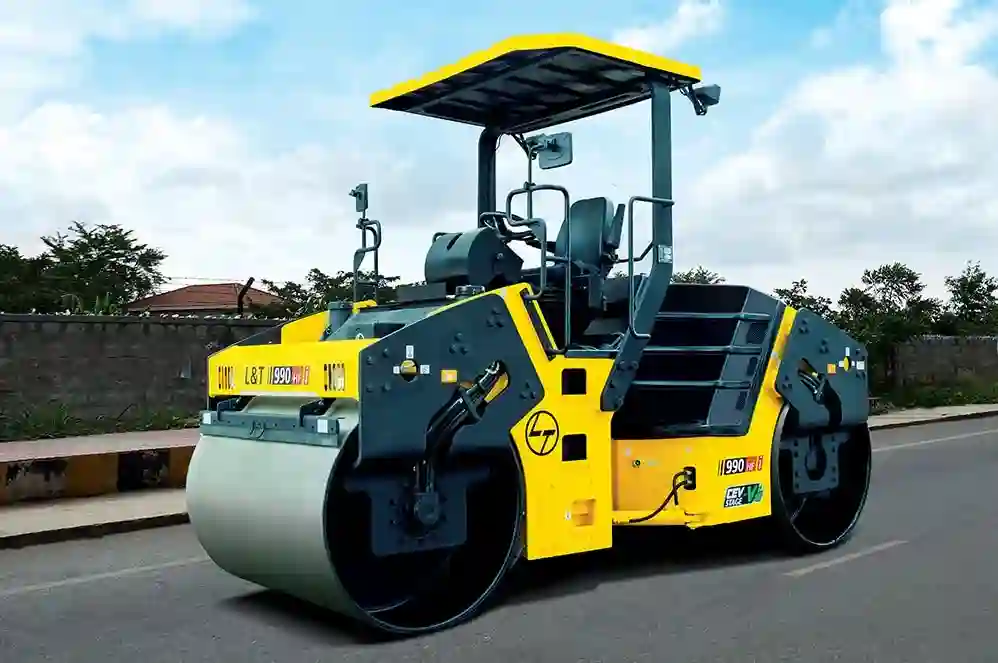
By operating weight, the L&T 990HFi at 9,200 kg (9.2 tonnes) and the Volvo DD90 at 8,700 kg (8.7 tonnes) sit in that 8 to 10 tonne band, as per their current Oct 2026 listings. MoRTH speaks of static weight, so check that figure on the spec sheet against the contract. Compare tandem roller models and prices and talk to a dealer before the overlay starts.
What should you check before milling starts on your road?
Most milling trouble starts before the drum turns. Run through these points with the site engineer:
- The milling depth and the areas to mill are marked on the drawings, and the core results back them up.
- Every manhole cover, valve chamber and cable cover in the cut is found and marked, and raised or lowered as the drawing says.
- Water is on hand for the drum all shift.
- There are enough tippers that the milling machine never waits, and a clean stockpile site is ready at the plant.
- The contract says who owns the millings. On a MoRTH contract, reusable material is stacked where the Engineer directs, so read the contract before you sell or tip any.
- If the milled road will carry traffic overnight, the texture is safe for motorcycles and the edges of the cut are ramped and lit.
Road resurfacing and strengthening jobs that call for milling come up regularly in public tenders; see the live construction tenders to find one near your fleet. Every other topic on how roads are built, tested and repaired sits under the road construction guide.
The figures on this page are from IRC:120-2015, Recommended Practice for Recycling of Bituminous Pavements, clauses 1.10, 1.11, 6.1 and 6.2 and Annex 1, and from the MoRTH Specifications for Road and Bridge Works, Fifth Revision, clauses 501.6, 501.8, 505.1, 507.1 and 519 and Table 500-5. Before the overlay goes down, compare compactors and road rollers and connect with a dealer.
Prices, specifications and features are indicative, vary by variant, location and date, and should always be confirmed with the official OEM or authorised dealer before any purchase decision. DesiMachines is not liable for decisions taken on the basis of information that may have changed after publication. Milling requirements quoted here follow IRC:120-2015 and the MoRTH Fifth Revision and are not a substitute for the contract specification or a pavement design by a qualified engineer; machine figures are taken from our listings at the time of writing.
Machines, tenders and news for this industry: Road Construction