
 Excavator
316 models
 Backhoe Loader
54 models
 Crane
68 models
 Concrete Mixer
79 models
 Wheel Loader
65 models
 Compactor / Roller
45 models
 Motor Grader
42 models

 Concrete Pump
66 models
 Skid Steer Loader
11 models


If you have to fix potholes on an Indian road, the pothole decides the machine: its size, the traffic on the road and whether it is raining matter more than any brand. A pothole repair machine is any machine that cuts, cleans, fills or compacts the hole, and IRC:82-2015, the Indian code for maintaining bitumen roads, names the main types: the jet patcher (velocity spray injection), infrared road patching, machines that mix cold mix on the spot, mobile maintenance vans, and the plain kit of hot or cold premix with a pavement cutter and a plate compactor or small roller.
Each one suits a different job. A jet patcher fills a wet hole on a busy highway quickly and needs no roller. Infrared heating melts the old surface into the new patch and leaves no joint, but the hole still has to be dug out and rolled. Cold mix from a small mixer is the everyday answer for town roads and village roads. Hot premix with a proper cut, tack coat and roller gives the strongest patch, in dry weather.
This guide is for a road contractor, a PWD or municipal engineer, or a small contractor bidding for road maintenance work. It explains how each machine works, which pothole and season it suits, how the IRC:82 steps of cut, clean, tack, fill and compact change with each one, and which compaction machine the patch needs. No prices are quoted here.
What machines are used for pothole repair?
Five kinds of machine do most pothole work in India, and IRC:82-2015 lists all of them in section 11. They differ in how the hole is filled: with mix sprayed in by air, with old asphalt heated back to life, with cold mix made on the spot, or with hot or cold premix placed and compacted by hand and machine.
| Machine or method | How it fills the hole | Mix used | Roller needed? | Best on |
|---|---|---|---|---|
| Jet patcher (velocity spray injection) | Blows water and dirt out with air, then sprays emulsion-coated stone into the hole | Bitumen emulsion and small stone, mixed in the nozzle | No, a dry stone layer goes on top | Busy roads, wet weather, many holes in a day |
| Infrared road patching | Heats the old asphalt in and around the hole until it is soft, then reworks it with some fresh mix | The old asphalt plus a little hot mix and a rejuvenating oil | Yes | Cracks and shallow potholes on a sound road |
| Spot cold-mix machine | Mixes cold mix at the roadside, which the crew places and compacts | Emulsion cold mix | Yes: rammer, plate compactor or small roller | Town and village roads, small and medium holes |
| Mobile maintenance unit | A truck or van carrying the mix, binder sprayer, cutter and compactor together | Hot or cold mix | Yes, carried on board | A maintenance gang covering a long stretch |
| Conventional patching kit | Hole cut square, cleaned, tacked and filled with premix by hand | Hot premix, or cold readymade mix | Yes: plate compactor or small roller | Deep holes and big patches, where the patch must last |
There is also a newer class of machine that does only the preparation. The JCB Pothole Pro, marketed in the UK, is a wheeled machine with a 600 mm planer, a 400 mm cropping tool and a 1,200 mm sweeper that cuts the hole square and cleans it, after which a crew fills it with asphalt. IRC:82’s own kit list does the same cutting job with an air compressor and a pavement cutter, and a cold planer on a skid steer loader can do it too.
How big is a small, medium or large pothole?
IRC:82-2015 sorts potholes into three sizes by depth and width, and the size is the first thing that points to a machine. A small hole can be filled in one go by any method. A large one is deeper than a typical surface course and is usually filled in layers.
| Size | Depth | Width |
|---|---|---|
| Small | 25 mm | 200 mm |
| Medium | 25 to 50 mm | 500 mm |
| Large | More than 50 mm | More than 500 mm |
The code also says why potholes form. The most common cause is water getting into the road and the bitumen losing its grip on the stone, after which traffic plucks the loose stone out. A weak bond between the bitumen surface and a water bound macadam base, too little bitumen in one spot, or a thin surface on a road with poor camber can all start one. The full list of road defects and their causes is in the guide to pavement failure.
That cause matters when you pick a machine. If water in the base made the hole, no machine will make the patch last until the drainage is fixed.
How does a jet patcher machine work?
A jet patcher, also called a velocity patching or spray-injection machine, fills a pothole by blowing material into it with air. The machine carries bitumen emulsion, small stone and a blower, and an operator aims a nozzle at the hole.
The repair runs in three stages. First the blower alone blasts water, dust and loose stone out of the hole. Then emulsion is added to the air stream and the stone is coated as it shoots out of the nozzle, so the hole fills with fresh mix. Last, a thin layer of dry stone goes over the top so tyres do not pick up the patch. The method has no rolling step.
The FHWA (the US Federal Highway Administration) describes the same three stages in its report on the SHRP H-106 study, the biggest pothole repair trial on record. More than 1,250 patches were placed at 8 test sites in the USA and Canada from 1991, and the spray-injection repairs performed as well as the comparison patches at all sites. The study added one warning: how well they last depends on the skill of the operator, and the machine has to be kept in good order.
On Indian roads that makes the jet patcher a good fit for national highways and city arterials where a lane cannot be shut for long, and for the monsoon, when holes are full of water. It is a specialised machine, so it pays only where there are many potholes to fill every day.
How does infrared pothole repair work?
Infrared repair softens the old road instead of cutting it out. A heater panel, mounted on a truck, a trailer or a small frame, is set over the pothole and the area around it, and heats the existing asphalt until it is soft enough to rake.
One published process, described in a document filed with AASHTO (the US association of state highway officials), runs like this. The heater warms the existing asphalt through its full depth. A tiller on a skid steer loader then mixes the softened asphalt, cutting the edge at a slope, and fresh hot mix is added if the hole needs more material. A rejuvenating oil goes in to bring the oil content of the aged asphalt back up. The surface is screeded level and rolled with a vibratory roller.
The advantage is the edge. Because the old asphalt round the hole is soft when the roller passes, the patch and the road are compacted together and no cold joint is left for water to get into. A cut-and-fill patch always has that joint.
The limit is depth. Infrared repair reworks the bitumen layers, so a large pothole that has reached the base still needs the base made good first. IRC:82-2015 lists infrared heating among the mechanised patching technologies, and it is best seen as a way to fix cracks and shallow potholes on a road that is otherwise sound.
What is a cold-mix pothole repair machine?
A cold-mix machine makes patching mix at the roadside without heating the stone, by coating it with bitumen emulsion. It is the simplest mechanised step up from carrying premix to the site in a trolley.
The best-known Indian example is Patch Fill, developed by CSIR-CRRI, the Central Road Research Institute in New Delhi. CSIR-CRRI states that the machine produces 75 kg of cold mix in 3 minutes, has a capacity of 1 tonne of mix an hour, and that one 3-minute batch repairs 8 potholes of 30 cm x 30 cm x 4 cm. The technology package covers spraying, mixing, compaction and the mix formula. The Office of the Principal Scientific Adviser lists it as a low-cost, made-in-India alternative to imported machines, aimed at MoRTH and state PWD work.
IRC:82-2015 sets the rules for the mix itself. Emulsion mixes for immediate use are made in a pug mill or even a concrete mixer, using MS or SS-2 grade emulsion, and the stone usually needs no heating. Readymade bagged cold mixes are expected to carry 4.5 to 5.5 percent residual bitumen and can be stored for up to six months from the date of making. The full specifications are in IRC:116 and IRC:SP:100.
Cold mix is also the method that tolerates a wet hole. For readymade mix, IRC:82 says the pothole need not be dry; only standing water must be removed before filling.
Which pothole repair machine suits which job?
Match the machine to the hole, the road and the weather. The table below sets out the usual choice for each case; where two methods are shown, either works and the one you already own is often the right one.
| Situation | Usual choice | Why |
|---|---|---|
| Monsoon, holes full of water, a busy highway | Jet patcher, or readymade cold mix | The blower clears the water and the emulsion bonds to a damp hole; no long lane closure |
| Dry season, deep holes on a highway | Cut, tack and fill with hot premix in layers, then roll | Hot bitumen needs a dry surface, and the layered, rolled patch lasts longest |
| A town road with many small holes | Spot cold-mix machine with a plate compactor or small roller | Low cost per hole and the crew can move quickly from one hole to the next |
| A village or PMGSY road with a few holes | Readymade cold mix and a hand rammer or plate compactor | No machine is worth bringing out for a handful of holes |
| Cracks and shallow holes on a sound road | Infrared patching | A joint-free repair with little new material |
| Large broken patches or many holes close together | Mill or cut the area square, then patch as a strip with a paver or by hand | One patch leaves fewer joints for water to get into than many small ones |
Weather decides between the two families of method. IRC:82-2015 says that when viscosity-grade bitumen or cutback is used, a wet surface should be allowed to dry first, while a cationic emulsion can be laid on a damp one depending on its quality. So in the rains the choice is between emulsion methods, and hot mix waits for a dry spell.
Speed matters as much in the monsoon as quality. The FHWA’s advice from the SHRP H-106 study is to use the fastest methods in bad weather, a quick throw-and-roll with good cold mix or a jet patcher. It also found that the cheapest cold mixes cost more in the end, because the same holes have to be filled again and again.
If your work is mostly compacting patches and small strips, compare the tandem rollers made for asphalt before you decide what to buy or hire.
What are the steps of pothole repair as per IRC:82?
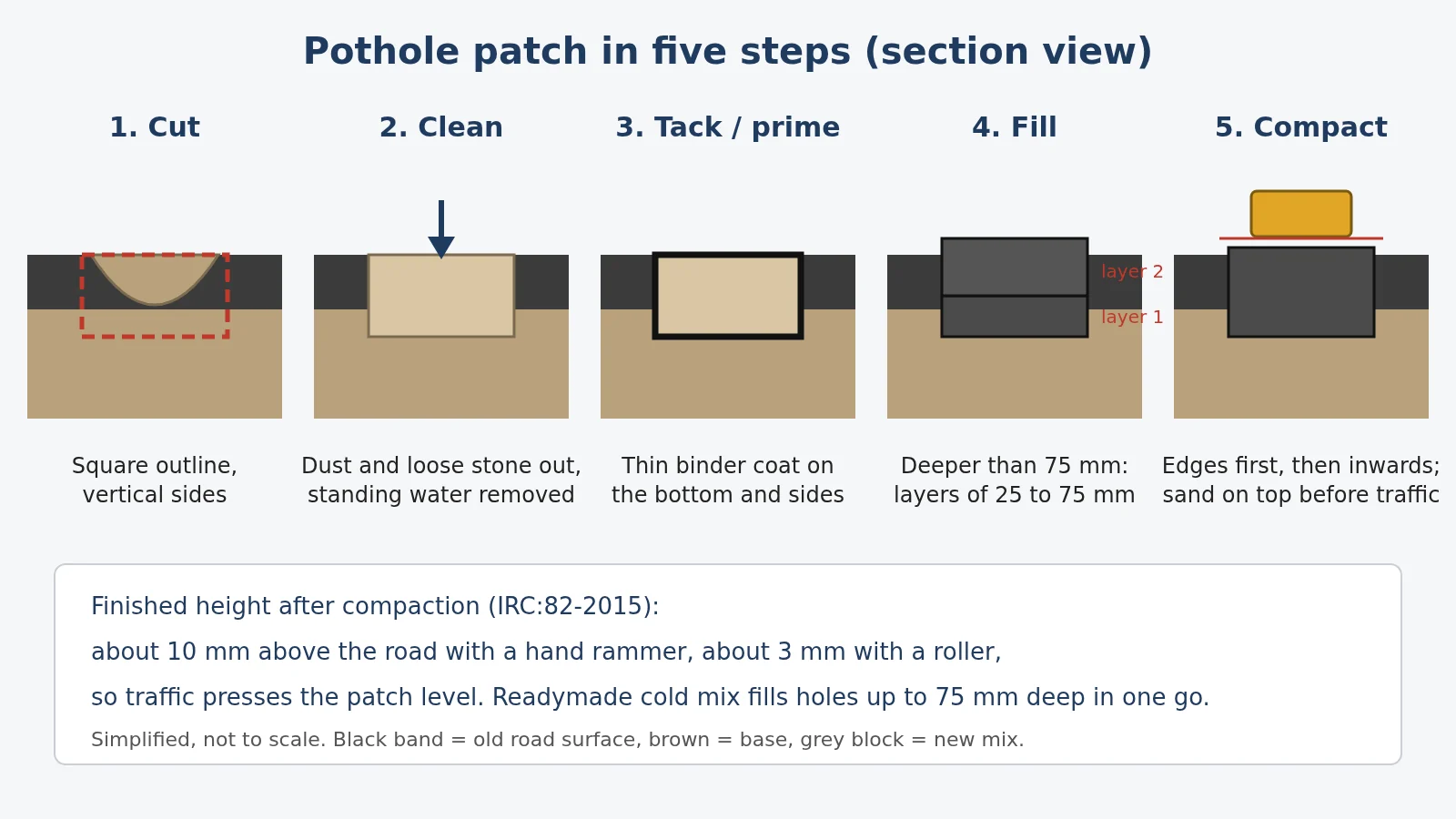
The basic method is the same whatever the machine: cut, clean, tack, fill and compact. IRC:82-2015 gives the details in section 10.3.8 and in section 11.4, which says the broken pavement around the hole should be cut and the loose material removed before any patching.
- Cut away the broken pavement round the hole. The usual practice is a square or rectangle a little bigger than the hole, with vertical sides, cut with a pavement cutter on an air compressor, a saw or a planer.
- Remove the loose material and dust with a stiff wire brush or compressed air, and take out any standing water.
- Apply a prime coat if the bottom is granular (WMM or WBM), or a tack coat on old bitumen, so the patch bonds to the bottom and the sides.
- Fill the hole. Readymade cold mix fills holes up to 75 mm deep in one go. Deeper holes are filled and compacted in layers of 25 to 75 mm, and a very deep hole can be filled first with crusher run macadam (CRM).
- Ram the edges first and then work inwards. Leave the patch about 10 mm above the road if a hand rammer is used, or about 3 mm if a roller is used. Sprinkle clean sand on top before the traffic comes back.
The prime and tack coats are covered in detail in the guide to prime coat and tack coat.
Each machine changes some of these steps. The table shows which.
| Step | Conventional kit | Jet patcher | Infrared | Cold-mix machine |
|---|---|---|---|---|
| Cut | Cutter or planer, square with vertical sides | Usually skipped | No cutting; the heater softens the edge | Cutter or planer |
| Clean | Wire brush, air, broom | The blower does it | Loose material raked out | Wire brush or air |
| Tack | Sprayed or brushed | Emulsion sprayed by the machine | Rejuvenating oil instead | Emulsion or prime coat |
| Fill | Premix by hand, in layers if deep | Coated stone blown in | Old asphalt reworked, fresh mix added | Cold mix by hand |
| Compact | Plate compactor or small roller | None; a dry stone cover | Vibratory roller | Rammer, plate compactor or roller |
The cut is the easiest step to skip, and it is the one that makes a patch last. A round, sloping hole lets the patch rock under the wheels and break out from the edges. A square cut with vertical sides holds it in place.
Which compaction machine does a pothole patch need?
IRC:82-2015 lists a compaction device, a vibratory walk-behind roller or a plate compactor, among the basic tools for pothole and patch repair, and says a small roller is better than a hand rammer where there are many patches close together.
A plate compactor suits single holes and the corners of a patch, and it travels on the back of any small truck. Where the patches run in a line or cover a few square metres, a small tandem roller is quicker and gives a flatter finish, because both steel drums pass over the mix.
The lightest tandem rollers sold in India are built for this kind of work. The Dynapac CC800 weighs about 1,575 kg and has an 800 mm drum, small enough for footpaths and town lanes. The CASE 450NX at about 2,900 kg and the L&T 491 at about 3,450 kg are the next step up, for long patches on wider roads. (Weights as listed on their model pages, checked November 2026.) How these machines differ from the 9 to 10-tonne class is explained in the guide to the tandem roller.
Whatever you use, compact while the mix is still workable. Hot mix that has cooled in the hole will not reach its density however many passes you make.
What else does a pothole repair crew need?
A pothole gang is a small convoy, not one machine. IRC:82-2015, section 11.3, lists what a crew needs for durable patching: a material truck with hand tools, an equipment truck, a tool for cutting and dressing the pavement, a compaction device, an air compressor with a pavement cutter, a spot mixer for hot or cold mix, equipment to carry and lay the mix, traffic control devices, and mechanical brooms for highways and city roads.
Most of these are machines with their own guides. The pavement cutter runs off the same kind of site compressor as a rock breaker, covered in the guide to the compressor breaker. Hot binder for tack coats and premix is heated in a bitumen boiler. A mechanical broom for road work cleans the area before patching and sweeps up the loose stone afterwards.
For bigger areas, cutting by hand is slow. A cold planer, either a full milling machine or a planer attachment on a skid steer loader, cuts a clean rectangle to an even depth in minutes.
Traffic control is easy to forget on a small job, and it matters most on a highway at night. Cones, signs, a flagman and lights belong on the equipment truck every time.
What should you check before buying or hiring pothole repair machines?
Start from the work you expect, not the machine. A maintenance contract for a highway stretch, a municipal ward and a few village roads each need a different set.
- Count the potholes you fill in a normal month and in the monsoon, and note their usual size against the IRC:82 table.
- Check what the contract asks for. Some maintenance tenders name the method or the mix, such as hot premix, readymade cold mix to IRC:116, or a jet patcher on highways.
- Ask the maker or dealer for output figures on your kind of road, and for the emulsion grade and stone size the machine needs.
- For a jet patcher, ask who trains the operator. The SHRP study found that results depend on operator skill.
- Check that you can get the emulsion and the right stone size near your site all year, including in the monsoon.
- Plan the compaction and traffic control along with the filling machine; a patch is only as good as the compaction behind it.
The road engineer on your contract has the final say on the method and the mix. The choice of machines is yours.
Patching runs on more than one machine. Compare the range of compactors for the rolling, and read the asphalt paver guide for the machine that lays strip patches and overlays. More guides on road building and repair are in the road construction section.
Sources: the pothole sizes, causes and repair methods, the cold-mix rules, the filling and compaction steps, the wet-surface rule and the list of tools and mechanised technologies are from IRC:82-2015, the Code of Practice for Maintenance of Bituminous Roads, clauses 7.5.3, 10.3.3, 10.3.8, 11.3 and 11.4. The Patch Fill figures are from CSIR-CRRI’s Patch Fill page and the Office of the Principal Scientific Adviser’s listing, read November 2026. The spray-injection stages and the SHRP H-106 findings are from FHWA Tech Brief FHWA-RD-99-202. The infrared steps are from the HeatWurx process description filed with the AASHTO Innovation Initiative. The Pothole Pro figures are from JCB’s UK product page. All were read in November 2026. Roller weights are from the model pages linked above.
Prices, specifications and features are indicative, vary by variant, location and date, and should always be confirmed with the official OEM or authorised dealer before any purchase decision. DesiMachines is not liable for decisions taken on the basis of information that may have changed after publication.
Machines, tenders and news for this industry: Road Construction