
 Excavator
316 models
 Backhoe Loader
54 models
 Crane
68 models
 Concrete Mixer
79 models
 Wheel Loader
54 models
 Compactor / Roller
45 models
 Motor Grader
42 models

 Concrete Pump
66 models
 Skid Steer Loader
11 models


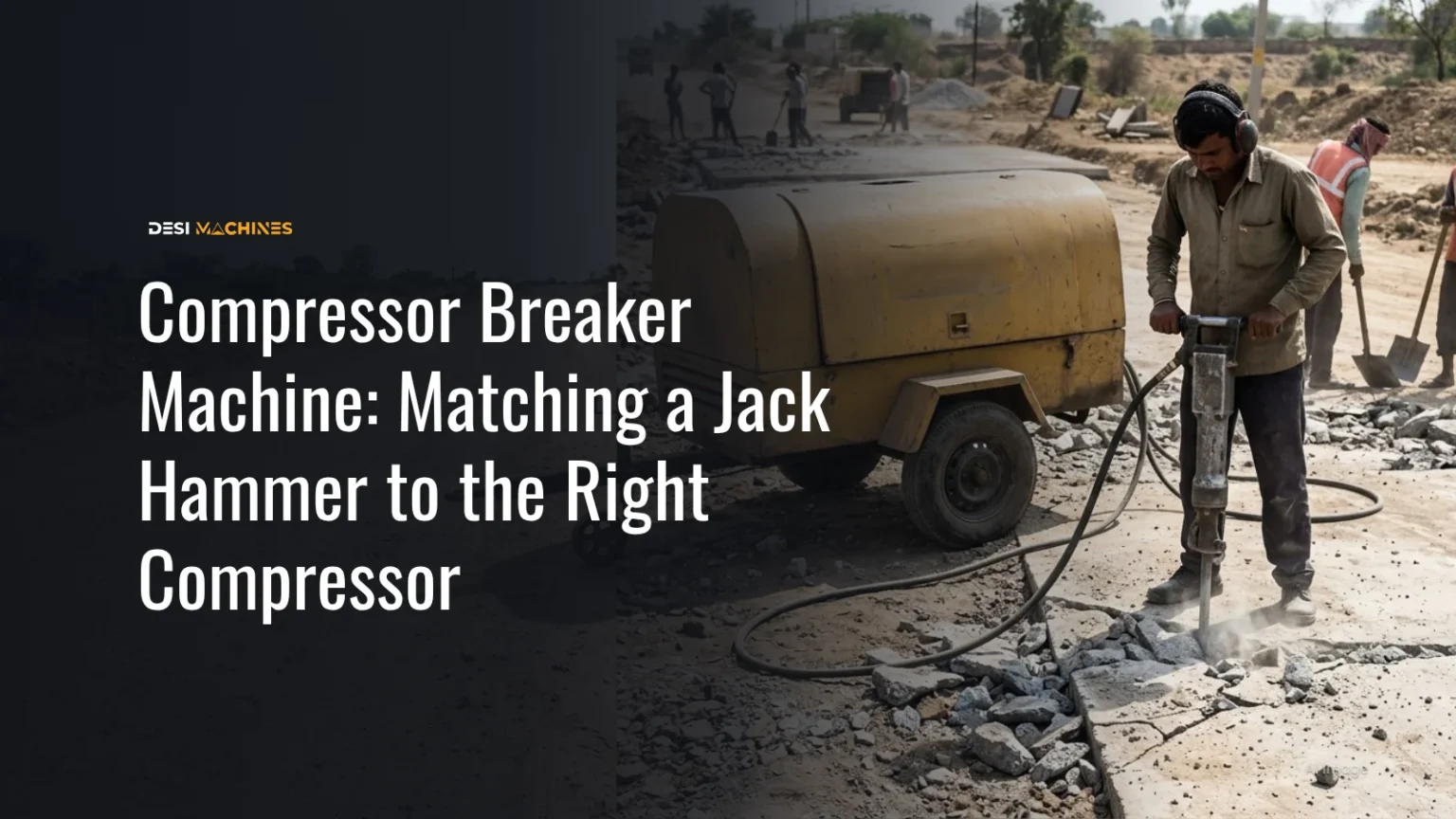
A heavy hand-held breaker burns about 85 cfm of air, so the compressor behind it, not the hammer, decides how many breakers a crew can run. A compressor breaker machine is that pair: a portable air compressor feeding one or more hand-held air breakers, the tools most sites call jack hammers, through a hose. As a rough guide, a 100 cfm tractor compressor runs one jack hammer and a 300 cfm portable compressor runs three.
This guide explains how the set works, which breaker weight suits which job, how many breakers each compressor size can feed, whether a tractor compressor is enough, what goes in the hose line, and why a breaker starts hitting weak. The full air arithmetic for a mixed set of tools, with hose and altitude losses, is in the air compressor cfm calculation guide.
What is a compressor breaker machine and how does it work?
It is two machines joined by a hose. The compressor squeezes outside air and stores it under pressure. The breaker turns that pressure into blows on a steel tool, a pointed or flat chisel, which cracks concrete, asphalt or rock.
Inside the breaker a heavy piston, called the hammer, runs up and down in a cylinder. Air drives it down onto the top of the chisel, then drives it back up, and a valve switches the air from one side to the other many times a second. Atlas Copco’s TEX breakers, for example, strike 1,110 to 1,530 blows a minute. The used air leaves through a silencer on the side of the tool.
A breaker only hammers. A rock drill, which looks similar, also turns its steel between blows so the bit cuts a round hole, and that hole is what quarries fill with explosive. People often say “jack hammer” for both. The difference matters when you order: a breaker will not drill a blast hole, and a drill is a poor tool for breaking a slab.
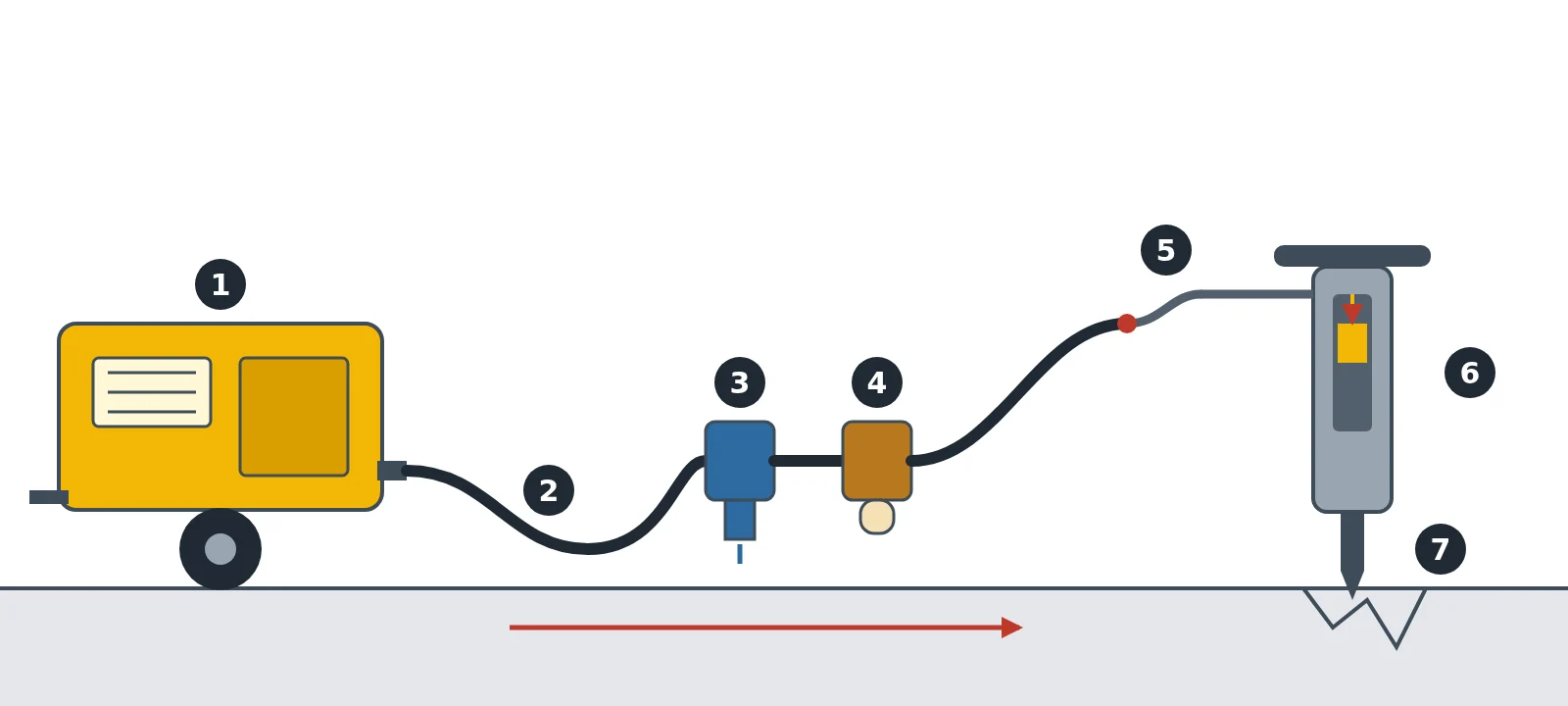
A full set has seven parts, in this order from the compressor:
- The compressor: diesel or electric, usually on a two-wheel trolley, sometimes carried on a tractor.
- The main hose.
- A water separator, which drops out water that condenses in the air.
- A lubricator, which puts a fine mist of oil into the air. Many breakers have one built in.
- A short whip hose that takes the shock between the tool and the coupling.
- The breaker.
- The working tool: point, chisel or spade.
Which breaker weight suits which job?
Pick the lightest breaker that does the job. A heavier breaker hits harder, but it also strikes fewer times a minute, burns more air and tires the operator sooner. Atlas Copco India sorts its TEX hand-held air breakers into three weight classes, and the classes are a fair way to think about any make:
| Class | Weight | Tool shank sizes (hex, mm) | Blows a minute | What the maker says it is for |
|---|---|---|---|---|
| Light | 19 to 23 kg | 22 x 82.5, 25 x 108, 28 x 160 | 1,140 to 1,530 | Service jobs and general demolition |
| Medium | 25.5 to 37 kg | 25 x 108, 28 x 160, 32 x 160 | 1,200 to 1,500 | Service jobs and general demolition; one model is built for asphalt and other medium-hard material |
| Heavy | 37 to 43 kg | 28 x 160, 32 x 160 | 1,110 to 1,260 | Medium and hard material such as asphalt and reinforced concrete |
Source: Atlas Copco India, TEX pneumatic breakers technical data, read 12 November 2026.
In practice, a light breaker cuts an opening in a floor or wall, chases a trench for a pipe or cable and chips away old plaster and tiles. A medium breaker takes up a concrete floor or a road patch. A heavy breaker is for thick reinforced concrete, old foundations and asphalt. The air each class uses, model by model, is listed in the air compressor for construction guide.
Look at the shank size before you buy chisels. The working tool must match the breaker’s shank exactly, both the size of the hexagon and its length, and the same weight class can come in two shank sizes.
How many breakers can one compressor run?
Add up the air of every breaker that will run at the same time, add about 15 per cent for leaks and wear, and the compressor’s free air delivery (the cfm on its plate) must be at least that figure. The table below does that sum for four common compressor sizes, counting the hungriest model in each class from the table above: 55 cfm for light, 76 cfm for medium and 85 cfm for heavy.
| Compressor (free air delivery) | Air left after a 15% margin | Light breakers | Medium breakers | Heavy breakers |
|---|---|---|---|---|
| 100 cfm, a typical tractor-mounted piston unit | about 87 cfm | 1 | 1 | 1 (only just) |
| 185 cfm, the smallest size in ELGi’s diesel trolley range | about 161 cfm | 2 | 2 | 1 |
| 300 cfm | about 261 cfm | 4 | 3 | 3 |
| 600 cfm, the top of Chicago Pneumatic’s portable diesel range in India | about 522 cfm | 9 | 6 | 6 |
Breaker air: Atlas Copco India TEX data. Compressor sizes: ELGi diesel trolley compressors, 185 to 1,200 cfm; Chicago Pneumatic India portable diesel range, 160 to 600 cfm; both read 12 November 2026. Counts are at sea level, at the tool’s rated pressure, before losses in a long hose.
The counts fall in three common situations. On a hill site the air is thinner, and Atlas Copco India gives about 15 per cent less output at 2,000 m. A long or narrow hose loses pressure before the air reaches the tool. And turning the compressor up does not help: Atlas Copco’s pocket guide to air tool installation says a tool built for 6.3 bar uses about 10 per cent more air at 7 bar and 25 per cent more at 8 bar. Each of these is worked through, with examples, in the cfm calculation guide.
Pressure matters as much as flow. The same pocket guide says air tools reach their rated power at 6.3 bar at the tool, and that 1 bar less costs 25 to 30 per cent of the work done. So a compressor that gives plenty of cfm at too low a pressure still gives a weak breaker.
Is a tractor-mounted compressor enough for a breaker?
For one tool, usually yes; for a crew, no. Tractor-mounted compressors are common in rural India because the farmer or contractor already owns the tractor. Many are piston compressors of around 100 cfm, like the ones in the case below, and that is enough air for one breaker or one jack hammer drill.
Chicago Pneumatic published a case from Rashin in Ahmednagar district, Maharashtra, where a contractor drills sideways into the walls of farm wells to let water in. He had been using tractor-mounted piston compressors of 100 cfm at 5 bar, and each ran only one jack hammer. One 300 cfm portable screw compressor at 7 bar now runs three, and the maker reports drilling 30 per cent faster. That is the maker’s own story, but the arithmetic agrees with the table above, and the 5 bar figure explains the slow drilling: it is well under the 6.3 bar an air tool needs for full power.
Before you hire a tractor compressor for breaking, ask for two figures from its plate: the free air delivery in cfm and the working pressure in bar. Under about 6 bar, expect a slower breaker. A piston compressor also delivers air in pulses and suits stop-start work; the screw vs piston compressor guide explains why a screw machine is the usual choice for a day of steady breaking.
What goes between the compressor and the breaker?
The hose line is where most of a breaker’s power is lost, so each part is worth a minute’s thought.
Water separator. Compressed air carries water, and on a humid day it collects in the hose and is carried into the breaker. A separator near the compressor drops it out. It must be rated for the total air of all the breakers on that line, or it becomes a choke point; the ratings are listed in the cfm guide.
Lubricator. An air breaker runs on a thin film of oil. A line lubricator drips oil into the air as a mist; many breakers, including the TEX range, carry their own, which Atlas Copco says lasts a shift. Lay the hose without low loops. Atlas Copco’s pocket guide warns that oil collects in a dip in the hose and never reaches the tool.
Whip hose. A coupling screwed straight into a breaker is shaken loose and broken by the blows. A short whip hose, 0.3 to 0.7 m long, takes the shock. It also cuts the air flow: in the pocket guide’s example a whip hose takes about a fifth off a short hose’s capacity, and a safety nipple takes another fifth.
Safety nipple and blow protector. On a hose longer than 3 m, a safety nipple lets trapped air out slowly when the hose is uncoupled, so it does not go off with a bang. A blow protector shuts the air off if a coupling comes loose, so a pressurised hose cannot whip about and hit someone.
Size the main hose to the total air and the length of the run; a narrow hose that is fine at 5 m can starve a breaker at 30 m.
Why does a compressor breaker hit weak or slow?
A weak breaker is nearly always short of air pressure at the tool, short of oil, or fitted with the wrong steel. Work through the line from the compressor outwards:
| What you see | Likely cause | What to check |
|---|---|---|
| All breakers slow down when one more is started | Compressor too small for the number of tools | Count the tools against the table above; run one fewer |
| Breaker strong near the compressor, weak at the end of the hose | Hose too long or too narrow, too many couplings | Shorter or wider hose; remove extra couplings and adapters |
| Weak from the start on a tractor or old compressor | Pressure below about 6 bar at the tool | Gauge at the compressor; plate pressure of the compressor |
| Breaker runs rough, starts slowly, wears fast | No oil reaching the tool | Fill the lubricator; take the low loops out of the hose |
| Water spits from the exhaust | Wet air, no separator or a full one | Drain or fit a water separator |
| Weaker on a hill site than in the plains | Thin air, less free air delivery | Allow about 15% less air at 2,000 m |
| Chisel bounces and will not bite | Wrong shank size, or a worn tool or retainer | Match the shank to the breaker; replace a worn point |
Never turn the pressure up to cure a weak breaker. It wastes air, wears the tool and does not fix a narrow hose.
When is a hydraulic breaker on a JCB or excavator better?
When there is a lot to break. A hand-held breaker suits small cuts, inside buildings, tight trenches and places a machine cannot reach. For a whole road, big boulders, a quarry face or old foundations, a breaker mounted on a backhoe loader or an excavator does the work with one operator instead of a hand crew. It needs no compressor, because it runs on oil from the machine’s own pump.
A backhoe loader such as the JCB 3DX or the smaller JCB 2DX carries a breaker on its back arm, and a 20-tonne excavator such as the Tata Hitachi EX 210 Infra carries a heavier one. The machine also needs a breaker piping kit, and most of these breakers carry a nitrogen gas charge. Matching breaker size to machine weight is covered in the hydraulic rock breaker guide, and the breakers themselves are listed under rock breakers.
If the job is big enough to keep a machine busy, compare backhoe loaders and excavators that can carry a breaker, and speak to a dealer about the breaker size.
How do you keep a breaker crew safe?
Dust, noise, vibration and the hose itself are the four risks.
Breaking concrete and rock throws up fine dust. Wikipedia’s article on the jackhammer gives the two ways to control it: a steady spray of water at the point of impact, or a shroud on the tool with a vacuum dust collector. Water is the cheap one on most Indian sites.
The same article puts the sound at the operator’s ears above 120 dB, so ear muffs and plugs belong in the same order as the breaker. Breakers also shake the hands and arms, and Wikipedia notes that long exposure can lead to vibration white finger, a form of Raynaud syndrome. Makers now fit handles that absorb part of the shaking, as the TEX range does, but the operator still needs breaks, and on a long job the work is better shared between two people. Add safety boots with steel toe caps, gloves and eye protection.
Check every hose coupling before the air is turned on, never point a breaker at a person, and shut the air off before changing the chisel.
Should you buy or hire a compressor breaker set?
For a single job or a few weeks a year, hiring the whole set, compressor, hoses and breakers, is usually the cheaper way to get the right size. You can list or find machines through machines on rent. Every guide on site compressors, from types to sizing, sits in the air compressor guide.
Sources, read 12 November 2026: Atlas Copco India, TEX pneumatic breakers technical data; Atlas Copco, Pocket Guide: Air Tools Installation; ELGi India, portable compressors range; Chicago Pneumatic India, portable diesel air compressors and the CPS 300-100 application story from Rashin, Ahmednagar; Wikipedia, Jackhammer. Compressors and hand-held breakers are not listed on DesiMachines, so this guide names no prices.
Prices, specifications and features are indicative, vary by variant, location and date, and should always be confirmed with the official OEM or authorised dealer before any purchase decision. DesiMachines is not liable for decisions taken on the basis of information that may have changed after publication.